Michigan road salt & the Detroit Salt Mine

Salt Mountain, photo by otisourcat

In the battle against snow and ice that is waged every winter day on Michigan’s roads, salt remains and essential ingredient. MDOT records for 1991 show that 442,223 tons of road salt were applied to 10,000 linear miles of trunk line maintained under MDOT’s jurisdiction. The Wayne County Road Commission notes that a single salt run for a truck can use up to 12 tons of salt, depending upon the truck size. That page has several more bits of trivia including the fact that at temperatures below 20 degrees, salt begins to lose its effectiveness. It becomes almost completely ineffective at 0 degrees or colder.

The Salt Institute’s page on Michigan salt says that estimated salt deposits in Michigan are astronomical. In the Detroit area alone, it is believed that there are over 71 trillion tons of unmined salt. Geological studies estimate that 55 counties of the Lower Peninsula cover 30,000 trillion tons of salt.

Our largest salt mine is actually the Detroit Salt Mine, operated by the Detroit Salt Company (closed for a time but now re-opened, comes with an annoying & loud Flash warning) and I suppose is makes sense that in 1940 Detroit became the first major city to use rock salt for snow and ice control. The Great Lakes Radio Consortium’s Ann Murray has a great report titled Exploring a Great Lakes Salt Mine that takes you inside the Cleveland salt mine that extends under Lake Erie. The best exploration of the mine is via The ghostly salt city beneath Detroit in the Detroit News:

In a 1925 Detroit News article, miner Joel Payton told about his salt mine job. “The only dirty part of this job is going down to work,” Mr. Payton explained.

“I have to wear this old outfit because the big buckets that take us down get smudgy from the action of the sulphur water on the iron of the buckets.

“The mine itself is dry and clean as pure rock salt in a solid vein 35 feet thick is bound to be. The high vaulted rooms that we have hollowed out have sparkling white floors, walls and ceilings.”

Payton continued, “One reason we don’t have any rats in our Detroit mine is because the rats would have nothing to eat except the leavings of our lunch pails. And by the way, not only are there no rats or cockroaches or other living creature in our mine, but also no remains of living things from past ages. The salt vein is, of course, a dried up sea that once covered this section for hundreds of miles. You’d naturally suppose that some fish or vegetation would have been pickled or fossilized in the brine as it hardened. But I’ve never seen a single fossil or sea shell or any remains of that kind”

The photo above was taken at the Verplank salt dock, Muskegon and you can see more photos of otisourcat has taken of Michigan road salt.

Yellow and Blue With a Touch of Green

Yellow and Blue With a Touch of Green

Yellow and Blue With a Touch of Green, photo by Cherie S..

Brought to you by the Committee for Sunshine and Blue Skies, Michigan Chapter (lapsed).

You can see this photo larger right here or check it out in Cherie’s Foliage and Flowers set (slideshow).

future hopefuls: Michigan Christmas Trees

future hopefuls

future hopefuls, photo by yodraws.

As might be expected, the Michigan Christmas Tree Association is not a fan of fake trees, pointing to hazardous chemicals and such and noting that:

  • Real Christmas trees help filter dust and smog from the air and help stop soil erosion.
  • Christmas trees on a farm produce oxygen – a necessary component of life for people.
  • Real Christmas trees provide a comfortable habitat for a wide variety of wildlife.
  • After the holidays, Christmas trees can be recycled and used for purpose including bird feeders/shelters, fuel chips and mulch. Fake trees end up in a landfill.

I read somewhere that live Christmas trees or decorating a tree outside are the absolute best choice. Anyway, check that link above for all kinds of Michigan tree dealers and info including also see Absolute Michigan keyword Christmas tree for more links and articles.

Yo writes that on this cold and snowy Saturday, they found a tree in record time that was short and sweet with tiny little pine cones. See it bigger in her Somewhere in Michigan slideshow!

If you feel like a visit to the Christmas tree farm or lot is a chore, check out The Christmas Tree Ships for a look at how things were “back in the day”.

The Demolition of the J.L. Hudson building in Detroit

Hudson Implosion 2

Hudson Implosion 2, photo by ExcuseMySarcasm.

I had a post mapped out in my head that started out “When I was a little boy, my grandma used to take me down to Hudsons in Detroit on Saturday…”

I realized I couldn’t find the link to the site I found last year with all the photos of Hudson’s in its glory, so that post will have to wait for another day. Besides, this isn’t that kind of a photo…

With the press of a button at 5:47 PM on October 24, 1998, Detroit Mayor Dennis Archer dropped the J.L. Hudson Department Store from his city’s skyline and into the history books and record books.

The above from a detailed page on the demolition of J.L. Hudson Department Store CDI (the company that performed the demolition). It understandably touts their work, explaining that at 439 feet tall and 2.2 million square feet, Hudson was both the tallest and the largest single building ever imploded.

Hudson’s Implosion at the Fabulous Ruins of Detroit tells the tale the best (with photos). I know it’s cheating to skip to the end and post that, but after watching a video of the implosion and hearing the cheers, I was very moved by it, especially given what has happened in Detroit and Michigan in the decade since and appears to be continuing:

The cheering had stopped as the immense reality of the event sobered all who viewed it. An emptiness followed and the guilt of our cheers weighed upon us.

The choking clouds dissipated and a ghastly scene was revealed. An inch of dust covered everything for blocks around and there, in the midst of it all, lay the smoldering and shattered heart of 20th Century downtown Detroit.

For more photos (and to see the above larger) check out ExcuseMySarcasm’s Hudson Explosion slideshow and also the Hudson’s Detroit slideshow on Flickr which also contains some pics of the Hudson car and this photo by Paul Hitz of the space where Hudson’s used to be where he suggests that a park or something would be nice where the Hudsons building used to be.

Here’s a video with a good view of the charges going off (this person has a number more too!), another video from across the river in Windsor and a third titled “Detroit Hope” showing Hudson’s rising like a phoenix.

meteoric: 2009 Leonid Shower & the sound of meteors

meteoric

meteoric, photo by postpurchase.

The other day I saw this sweet video of the meteor that fell to earth near Edmonton, Alberta. When Gmail tossed me a link to this report on Space.com that the 2009 Leonid Meteor Showers are predicted to be stronger in 2009, I checked it out, clicking on to Top 10 Leonids facts. That had some pretty cool stuff including the 1833 Leonids which were so bright and sustained that they lit up the sky and the assertation that you’re more likely to be struck by lightning seven times in a row than to be hit by a meteor (whew).

One that especially caught my eye was the Scary Sounds of Meteors. Sounds have been reported along with meteors for millenia, and while Sir Edmund Halley (he of the comet) wrote it off in the 1700s as imagination:

Australian researcher Colin Keay uses the term to describe a theory he developed in the early 1980s.

As the theory goes, when a space rock plunges earthward, friction caused by the atmosphere creates a trail of electrically charged particles, or plasma, in which Earth’s invisible but potent magnetic field lines become trapped, tangled and twisted like strings of cooked spaghetti.

This magnetic spaghetti is thought to generate very low frequency radio waves, says Keay, a researcher at the University of Newcastle who, though not famous like Halley, does have an asteroid named after him.

Read more from NASA and Colin Keay’s pages on Geophysical Electrophonics. Tying this all back to Michigan, this whole things struck me because I noticed a faint hissing sound in association with the Perseid shower this summer that I wrote off to Halley’s imagination.

Thankfully, the Absolute Michigan pool has a few sky watchers, and Ann Arbor’s postpurchase recently uploaded a beauty! View more of postpurchase’s amazing night sky photography and see this photo larger in his slideshow.

Stuffed animal road trip: The Big Three return to Washington

Stuffed animal road trip

Stuffed animal road trip, photo by caterpillars.

Today it’s possible that the future of Michigan gets decided in Washington DC as the CEOs of Ford, GM & Chrysler return to Washington. They’re driving themselves this time (though each in their own cars). Word is that if they fail again, they will all pile onto a solar powered unicycle … or go out of business. (update: see the cartoon!)

Laura writes that this is from The Heidelberg Project in Detroit during a meet-up with Exposure.Detroit on December 20th, 2007 .

The book Connecting the Dots: Tyree Guyton’s Heidelberg Project is pretty cool too if you want to learn more about this unique Detroit project.

Sturgeon Falls on the West Branch of the Sturgeon River

Falls on the West Branch of the Sturgeon River

Falls on the West Branch of the Sturgeon River, photo by Treefarmer.

This photo is part of Treefarmer’s Waterfall set (slideshow). Not all are from Michigan, so if you’re feeling exclusive, you can see it in his Upper Peninsula of Michigan set.

Go Waterfalling’s page on Sturgeon Falls says:

Sturgeon Falls is located in the Sturgeon River Gorge Wilderness in Ottawa National Forest. The Sturgeon River has carved out a deep, forested gorge, that is 300 feet deep in some places. The falls are located deep in the gorge. The drop is only 30 feet, but the river is very powerful. Above the falls the river is well over 100 feet wide. It then narrows into a chute only about 30 feet wide before shooting over the falls, spraying mist in all directions.

The Go Waterfalling page has detailed directions and some cool movies. They add that that Canyon Falls (also on the Sturgeon River) are much easier to reach.

Should you want to reach them though, here’s Sturgeon Falls on the Absolute Michigan Map of Michigan.

Palmer Woods, Highland Park

Untitled, photo by tEdGuY49®.

Check it out bigger in Ted’s slideshow.

frozen in motion: Michigan Winter Wallpaper Page

frozen in motion

frozen in motion, photo by Where’s Walden?.

This is part of Megan’s excellent Michigan Meanderings set (slideshow) and you can see some other sweet photos of ice she’s taken.

The blizzard howling out my window says to me that it’s time to shovel out the Michigan Winter Wallpaper page!

Michigan Winter Wallpaper Page

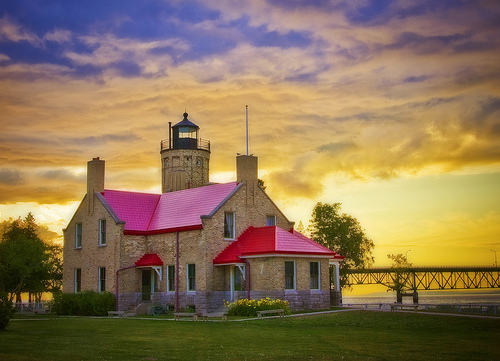
Old Mackinac Point Lighthouse – Mackinaw City

Mackinac Point Lighthouse at sunset

Mackinac Point Lighthouse at sunset, photo by the pentax hammer.

Gary asks that you please view this the way it should be viewed: Large On Black. See this photo (and many more) larger in his Junk on Explore slideshow.

On his Seeing the Light entry for Old Mackinac Point Lighthouse, Terry Pepper writes that as the connecting passage between Lake Michigan and Lake Huron, the Straits of Mackinac have always been critical to maritime commerce. As the Straits are frequently shrouded with fog, Mackinac Point was an ideal location for a fog signal building and lighthouse and an effort to build a facility began in 1888 and was completed with the installation of a red Fourth Order Fresnel lens in 1892:

As the use of automobiles became increasingly widespread in the early 1900’s, Midwesterners began to take increasing advantage of the newfound freedom that their automobiles provided, driving ever increasing distances to vacation. The unspoiled beauty of Michigan’s Upper Peninsula beckoned, and regular car ferry service began to ply the waters between Mackinaw and St. Ignace. With large amounts of vessel traffic now moving through and across the Straits, the Old Mackinac station became increasingly important as the light enabled the car ferries to operate throughout the night.

When the Mackinac Bridge opened in 1957, the car ferries were out of business, and with the brightly illuminated bridge serving as a navigation aid par excellence, the old light station was immediately rendered obsolete and was decommissioned.

The facility is now part of Mackinac Island State Historic Parks, and you can visit their Old Mackinac Point Lighthouse pages for history of the light and some great old photographs and educational resources for kids.