Coffee Tasting at Paramount Coffee of Lansing

Coffee Tasting, photo by WAXY.

John writes that this is from a coffee tasting session at Paramount Coffee in Lansing. The man on the right is his grandfather, Lawrence B. Weingarten, one of the founders of Paramount. He got this history from a previous version of the Paramount Coffee web site:

In 1935, during the height of the great depression, two established coffee salesmen decided to take a chance. They left their jobs in Chicago and ventured up I-94 to Lansing, Mich., to start their own company. They chose Lansing as they felt it was the ideal location for their new challenge. So on Aug. 14, 1935 the two friends scraped together every penny they had and went after their lifelong dream. What they lacked in money, they more than made up for in enthusiasm and energy. Paramount Coffee Company was born.
You can see this photo bigger in John’s slideshow and more of his work can be found at Waxy Photography.

Welcome to Winter…

Untitled, photo by Brooke Pennington.

…probably seems like you never left, right?

View this photo (and many more) bigger in Brooke’s slideshow and see the same building in summer.

If you need another link, here’s “winter” as performed by the Absolute Michigan pool.

Albion: History of The Forks

Destination, photo by Stephen K. Willi

In keeping with this blog’s tradition of “Well here I am, now where is that actually?” (as opposed to “Hey that looks cool, I wonder what’s up with that?”) I thought I’d take a look at the city of Albion. Although I come here once or twice a year, my knowledge has been confined to Albion College (which is always closed when I’m here), Albion’s world class sledding hill, the Bohm Theater, the “other” Cascarelli’s (cause Homer’s Cascarelli’s rocks), the Coca-Cola sign and one very cool bookstore. I suppose that could be enough to build a post on, but I have my reputation to think about. And so, with already far too much adieu…

Wikipedia’s entry for Albion, Michigan says that this city in Calhoun County had a population of 9,144 in 2000.

The first white settler, Tenney Peabody, arrived in 1833. As local legend goes, Peabody’s wife decided to name the city after Albion, Oswego County, New York where another prominent pioneer, Jesse Crowell, came from. The city was almost named Peabodyville, but Albion was the preferred choice.

….The forks of the Kalamazoo River provided power for mills and Albion quickly became a mill town as well as an agricultural market. A railroad line arrived in 1852, fostering the development of other industries.

From the time that the earliest English-speaking settlers arrived, the area has also been known as The Forks, because it is situated at the confluence of the north and south branches of the Kalamazoo River. The Festival of the Forks has been celebrated annually since 1967, celebrating Albion’s ethnic heritage.

If you want to really dive into the history, you’re in luck because the Albion Michigan website has an amazing amount of historical information courtesy of historian Frank Passic. The site is framed so it’s hard to link directly to stuff, but be sure to go to the Albion History section and click into the gallery of photographs.

See this photo larger in Stephen’s Black and White Photography slideshow (view set).

And Other Weapons

And Other Weapons

And Other Weapons, photo by #anne#.

By any means necessary, right?

View it bigger in Anne’s Ann Arbor set (view slideshow) and check out more TTV pics on Michigan in Pictures.

Ski it up, Michiganders!

Chris 360 Cross

Chris 360 Cross, photo by btwphotography.

Absolute Michigan has some cool resources for skiers from beginners that are summarized more or less neatly in today’s Michigan Skiapalooza Thursday which begins:

While Winter 2008 hasn’t been good for things like car makers, investments and national economies, it has presented us with some incredible conditions for skiing and snowboarding.

USA Today noticed that Midwest skiers have all kinds of options in Michigan where we have more downhill areas – 42 – than any state except New York with 200 chairlifts, 840 runs and 40 terrain parks!

There’s even a deal for beginning skiers for the whole month of January that you’ll definitely want to check out if you’re a novice without equipment!

You can see this photo (and many more) bigger and bolder in btw’s Nubs Portfolio slideshow (view set) or his Skiing – Nubs Nob slideshow.

Northern Lights Forecast: Predicting the Aurora Borealis in Michigan

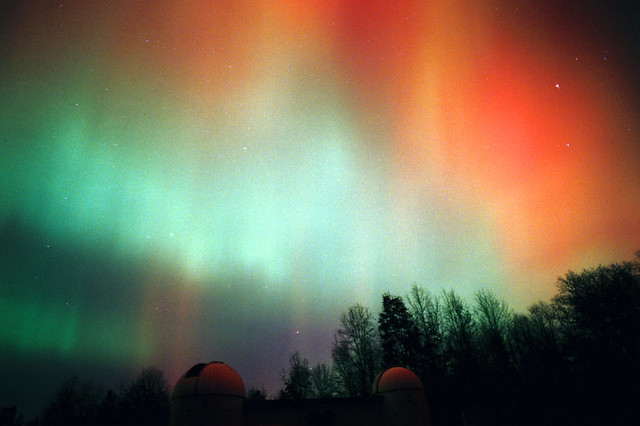
Skyfire by Kevin’s Images

A lot of people end up at Michigan in Pictures every day when searching for the northern lights, and one of the biggest questions I get asked through comments and email is “When and where can I see the Northern Lights in Michigan?”

The Geophysical Institute in Alaska is one of the hotspots for information about viewing the aurora borealis aka the northern lights. In their excellent Aurora FAQ, they answer the question Can you predict when and where there will be aurora?, saying you can, but with less confidence than weather prediction. The aurora is powered by the solar wind, and strong solar winds tend to bring intense auroras.

The Institute’s Auroral Forecast Page presents data on the solar wind forecasts the intensity level of the aurora. You can then check the “Can I see the aurora?” link at the top and also their page on interpreting the aurora, where they offer this advice:

The auroral activity forecast predicts the expected location of the most active auroral forms that can be expected for the given period. Aurora viewing is also affected by a variety of other factors, such as cloud cover, moonlight, and urban light pollution, so what you see will be strongly affected by your particular location and meteorological luck.

The best time to observe aurora is near local midnight, when the most active forms often occur. More precisely, the time to shoot for is an hour or two prior to local geomagnetic midnight, and the forecast maps found here are calculated for that time. If you are a serious aurora watcher, plan to spend the night from about 9 P.M. to 3 A.M. watching for auroral action. Auroral activity tends to come in waves during an evening, which are called auroral substorms. Even during an active period, there will be lulls in which the auroral activity is subdued; however, the patient observer will often see a new burst of activity within an hour or two.

I found that selecting the North Polar view seemed to provide the best view for Michigan, and it appears to me that we need to have an activity level of 3 to see any of the lights in Lower Michigan and 2 for the Upper Peninsula. Based on today’s forecast, it appears that on December 23 we’ll have a chance to see the aurora – if anyone does, please post it here and on the Michigan Northern Lights Log over on Absolute Michigan.

You can see this photo larger and also more shots that Kevin took that night at the James C. Veen Observatory in Grand Rapids in his Astronomy set (slideshow).

For much more Michigan northern lights goodness check out the northern lights category on Michigan in Pictures and the Michigan Tech-based leading page on the northern lights, The Aurora Page. And I might as well slip in this amazing time lapse of the aurora borealis from British Columbia.

Michigan Fox Squirrel

Got My Nut . . . I'm Outta' Here

Got My Nut . . . I’m Outta’ Here, photo by Matt Kedzior.

Wikipedia’s Fox Squirrel entry says that the Fox Squirrel (Sciurus niger) is the largest species of tree squirrel native to North America and are also sometimes referred to as the Stump-eared Squirrel, Raccoon Squirrel, or Monkey-faced Squirrel.

Fox Squirrels depend primarily on tree seeds for food, but they are generalist eaters and will also consume buds and fruits, cultivated grain, insects, birds’ eggs, and small lizards … In their regular diet of nuts, fox squirrels are classic scatter-hoarders that bury caches of nuts in dispersed locations, some of which are inevitably left unretrieved to germinate. (Matt says he watched this little guy dig around for a couple seconds in the snow and he came up with a nut that I assume he buried earlier)

Fox Squirrels are strictly diurnal, non-territorial, and spend more of their time on the ground than most other tree squirrels. They are still, however, agile climbers…

They are gregarious and apparently playful, often chasing each other up and down trees and across yards and clearings. They have a large vocabulary, consisting most notably an assortment of clucking and chucking sounds, not unlike some “game” birds, and they warn the listening world of approaching threats…

Fox Squirrels are also known for being living fossils, skeletally very similar to remains of the oldest-known squirrel, Protosciurus, from the late Oligocene and early Miocene epochs.

For more, check out the Animal Diversity Web pages on the Fox Squirrel and also Michigan DNR’s page on Michigan squirrels.

You can see this bigger in Matt’s slideshow.

Yeah, it’s cold outside…

Yeah, it’s cold outside… by Dale Treadway

After a brief reprieve from the chill over the weekend, winter has ridden roaring winds back to Michigan this morning.

He says you should probably view this photo large and on black, or you can see it and others larger in Dale’s Winter ’08 Series 1 set (slideshow) and try and stay warm!

More Sunrise This Morning

More Sunrise This Morning

More Sunrise This Morning, photo by jacalynsnana.

As she says: view large (or check this and a few other shots out in her slideshow).

More wintry goodness on the Michigan Winter Wallpaper page.

Step Right Up: Day Care for photographers in Ann Arbor

Step Right Up!, photo by murn

In Gallery Project: Step Right Up! on her awesome blog Relish, Myra explains:

I took a break from working on orders yesterday to join Mary Morgan in visiting the Gallery Project space on S. Fourth Ave. (Ann Arbor), where artists are in the process of installing their pieces for a new show that starts tomorrow, December 10. I don’t normally cover (non-performing) art, but this exhibit is just so cool I couldn’t resist.

The exhibit is comprised of 18 theatrical, interactive scenes — many with costumes and props — designed as backdrops and inspiration for exhibit-goers’ own photographic portraits.

Fulfill your dream of being photographed with a life-size Barbie cake, complete with your own tiara. Or if you’ve always wanted to join the circus, now you can. The 18 different installations are symbolic/conceptual monkey bars for your creative expression. You are limited only by your imagination. Come play!

The exhibit is a fundraiser for the Gallery Project — and a brilliant one at that! A PhotoPasses may be purchased for $20, which entitles you to visit the exhibit and snap as many photos thereof as you’d like over the course of the 6-week show (excluding the opening reception). Tickets for the opening reception (this Friday, December 12) are only $10. If you don’t have a camera or a photographer (or a vast retinue of paparazzi) with you, don’t despair — gallery assistants will be slinging genuine, actual film–based, Polaroid instant cameras, and you may purchase portraits for $5 (or 3 for $10).

Sounds like a blast! Click over to Relish to see more pics of the scenes and head to Myra’s slideshow on Flickr to see the above photo bigger and bolder. You should also read Mary’s article in the Ann Arbor Chronicle!