I love Michigan in Pictures

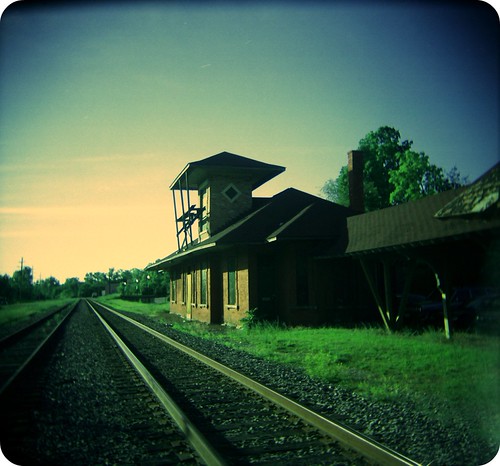
Holga_04_15.jpg, photo by Andy Tanguay

I think that Michigan in Pictures is the best web site that I have ever been involved with. Then again, my response to “You’ve won a trip to Milan!” would probably be “Milan, Michigan?”

One of the happiest parts of my life is that I get to spend some time every day looking at photos about Michigan from some amazing photographers and then learning about the subjects of the photographs and often times the people behind the lens. I’m very grateful for all that the photographers and readers contribute to make Michigan in Pictures what it is. Thanks!

The random background of the day on my computer is this photo from Andy’s Hardcore 313 set. This picture is of an abandoned train station station in Ypsilanti. It might be the same Ypsilanti train station where Presidents Ulysses S. Grant & Martin Van Buren delivered speeches and where Charles J. Guiteau, the assassin of President Garfield, was thrown off the train when the conductor found out he didn’t have a ticket.

Then again, it might be just an abandoned train station. You can view it bigger on white, or in Andy’s photostream.

Edit: Almost forgot! I did this post about Michigan in Pictures so I could link to it from the new Absolute Michigan group on Facebook.

The Future turns 100

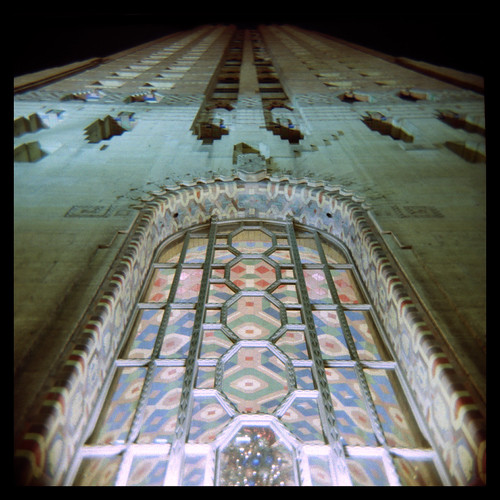
The Guardian Building

The Guardian Building, photo by Ralph Krawczyk Jr.

The Futurist Manifesto by Italian poet Filippo Tommaso Marinetti was published on February 20, 1909 in Le Figaro. Futurism rejected the past and celebrated speed, machinery and industry … and also war, violence, pollution, misogyny, the triumph of technology over nature and likely influenced fascism.

Futurism influenced many other twentieth century art movements, including Art Deco, Vorticism, Constructivism, Surrealism and Dada. Futurism as a coherent and organized artistic movement is now regarded as extinct, having died out in 1944 with the death of its leader Marinetti, and Futurism was, like science fiction, in part overtaken by ‘the future’.

Ralph says that this is a 1 minute + exposure with cable release Holga modification. Best viewed large. You can do that in his Holga Goodness slideshow. You can learn more about The Guardian Building in Detroit from Michigan in Pictures.

Sometimes Michigan’s great

see sometimes michigans great

see sometimes michigans great, photo by iwywhjtm.

As we prepare for another bout of winter, I thought it might be nice to have a little reminder that any state where you get to wear t-shirts and shorts in the middle of winter and still HAVE winter is pretty darn cool.

(note – don’t try this today!)

Again with the ice

IMG_1513

IMG_1513, photo by wcwhiting.

Bill says he’s waited all year for this to happen again.

Check out Bill’s other photos from this day and in his slideshow (there’s a music video at the tail end of the slideshow, so make sure your speakers aren’t on too loud!).

Sorry to keep coming back to the ice theme but it’s just too awesome.

What makes the colors of the Northern Lights?

Colors of the Northern Lights

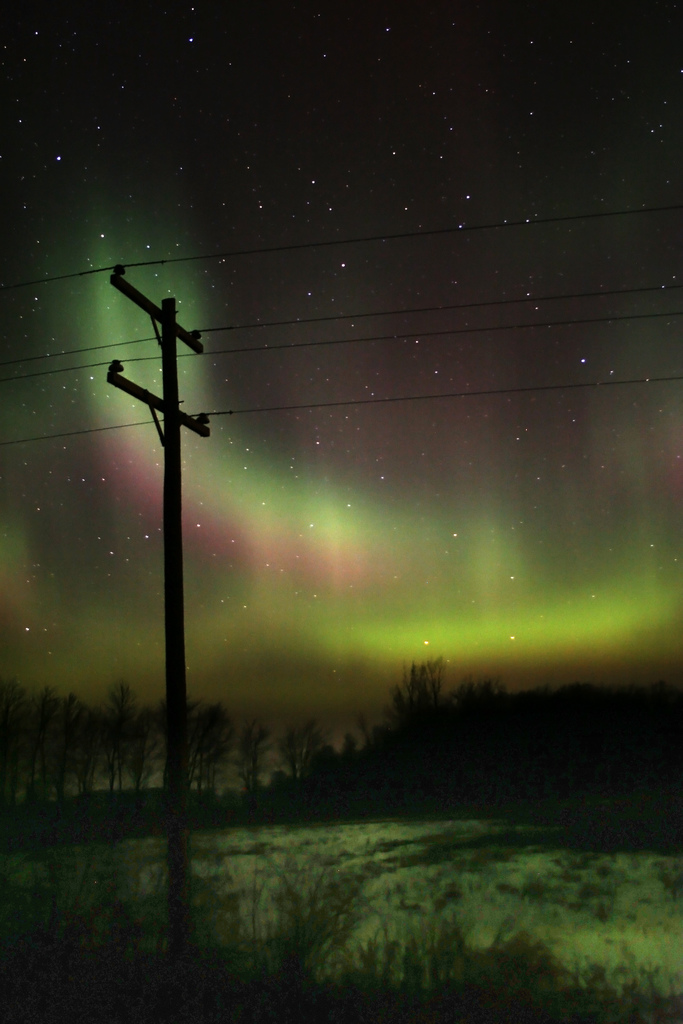
Electric, photo by Muvv

Matt took this picture (and a few others) on December 15, 2006. Just for fun, I thought I’d link to a slideshow of “aurora” photos taken on December 15th of 2006 on Flickr (there are a lot of them – I even have one in there!)

10 Stunning Images and Legends of the Northern Lights (Aurora Borealis) notes that in Latvian folklore the aurora borealis, especially if red and observed in winter, are fighting souls of dead warriors. The images are indeed stunning.

If you’re not buying that dead Latvian warrior thing, the most excellent Aurora FAQ from the Geophysical Institute at the University of Alaska has an answer to what makes the different colors of the northern lights (aurora borealis). They explain that the composition and density of the upper atmosphere at the altitude of the aurora are behind it all.

Basically, the aurora excites atoms & molecules (as well as photographers) and as that atom or molecule returns to the ground state, it sends out a photon with a specific energy.

This energy depends on the type of atom and on the level of excitement, and we perceive the energy of a photon as color. The upper atmosphere consists of air just like the air we breathe. At very high altitudes there is atomic oxygen in addition to normal air, which is made up of molecular nitrogen and molecular oxygen. The energetic electrons in aurora are strong enough to occasionally split the molecules of the air into nitrogen and oxygen atoms. The photons that come out of aurora have therefore the signature colors of nitrogen and oxygen molecules and atoms. Oxygen atoms, for example, strongly emit photons in two typical colors: green and red. The red is a brownish red that is at the limit of what the human eye can see, and although the red auroral emission is often very bright, we can barely see it.

Photographic film has a different sensitivity to colors than the eye, therefore you often see more red aurora on photos than with the unaided eye. Since there is more atomic oxygen at high altitudes, the red aurora tends to be on top of the regular green aurora. The colors that we see are a mixture of all the auroral emissions. Just like the white sunlight is a mixture of the colors of the rainbow, the aurora is a mixture of colors. The overall impression is a greenish-whitish glow. Very intense aurora gets a purple edge at the bottom. The purple is a mixture of blue and red emissions from nitrogen molecules.

The green emission from oxygen atoms has a peculiar thing about it: usually an excited atom or molecule returns to the ground state right away, and the emission of a photon is a matter of microseconds or less. The oxygen atom, however, takes its time. Only after about a 3/4 second does the excited atom return to the ground state to emit the green photon. For the red photon it takes almost 2 minutes!

Check the Aurora FAQ for much more information about this wonderful phenomenon and get more posts about the Northern Lights from Michigan in Pictures!

Will Shoe Be Mine?

Will Shoe Be Mine?

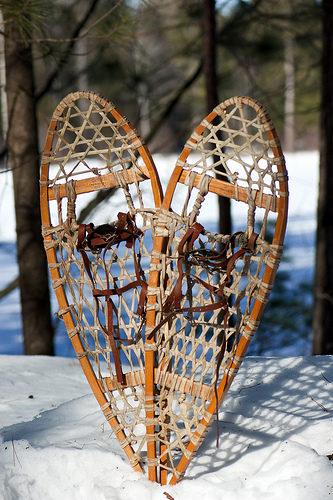
Will Shoe Be Mine?, photo by docksidepress.

Someone stole my cookies, but fortunately Matt takes his funny Valentines seriously. He suggests you view it on black and I suggest you also view it in his very un-GLUM Winter GLUM 2009 show.

I hope that those of you who celebrate Valentine’s Day have a day filled with fun and love (and chocolate) and that those of you who don’t have a day full of fun and love and chocolate too!

Michigan Valentine's Day stuff!

Grand Sable Dunes In Winter

Grand Sable Dunes In Winter

Grand Sable Dunes In Winter, photo by mandj98.

James says they rode his brother’s snowmobiles back along H58 to this overlook of Grand Sable Dunes in the Pictured Rocks National Lakeshore last weekend.

Grand Sable DunesHe has more photos from Pictured Rocks in winter & all seasons in his tremendous Pictured Rocks National Lakeshore set (slideshow) with tons of photos including the pic to the right of the same scene in August.

I was a little surprised to find that I hadn’t written anything about Grand Sable Dunes on Michigan in Pictures. In my opinion, it’s one of the most amazing vistas in Michigan, a broad sweeping dune that arcs along the shore of Lake Superior. It’s a great hike, either from the drive-up overlook (where you can view or visit the Au Sable Light Station) or by walking along the base on the Superior shore just a mile west from Grand Marais. Michigan Tech has a nice writeup on the history, geology and natural character of the Grand Sable Dunes. They’re a perched dune like the Sleeping Bear Dunes in lower Michigan that were formed when:

Glacial ice that melted within the Superior Basin produced many large rivers after the last major readvance, The Marquette readvance, in North America. These rivers deposited millions of tons of debris into many different configurations south of the Superior Basin. The Grand Sable Banks may have originated as a glaciofluvial kame terrace along one of these glacial rivers during deglaciation.

Pictured Rocks then became very dry about 9500 years before present due to the Lake Superior basin draining to the north. The outlets to the east were now the low spots. A north facing ice contact bluff and a platform to the south of it remained in place for 4500 years after deglaciation right around the area where Grand Marais is located today.

Isostatic rebound then occurred about 4000 to 6000 years before present. North Bay began to rise which caused water levels to rise rapidly. In fact, Lake Superior rose to about 40 feet higher than it is today! The rise in lake levels formed Lake Nipissing. Lake levels of Lake Nipissing also began to rise which caused the Grand Sable Banks to become unstable. From this point the formation of a perched dune can explain how the dunes formed from the Grand Sable Banks.

When Lake Nipissing water level rose it caused the Grand Sable Banks to become unstable. In turn, the high water eroded the bluffs which left them exposed to wind. A dominant northwesterly wind blew through the Grand Sable Banks which carried the wind from the bluff to the top of the flat upland. This sand was “perched” on top of the upland, hence the name, “perched dune system.”

You can check out Grand Sable Dunes on Absolute Michigan’s Map of Michigan and check out the Grand Sable Dunes slideshow on Flickr. I have written a fair amount on Pictured Rocks that you might enjoy.

Getting ready for Valentine’s Day

Building_Silhouette

Building_Silhouette, photo by jmsmith000.

All across the state husbands, wives, lovers and friends are thinking about what to do for Valentine’s Day.

If you’re one of those folks, you might want to head over to Absolute Michigan to check out our thoughts on Celebrating Valentine’s Day the Michigan way (with bonus song!) and also the Mondo Valentine’s Day Rundown.

More photos from Jeffrey on his photography web site.

Michigan Meltdown

Michigan Meltdown, photos courtesy Great Lakes Coastwatch

Usually when I want to blog about something in particular, the Absolute Michigan pool on Flickr has what I need. In this case, however, I think that everyone may have been out enjoying the amazing thaw that happened across the state yesterday as Mother Nature dropped the hammer on Old Man Winter, shattering record highs all across the state. From Marquette (48.5) to Detroit (59), the state of Michigan basked in springlike weather. Even Pellston aka “The Icebox of the North” managed to set a new record high (54).

Fortunately, the National Oceanic and Atmospheric Administration (NOAA) had their eyes in the sky on the job and dramatically captured what happened in just a few days. You can check these pictures out at Great Lakes Coastwatch and also right here in my Flickr where it should be big enough for some nice wallpaper. I used Lake Michigan because there seemed to be clouds everywhere else (and I’m a total homer). You can click the pic at the right to see the statewide view yesterday and also the Coastwatch link above for live satellite views!

Passage to… the February Exposure.Detroit Show!

Passage to…., photo by Ajit Rudrangi

The Exposure Detroit February 2009 Exhibit opens next Friday (Feb 20) from 7-10 PM at the Bean & Leaf Cafe in Royal Oak. The show features work from five photographers:

These openings are a great chance to view work from some very talented photographers and to meet many fimne folks from the Exposure.Detroit group.

You can view this photo from an Exposure.Detroit Ann Arbor photo safari larger in Ajit’s Exposure Detroit Show Probables set (slideshow)