Pellston, Icebox of the Nation

Brrr!
Brrr!, photo by loungelistener

The Icebox of the North page on the city of Pellston web site says that since Pellston recorded the State of Michigan’s record low temperature of -53° F. in 1933, it has been known as the Icebox (disclaimer: The Federal Trademark “Icebox of the Nation” is held by International Falls, MN).

With temperatures in Pellston well below zero for an average of around 40 days each winter, and beginning each November averaging the coldest temperatures in the state, it continues to be one of the coldest places in the nation. Many people nationwide hear the name of Pellston on their local weather each morning in the winter, along with towns like Big Piney, Wyoming, Fraser, Colorado and International Falls, Minnesota, it is continually called out as one of the coldest spots.

The record lows and the continuous cold streaks in Pellston are caused by a unique geography, as the village sits in a basin of sand between two vast semi-circular hill ranges. As the Maple River passes thru the basin, evaporation causes dense daytime cloud-cover, reflecting much of the suns heat away from the valley. As night falls and the air cools, those low-level clouds disperse allowing most of the remaining heat to radiate up and out of the basin.

If you grew up in Pellston, there’s a Facebook group for you.

Check this sign and many (many) more out bigger in Gary’s Michigan, My Michigan slideshow.

Bones … and barns

Bones

Bones, photo by Cherie S..

Be sure to check this out bigger or in Cherie’s Rural Explorations set (slideshow).

If you’re interested in helping old barns like this, consider joining the Michigan Barn Preservation Network.

International Caribbean Festival and Parade in Detroit

detroit-caribbean-carnival

The 2009 International Caribbean Festival and Parade will be held as a joint venture with African World Festival on August 14, 15, & 16 at Hart Plaza. The Parade will be staged from Woodward and Mack to Hart Plaza on Saturday, August 15, 2009, beginning at 11:00 a.m. The featured country this year is Jamaica.

Be sure to visit Detroit Bike Blog for more photos from last year’s parade.

Calico Pennant Dragonfly

Calico Pennant Dragonfly

Calico Pennant Dragonfly, photo by jbnuthatch.

Wikipedia doesn’t have much to say about the Calico (or Elisa) Pennant, Celithemis elisa. The Calico Pennant Dragonfly – Celithemis elisa page at North American Insects and Spiders says that Calico Pennants are of the order Odonates and that:

Dragonflies have excellent eyesight. Their compound eyes have up to 30,000 facets, each of which is a separate light-sensing organ or ommatidium, arranged to give nearly a 360° field of vision, important for taking prey on the wing, as has done the female shown above. Odonates are completely harmless – they do not sting or bite. Indeed, they are beneficial in the same respect spiders and other predators are beneficial – they keep the burgeoning insect population in check..

Dragonflies are among the most ancient of living creatures. Fossil records, clearly recognizable as the ancestors of our present day odonates, go back to Carboniferous times which means that the insects were flying more than 300 million years ago, predating dinosaurs by over 100 million years and birds by some 150 million…

Dragonflies are the world’s fastest insects and, although estimates of their speed vary wildly, most credible authorities say they are capable of reaching speeds of between 30 and 60 km/h (19 to 38 mph). A study showed that dragonflies can travel as much as 85 miles in one day.

Here’s some more general information about dragonflies.

Check this photo out bigger or in John’s Critterz set (slideshow).

Light

Light

Light, photo by Ralph Krawczyk Jr.

Here’s hoping the light shines for everyone this weekend.

Get it bigger or in Ralph’s x-Pro slideshow.

Throw in a Petoskey Stone Day

petoskey stones on the beach2

petoskey stones on the beach2, photo by jimevans_2000.

In the summertime in northwest Michigan, almost any Lake Michigan beach will have a person or two slowly walking or wading their way along the beach, gathering Petoskey stones in a bucket.

While I don’t begrudge anyone the extra money from harvesting them or the simple pleasure of finding, I do get a little peeved that there are times when I can’t find one to show a visitor or child who has never seen one. In honor of that, I am hereby creating Throw in Petoskey Stone Day, wherein participants head to a likely beach, look for Petoskey stones and then throw them way out in the water so that folks in the months or years to come can find them. It takes place every year on the third Saturday of July – tomorrow this year and Saturday, July 17 2010 if you’re the planning ahead sort.

Wikipedia’s Petoskey stone entry says:

A Petoskey stone is a rock and a fossil, often pebble-shaped, that is composed of a fossilized coral, Hexagonaria percarinata. The stones were formed as a result of glaciation, in which sheets of ice plucked stones from the bedrock, grinding off their rough edges and depositing them in the northwestern portion of Michigan’s lower peninsula.

Petoskey stones are found in the Gravel Point Formation of the Traverse Group. They are fragments of a coral reef that was originally deposited during the Devonian period, about 350 million years ago. When dry the stone resembles ordinary limestone but when wet or polished using lapidary techniques, the distinctive mottled pattern of the fossil emerges. It is sometimes made into decorative objects. Other forms of fossilized coral are also found in the same location.

In 1965, it was named the state stone of Michigan.

You can learn more about the name of the Petoskey stone from Rose Petoskey.

Jim found these on the Lake Michigan shore near Watervale (an amazing resort). Be sure to check this photo out bigger.

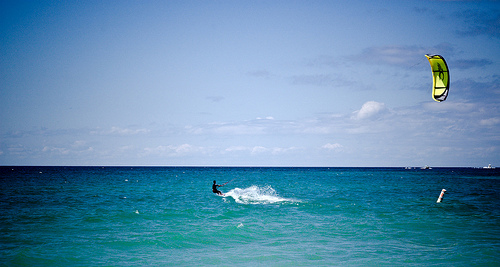
Michigan Kiteboarding: Big Wind, Big Water

Getting to Grandma's May Be Tricky

Getting to Grandma’s May Be Tricky, photo by docksidepress.

Check out some Michigan kiteboarding links from kiteUS and also Great Lakes Kiteboarding (check out their sweet video of a session on Lake Huron at Tawas.

Be sure to check this out bigger.

Will Air Force One be back for President Obama’s summer vacation?

Air Force One over Michigan

Under Air Force One, photo by foteck.

President Obama came to Michigan yesterday to talk about education, retraining and jobs.

While Michigan does make lovely backdrop for such speeches, it would be nice if the President would consider Michigan’s offerings as a summer vacation destination. That’s what folks in the Facebook group Mr. President! Come to Michigan for Your Summer Vacation! think.

See this bigger in fotek’s various slideshow.

Invasive Menace of the Day: Round Goby

must be exterminated

must be exterminated, photo by Kasey Carroll.

Kasey writes:

About ten seconds after I caught this, my fiancee’s uncle beat it repeatedly against the side of the boat. He said that it was an “intruder from outer waters and it must be exterminated because it eats all the perch eggs in Lake Eerie.” I’m sorry Peta. I didn’t do it.

See this bigger in her Things slideshow. The USGS Invasive Species Center page on the round goby says:

The round goby, Neogobius melanstomus, is a small, bottom – dwelling fish that was first found in the Great Lakes region in 1990. Originally from the Black and Caspian Sea areas of Eastern Europe, it is believed that this exotic species arrived in the ballast water of vessels coming into the Great Lakes. Since the first sighting in the St. Clair River, round gobies have spread to all of the Great Lakes and are working their way inland through the rivers and canal systems.

…Round gobies are found in all of the Great Lakes with the greatest numbers in Lake Erie, Lake St. Claire and southern Lake Michigan. Many of the areas with round goby populations are best described as infested. Once round gobies arrive they can become the dominant fish species. Round gobies prefer rocky, shallow areas, but have flourished in a variety of habitat types. Regardless of the habitat, round gobies are very aggressive fish that compete with native fishes for food and space. Anglers who fish in areas with round gobies often find that the gobies steal their bait and appear to be the only type of fish in the area.

Round gobies can eat zebra mussels in addition to fish eggs, plankton, fish, and benthic invertebrates. Because zebra mussels are filter feeders that accumulate contaminants in their body tissues, round gobies that eat zebra mussels may be consuming a high level of contaminants. When a predatory fish such as a walleye eats a round go by that has fed primarily on zebra mussels, they may be getting a much larger load of contaminants than they would from eating other types of prey fish. This could put dangerous concentrations of contaminants into sport-fish at a much faster rate.

According to the MLive, there are now an estimated 10 million pounds of gobies in Lake Michigan alone! More information at round goby on Wikipedia and from the round goby page on Protect Your Waters. How do we stop their spread? Always follow the procedure to Stop Aquatic Hitchhikers!

Stony Creek Sunset

Stony Creek Sunset

Stony Creek Sunset, photo by NnYSeb.

Summer in Michigan – dive in!

Be sure to check this photo out bigger or in Sebastian’s still in process July 2009 slideshow.

More summer wallpaper from Michigan in Pictures.