The Fantastic Mr. Fox … Michigan Red Fox that is

The Sly look

The Sly look, photo by taterfalls.

A little nonsense now and then is relished by the wisest men.
~Roald Dahl

Wes Anderson’s film Fantastic Mr. Fox (based on the book by Roald Dahl / view trailer) opens tomorrow, so I thought it a good time to take a look at the red fox. The Michigan DNR’s Red Fox (Vulpes vulpes fulva) page says:

Red foxes can be found in every county in Michigan but are especially common in areas with fallow and cultivated fields, meadows, bushy fence lines, woody stream borders, and low shrub cover along woods and beaches. They can also be found in suburban and, less commonly, urban areas where food is readily available. Foxes are highly mobile, which means they can use a large area to find food and shelter.

Red foxes resemble slender, small dogs, with the head and body typically around two feet long. Red fox tail is long and bushy, usually around 15 inches. The size and weight of foxes are commonly overestimated, because their long fur masks a bone structure that is slighter than that of most domestic dogs. Red foxes have a characteristic red coloration (hence their name), with the face, top of head, and neck having yellow or orange coloration. The tail is reddish mixed with black, and always has a white tip. The outer sides of the ears, lower parts of the legs, and feet are dark or black, while the insides of the ears, and the lips, chest, and belly are creamy white.

Much more about red foxes at Wikipedia and at Vulpes vulpes (red fox) on the UM Animal Diversity Web.

Be sure and check this out bigger also have a look at Tate’s slideshow of this brave fox in action.

Lake Michigan @ PJ Hoffmaster State Park

Untitled, photo by DTOWN Thug (Tim Mayo).

See it bigger in his Lake Michigan slideshow and see more from PJ Hoffmaster State Park on Michigan in Pictures..

Before the Mackinac Bridge: City of Munising

Mackinac MI UP Great Lakes Passenger and Auto Ferry City of Munising connecting Mackinaw City and St Ignace before the Mackinaw Bridge was build

Mackinac MI UP Great Lakes Passenger and Auto Ferry City of Munising connecting Mackinaw City and St Ignace before the Mackinaw Bridge was built, photo by UpNorth Memories – Donald (Don) Harrison.

Before the Mackinac Bridge was built (check Absolute Michigan for lots more on that), going to or from the UP was by ferry. The City of Munising was the last of the breed:

Built by the American Ship Building Company of Cleveland in 1903 for the Pere Marquette Railway Company, the “Pere Marquette 20” became the “City of Munising” in 1937. The Michigan Department of Highways used the ship to ferry autos across the Straits of Mackinac until 1959. The ship was used for potato storage by a Washington Island, Wisconsin firm until 1973.

Michigan State Ferry Album has some photos of the City of Munising and other ships that plied the Straits.

Check this out bigger and see some shots of the old ferry docks in Don’s slideshow of old Mackinac photos

An Ill Wind

An Ill Wind

An Ill Wind, photo by MightyBoyBrian.

Be sure to check this out bigger and in his sky, my friend set (slideshow).

Hope the winds blow fair for you this weekend!

The Cutting Room Floor

God and Automobiles

God and Automobiles, photo by g. s. george.

Yesterday on Absolute Michigan we featured Generation Y Michigan, a project of Michigan Radio that is probing why young adults leave Michigan (or buck the trend and choose to stay). While poking around, I found an engaging feature by Colleen Hill of Pixelgawker that features the photography of Geoff George (a regular on Michigan in Pictures). It’s titled Editors and Image Makers: On Photographing Detroit, Part 1 and begins:

One of the most important jobs in the media, that of the editor, often goes unseen. A well-edited film is seamless in its delivery. There are no awkward cuts or pauses, and the plot transcends time and distance effortlessly. Recently Detroit has been a prime topic of interest both in the national media and in film. With the copious number of photographs and footage of the city circulating the Internet and television, I can’t help but wonder, what is the edited version of Detroit that resides in the minds of the most of Americans? What are the parts left behind on the cutting room floor?

Read on for a lot more! About the photo above, Geoff writes:

This is the memorable and ironic view that greets every motorist traveling south on I-75 towards downtown. Thousands of these motorists are surely suburban GM workers on their way to work every day, and the irony of this chance alignment is hopefully not lost on them. In the background, the Renaissance Center, Detroit’s tallest building and GM World Headquarters. In the foreground, St. Josaphat, a 105-year old still-functioning relic from Detroit’s heyday. Detroit is the Motor City, but the sins committed here cannot be forgotten or forgiven–from the hundreds of murders every year to the construction of a freeway system that divided and destroyed vibrant and working neighborhoods. Hopefully this image will one day have different associations.

For me, it is a powerful view that is quintessentially Detroit. I’m sure it’s been photographed hundreds of times, but the balance and contrast between Detroit’s largest and most infamous glass skyscraper, a struggling community church, and the freeway that cut a swath across the city and acted as a runway for white flighters provides me with endless fascination. I hope you will find it equally stimulating.

You can see a whole lot more in Geoff’s the city on the strait: detroit set (slideshow).

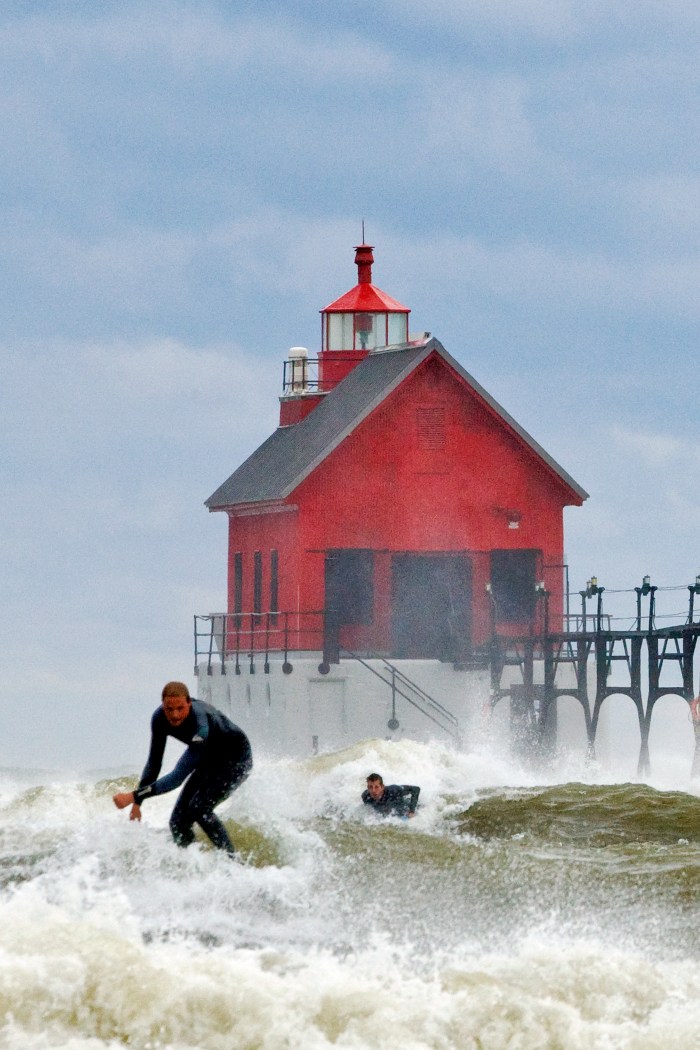
Storm Chaser: Surfing in Grand Haven

Storm Chaser

Storm Chaser, photo by johndykstraphotography.

Around the end of August, surf season really starts in earnest in Michigan and on the Great Lakes. As the winds and waves build through September and November, so does the level of the surfing. Grand Haven is one of Michigan’s best breaks (see Surf Grand Haven) and one of the locations featured in Vince Deur’s awesome film Unsalted. Here’s a cool preview of Unsalted from Absolute Michigan.

Be sure and check this out bigger and also check out the Michigan surfing slideshow in the Absolute Michigan pool on Flickr!

The Pontiac Silverdome

Abandoned Pontiac Silverdome - Pontiac Mi

Abandoned Pontiac Silverdome – Pontiac Mi, photo by Derek Farr ( DetroitDerek ).

Crain’s Detroit reported yesterday afternoon that an as yet unnamed Canadian company has purchased the Pontiac Silverdome for $583,000.

Ballparks.com’s page on the Pontiac Silverdome notes that at 80,368, the massive Silverdome long had the largest seating capacity in the NFL. The air-supported and cable-restrained facility was the largest of its kind in the world and is the first successful example of a fiberglass fabric roof system. From Wikipedia’s entry on the Pontiac Silverdome, I found this site dedicated to Silverdome architect C. Don Davidson. The site explains:

After working in the south as a prominent architect for several government and city projects, Davidson returned home in 1965 to a city that was slowly dying and stated in his own words, *”It looked as if someone had dropped a bomb on the city”. In 1966 he was hired at the University of Detroit to teach architecture and urban planning.

It was then when Davidson and his U.of D. class embarked upon an urban renewal project for Pontiac under the direction of Bruno Leon, Dean of Architecture.

You’ll definitely want to click through for drawings, press clippings and more about the Pontiac Silverdome.

Curiously enough, Derek’s photo appears on that site! See it bigger in his Detroit Ruins (and other cities) slideshow.

If you’d like a video look, you can check out the auction preview video (go to about 1:20 to get past the auction promo). If you’d rather just see what it looks like with laser lights and a rave going on, how about this video of Project Hardcore @ Silverdome in 2009?

November on Old Indian Trail

November - Old Indian Trail

November – Old Indian Trail, photo by cedarkayak.

Last November Todd wrote:

In November, the Michigan sun has dropped low to the horizon, and the first hints of snow are starting to lace the ground. The forest belongs to the deer hunters who have waited all year for hunting season. The approaching Winter is getting hard to ignore.

It’s a little sunnier and warmer now, but you can feel winter approaching almost every day. If you decide to head out to the amazing Old Indian Trail in the Sleeping Bear Dunes National Lakeshore, do be aware that the Park allows hunting in most areas. FYI, this trail offers amazing views of Sleeping Bear Point and Platte Bay all year long!

You can see this photo bigger. It’s also part of Todd’s cool One Year in Michigan set and his Sleeping Bear Dunes set (slideshow).

Here’s a few more shots of Old Indian Trail from the Sleeping Bear Dunes group and here’s a video from the trail.

The Game: University of Michigan Wolverines vs Ohio State Buckeyes

Michigan vs Penn State Wide-Angle

Michigan vs Penn State Wide-Angle, photo by AdamJacobsPhotos.

One week from today on Saturday, November 21, 2009 UM and Ohio State square off at the Big House in Ann Arbor at 12 noon.

The Game: Michigan Wolverines vs. Ohio State Buckeyes on Absolute Michigan has all kinds of information about this historic rivalry.

Michigan won the first meeting in 1897 (sweet photo of the teams!) and Ohio State didn’t notch a victory until 1919. At the Official Opening of Michigan Stadium in 1927 (click through for a photo) Michigan blanked the Buckeyes 21-0. While Michigan leads 57-42-6, OSU has won the last 5 meetings and is the favorite this year as well.

Be sure to check this out bigger in Adam’s slideshow!

2009 Leonid Meteor Shower & the Great Meteor Storm of 1833

My God...
My God…, photo by Muvv

It’s Friday the 13th and while we should probably have a photo of a black cat breaking a mirror or something, we’re going to look ahead to next week when the Leonid meteor shower peaks on Tuesday, November 17th. According to NASA:

If forecasters are correct, the shower should produce a mild but pretty sprinkling of meteors over North America followed by a more intense outburst over Asia. The phase of the Moon will be new, setting the stage for what could be one of the best Leonid showers in years.

“We’re predicting 20 to 30 meteors per hour over the Americas, and as many as 200 to 300 per hour over Asia,” says Bill Cooke of NASA’s Meteoroid Environment Office. “Our forecast is in good accord with independent theoretical work by other astronomers.”

Leonids are bits of debris from Comet Tempel-Tuttle. Every 33 years the comet visits the inner solar system and leaves a stream of dusty debris in its wake. Many of these streams have drifted across the November portion of Earth’s orbit. Whenever we hit one, meteors come flying out of the constellation Leo.

While it will probably be a pretty good meteor shower, it will have nothing on 1833, as this first-hand account of Great Leonid Meteor Storm of 1833 by Elder Samuel Rogers explains:

We had but little rest that night, for, before three o’clock in the morning, we were all aroused from our slumbers, making preparation for an early start. Some one, on looking out of the window, observed that it was almost broad daylight. “That can not be,” another answered, “For it is scarcely three o’clock.” “I can’t help what the clock says,” replied the first speaker, “my eyes can not deceive me; it is almost broad daylight –look for yourselves.”

After this little altercation, some one went to the door for the purpose of settling the question. Fortunately, there was not a cloud in the heavens; so by a glance, all was settled. I heard one of the children cry out, in a voice expressive of alarm: “Come to the door, father, the world is surely coming to an end.” Another exclaimed: “See! The whole heavens are on fire! All the stars are falling!” These cries brought us all into the open yard, to gaze upon the grandest and most beautiful scene my eyes have ever beheld. It did appear as if every star had left its moorings, and was drifting rapidly in a westerly direction, leaving behind a track of light which remained visible for several seconds.

Some of those wandering stars seemed as large as the full moon, or nearly so, and in some cases they appeared to dash at a rapid rate across the general course of the main body of meteors, leaving in their track a bluish light, which gathered into a thin cloud not unlike a puff of smoke from a tobacco-pipe. Some of the meteors were so bright that they were visible for some time after day had fairly dawned. Imagine large snowflakes drifting over your head, so near you that you can distinguish them, one from the other, and yet so thick in the air as to almost obscure the sky; then imagine each snowflake to be a meteor, leaving behind it a tail like a little comet; these meteors of all sizes, from that of a drop of water to that of a great star, having the size of the full moon in appearance: and you may then have some faint idea of this wonderful scene.

Be sure to check this out bigger or in Matthew’s My Photographic Love Affair slideshow (view the set). You might also enjoy on meteoric: 2009 Leonid Shower & the sound of meteors from Michigan in Pictures.