The Chain of Lakes

Torch River

Torch River by southarmstudio

Wikipedia relates that the Elk River Chain of Lakes is a seventy-five mile-long series of fourteen lakes and interconnecting rivers in Antrim, Charlevoix, Grand Traverse and Kalkaska Counties forming a single waterway.

The chain of lakes system begins with the upper stage of the Intermediate River, which rises in hill country at 45°00′20″N 85°04′45″W in the northwest corner of Chestonia Township in central Antrim County. From here, the waterway traverses a number of small lakes flowing north, then making a sharp turn near the village of Ellsworth, flows south through a narrow valley, paralleling the tracks of the Pere Marquette Railroad, until emptying into Intermediate Lake. The outlet of Intermediate Lake converges with the Cedar River in the village of Bellaire, gaining considerable volume. Now a river of substantial flow, it continues south into 1,700-acre (6.9 km2) Lake Bellaire. Leaving the lake, the stream becomes the Grass River, winding for some two miles (3 km) through the scenic Grass River Natural Area before emptying into Clam Lake. Clam Lake in turn empties directly into Torch Lake. At over 18,000 acres (73 km2) in size, Torch Lake is the largest body of water in the system.

The waterway, now clarified after traversing the immense depths of the lake, continues south through the Torch River, joins with the Rapid River, a major tributary, and empties into Lake Skegemog, a 2,500-acre (10 km2) lake that is studded with large stump fields, the result of the flooding of timberlands when the lake level was raised several feet by the construction of the dam at the terminus of the system. Lake Skegemog, which is the meeting point of Grand Traverse, Kalkaska and Antrim counties, is conjoined at its western end to 7,700-acre (31 km2) Elk Lake, the second-largest and final lake in the system. The outflow of Elk Lake, the Elk River, flows a short distance to a power dam in the town of Elk Rapids, then out into the east arm of the Grand Traverse Bay of Lake Michigan at 44°54′06″N 85°24′49″WCoordinates: 44°54′06″N 85°24′49″W. For most of its length, “The Chain” is navigable by small boat, broken up only by a dam in Bellaire. Larger boats are able to navigate between Elk Rapids and Torch Lake.

Click here to follow the Chain of Lakes on Google Earth. I was only able to get from Grand Traverse Bay up to Intermediate Lake – if anyone knows of a better map, let me know. Here is (roughly) where Ron took the photo above Torch Lake looking up the Torch River to Lake Bellaire and here is where Google Maps says the Chain starts. Don from Up North Memories has an old postcard with some of the lakes labeled.

Ron took these in late April of 2010 – it’s a must see slideshow with some great early moring views of  mist on the lakes and even some cherry blossoms.

All Ears: Michigan Whitetailed Deer

All Ears

All Ears, photo by (Andrew).

The Michigan DNR says that White-tailed Deer (Odocoileus virginianus) are the smallest of the three members of the deer family found in Michigan – the others being elk and moose.

“White-tailed” refers to the distinctive white tail that when raised is a flag and provides a flash of white, signaling other deer when there is danger. Deer are graceful and swift runners (up to 35 miles per hour), but do not generally run long distances, preferring to seek the nearest shelter whenever possible. Male deer are called “bucks”, females “does” and baby deer “fawns”. These deer tend to live in female-led family groups of up to 25 deer and may live to ten years or more.

Their size ranges between 125 to 225 pounds, although really healthy bucks may be even larger. Their coat is a reddish-brown color in the summer, but becomes much more gray in the winter. This change helps to hide them as the colors of their environment change. Their tubular or hollow hairs provide insulation, allowing them to lie on snow without melting it, as well as creating enough buoyancy for swimming.

Check this out background big and in Andrew’s giant and cool Whitetail Deer slideshow.

North light

North light

North light, photo by R.J.E..

June in Ludington. More about the North Pier Light (a wintry view at that).

Don’t miss the Michigan June Calendar on Absolute Michigan. Lots of fun stuff to do when you’re not soaking up a Michigan sunset!

Check it out bigger and on the map. More from R.J.E. on Michigan in Pictures.

And yes, we have sunsets.

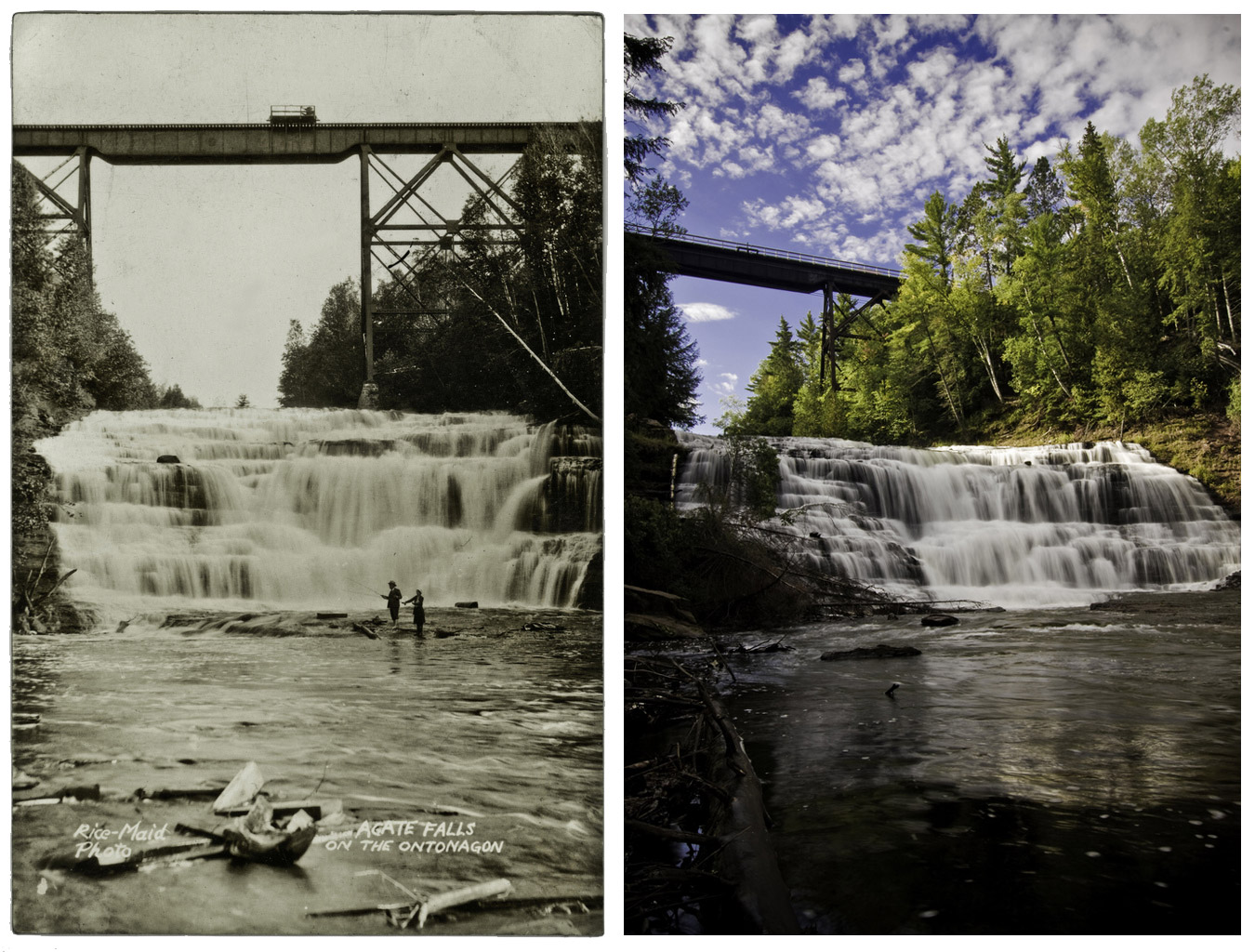
Yesterday & Today at Agate Falls


Agate Falls 1939 and Agate Falls, photo by Marty Hogan

Dear Everybody
having a swell time
tried a different lake today and caught some nice bass.
-Nick

Marty posted this postcard of Agate Falls that Nick mailed at 1pm on the 14th of July,1939 to Kenosha along with a modern-day look. No word on if Nick’s last name was Adams. ;)

GoWaterfalling.com says that Agate Falls is a pretty waterfall that is relatively easy to get to on your way to or from Bond Falls. They write:

Agate Falls is a Michigan State Scenic Site 6.5 miles east of Bruce Crossing on MI-28. There is a roadside park (Joseph F. Oravec roadside park) just past the bridge over the Ontonagon River. Unfortunately the provided trails and overlooks are somewhat limited. With some effort you can scramble down to the river to get some very good views of the falls, which seems to be popular with local fishermen, or scramble up the river banks to get to the old railroad bridge over the falls. The bridge is now part of a snowmobile trail.

Marty’s Agate Falls slideshow has several more photos including the roadside sign.

Also see Michigan Wild & Scenic Rivers: Ontonagon River on Michigan in Pictures.

Eastern Hog-nose Snake

Eastern Hog Nose Snake 2

Eastern Hog Nose Snake 2, photo by ShaneWyatt.

The Michigan DNR page on the Eastern Hog-nosed Snake (Heterodon platirhinos) says this is a:

A thick-bodied, slow-moving snake with a flattened, upturned “nose.” Color is variable some have dark spots and blotches on a yellow, orange, or brown background, but other specimens are solid black, brown, or olive with little or no visible pattern. Easily identified by defensive behavior. Adult length: 20 to 40 inches.

A snake of open, sandy woodlands – found in the wooded dunes of western Michigan. The upturned snout is used to burrow after toads, a favorite food. When threatened, hognose snakes puff up with air, flatten their necks and bodies, and hiss loudly. (This has led to local names like “puff adder” or “hissing viper.”) If this act is unsuccessful, they will writhe about, excrete a foul smelling musk, and then turn over with mouth agape and lie still, as though dead. Despite this intimidating behavior, Hog-nosed snakes are harmless to humans.

You can see a lot of pictures at the UM Animal Diversity Web and definitely check out Hog Wild on the Herping Michigan blog.

Shane writes that it was pretty intimidating to see the snake flair like a cobra and start hissing at him. Check it out bigger and see some more shots in his eastern hognose slideshow.

More Michigan snakes on Michigan in Pictures!

Gray’s Reef Lighthouse

Gray's Reef Lighthouse

Gray’s Reef Lighthouse, photo by AdamMI88.

Terry Pepper’s Seeing the Light is the best resource for Great Lakes Lighthouses. The Grays Reef Light page begins:

Grays Reef Passage serves as the primary route between the Straits and the ports on the southern shores of Lake Michigan. Bounded on the east by Vienna Shoal and East Shoal, Grays Reef itself forms the western boundary of the passage, and consists of an extensive area of shallow water over a rocky bottom stretching over eight miles in length. With some portions of its rocky bottom almost protruding above the water’s surface, the reef has long represented a significant threat to any vessel master unfamiliar with the intricacies of the passage.

He goes on to explain tells how lightships kept the reef safe from 1891 until a crib light was finally approved in the 1930s. Click through for some photos of the lightships and a detailed account of what goes into building a crib light in 26 feet of water. The Archives of Michigan has a cool pencil drawing of Gray’s Reef as well!

Adam says that White Shoal Light is also visible (barely) in the distance (left). Check this out on black and in his Northern Michigan slideshow (which includes some other northern Michigan lighthouses!).

Check out more Michigan lighthouses on Michigan in Pictures.

Memorial Day in Michigan

Tribute 9804-09

Tribute 9804-09, photo by StacyN – MichiganMoments

Stacy took this photo at the Grand Rapids Veteran’s Cemetery. View it bigger in her slideshow and I hope you have a chance to remember those who’ve sacrificed for our nation.

Fresnel lens at the Museum Ship Valley Camp

Untitled

Untitled, photo by Jim Bedell.

The Michigan Lighthouse Conservancy’s page on Fresnel lenses begins:

The Fresnel lens is the 1822 invention of French physicist Augustine Fresnel who invented a lens that would make his name commonplace along the seacoasts of Europe and North America. Most lenses were handmade and shipped unassembled from France. Others were made in England. Early lens designs resembled a giant glass beehive, with a light at the center. The lens could be as tall as twelve feet high with concentric rings of glass prisms above and below a center drum section to bend the light into a narrow beam. Later designs incorporated a bull’s eye design into the center of the lens shaped like a magnifying glass, so the concentrated beam was even more powerful. Tests showed that while an open flame lost nearly 97% of its light, and a flame with reflectors behind it still lost 83% of its light, the Fresnel lens was able to capture all but 17% of its light. Because of its amazing efficiency, a Fresnel lens could easily throw its light 20 or more miles to the horizon.

Definitely read on to learn how flash panels or bull’s eyes were used to distinguish one light from the next and to view the different orders of Fresnel lenses that were used on the Great Lakes and also see Wikipedia’s Fresnel lens entry.

Jim snapped this aboard the Museum Ship Valley Camp in Sault Ste. Marie. You can take a photo tour right here.

Check his photo out bigger and take an awesome tour of the Valley Camp in his slideshow.

If you’re out and about this weekend, take some time to stop in at a Michigan museum!

Superior Dawn at Grand Sable Dunes

"Superior Dawn" - Grand Sable Dunes , Pictured Rocks National Lakeshore

“Superior Dawn” – Grand Sable Dunes , Pictured Rocks National Lakeshore, photo by Michigan Nut.

By curious coincidence, I was just a short distance (at Twelve Mile Beach Campground from where John captured this stunning view of the Grand Sable Dunes. That link can tell you all about this amazing dune structure and I heartily encourage you to visit the Pictured Rocks National Lakeshore sometime soon!!

Check it out big as the BIG lake or in John’s Pictured Rocks National Lakeshore slideshow.

Many more photos from the Pictured Rocks National Lakeshore can be found on Michigan in Pictures!

Frankenmuth Dog Bowl

Champion coming!

Champion coming!, photo by Frankenmuth Fun.

Frankenmuth invites you to Dog Bowl 2011, the Midwest’s largest Olympic style event for dogs. This annual event takes place Memorial Weekend (May 28 & 29) at Frankenmuth River Place and includes events for dogs including agility competitions, dock dives, dog disc competition, fashion shows, canine cruise and (of course) biggie dog & weiner dog races! The event is FREE – there’s even a hot air balloon show – and you can click the link above for all the details!

Check this out bigger than a beagle and also see their huge 2008 Dog Bowl and 2009 Dog Bowl slideshows!