
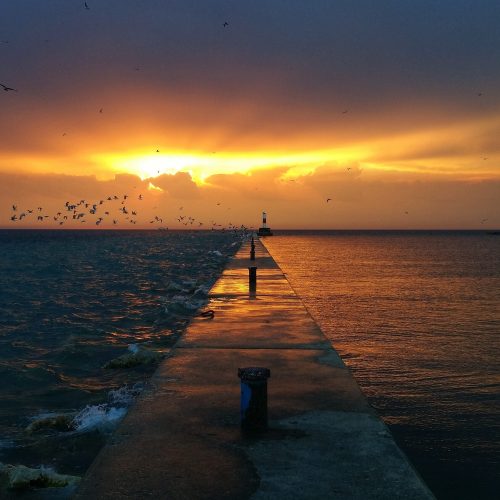
Untitled, photo by Noah Sorensen
You really should check out this photo background bigtacular. Lots more in his slideshow and if you do the Instagram thing, Noah is a great follow @mcsorensens.
Untitled, photo by Noah Sorensen
You really should check out this photo background bigtacular. Lots more in his slideshow and if you do the Instagram thing, Noah is a great follow @mcsorensens.
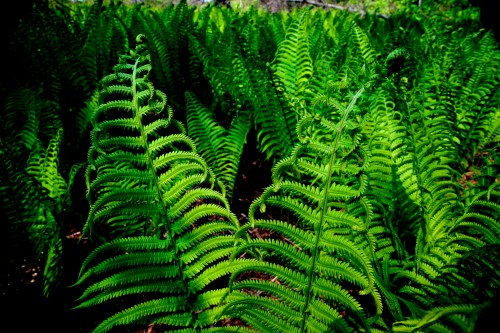
Ferns, photo by Tom Mortenson
The American Fern Society offers A Brief Introduction to Ferns that says (in part):
Ferns have been with us for more than 300 million years and in that time the diversification of their form has been phenomenal. Ferns grow in many different habitats around the world. The ferns were at their height during the Carboniferous Period (the age of ferns) as they were the dominant part of the vegetation at that time. During this era some fern like groups actually evolved seeds (the seed ferns) making up perhaps half of the fern like foliage in Carboniferous forests and much later giving rise to the flowering plants. Most of the ferns of the Carboniferous became extinct but some later evolved into our modern ferns. There are thousands of species in the world today.
…The life cycle of the ferns may seem complicated but it has worked quite successfully for millions of years. Though spores come from fronds of ferns, the fronds do not come directly from the spores. Spores from the parent fall to the ground and with an enormous amount of luck (millions perish for every success) they will find suitable moisture and light. The tiny single-celled organism starts to grow by cell division. Soon orderly arrangements of cells form little green heart shaped plants or Prothallia (gametophytes). These plants go unnoticed by most people as they are only 1/2 inch or less across and lie flat on the ground. This is an independent plant with its own simple “root” system (rhizoids) to provide it with nutrients and water.
Read on for more and you can view native and non-native Michigan ferns at the University of Michigan Herbarium.
Tom took this shot on the Montreal River that forms the Wisconsin/Michigan U.P. border near Superior Falls. Definitely check it out background bigtacular and see more in his slideshow.
You can read more about Superior Falls and check out more summer wallpaper on Michigan in Pictures!
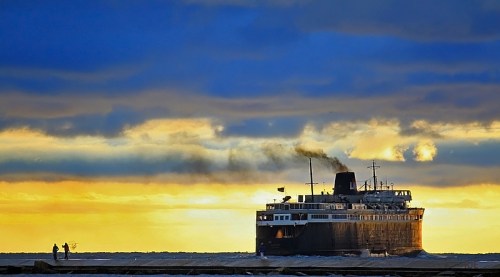
S.S. Badger – Ludington Mi., photo by RJE
NPR has a feature on the upgrades to the SS Badger that allow the car ferry to continue to operate between Michigan and Wisconsin on Lake Michigan:
A slice of history sails across Lake Michigan, carrying cars between Ludington, Mich., and Manitowoc, Wis. It’s the SS Badger: the largest coal-fired passenger ship still operating in the United States.
For years, the ship was the focus of environmental scrutiny because of its practice of dumping waste coal ash directly into the lake. The pollution nearly stopped the Badger from steaming again — but now, the ash-dumping has ended.
…After decades of letting the Badger pollute the lake, the Environmental Protection Agency issued an ultimatum: Stop dumping or be grounded.
Finally, this off-season, the boat’s owner installed a $2 million solution: a set of blue pipes that collect ash each trip, about 500 tons per year. Once a week, that ash gets trucked to Charlevoix, Mich., for use in making cement products.
You can get all the info on the Badger right here. For an added dose of awesome in your day, check out The Steamer 43 Song by Pete Host, featuring photos of the SS Badger on Absolute Michigan. It’s from a 45 Pete recorded in the early 70s about a sailors life on the C&O carferries out of Ludington, Michigan. With his spare time aboard the Badger, he learned how to play the guitar, and in just a few months, went to Milwaukee Wis. and recorded this song.
View the photo bigger and see a couple more of R.J.E.’s photos of Ludington, Michigan.
More Michigan ships and boats on Michigan in Pictures.
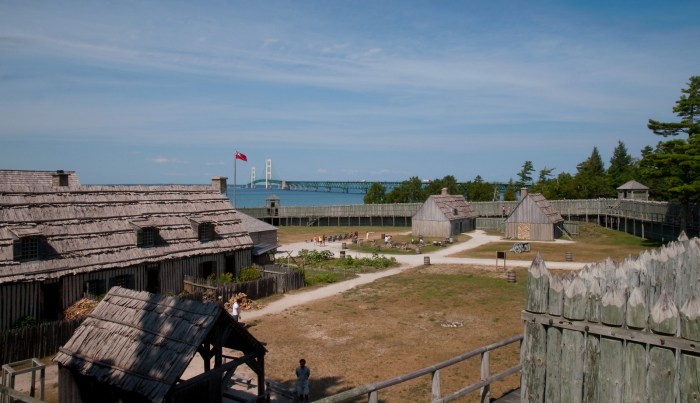
The Fort and the Bridge, photo by Joel Dinda
Mackinac State Historic Parks page on Colonial Michilimackinac says that:
French soldiers constructed the fortified community of Michilimackinac on the south side of the Straits of Mackinac in 1715. The community grew and prospered over the coming years as Michilimackinac became an important center of the Great Lakes fur trade. Every summer, thousands of Native Americans and French-Canadian voyageurs gathered at the post, which served as transfer station for furs trapped in the western Great Lakes and trade goods shipped in from eastern cities such as Montreal and Quebec. Michilimackinac came under British control in 1761, but the fur trade and community life remained relatively unchanged.
Fearful that the post was vulnerable to attack by American rebels, the British disassembled the fort and community and moved it to Mackinac Island in 1779-81.
One factor in the move may also have been an event that happened 252 years ago on June 2, 1763. The fort was captured by Ojibwa & Sauk warriors who gathered to play a huge game of baggatiway. Elizabeth Edwards of Traverse Magazine wrote a great article about the massacre that begins:
Under an unusually hot sun on a late spring day on the Straits of Mackinac, British Major George Etherington, commandant of Fort Michilimackinac, was suffering from an acute case of cultural blindness. And there was no excuse for it. Relaxed at the sidelines of a rousing game of baggatiway (similar to lacrosse) outside the fort, the major should have seen the danger signs in this Ojibwe versus Sauk contest of sweaty, half-naked bodies painted with white clay and charcoal.
The 30-year-old officer was born in the colonies, and most likely grew up on stories of Indian uprisings. He’d even served in the just-ending French and Indian War, in which the English had wrested control of North America from the French—a victory that had put this previously French fort in Etherington’s care. Though the major had been raised on American soil and had fought on it, he was still English. And in that country, a battle was a battle, and a sporting event was a sporting event.
Perhaps that explains why the major missed the clues…
Read on for much more at Traverse, and you can also watch a video on Pontiac’s Rebellion from the History Channel or jump right to the story.
Joel adds that almost every building at Colonial Michilimackinac is a reconstruction, with only two or three minor exceptions. View his photo background bigtacular and see more from the fort and surrounding area in his Straits of Mackinac slideshow.
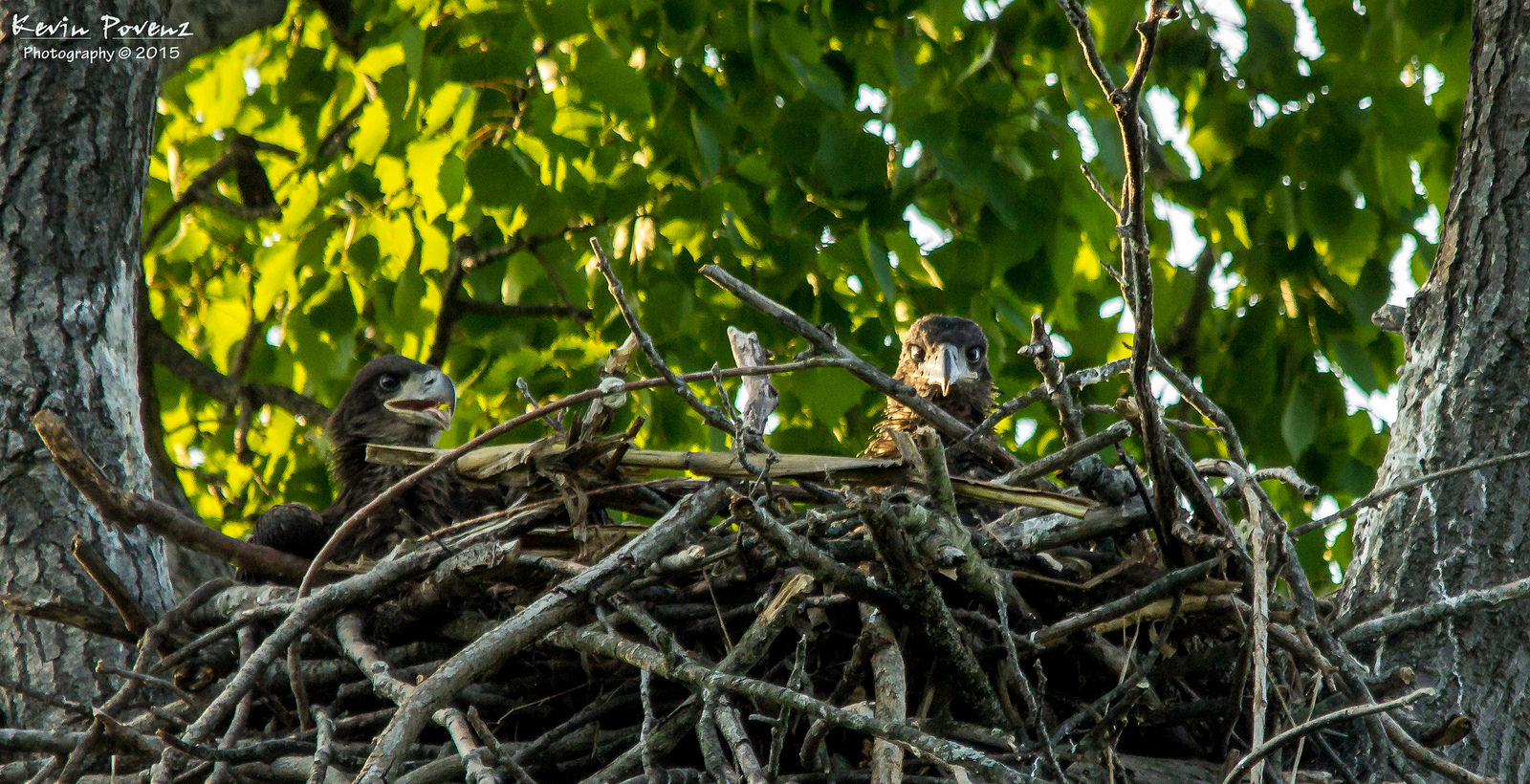
Eaglets, photos by Kevin Povenz
The State of Michigan’s page on Bald Eagles (Haliaeetus leucocephalus) says in part:
When bald eagles reach maturity (at four to five years of age), they select a mate, with whom they probably mate for life. In captivity, they have been known to live to 50 years, but in the wild, they probably don’t reach much more than 20 years of age.
The beginning of the breeding season, from mid-February to mid-March, consists of the establishment of a territory, nest building and mating displays. The mating “cartwheel” display begins high in the air with the two birds darting and diving at each other, until they lock talons and drop in a spinning free fall, until the last possible moment when they separate. The nest is usually located in the tallest tree in the area, often a white pine or dead snag. They are usually made of sticks with a lining of grass and moss. Nests may be added to each year until they reach enormous sizes, up to ten feet in depth and 20 feet across.
From late March to early April, one to four (average two) pure white eggs, approximately twice the size of a chicken egg, are laid. Both males and female bald eagles participate in the incubation, and the feeding of the chicks that hatch around seven weeks later. In about three months, by late summer, the fledglings are ready for flight. When it is time to move for the winter, the young birds are abandoned by their parents.
Kevin is certainly the Official Bald Eagle Photographer of Michigan in Pictures! View his photo bigger and see more (including more of these little ones) in his Birds of Prey slideshow.
More Michigan birds on Michigan in Pictures.
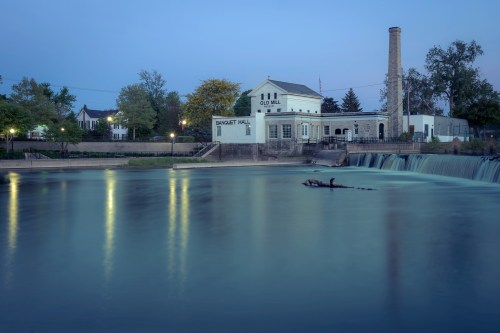
Night Mill, photo by The Ottolab
The Old Mill Museum is Dundee’s historical museum. Their history page says that over the years, it has served as a grist mill, hydro-electric power plant, Ford factory and fabricating factory.
The three-story frame mill as we know it was built in 1848-49 by Alfred Wilkerson, as a grist mill. The nearby dam had been constructed out of logs in 1846.
The building is of Greek Revival design, popular in Monroe County in the 1840s. “It is compact, geometric and of exquisite proportion,” according to the community’s Sesquicentennial Book, published in 1974.
The windows are double-hung with multiple lights. The exterior doors are divided horizontally (Dutch) and the overall design is symmetrical.
Hand-hewn beams, 10×10 inches for the main columns, support the building. The roof, floors and other connections were made with oak pegs. No longer existing are two smaller additions at the rear of the mill which were used to store flour barrels and milling tools during the building’s grist mill days.
Read on for much more.
View the Ottolab’s night exposure of the mill background bigtacular and see more in his slideshow.
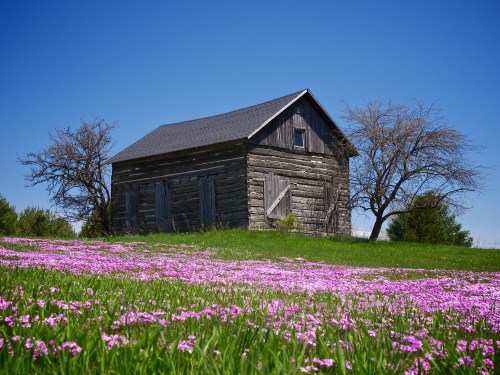
Old Cabin In Spring, photo by David Marvin
I’m going to declare that the statute of limitations on posting another photo from David Marvin expired at 7:38 AM today.
Check his photo out background bigilicious and see more of his photos from the Brevort Lake area. Be sure to follow his blog too!
More spring wallpaper on Michigan in Pictures … and then let’s bring on the summer!
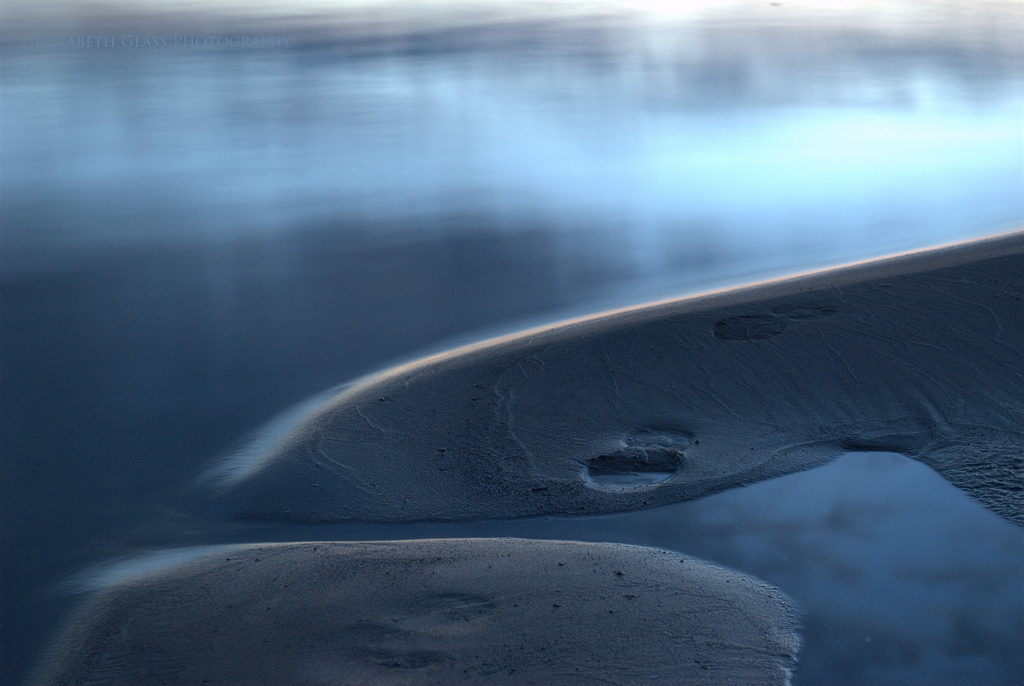
Close Encounter, photo by Liz Glass
Liz took this back in May of 2011 at Glenwood Beach on Lake Charlevoix in Boyne City. View it bigger and see a ton more of her Lake Charlevoix photos on Flickr.
PS: If you’re in Boyne City and looking for good things to eat, visit Liz at the Lake Street Market!
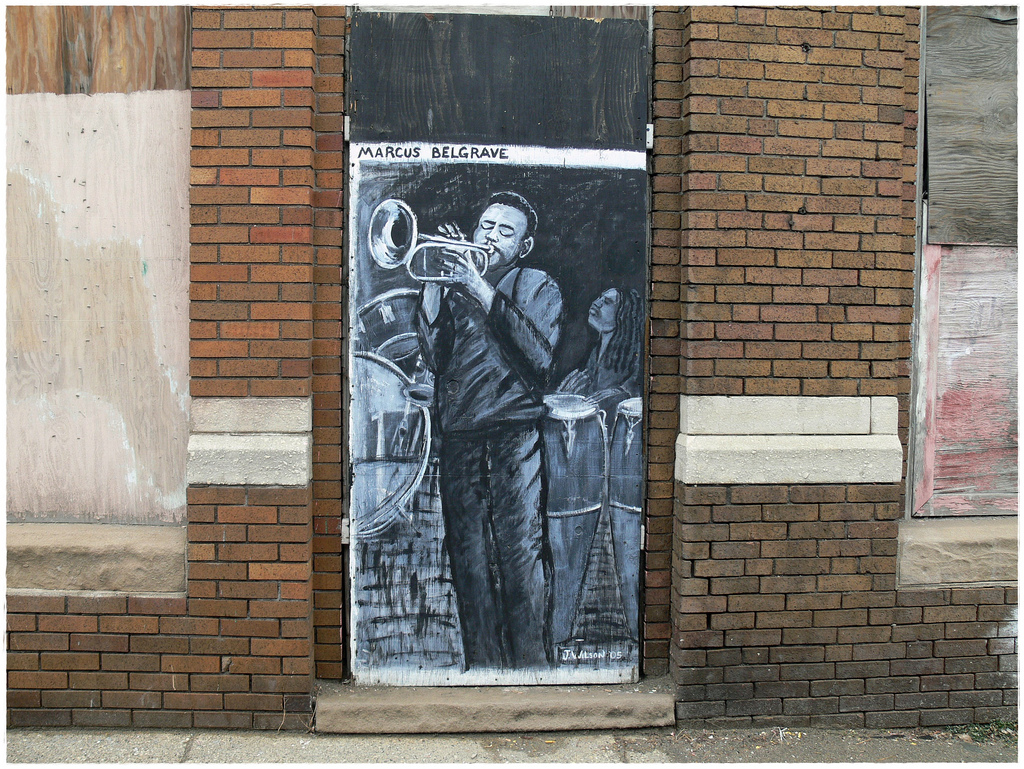
Marcus Belgrave is the Door to Jazz, photo by Derek Farr
“In order to get to the future, you have to go to the past. I try to instill that you learn from the masters in your presence and go back and forward from there. In order to find yourself, you have to be cognizant of what went down before you. That’s always been my philosophy.”
~Marcus Belgrave
The Freep reports that world-renown trumpeter Marcus Belgrave has passed away at the age of 78.
It’s impossible to overstate the impact that Belgrave has had on musical culture in Detroit as a musician, teacher and standard-bearer of jazz. Like an African griot (historian, storyteller, praise singer, poet and/or musician), he came to embody the soul and mythology of the city’s jazz history, handing down the values of swing and blues to multiple generations of students — many of whose fame would eventually outshine his own. Belgrave symbolized Detroit’s continued vitality as an incubator and epicenter of jazz, and he remained a key link between the city and the international jazz scene.
“He became a mentor to entire generations of musicians, and a lot of us would not have found the music without him,” said bassist Rodney Whitaker. “He brought us together. I have not met one musician from the last 50 years in Detroit that Marcus has not had some sort of impact on.”
Belgrave’s A-list resume included a long tenure with Ray Charles in the 1950s and early ’60s and associations with jazz royalty like Max Roach and Charles Mingus. Ultimately, however, Belgrave’s greatest contribution was the remarkable honor roll of his former students who graduated to leading roles on the national scene — including pianist Geri Allen, bassists Whitaker and Robert Hurst, alto saxophonist Kenny Garrett, violinist Regina Carter, and drummers Karriem Riggins, Ali Jackson and Gerald Cleaver.
Read on for lots more about this Detroit jazz legend and also check out their compilation of Belgrave recordings & videos – it’s some wonderful music. Be sure to also check out this great interview with Belgrave about the Detroit jazz scene and a bit of a performance from Eastern Market.
Derek says that four paintings including this one were put on doorways of an abandoned building on Gratiot Avenue near Downtown in 2005, but were taken down for some reason in 2008. View it bigger and see more in his massive Detroit Ruins (and other cities) slideshow.
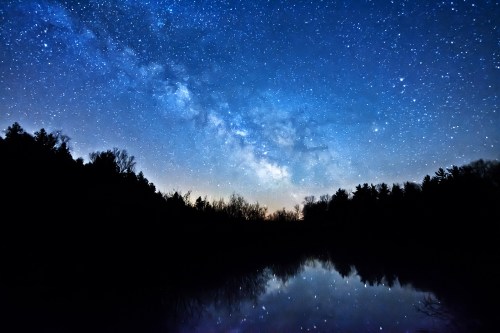
Milky Otter, photo by Heather Higham
The stars don’t look bigger, but they do look brighter.
~Sally Ride
Google reminded me this morning that today would have been astronaut & physicist Sally Ride’s 64th birthday. The Wikipedia entry for Sally Ride says that on June 18, 1983, she became the first American woman in space. Along with her NASA career, Ride also wrote a number of books aimed at encouraging children to study science, something I strongly believe that all of us should remember to do with the young girls & boys who look up to us.
To put a Michigan bow on this, be sure to check out the Women in Aviation and Space exhibit at the AirZoo in Portage. The exhibit honors women including astronaut Sally Ride and aviation pioneer Amelia Earhart. It includes original uniforms, a visual history mural, photo collages, a timeline and a unique mosaic, which includes each of the 1,102 WASP plus Jacqueline Cochran, founder of the Women in Aviation and Space organization.
Heather took this incredible shot at Otter Creek in the Sleeping Bear Dunes National Lakeshore. View her photo bigger and see more in her Night Sky slideshow.
PS: If you want to get your Night Sky fix at the Sleeping Bear Dunes National Lakeshore, check out their Your Park After Dark program this summer!
 Michigan in Pictures