Michigan Blues: Blueberries that is!

38.5 pounds of love

38.5 pounds of love, photo by sethrt.

Every week, Taste the Local Difference posts an article with facts, lore and recipes for foods that grow in Northern Michigan. As a bonus, they have many posts from previous years in their Ready to Pick archive so that folks downstate who are already picking (I’m looking at you, Edward Vielmetti) what’s not yet ready to pick up north.

Blueberries are coming on strong in Michigan, and here’s what their blueberry page has to say about these blue marvels!

  • Over 18,000 acres of blueberries are grown in Michigan, the largest blueberry-producing state in the U.S.
  • More than 20 varieties of blueberries are grown in Michigan. The Jersey variety is the most planted blueberry bush in the state.
  • Blueberries are one of the few truly blue foods on earth.
  • Blueberries are considered a super food! They are the fruit that is highest in antioxidants.
  • Each blueberry grows from a different white blossom on the bush. Growers can tell how good their crop will be by counting the blossoms.

More about blueberries from the the Blueberry People (aka the Michigan Blueberry Growers Association) and also Eat Local: Michigan Blueberries from Absolute Michigan.

Be sure to check this amazing haul of blue gold out bigger and check out the blueberry slideshow from the Absolute Michigan pool on Flickr!

Michigan’s tart cherries take their time in ’09


Untitled, photo by CourtneyCraven

I read that this year is one of the latest tart cherry harvests, but these look just about ready.

See it bigger in Courtney’s Sleeping Bear Dunes set (slideshow) and check out cherries in the Absolute Michigan pool on Flickr.

Bones … and barns

Bones

Bones, photo by Cherie S..

Be sure to check this out bigger or in Cherie’s Rural Explorations set (slideshow).

If you’re interested in helping old barns like this, consider joining the Michigan Barn Preservation Network.

Afton…now and then

Afton...now and then

Afton…now and then, photo by smartee_martee.

Marty writes:

21 September 2008; Afton, Michigan.

The postcard is postmarked Sept 2, 1920.

Patrick O’Connor opened a lumber camp in Ellis Township in 1887. Ellisville was the name given to its first post office in 1905. It was asked to be renamed Afton, for that it was thought to resemble Afton in Scotland because of the Pigeon River flowing nearby. It was officially Afton on Feb. 12, 1906.

This photo is part of Marty’s amazing Overnight Photo Trip September 2008 (slideshow). He drove nearly 2000 miles through northern Michigan and the Upper Peninsula, chronicling small towns, hamlets and crossings.

Traverse City: Cherry (Festival) Capital of the World

Traverse City Cherry Capital Postcard

Traverse City Cherry Capital Postcard, photo by Seeking Michigan.

The annual National Cherry Festival kicks off on July 4th, 2009. The first festival was held in 1926 and it has grown into an $26 million dollar powerhouse. Many of the concerts and events are free, and in addition to a number of parades, there’s music (headlined by Kenny Wayne Shepherd), food & wine tasting and an air show.

Check it out bigger and also in their Tourism set (slideshow).

I think the woman above barely missed the cut for this amazing travelogue from the 1940s.

up on the rooftop

up on the rooftop

up on the rooftop, photo by n.elle.

Be sure to check this out background bigalicious and in Nicole’s rural exploring set (slideshow).

future hopefuls: Michigan Christmas Trees

future hopefuls

future hopefuls, photo by yodraws.

As might be expected, the Michigan Christmas Tree Association is not a fan of fake trees, pointing to hazardous chemicals and such and noting that:

  • Real Christmas trees help filter dust and smog from the air and help stop soil erosion.
  • Christmas trees on a farm produce oxygen – a necessary component of life for people.
  • Real Christmas trees provide a comfortable habitat for a wide variety of wildlife.
  • After the holidays, Christmas trees can be recycled and used for purpose including bird feeders/shelters, fuel chips and mulch. Fake trees end up in a landfill.

I read somewhere that live Christmas trees or decorating a tree outside are the absolute best choice. Anyway, check that link above for all kinds of Michigan tree dealers and info including also see Absolute Michigan keyword Christmas tree for more links and articles.

Yo writes that on this cold and snowy Saturday, they found a tree in record time that was short and sweet with tiny little pine cones. See it bigger in her Somewhere in Michigan slideshow!

If you feel like a visit to the Christmas tree farm or lot is a chore, check out The Christmas Tree Ships for a look at how things were “back in the day”.

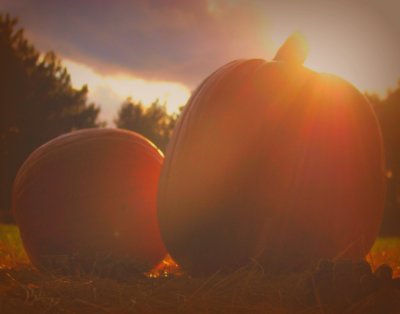
Pre-Jack-O-Lanterns-Sun-Kist

Jock o Lantern Sunset

Pre-Jack-O-Lanterns-Sun-Kist, photo by mdprovost

Wikipedia’s pumpkin entry says:

The word pumpkin originates from the word pepon, which is Greek for “large melon.” The French adapted this word to pompon, which the British changed to pompion and later American colonists changed that to the word we use today, “pumpkin.” The origin of pumpkins is not known, although pumpkins are thought to have originated in North America.

…Pumpkins are commonly carved into decorative lanterns called jack-o’-lanterns for the Halloween season in North America. Throughout Britain and Ireland, there is a long tradition of carving lanterns from vegetables, particularly the turnip, mangelwurzel, or swede. Not until 1837, however, does jack-o’-lantern appear as a term for a carved vegetable lantern, and the carved lantern does not become associated specifically with Halloween until 1866.

You can read more about Michigan pumpkins from Absolute Michigan and also view a pumpkin slideshow from the Absolute Michigan pool!

Click for more fall wallpaper on Michigan in Pictures!

Michigan is Wine Country

Wine Country, photo by smiles7

Last night I had dinner with a writer from England who is exploring vineyards in Leelanau by bicycle for a story. He was asking me some questions about how Michigan ranks nationally in grape & wine production. I didn’t have all the answers, but fortunately there’s the great Michigan Wines web site from the Michigan Grape & Wine Council.

From their fast facts page, I learned that Michigan has about 1,800 acres of wine vineyards, making Michigan the eighth largest in wine grape producer in the nation (if our juice grapes are factored in, we’re 4th largest). We’ve increased our vineyard area over 60% in the last 10 years. Michigan is 13th in wine production with 56 commercial wineries that produce over 425,000 cases of wine annually. The state’s wineries are also popular tourist destinations, attracting more than 800,000 visitors annually.

Most of Michigan’s quality wine grapes grow within 25 miles of Lake Michigan. Here, the “lake effect” protects the vines with snow in winter, retards bud break in spring helping avoid frost damage, and extends the growing season by up to four weeks.

Michigan has four federally approved viticultural areas (AVAs). In the northwest part of the state, near Traverse City, lie the Leelanau Peninsula and the Old Mission Peninsula. This area has a growing season averaging 145 days and an average heat accumulation of 2,350 growing degree days; 51% of Michigan’s wine grapes grow here. In the southwest part of the state lie the Lake Michigan Shore and Fennville appellations, where 45% of Michigan’s wine grapes are grown. This area has a growing season averaging 160 days and an average heat accumulation of 2,750 growing degree days.

You’ll also want to check out their history page for the very interesting story of Michigan’s winemaking history. Here’s the vineyard slideshow from the Absolute Michigan pool and you can get lots more features and links for Michigan wines from Absolute Michigan.

through the viewfinder and up the apple tree

Untitled, photo by Jenny Murray.

Speaking of Through the Viewfinder (aka TTV) (which we were the day before yesterday) here’s one of Jenny’s.

She has many (many) more in her great ttv set (slideshow).