
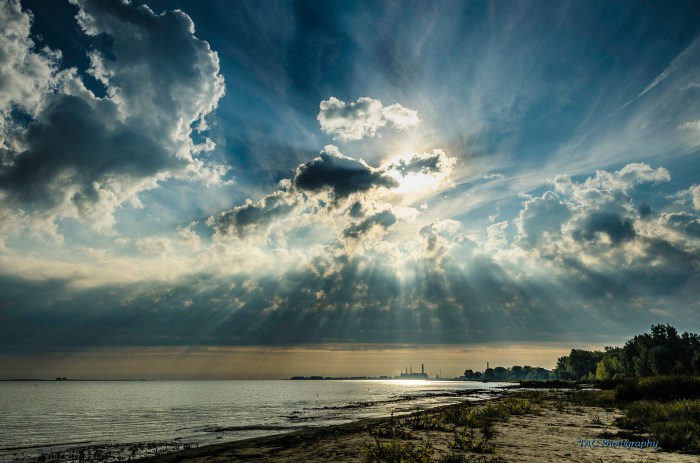
God’s Rays over Saginaw Bay, photo by Tom Clark
Awesome shot from one month ago on Saginaw Bay! View Tom’s photo bigger and see more in his Skyscapes slideshow.
More from Saginaw on Michigan in Pictures.
God’s Rays over Saginaw Bay, photo by Tom Clark
Awesome shot from one month ago on Saginaw Bay! View Tom’s photo bigger and see more in his Skyscapes slideshow.
More from Saginaw on Michigan in Pictures.

I hope that you vote today but equally importantly, please consider becoming more engaged with government in the months and years to come – it’s clear our government needs us!
View Meghan’s photo from 2008 bigger and see more in her Voting slideshow.
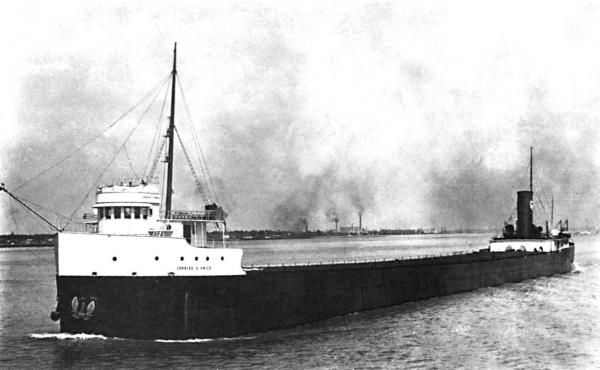
I’ve featured the worst storm in Great Lakes history before, but ThumbWind has a cool feature on The Great Storm of 1913 that includes some interesting information and photos. It says in part:
…the most savage storm in the history of the Great Lakes swept the inland waters November 7-12, 1913 resulting in much greater loss of life. Combined of the forces of two storm fronts colliding with hurricane force bringing monstrous waves and driving snow and ice that doomed anyone caught out on the big lake. The greatest losses in lives and ships occurred on Lake Huron where 24 vessels were lost or severely damaged. 10 ships went to the bottom of the lake.
…On Lake Huron big freighters were tossed about by winds blowing from seventy-five to eighty miles an hour. One of these steamers was the Charles S. Price which received more space on the front pages of newspapers than any other ship. On Saturday morning, the Price, laden with soft coal, left Ashtabula, Ohio. When the freighter passed the town of St. Clair before dawn on Sunday morning, November 9, Second Mate Howard Mackley gave a short blast of the whistle as a signal to his young bride that he was passing and in reply she turned on an upstairs light in their home. By dawn the Price was making its way up Lake Huron. About noon Sunday the Price was seen north of Harbor Beach by Capt. A. C. May of the Steamer H. B. Hawgood.
On Monday afternoon a big steel freighter was seen floating upside down in the lake about eight miles north and east of the mouth of Lake Huron. Many people were anxious to learn the name of the steamer, although it was generally believed to be the Regina. On Wednesday morning an attempt was made to find out the identity of the vessel, however, owing to the high sea the diver did not make his descent. Lake Huron kept its awful secret for almost a week. It was not until Saturday morning, November 15, that William H. Baker, a diver from Detroit, solved the mystery. When he went down he read the name of the steamer twice and the letters spelled out Charles S. Price. The forward part of the bottom of the ship was buoyed up by air that was held in her when she turned turtle, but two streams of bubbles were coming out of the bow which meant that she would settle gradually. On Monday morning, November 17, the Price disappeared from view.
Read on for much more and follow Thumbwind on Facebook too!
More Michigan shipwrecks on Michigan in Pictures.
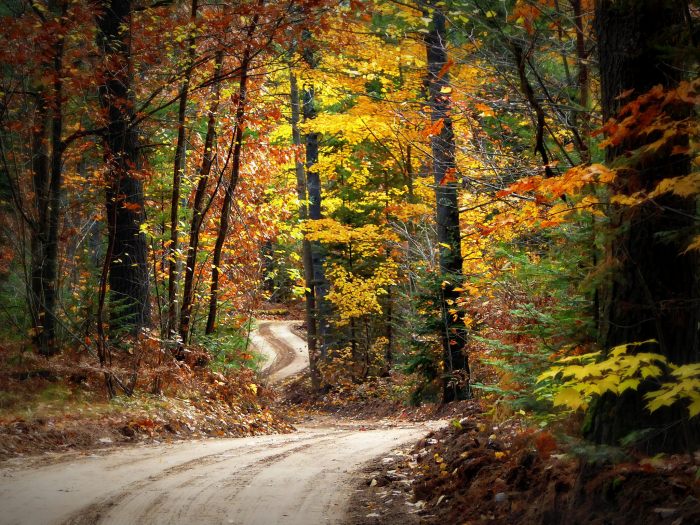
The Road Goes On, photo by Ann Fisher
Not. Giving. Up. On. Fall.
View Ann’s photo background big and see more in her 2016 U.P. slideshow.
Lots more fall wallpaper on Michigan in Pictures.

Super Color Tree, photo by Scottie Williford
If you’d like to try this at home, the recipe is: 590nm infrared, f/11 @1/125, iso 200
Here’s hoping you can catch some more fall color this weekend – looks like a great forecast!!
View Scottie’s photo bigger, see more in his slideshow, and be sure to follow Scottie Photography on Facebook.
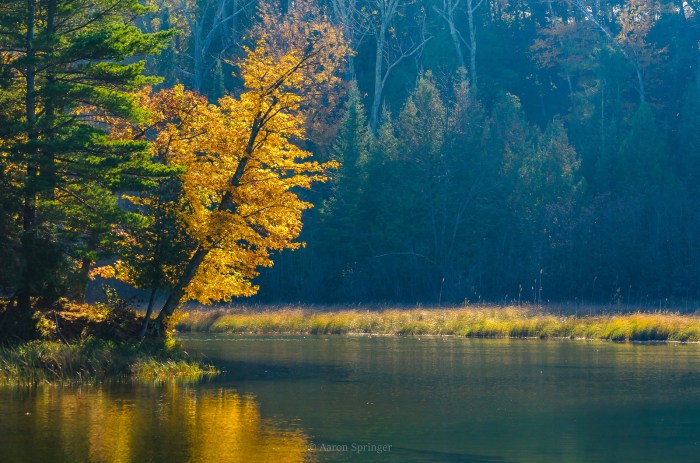
Platte River, photo by Aaron Springer
Today’s photo shows that fall color is still hanging on … as does the latest cover for the Michigan in Pictures Facebook that I took not far away yesterday. Definitely still color out there to be had!!
View Aaron’s photo of this gorgeous maple at a bend on the river bigger and see more in his slideshow.
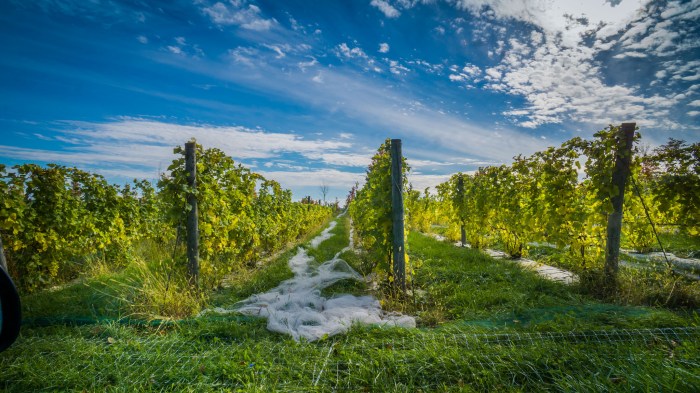
The Nets Are Off, photo by Mark Smith
The Detroit News reports that 2016 is shaping up to be a great year for Michigan wine grapes:
Frigid winters contributed to dismal harvests the past two falls. In 2014, Michigan winemakers lost a majority of their crops to the extreme cold. And last year, up to 75 percent of the wine crop was decimated because of winter, a late spring and, in northern Michigan, a late-summer hail storm. Many wineries were forced to supplement their vintages with grapes and juice bought from out-of-state growers.
“Winemakers are very excited about the harvest this year,” said Karel Bush, executive director of the Michigan Grape and Wine Industry Council. “After that second brutal winter, some vineyards had to buy from elsewhere and that made it very difficult for them, especially if their business model is to be an estate winery. You have to be open, you have bills to pay, staff to pay, so you had to buy grapes and juice from elsewhere. This year, they’re delighted to have their own crop to work with.”
…It’s good news for an industry that continues to grow and is winning accolades for both white and red varietals, most notably chardonnay, riesling, cabernet franc and pinot noir. Home to more than 120 wineries, Michigan ranks 10th in the nation in production, producing more than 2.5 million gallons a year — a number expected to be reached again this year. And wineries, with their ever-expanding tasting rooms and activities, have become a big business across the state, attracting more than 2 million visitors a year.
Mark took this photo at Bel Lago Winery on Michigan’s Leelanau Peninsula. The nets he refers to are those snow-looking piles that are white nets that hang over the vines to keep birds away during the final weeks of ripening. View his photo background bigilicious and see more late-fall goodness in his slideshow.

Executive Level in the city of Detroit, photo by Dan Frei Photo
Follow @danfreiphoto on Twitter and view & purchase his work on his website.

Happy Halloween, photo by Julie
Happy Halloween everyone! I shared this story a few years ago, but since we’re back up on northern Lake Michigan at a time when the witch of November is rousing, why not share it again? In 1915, William MacHarg & Edwin Balmer wrote a book called The Indian Drum. The whole book is available online along with 53,000+ more books at Project Gutenberg. Chapter I begins:
Near the northern end of Lake Michigan, where the bluff-bowed ore-carriers and the big, low-lying, wheat-laden steel freighters from Lake Superior push out from the Straits of Mackinac and dispute the right of way, in the island divided channel, with the white-and-gold, electric lighted, wireless equipped passenger steamers bound for Detroit and Buffalo, there is a copse of pine and hemlock back from the shingly beach. From this copse—dark, blue, primeval, silent at most times as when the Great Manitou ruled his inland waters—there comes at time of storm a sound like the booming of an old Indian drum. This drum beat, so the tradition says, whenever the lake took a life; and, as a sign perhaps that it is still the Manitou who rules the waters in spite of all the commerce of the cities, the drum still beats its roll for every ship lost on the lake, one beat for every life.
So—men say—they heard and counted the beatings of the drum to thirty-five upon the hour when, as afterward they learned, the great steel steamer Wenota sank with twenty-four of its crew and eleven passengers; so—men say—they heard the requiem of the five who went down with the schooner Grant; and of the seventeen lost with the Susan Hart; and so of a score of ships more. Once only, it is told, has the drum counted wrong.
At the height of the great storm of December, 1895, the drum beat the roll of a sinking ship. One, two, three—the hearers counted the drum beats, time and again, in their intermitted booming, to twenty-four. They waited, therefore, for report of a ship lost with twenty-four lives; no such news came. The new steel freighter Miwaka, on her maiden trip during the storm with twenty-five—not twenty-four—aboard never made her port; no news was ever heard from her; no wreckage ever was found. On this account, throughout the families whose fathers, brothers, and sons were the officers and crew of the Miwaka, there stirred for a time a desperate belief that one of the men on the Miwaka was saved; that somewhere, somehow, he was alive and might return. The day of the destruction of the Miwaka was fixed as December fifth by the time at which she passed the government lookout at the Straits; the hour was fixed as five o’clock in the morning only by the sounding of the drum.
The region, filled with Indian legend and with memories of wrecks, encourages such beliefs as this. To northward and to westward a half dozen warning lights—Ile-aux-Galets (“Skilligalee” the lake men call it), Waugaushance, Beaver, and Fox Islands—gleam spectrally where the bone-white shingle outcrops above the water, or blur ghostlike in the haze; on the dark knolls topping the glistening sand bluffs to northward, Chippewas and Ottawas, a century and a half ago, quarreled over the prisoners after the massacre at Fort Mackinac; to southward, where other hills frown down upon Little Traverse Bay, the black-robed priests in their chapel chant the same masses their predecessors chanted to the Indians of that time. So, whatever may be the origin of that drum, its meaning is not questioned by the forlorn descendants of those Indians, who now make beadwork and sweet-grass baskets for their summer trade, or by the more credulous of the white fishermen and farmers; men whose word on any other subject would receive unquestioning credence will tell you they have heard the drum.
Read on at Project Gutenberg.
View Julie’s photo bigger and see more in her Holidays slideshow.
See 700 more Halloween photos in the Absolute Michigan photo group and more haunted, Halloween fun on Michigan in Pictures.
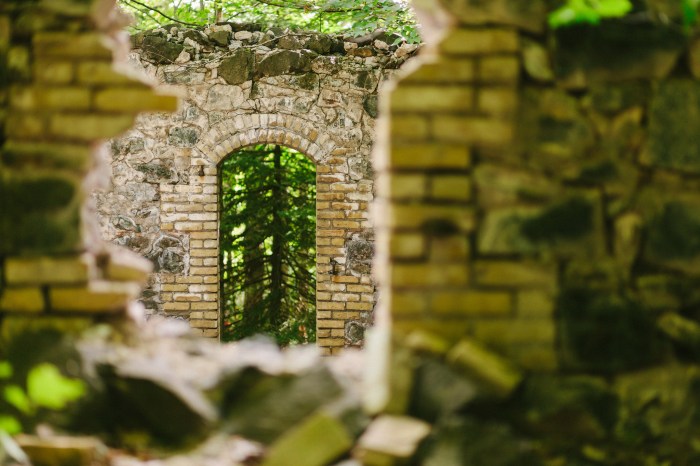
through the never, photo by Marty Hogan
mLive’s Emily Bingham has a feature on 11 eerie & intriguing ghost towns in Michigan that is definitely worth checking out. The slide for the Upper Peninsula ghost town of Central says:
This abandoned village on the U.P.’s Keweenaw Peninsula was a company town of nearly 1,300 residents, many of them German and Cornish immigrants who’d come to work in the copper mines. The town had a post office, three-story school, and one of the first telephone services in Copper Country. The mine closed in 1898, only four decades after it had opened, and residents quickly left to find work elsewhere. All that remains are thirteen houses and a Methodist church, maintained by the Keweenaw Historical Society; every year on the last Sunday of July, locals and descendants of the Central Mine villagers attend a special service at the church to honor those who lived there.
If you’re looking to get more ghost town goodness, look no further than Marty Hogan! His photo albums get up close and personal some of Michigan’s coolest forgotten communities. View this photo background bigilicious and see more in his Central slideshow.
 Michigan in Pictures