Lake Michigan: Port Oneida Edition

Port Oneida, photo by JamesEyeView Photography

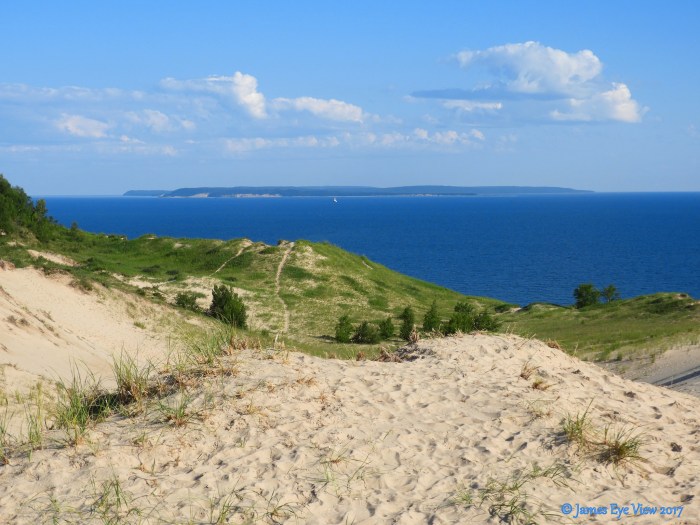
Just one of the many staggering vistas that await you on the Pyramid Point Trail in the Sleeping Bear Dunes National Lakeshore.

View the photo background bigtacular and see more in James’ The Great Lakes slideshow.

PS: If you head this way the weekend of August 11-12, be sure to check out the annual Port Oneida Fair. presented by the Sleeping Bear Dunes National Lakeshore.

What’s up everyone?

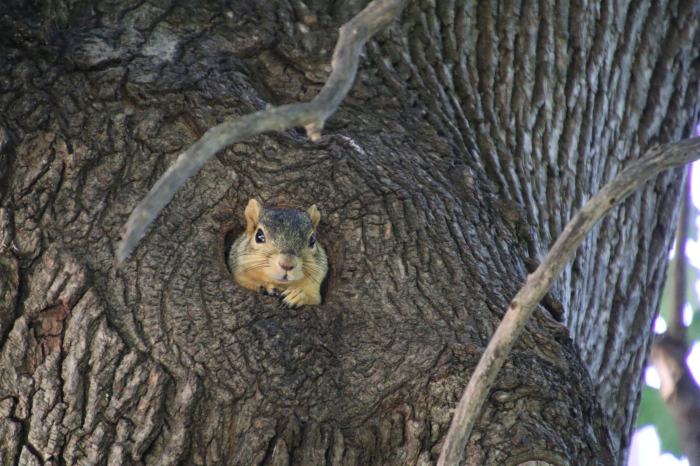
Squirrels in Ann Arbor at the University of Michigan (July 31st, 2017), photo by Corey Seeman

Apologies for the spotty posting over the last week. I’ve been pretty busy on a project.

Corey took this photo yesterday on the University of Michigan campus in Ann Arbor when he was testing out his new Tamron 18mm-400mm lens, which he totally loves. View the photo background bigtacular and see more in Corey’s Project 365: Year 10 slideshow. (spoiler alert – there’s a lot of squirrels in it!)

More summer wallpaper on Michigan in Pictures.

Friday Yoga: Crane Position

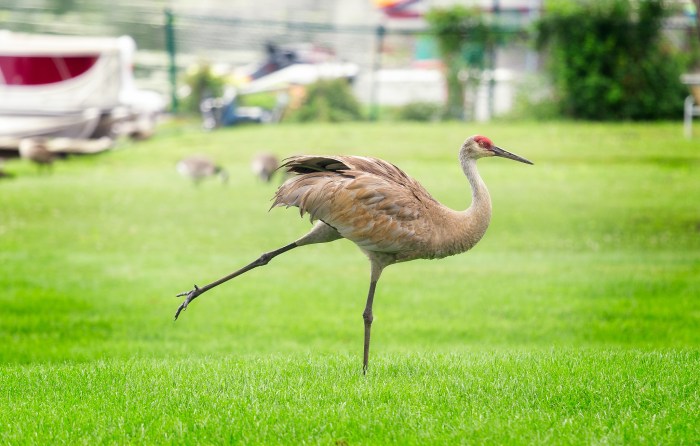
Crane stretching, photo by Mark Zacks

It’s important to stay loose!

View Mark’s photo background big and see more in his slideshow.

S.S. Aquamara: The Great Lakes’ Largest Liner

aquarama-unloading-detroit

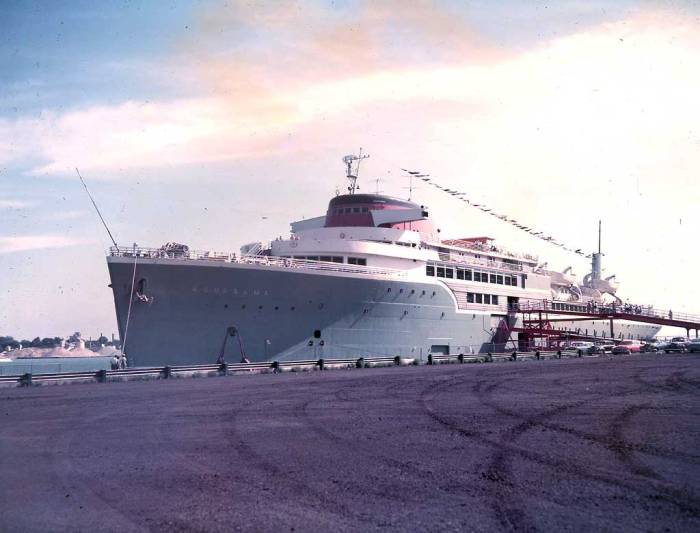
Aquamara unloading in Detroit, courtesy Marine Historical Society of Detroit

The S.S. Aquarama was the largest passenger ship ever to operate in the Great Lakes. We’ll head to Ohio (gasp) for this article on the Aquamara from Cleveland Historical:

The Aquarama began its life in 1945 as a transoceanic troop carrier called the Marine Star: 520 feet and 12,733 tons. It made only one Atlantic Ocean trip before combat ceased. Eight years later, the ship was purchased by Detroit’s Sand Products Company and taken to Muskegon, Michigan, where it underwent an $8 million, two-year conversion, and was reborn as a nine-deck luxury-class ferry capable of carrying 2,500 passengers and 160 cars. The rechristened Aquarama also touted five bars, four restaurants, two dance floors, a movie theater, a television theater, and a playroom. Special events often were held in conjunction with day or evening cruises. For example, on June 10, 1962, passengers were treated to a style show from Lane Bryant’s Tall Girl Department. The next month, evening cruisers on the Aquarama could watch the Miss World finals. Regular shipboard entertainment included musical performances, dancing, marionette shows, games, and contests.

The cruise portion of the ship’s life actually began in 1955, with tours to various Great Lakes ports and a brief stint as a “floating amusement palace” docked along Chicago’s Navy Pier. Soon after, service began focusing solely on runs between Cleveland and Detroit: six hours “door to door” with Cleveland-based passengers embarking in the morning from (and returning in late evening to) the West 3rd Street pier. For the next six years, the Aquarama was extremely popular but never profitable. Part of the problem may have been frequent “incidents”: One summer, the Aquarama backed into a seawall. A year later, it hit a dock in Cleveland. A week after that, it banged into a Detroit dock, damaging a warehouse. Alcohol issues also were recurrent: Accusations included untaxed booze and liquor sold in Ohio waters on Sunday. Still, the ship’s most likely death knell was simply high operating costs.

The Aquarama made its last trip on September 4, 1962. It then was towed back to where it had been rebuilt–Muskegon, Michigan, ostensibly to continue as cruise vessel. Unfortunately, a prohibitively large dredging investment was needed to accommodate the harbor. The Aquarama thus sat dockside—residing (but not operating) later in Sarnia, Ontario, Windsor, Ontario, and Buffalo, New York, where entrepreneurs hoped in vain to convert it to a floating casino. In 2007 the Aquarama was towed to Aliağa, Turkey, where it was broken up for scrap.

This photo from Boatnerd shows the Aquarama unloading passengers from Cleveland at Detroit’s city park next to the J.W. Westcott Co. dock, 1963. Another view.  Hartland Smith, William Hoey collection. More pics at Boatnerd.com.

Read more about the Aquamara at Wikipedia.

Summertime Fun!

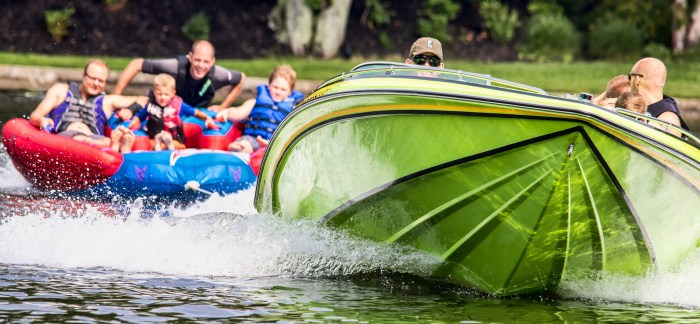
Summertime fun….., photo by Kevin Povenz

Hope you’re having some summertime fun!!

View the photo bigger and see more in Kevin’s Fun/Interesting slideshow.

More Michigan fun on Michigan in Pictures!

Oak Savannah

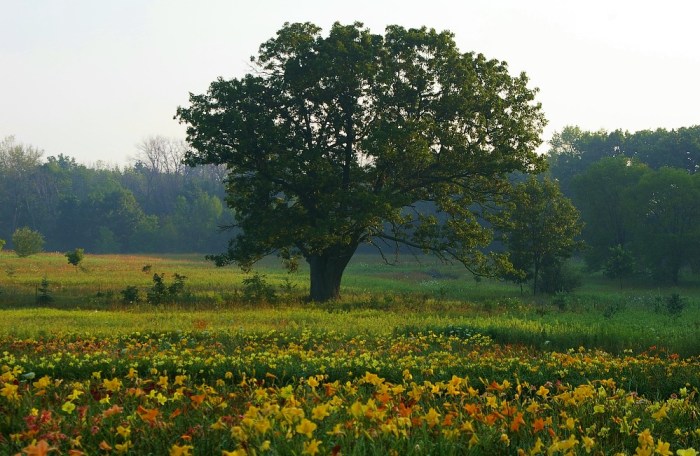
Oak and the Day Lilies, photo by Diane Constable

“Too old to plant trees for my own gratification, I shall do it for my posterity.”
-Thomas Jefferson

Dianna writes:

So glad someone planted THIS Black oak some 200-250 years ago–maybe about the time Mr Jefferson made the above quote!

Do not know who or what planted the acorn–but this tree lived in grasslands just about it’s whole life judging by the spread of the branches.

Local history says Indians lived in the area and would burn the grasslands on occasion to keep the oak-grass savannah in much of southern/central Michigan–may have very well been what this tree witnessed. Slow burning grassfires would not have harmed the tree.

View the photo bigger and see more in Dianna’s Oak slideshow.

PS: Read more about oak savannahs and the flora & fauna they support from the Michigan DNR.

The Calumet Children’s March and the Keweenaw Miners Strike

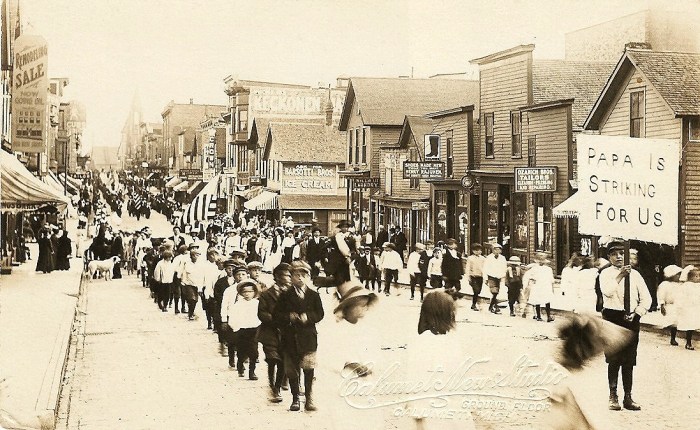
Children’s Parade, Calumet Copper Miners Strike — RPPC by Calumet New Studio, Calumet, Michigan, photo by Wystan

Here’s a throw back Monday for you – a photo from July 23, 1913 of children marching in Calumet during the tumultuous miners’ strikes of 1913. It’s an interesting case study for our modern world given that the driver was the same driver that’s beginning to impact our labor market – automation. The excellent article Labor unions, strikes and violence in the Keweenaw: The Copper Miner Strike of 1913 – this is seriously great work by Frank Zawada’s descendent(s) – the says that there  had been strikes in the Keweenaw in 1872, 1874, 1890 and 1893, but they hadn’t turned deadly. And then:

Around 1910, the mining companies sought to cut back the expenses of mining, and they started to consider lighter machinery such as the J. George Leyner rock drills. Leyners drills were 154-pounds heavy, compared to the 293-pound drills then in use at the mines. Not only that, but the smaller drills could drill just as much as the larger drills but with only one person to man it, instead of two.

The mining companies tried these drills out with the miners, and it was pretty unanimous; the miners didn’t like the new drills. First of all, the men complained that the drills were still too heavy for one man to carry, set up and operate. Secondly, losing a drilling partner opened up safety concerns – who would watch out for the guy alone on the drill if something should happen to him in the loud, darkened mine? Third, but related to number two, was worker concern of being displaced to a lower-paying job or of losing one’s job altogether when the one-man drills became the standard.

Discontent brewed amongst the workers in the mines, and some miners refused to use the drills. Some got into fights with the management about the drills. And some miners walked off the job or were told to leave for disobeying the new rules. Before things could get too crazy, winter set in and so the miners calmed the labor unrest. By early 1913, tensions were running at maximum capacity between workers and the mining companies on the Keweenaw Peninsula.

Read on for more about this strike that turned into one of Michigan’s most deadly labor struggles, including the Italian Hall Massacre of Christmas 1913 in which dozens and dozens of of these children lost their lives.

View the photo background big and see more in Wystan’s slideshow.

The Tale of Mackinac Island’s Arch Rock

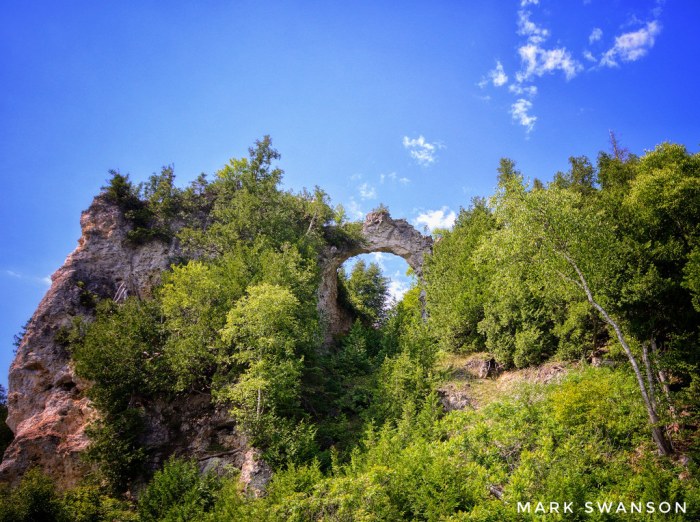
Arch Rock, Mackinac Island, photo by Mark Swanson

Here’s one of my favorite Michigan origin stories, the tale of Arch Rock, adapted from Dirk Gringhus’s wonderful book, The Lore of the Great Turtle. Head over to Mackinac State Historic Parks for more Mackinac area history!

This strange rock formation was looked upon with awe by the Indians as a bridge to another world after death where departed souls could find their last resting place in the island caves. There are many stories, or legends, to how Arch Rock was formed. This one tells about a mortal woman and her love for a sky spirit.

Along the beaches on the shores of Lake Huron lived a band of Ojibwa. Their lodges, or homes, were round topped and made of saplings and elm bark. The homes lay peacefully beneath forest boughs.

In the finest lodge, with its door blanket made of moose hide, lived the chief of the band and his beautiful daughter called She-who-walks-likethe-mist.

When She-who-walks-like-themist carried water from the lake in her clay vessel or worked the bright designs of dyed moose hair and porcupine quills into soft moccasins, the young braves watched with admiring eyes.

But Mist Woman paid little attention. Her work days were long without a mother to help her. She never complained. Her father was proud of this. Some day, he knew, she would marry a fine brave from another clan and have many children.

At first, when the young men began coming to their lodge bringing gifts, Mist Woman smiled and offered them wild rice she had gathered in the canoe.

Then, one day, all was changed. Suddenly the young men would find Mist Woman sitting with downcast eyes instead of welcoming smiles. As her father saw her growing more and more sad, paddling her canoe alone at night, he became angry.

“Why, my daughter, do you who once smiled on the strong young men who brought you gifts, now treat them with a cold heart? Are you under an evil spell?”, he asked. Mist Woman only shook her head.

“A daughter cannot always live in the house of her father. You must choose a husband soon or you will become old and wrinkled like Mez-he -say, the turkey,” he said.

Slowly the girl lifted her head. She saw anger in her father’s eyes. At last she spoke.

“It is true, my father, that I am under a spell. But not the spell placed by an evil spirit,” she spoke. “What then?” her father asked fiercely.

“Let me speak that you may know my heart,” she said. “Often when I go to gather the wild rice it is late. The star of the path of the dead is in the sky when I return.

“Two moons ago, as I paddled to the eastern shore of our village, a handsome brave appeared to me. His clothing was one of the whitest deerskin I have ever seen and covered with designs my fingers could have never made.

“But even more wonderful was his robe of shining light. I tried to paddle quickly homeward, as a daughter should, but my hands were helpless and my canoe drifted into the lake.

“It was then that he spoke to me. ‘Oh, lovely one,’ he said. ‘Long have I watched you in the village wishing that you might be mine for all time. In my home, high above you, I am the son of a chief, Evening Star, and therefore, a Sky Person. And so, I felt I could not speak to you of my love.’

“’Then, as I watched the young men coming to your ledge bearing gifts, my heart felt heavy and I became one without hope. It was then that my father came to my couch of bird feathers and I told him of your beauty. He understood and gave me leave to descend to earth that I might ask you to join me in my sky home.’”

“And what did you answer, my daughter?” her father asked.

“I said I would marry no one, but him,” she answered.

“Daughter! No! It is forbidden! You should marry no one at all then!” he shouted.

Holding her by the arms, he took her out of the lodge toward the lake shore. He placed her in the bow of his canoe. With mighty strokes he drove the canoe straight to the Island of the Turtle Spirits.

There, he took her to the top of the great rock, which towered above the beach. “Now,” said he, “you shall not see your love again. Here you shall stay until you decide to be a faithful daughter once more.” And he left.

Mist Woman made no answer. She did not cry out when the sun grew hot or the rain fell. Only her tears flowed down the rock to show her longing for the man.

Little by little, the tears began to melt the stone until at last an arch appeared beneath her and she was left on a high bridge of rock. That night, through the arch, appeared the rays of an evening star and down these rays walked the one she loved.

Gathering her into his arms, he carried her up the stars into the land of the Sky People. But the arch rock was formed and stayed to remind people of this story.

View Mark’s photo bigger and see more in his Mackinac, Michigan slideshow.

The River Grand

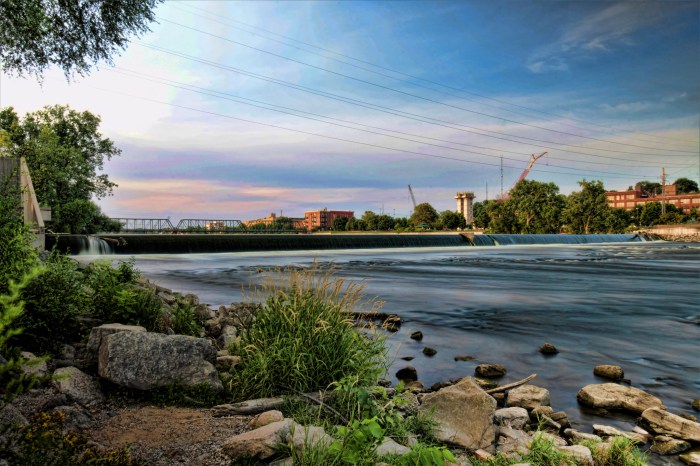
The River Grand, photo by John Rothwell

Wikipedia’s entry on the Grand River says in part:

The Grand River is the longest river in the U.S. state of Michigan. It runs 252 miles (406 km) through the cities of Jackson, Eaton Rapids, Lansing, Grand Ledge, Portland, Ionia, Lowell, Grand Rapids, and Grand Haven. Native Americans who lived along the river before the arrival of the French and British called the river O-wash-ta-nong, meaning Far-away-water, because of its length.

As the glacial ice receded from what is the central Lower Peninsula of Michigan around 11,000 years ago, the Maple River and lower Grand River served as a drainage channel for the meltwater. The channel ran east to west, emptying into proglacial Lake Chicago, the ancestor of Lake Michigan. Today the Grand River rises in Somerset Township in Hillsdale County and Liberty Township in Jackson County, and flows through Jackson, Ingham, Eaton, Clinton, Ionia, Kent, and Ottawa counties before emptying into Lake Michigan. Its watershed drains an area of 5,572 square miles (14,430 km2), including 18 counties and 158 townships. Tributaries of the river include (beginning near river source and travelling downstream): Portage River, Red Cedar River, Looking Glass River, Maple River, Bellamy Creek, Flat River, Thornapple River, Rogue River, Coldbrook Creek, Plaster Creek, Bass River, and Crockery Creek.

…Grand Rapids was built on the site of a mile long rapids on the Grand River, although these have disappeared after the installation of a run-of-river dam in 1866 and five low-rise dams during a river beautification project in 1927.

View the photo background bigtacular and see more in John’s slideshow.

More Michigan rivers on Michigan in Pictures.

Michigan’s Loon Boom

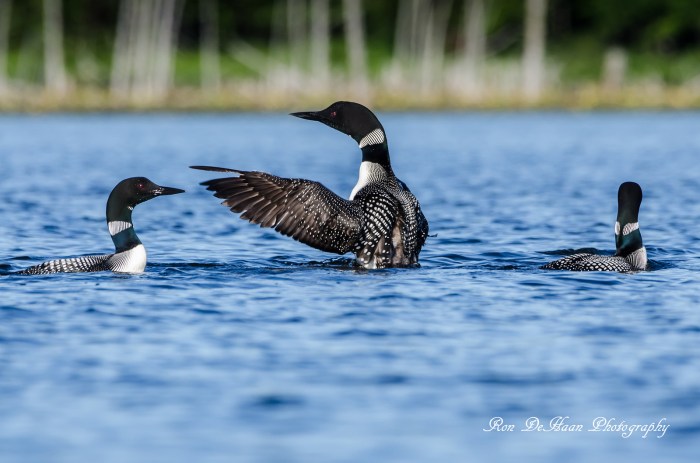
Common Loon, photo by Ron DeHaan

So I sez to this loon, I’m seeing more & more loons every year…

At least I imagine something to that effect in the conversation above. I’ve definitely been noticing more loons again this summer. While loons are far from out of the woods, this is a real success story for conservation efforts that you can read about from the Michigan Loon Preservation Association.

The Michigan Nature Guy (Donald Drife) wrote about the rebound of Michigan’s loon population, saying in part:

No other bird signifies the wilds of northern Michigan better than the Common Loon (Gavia immer). When I wake up while camping along the shore of a northern lake and feel its eerie cry, I am connected to a primitive time and the primitive land.

…Common Loons breed in Michigan north of Saginaw. Our current population is 500-775 nesting pairs. While this is up from the estimated 220 pairs in the early 1980s, there are still thousands of suitable lakes without a nesting pair. Loons are diving birds with their legs placed toward their tails. This gives them trouble walking on land. It is rare to see a loon on land except at its nest. Loons return in early spring and it is not uncommon to see them on a lake the day after its ice melts. How they know that the water is open remains a mystery. Nests are built near the waterline and often touch the water. Nests are little more than bare ground when the eggs are laid. Both parents incubate the eggs and add grass, sedges, reeds, and other vegetation to the nest.

View the photo from kayaking in Lake Dubonnet near Interlochen bigger, see more in Ron’s slideshow, and follow Ron DeHaan Photography on Facebook.