Flickr, the Dequindre Cut and reworking Michigan

Detroit Scribe Tribe Space Monkey

Detroit Scribe Tribe Space Monkey, photo by Detroit BikeBlog

At the risk of producing a vortex of self-referentiality, I wanted to link over to Mac at DetroitBike Blog, who is linking to Absolute Michigan, which is linking to his blog as the latest “Blog We Dig” (you see the danger). Here’s what he posted last Friday:

Flickr: One thing that’s cool about the Flickr photo site is its sense of community. Not only virtual communities but groups of people who find each other through Flickr, decide to meet-up, and then go out shooting photos together. If you’re reading this and aren’t on Flickr I’d recommend the Exposure Detroit and AbsMich groups as starting points. One of the latest get togethers the ExpDet group organized was a walk along the dequindre cut. Closed for 10 years this abandoned rail cutting has become a graffiti haven with some amazing work that has been posted here before. The ExpDet group took some great shots, well worth exploring.

Now this is where things get interesting. The old rail line (still a few abandoned rail cars along the route) runs from midtown beneath and between the street structure to the river. It’s now inhabited by a few folk who have built shacks and the graff community. But it could also serve as a great bike route between the river and midtown. Detroit has virtually no bike lanes and some of the things I’ve seen on Detroit streets make me wince (the guy with the 6ft plank stuck out of his trunk like a guillotine for example). While there are serious personal safety issues to be considered it’s good to see that work has begun into converting this route into a non-vehicle corridor through the city.

Check his links out and be sure to also view this slideshow of photos from Exposure.Detroit’s April 29, 2007 photo safari to the Dequindre Cut.

While you’re reading and looking, you might think about how $5/gallon gas will require us to rethink the layout of our cities and transportation … and also what fascinating cave paintings these “vandals” are producing in an abandoned space.

Memorial Day, near Charlotte, MI

Memorial Day, near Charlotte, MI

Memorial Day, near Charlotte, MI, photo by spaunsglo.


New Buffalo, Michigan

Sunset over Lake Michigan

Sunset over Lake Michigan, photo by briethe.

There’s not much doubt that as we head up Michigan’s west coast in our shoreline tour, we’ll see a lot of breakwalls and sunsets.

The New Buffalo Township’s excellent history tells us (among other things):

The city of New Buffalo came into being because of a violent October storm in 1834, when Captain Wessel D. Whittaker grounded his schooner Post Boy in the mouth of a small stream called State Creek near the present village of Grand Beach. The ship was destroyed, but Captain and crew survived the disaster and walked to Michigan City, where there were taverns that could provide food and shelter. There Whittaker hired a rig and headed north for St. Joseph to report the ship’s loss to its underwriters. On his way up the coast, he was struck by advantages and beauty of the spot where the Galien River passed through Lake Potawatomi into Lake Michigan. Lake Potowatomi, since drained by the sawmills, was, by varying accounts, two miles long, a half mile wide and up to ninety feet deep or four miles long by a mile wide and fourteen feet deep. It is now just “a lazy bend in the river.”

In addition to all kinds of visitor and business information, The New Buffalo Business Administration has a nice timeline of the history of New Buffalo and a cool old photos of the C&O Railroad Roundhouse that I would very much like to see larger. Maybe it can be found at the New Buffalo Railroad Museum. I also learned at NewBuffalo.com that the nation’s first Highway Travel Information center opened on May 4, 1935, on US-12 at New Buffalo. New Buffalo’s Wikipedia entry is on the lame side, and I would encourage any enterprising New Buffaloeans to spruce it up a little.

You can View a map of photos from New Buffalo and nearby, and explore more of our Michigan Shoreline tour pictures.

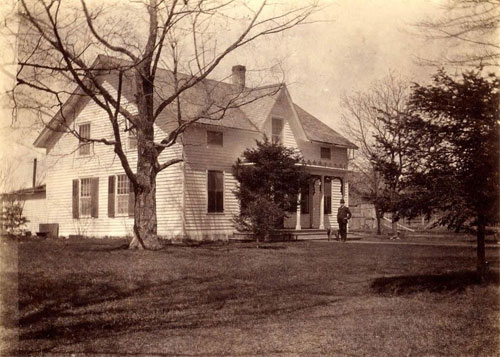
Rev. Peter Dougherty House on Old Mission having one heck of a yard sale

Reverend Peter Dougherty House, Old Mission Peninsula

The Dougherty House, Old Mission Peninsula Historical Society

Memorial Day Weekend is the start of many things in Michigan: summer, countdown till school is out, and the yard/garage sale season. On the Old Mission Peninsula just outside of Traverse City, there will be an amazing one at the house of one of the area’s first white settlers, Rev. Peter Dougherty. Once Upon a Time in Old Mission by Walter Johnson explains:

The earliest picture we have of Old Mission comes from the diaries and letters of Rev. Peter Dougherty, a missionary sent here by the Presbyterian Board of Missions in 1838. The Indians here and at settlements along the Lake Michigan shore were Ottawas. There were gardens on the Peninsula, maple trees scarred from sugaring, indicating centuries of human occupancy, and a village at Old Mission. They lived in permanent dwellings built of cedar poles and bark and also wigwams made of evergreen boughs. None of the dwellings had windows, and all of them allowed smoke to escape through a hole in the roof. Chief Ahgosa’s shanty was a little south of Prescott Lake.

According to the terms of the Treaty of 1836, the government was to provide the Indians with missions and schools and Indian reservations. The site of Mission Harbor was personally selected by Henry Schoolcraft between the present School Road and Swaney Road.

Having spent the winter on Mackinac Island, Mr. Dougherty arrived at Mission Harbor near the present Haserot Beach in May, 1839 in a Mackinaw boat. Arrangements were made for opening a school, and Mr. Dougherty’s house was finished before fall, built with logs cut near the border of the harbor and covered with shingles and boards brought from Mackinac. The house was on the shore directly east of the present larger Dougherty house. The second house was the first frame house built in Grand Traverse County, later owned by the Rushmores and used as an inn. In the fall of 1841 there was a schoolhouse and four dwellings. The schoolhouse was used for religious services until the mission house could be built.

Today and Saturday, The Peter Dougherty Society is holding an estate sale to benefit the restoration of the 1842 Dougherty House (article in the Traverse City Record-Eagle). Plans call for an archeological survey of the property, renovation of the house and to open it to the public with  exhibits and tours that will explain its place in the history of not only Grand Traverse, but also as part of the westward expansion of the country in the mid- nineteenth century. While the most historically significant artifacts are being saved for when the house is restored, it sounds as if there are thousands of artifacts spanning over 150 years.

If you’re in the area this weekend, you might want to check this out, and you can also read A Short History of the Dougherty House from the Old Mission Peninsula Historical Society.

Throwing heavy stuff at the Alma Highland Festival & Games

Caber Toss!

Caber Toss, photo by BearlyWorking

This photo is part of a set of 2006 Alma Highland Festival photos featuring kilt-clad competitors lifting and hurling heavy objects.

The Alma Highland Festival and Games take place May 26 & 27, 2007 on the campus of Alma College (2007 is the 40th annual). In addition to the Great Lakes Scottish Heavyweight Athletic Events, the festival includes piping, drumming and traditional Scottish fiddling and dancing competitions. There’s also games for children, the Parade of Tartans, and lessons and Scottish clan tents when you can learn about Scottish culture.

In addition to explaining the dance and band competitions, Wikipedia’s entry on the Highland Games lists the Heavy Events as stone put, Scottish hammer throw, weight throw, weight over the bar, sheaf toss and:

Caber toss: A long tapered pine pole or log is stood upright and hoisted by the competitor who balances it vertically holding the smaller end in his hands. Then the competitor runs forward attempting to toss it in such a way that it turns end over end with first, the upper (larger) end striking the ground and then the smaller end, originally held by the athlete, following through and in turn striking the ground in the 12 o’clock position measured relative to the direction of the run. If successful, the athlete is said to have turned the caber. Cabers vary greatly in length, weight, taper, and balance, all of which affect the degree of difficulty in making a successful toss. Competitors are judged on how closely their throws approximate the ideal 12 o’clock toss on an imaginary clock.

The Packard Proving Grounds in Shelby Township

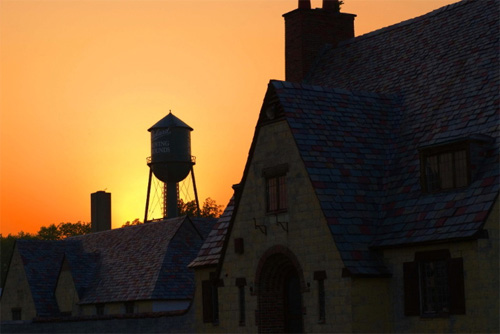
Packard Plant House

Packard Proving Grounds Lodge, photo by Sibylle Basel, Casting Shadow Photography

Sibylle says that photograph is a great art that washes away the dust of every day life. Click the photo above to see more of how she washes the dust away.

The Shelby Township Historical Committee is managing renovations at the Packard Proving Grounds and has some great information and old photos about the site including the text from the front and back of the Michigan Historical Marker:

Packard logoThe Packard Motor Car Company began building a proving ground on this site in 1926. Packard, like its competitors, had previously tested cars on city streets. Architect Albert Kahn designed the principal buildings. By 1929 the complex included the Gate Lodge, warehouses, laboratories, a high-speed test track, and twelve miles of roads simulating the worst conditions of the day. During World War II (1941-1945) Packard built aircraft and marine engines while leasing the grounds to Chrysler for tank testing. Packard ceased production in 1958, and the Ford Motor Company purchased the site in 1961. In 2000 Ford and the Packard Motor Car Foundation began working to preserve the design complex portion of the site.
(back) In 1899 brothers James Ward and William Doud Packard founded the Ohio Automobile Company in Warren, Ohio. In 1902 Detroiter Henry Joy and several other local investors purchased the company, moved it to Detroit and renamed it the Packard Motor Car Company. During the 1920s and 1930s, Packard set the standard for luxury and design. Under the direction of chief engineer Jesse G. Vincent, Packard, known as “America’s Master Motor Builder,” also made advances in aviation technology. Vincent contributed to the development of the Liberty aircraft engine during World War I and predicted the growth of commercial aviation. He considered a proving ground to be essential to high quality.

If you want to get an idea of the full layout, check this aerial photo. Also see Michigan Auto Racing – Packard Proving Grounds, Utica, Michigan at Water Winter Wonderland, Wikipedia’s Packard entry and the National Packard Museum in Warren, OH.

Twilight Wishes and Dandelion Clocks

Twilight Wishes

Twilight Wishes, photo by suesue2.

I saw this photo and my first thought was to wish for “more time”.

That led me to remember “dandelion clocks” which in turn led me (as many idle wonderings do) over to Wikipedia, specifically the page on dandelions. The entry says that the globe of seed-containing achenes are called the “dandelion clock,” and blowing it apart is a popular activity for children worldwide (cool macro of the dandelion clock).

I also found this gorgeous dandelion illustration from Elizabeth Blackwell’s flora Herbarium Blackwellianum… published in 1757.

An astute observer might well point out that were I not so prone to wondering and then wandering and then writing it all down, I might have more of that time I’m wishing for.

In my defense, I also found a link to dandelion folklore which quotes Alexander Chamberlain as saying “the dandelion is called the rustic oracle; its flowers always open about 5 A.M. and shut at 8 P.M., serving the shepherd for a clock.” I also learned:

“The dandelion is an excellent barometer, one of the commonest and most reliable. It is when the blooms have seeded and are in the fluffy, feathery condition that its weather prophet facilities come to the fore. In fine weather the ball extends to the full, but when rain approaches, it shuts like an umbrella. If the weather is inclined to be showery it keeps shut all the time, only opening when the danger from the wet is past.”
-Source: “Camping For Boys,” by H.W. Gibson

So there you go.

Celebrating 360 degrees of Michigan Week at the Dossin Great Lakes Museum

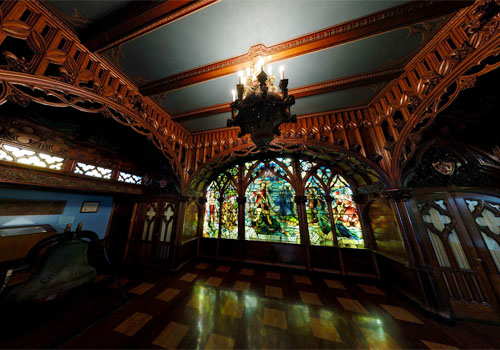
Gothic Room from the SS City of Detroit III

Gothic Room from the SS City of Detroit III, photo by Mark Houston

In celebration of Michigan Week (May 19 – 25, 2007), Mark Houston over at 360Michigan has posted new panoramas from four locations: the National Trout Memorial (downtown Kalkaska in front of the Kalkaska Historical Museum), the Michigan Fireman’s Memorial (near Roscommon), the Manistee River and the Dossin Great Lakes Museum (Belle Isle, Detroit).

All of these are available as full screen, 360˚ QuickTime VR panoramas and are well worth a look, but the ones of the Dossin Museum really showcase the power of the technology.

The 16,000 square foot Dossin Great Lakes Museum is located on Belle Isle in the Detroit River and is dedicated to showcasing the story of the Great Lakes and Detroit’s role in regional and national maritime history. Permanent exhibits at the museum include the Miss Pepsi hydroplane racing boat, the bow anchor of the Edmund Fitzgerald, the S.S. William Clay Ford Pilot House, the restored smoking lounge of the S.S. City of Detroit III and one of the largest known collection of scale model ships in the world.

Mark has also created a Google map showing the location of all his panoramas.

Michigan (Shoreline) in Pictures

You can see Chicago from 42 miles away! by by TRVentura

You can see Chicago from 42 miles away! by TRVentura

This summer, Absolute Michigan will be taking a tour of Michigan’s shoreline, looking at the heritage and attractions of the communities along Michigan’s Great Lakes shoreline.

Michigan in Pictures will be going along, trying to point out some of the beauty along the way.

We’d really like it if you’d help us by telling us what not to miss. If we do miss something – and with 3000+ miles of coastline, that’s pretty likely – then please feel welcome to post a comment or a link at the place where we missed it.

And if you want to climb in the car (or on the bike or in the kayak) and join the tour and let us know what you found, well that would be very cool too.

The above photo was taken at the beach in Michiana, Michigan (and Yahoo/Flickr geotagged photo map). I’m always a little surprised to find that you can’t see the state line from space.

Detroit’s Penobscot Building – leapable in a single bound?

...leap tall buildings in a single bound. by tEdGuY49

…leap tall buildings in a single bound by tEdGuY49

Narrator: Faster than a speeding bullet. More powerful than a locomotive. Able to leap tall buildings in a single bound… (more)

The plan was to do something on Detroit’s Penobscot Building next week or so … apparently Ted didn’t get the message. Ah well. It looks like May is Detroit Architecture Month on Michigan in Pictures.

To bring things full circle, here’s the intro to the 50s classic Adventures of Superman. Ted just let me know that the intro to Superman was voiced by Bill Kennedy of Bill Kennedy at the Movies fame (on CKLW and later WKBD). Also see this great Detroit News feature The Stars who turned Detroiters into couch potatoes.

Penobscot Building information now here.