The Shiawassee River

Shiawassee River

Shiawassee River, photo by naokomc.

Poked around the map of Michigan this morning, looking for a place I hadn’t been. That turned out to be the Shiawassee River. (Shiawassee River slideshow)

The very good (if staggeringly bright yellow) page on the Shiawassee River basin from Shiawassee History says:

The Shiawassee River Basin plays a major role in the mid-Michigan area. Its drainage area is approximately 1,200 square miles and portions of the river touch at least 7 counties.

The river is about 110 miles long and generally flows in a northerly direction, which is one of only two or three in the world. The Flint River, Cass River and Titabawassee River join the Shiawassee just southwest of the City of Saginaw and together form the Saginaw River which drains into the Saginaw Bay.

Shiawassee History also explains that Shiawassee may come from the Chippewa term for straight running river; Shiawassee (straight, or straight ahead) wassee. Then again, you can find other sources saying that the name means “river that twists about”.

The Nature Conservancy has a nice page on the Shiawassee River Watershed and the threats it faces from development pressures.

I’ll link to Wikipedia’s brief entry on the Shiawassee River because it had a link to Headwater Trails proposed Shiawassee River Water Heritage Trail (and in hopes that someone can go there and make the entry better).

Update (6/12/07): I just found the Saginaw Basin Land Conservancy who relate that the Saginaw Bay Watershed is the largest contiguous freshwater coastal wetlands system in the United States, featuring more than 175 inland lakes and about 7,000 miles of rivers and streams that are home to large populations of waterfowl, birds, snakes, turtles, amphibians, and more than 138 endangered or threatened species. They’re having a photo contest too – see the comments for details!

Little Foxes

Little Foxes

Little Foxes, photo by curlyson.

Red fox cubs exploring the world near their den.

The Michigan DNR’s red fox (Vulpes vulpes fulva) page says that a large fox (14 inches high) will weigh only 12-15 pounds and be able to easily pass through a four inch hole.

The Red fox pages at the UM Animal Diversity web are sleeping late this morning but doubtless have great info, photos and fox barks. Wikipedia’s red fox entry has a lot more about foxes and shows their range as covering most of the northern hemisphere.

Michigan Shoreline Tour: Grand Mere State Park (and a flying dog)

My dog can fly

My dog can fly, photo by J. Star.

J Star writes:

The boy, the dog and I went to Lake Michigan yesterday, planning to stay until tonight. The forecast called for clear skies and eighty degrees for today…last night at about midnight the storms started. By morning, the thunder was deafening, the tent was afloat in three inches of water, and hail was pounding down everywhere. Needless to say, we packed it in early and headed home.

We did have fun on the beach for about two hours yesterday. Steve seems to think it was worth the drive. You can tell by the sand being joyously flung everywhere, and by the huge gob of it he left stuck to my polarizer.

The DNR page on Grand Mere State Park near Stevensville says that the 985 acre park features magnificent sand dunes, deep blowouts, one mile of Lake Michigan shoreline and three inland lakes behind the dunes in the undeveloped natural area. Both the DNR page and Wikipedia entry for Grand Mere State Park are remarkably scant on information, leading me to believe that with a 1/2 mile hike to the beach, it’s a pretty good place to avoid the crowds. Here’s a Google map to Grand Mere State Park.

Been there? Done that? Tell us or show us what it was like in the comments!

Arch Rock, Mackinac Island Michigan

Arch Rock, Mackinac Island Michigan, c. 1899

Indians.org tells the story of the creation of Mackinac Island’s Arch Rock and says that even now the bravest of the Ottawa people will not walk over it. My favorite Michigan history book, Lore of the Great Turtle by Dirk Gringhuis, says that Arch Rock was the bridge over which departed souls could find their final resting place and also tells another story of its formation due to an angry father, the Sky Person Evening Star and the tears of She-who-walks-like-mist. (seriously, if you have an 8-12 year olf on your gift list, buy them this book)

Wikipedia’s Arch Rock entry takes a more scientific bent, saying that this 149′ limestone arch formed during the Nipissing post-glacial period, characterized by high Lake Huron levels following the end of the Wisconsin glaciation. Arch Rock is one of several limestone formations in Mackinac Island State Park.

I believe that the boat so perfectly posed in the arch is a “mackinaw boat” (photo).

The photo is from the Detroit Publishing Company collection (c. 1899) at the Library of Congress (LC-USZC2-6399 DLC). You can get a larger view at Flickr and a massive 47 MB TIFF at the Library of Congress.

Michigan Shoreline Tour: Warren Dunes State Park

Warren Dunes State Park

Warren Dunes State Park, photo by mizjellybean

Heading up the shoreline from New Buffalo, we come to the Warren Dunes State Park. I think that the first thing you need to do is check out this slideshow of the Warren Dunes. Go ahead, we’ll wait.

Wikipedia’s entry for Warren Dunes State Park is a 1,952 acre state park, located along the shore of Lake Michigan in Berrien County, Michigan (near Sawyer). The park’s dunes include Mt. Fuller, Pikes Peak, Mt. Edwards and (the tallest) Tower Hill which rises 250′ above Lake Michigan. Warren Dunes was designated as a state park in 1930 and draws around one million visitors annually. The page on the village of Sawyer from the Harbor Country Chamber of Commerce adds that although most in the area saw the land as worthless, businessman Edward K. Warren had a vision to preserve them and bought the land at the turn of the century.

Speaking of Wikipedia – something we seem to do fairly often – they have a massive page of map data and hacks for Warren Dunes including a Flickr map of photos from the Warren Dunes area and the Google map to Warren Dunes State Park.

I should add that the DNR page for Warren Dunes State Park notes that due to an infestation of the Emerald Ash Borer beetle, over 4,000 ash trees have been removed from the modern campground unit, dramatically changing the appearance of that campground.

Dairy King.

Dairy King.

Dairy King., photo by Arace.

Nothing really left to do but link to a map to Eva’s Dairy cafe of Lake Orion and say “yow!”

The Supremes at the Roostertail in Motown

The Supremes at the Roostertail in Detroit

The Supremes at the Roostertail, Detroit 1966, Archives of Michigan

Every month the Archives of Michigan post their Image of the Month. This month it’s the Supremes:

Where Did Our Love Go? (1964)As the most successful female singing group of all time, the Supremes are well known – not only for their music, but also their rise to stardom. Starting out in “the Projects” of Detroit, the group rose to become the most popular female group of the 1960’s. The recent film Dreamgirls, based loosely on their story, shows that Americans’ fascination with this successful African American singing trio has not waned.

The Supremes started as a quartet called “The Primettes” in 1959. After hearing the girls sing, the manager of the locally popular male group, “The Primes” (the future Temptations) decided to start a sister group. They were signed to Motown records in 1961. Soon after, the fourth member left the group, leaving the trio of Florence Ballard, Diana Ross, and Mary Wilson. In their negotiations with Berry Gordy, manager of Motown Records, they changed their name to “The Supremes.” Gordy decided to make Diana Ross the sole lead singer, a role the three had previously shared.

Read the rest of the article and see a larger photo of the Supremes at the Roostertail at the Archives of Michigan, explore The Supremes at Wikipedia, (and Billy’s Supremes web site),  check out the Roostertail’s history page and then turn up your speakers and click over to the Motown Historical Museum for more on the Supremes and other Motown greats.

And then – if you’re still looking for an “and then” – YouTube has The Supremes At Hollywood Palace “Stop In The Name Of Love”Baby Love on Top of the Pops and a whole lot more videos.

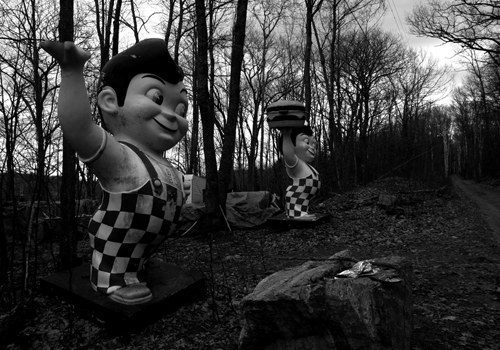
Big Boy Graveyard

Big Boy Graveyard

Big Boy Graveyard, photo by Charles Peace

I think that the only thing that is more disturbing than the knowledge that there is a Big Boy Graveyard to someone who grew up yelling “Big Boy! Big Boy!” every time we drove past one is the knowledge that there are (at least) TWO Big Boy graveyards in Michigan. (Detroit area Big Boy Graveyard from dETROITfUNK)

They never tell you about this when you’re in line at the buffet or evaluating which of the menu’s full-color desserts will most make you resemble the smiling icon of Big Boy Restaurants. Even Bob Wian who started Bob’s Big Boy in California in 1936 probably kept quiet about where the Big Boys go when they’re too old to huck hamburgers.

And Fred, Louis, and John Elias, the Elias Brothers who started their mainly Michigan-based Big Boy franchise in 1951? Well, the less said about where they wound up, the better.

Charles is a graduate of Lake Fenton High School (south of Flint) and just received his BFA in Photography from Northern Michigan University. You can check out his portfolio right here.

UPDATE: The Ultimate Upper Peninsula Blog has some photos from the mysterious Big Boy Graveyard.

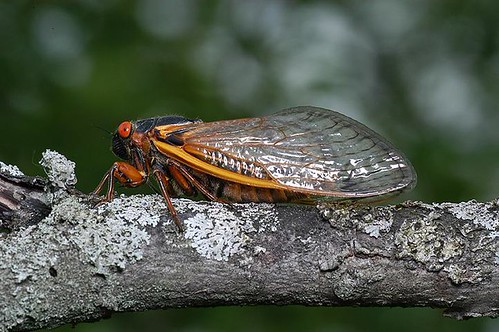
Brood XIII Cicadas in SW Michigan?

After 17 years?

After 17 years?, photo by mfophotos.

The Magicicada are the genus of the 13- and 17- year periodical cicadas of eastern North America who display a unique combination of long life cycles, periodicity, and mass emergences. They are classified according to “Brood” and 2007 is the year of Brood XIII, on a 17-year cycle and also known as the Northern Illinois Brood. Wikipedia’s Brood XIII page has a nice picture of the cicadas of this brood.

While Wikipedia and the U-M’s Museum of Zoology cicada page say that Brood XIII has a presence in southwest Michigan, retired University of Michigan entomologist and cicada expert Thomas Moore says (Freep article) that overeager graduate students and sloppy work by a 19th-Century government scientist and irresponsible replication are responsible for the erroneous perception that Brood XIII may make an appearance in Michigan.

Mark O’Brien comments that it’s unfortunate that Tom Moore was quoted as dismissing the work by former UMMZ graduate students John Cooley and David Marshall (who created the useful pages and did state that the maps are “approximate”). On his blog, Six-legged Wonders, Mark has a post about Brood XIII in Michigan where he says:

What needs to be done is to get modern records. Researchers tend to go to where previous records show emergences. So, if you know that Lake County, Illinois has 17-yr cicadas, that’s where you go if you have limited time to do experiments, etc. I don’t doubt that there may have been 17-yr cicadas at some point in SW Michigan — especially inland away from the sand dunes. However, the area has been heavily agriculturized over the past 100 years, and some areas have also gone back to woods. Have small pockets of Magicicada survived? The only way to know is to go and traverse the area and listen. Lacking that… if you live in that area of the state, tell me that you have them and show me the specimens. It would be nice to know, either way. The next emergence would be in 2024. I’m going to be an old man by then.

You can get a ton more information about the cicadas of Brood XIII (and others) including lots of photos and video and all your Brood XIII gear at Cicada Mania.

Summer 2007 … LAUNCHED!

The Launch! by starryeyez024

The Launch! by starryeyez024

Memorial Weekend is a time to honor the sacrifice of those who have fought for our country, but it’s also the beginning of summer. When I saw the photos of Kendall and her family having fun this weekend on a Michigan lake (Joslin Lake in Unadilla), I knew that this important facet of Memorial Weekend couldn’t pass unremarked.

It seems as if quite a number of people braved the dire forecast, took their lives in their hands and ventured out into the potentially chilly Michigan air. 360Michigan’s Mark Houston went to the Memorial Day Parade in Ferndale while Dave Hogg snapped some shots at Royal Oak’s Parade. David McGowan spent the weekend in the Manistee National Forest with some campfire cooked venison stew. Shqipo went to the St. Mary’s Polish Fair in Keego Harbor while Craig took in the Holland Farmer’s Market (and some tasty asparagus!). Joy took a pair of horses to the Empire Beach while Mario Q lamented that the Tigers just didn’t have the horses to pull off a victory vs. the Indians at Comerica.

I could go on and on, but since I’m starting to reach for transitions, I’ll ask you all to continue by posting links in the comments to any of your Michigan Memorial Day Weekend photos!