Barack Obama in Detroit – Labor Day 2008

Detroit Loves Obama

Detroit Loves Obama, photo by Maia C.

Maia writes that this is just part of the crowd gathered in Detroit’s Hart Plaza to show their support for Barack Obama on Labor Day, 2008.

The Detroit News has a great panorama by photographer Anne Savage and there’s a nice photo gallery on the Freep as well. There’s some video at the Freep and (when that gets removed) on YouTube from tdndavid. Nice to see Michigan get as little national face time looking sunny & fun!

You can see a lot more photos from Obama’s Labor Day visit to the Motor City on Flickr (slideshow).

Note: Not trying to be partisan here, just documenting a major Michigan story. As an aside, I’ve been looking all summer for pics from John McCain in Michigan – nothing has been shared with Absolute Michigan yet. So get out there, you McCainiacs and get clicking!

Sunset on the Two-Hearted River

Sunset on the Two-Hearted River

Sunset on the Two-Hearted River, photo by Vision Three Images – Michael Koole.

This photo is part of Michael’s Beach & Water Things and other sorta natural stuff set (slideshow). The Two-Hearted River was the setting for Hemingway’s short story, Big Two-Hearted River. An excerpt…

He stepped into the stream. It was a shock. His trousers clung tight to his legs. His shoes felt the gravel. The water was a rising cold shock.

Rushing, the current sucked against his legs. Where he stepped in, the water was over his knees. He waded with the current. The gravel slipped under his shoes. He looked down at the swirl of water below each leg and tipped up the bottle to get a grasshopper. The first grasshopper gave a jump in the neck of the bottle and went out into the water. He was sucked under in the whirl by Nick’s right leg and came to the surface a little way down stream. He floated rapidly, kicking. In a quick circle, breaking the smooth surface of the water, he disappeared. A trout had taken him.

Another hopper poked his face out of the bottle. His antennas wavered. He was getting his front legs out of the bottle to jump. Nick took him by the head and held him while he threaded the slim hook under his chin, down through his thorax and into the last segments of his abdomen. The grasshopper took hold of the hook with his front feet, spitting tobacco juice on it. Nick dropped him into the water.

Holding the rod in his right hand he let out line against the pull of the grasshopper in the current. He stripped off line from the reel with his left hand and let it run free. He could see the hopper in the little waves of the current. It went out of sight.

There was a tug on the line. Nick pulled against the taut line. It was his first strike. Holding the now living rod across the current, he hauled in the line with his left hand. The rod bent in jerks, the trout pulling against the current. Nick knew it was a small one. He lifted the rod straight up in the air. It bowed with the pull.

He saw the trout in the water jerking with his head and body against the shifting tangent of the line in the stream.

Nick took the line in his left hand and pulled the trout, thumping tiredly against the current, to the surface. His back was mottled the clear, water-over-gravel color, his side flashing in the sun. The rod under his right arm, Nick stooped, dipping his right hand into the current. He held the trout, never still, with his moist right hand, while he unhooked the barb from his mouth, then dropped him back into the stream.

He hung unsteadily in the current, then settled to the bottom beside a stone. Nick reached down his hand to touch him, his arm to the elbow under water. The trout was steady in the moving stream resting on the gravel, beside a stone. As Nick’s fingers touched him, touched his smooth, cool, underwater feeling, he was gone, gone in a shadow across the bottom of the stream.

Read the full story.

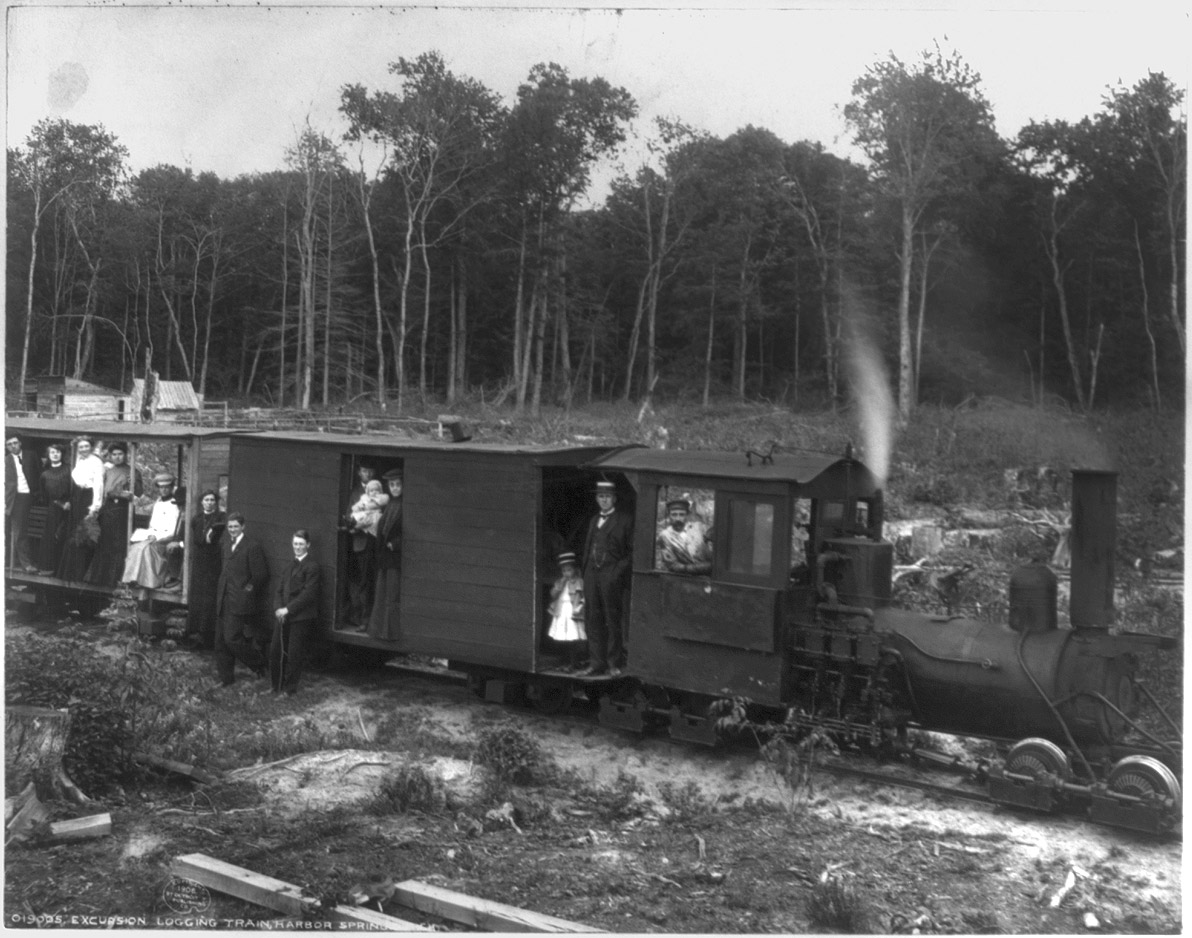
Michigan Logging Train Excursion

Excursion Logging Train, Harbor Springs, photo from Detroit Publishing Co., c1906 (at the Library of Congress)

I noticed that the Newaygo Logging Festival (Eventful link w/ map) happens this weekend. Several recent conversations and excursions of my own have driven home how profoundly the logging industry has shaped Michigan. Like miners, the timber trade roamed from river mouth to natural harbor up and down our Great Lake shoreline, into connected lakes and with the coming of the railroad, across the entire Lower & Upper Peninsulas.

At every stop, when the trees were gone, the land was left cleared and ready for villages and farms. Many of those working in the timber trade turned to farming and town building, and the names of the founders of these towns (and the owners of the dry goods stores) were often the names of the principals of the lumber companies.

Over Labor Day Weekend, I think it would be neat if Michigan were to somehow remember and honor the role of logging and loggers played in creating our state.

…and when it’s not such a lovely, last weekend of summer out there, be sure to check out some Michigan lumbering history and this really cool collection of Michigan logging photos from MichiganEpic.org.

Seriously, these logging photos are great!

Saving up your acorns

Acorns

Acorns, photo by StormchaserMike.

StormchaserMike says that he gathered these up because he heard that blue jays like them.

Hope everyone gets a chance to put away a few golden moments of summer before it slips away!

Michigan Lake Monsters, Sea Serpents & Serendipity

at Mackinac

at Mackinac :: a composite from -3 and -43 by Emery Co Photo

Last night I was looking for Creative Commons photos* with the appropriate license of the Mackinac Bridge so I could photoshop up a little something for Weird Wednesday: Michigan Sea Monsters (be sure to go back and read this!). I love it when the last Wednesday of the month rolls around as I get a chance to indulge my love of fooling with Photoshop. I was especially fired up as this month’s feature from Weird Michigan by Linda S. Godfrey because it was the feature that I had hoped to run last year as the debut of Weird Wednesdays on Absolute Michigan.

In my search, I saw this photo of the Bridge and thought “Now that looks cool & misty.” Then I came upon this photo of a rock and said “Sea serpent ahoy!” The coolest part was that both photos were taken by Emery Co Photo (emerycophoto.com). I contacted her and she graciously allowed me to use them.

Hope you all get some time on the water this weekend and that everyone remembers that on the list of things we should be worrying about, sea serpents in Michigan come in somewhere around #23,432,555. ;)

*That would be the Attribution-ShareAlike Creative Commons license. There are also a number of people in the Absolute Michigan pool who have told me that they are OK with me manipulating their photos for features on Absolute Michigan.

51st Annual Mackinac Bridge Walk

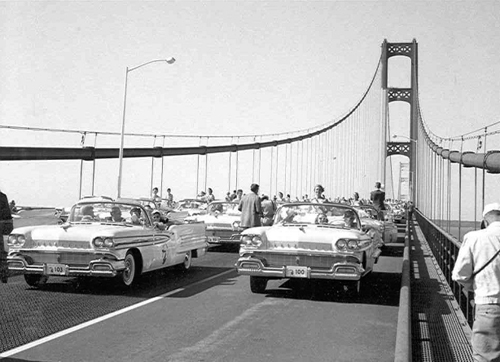
Mackinac Bridge Opening

While this year’s annual Labor Day walk across the Mackinac Bridge isn’t getting nearly the fanfare of last year’s 50th anniversary walk across the Mighty Mac, it’s still the one day each year that you can walk across Michigan’s engineering wonder.

The photo above is from the Opening Ceremony gallery at the Mackinac Bridge Authority web site where you can also find a Bridge Walk gallery and more information about the bridge. For a ton more photos and stories about the Mackinac Bridge, click the button below!

The Mackinac Bridge

a little closer … to hornets, yellowjackets & wasps

a little closer

a little closer, photo by gerrybuckel.

Gerry was watching these wasps at work and got a little closer to the nest to take this photo, but had to back off as they got closer too!

I thought Gerry was wrong to refer to these “bees” as wasps, but in digging a little deeper, I realized that I was the one in error.

Wikipedia has a lot to say about yellowjackets & hornets. One good thing to know is not to mess with a nest as wasps aren’t limited to a single sting!

Hornets, like many social wasps, can mobilize the entire nest to sting in defense: this is highly dangerous to humans. The hornet alarm pheromone is used to raise alarm of nest attack, and to identify prey, for example bees. It is not advisable to kill a hornet anywhere near a nest, as the distress signal can trigger the entire nest to attack. Materials that come in contact with pheromone, such as clothes, skin, dead prey or hornets, must be removed from the vicinity of the hornets nest. Perfumes, and other volatile chemicals can be falsely identified as pheromone by the hornets and trigger attack.

My bee guy told me that you can neutralize hornet & yellowjacket venom with “Shout” – I have no idea whether or not that is true!

I still can’t tell what particular breed these wasps are, but the most common breed in our region is now the German yellowjacket. The Yellowjacket & Hornets through a Lens at bugguide.net might hold the answer!

Michigan Orange

Untitled, photo by Blondieyooper.

Usually you have to wait a month or so to see orange like this in Michigan.

Be sure to check it out bigger. This one too!

In fact, if it’s raining where you are, why not settle back and wander through April’s Negaunee photos (slideshow).

Dream No. 2 and Holga Goodness

Dream No. 2

Dream No. 2, photo by rckrawczykjr.

Not sure what Dream No. 1 was, but I think it was this one.

This photo is part of Ralph’s Holga Goodness set (slideshow).

Mmmm, Holga Goodness.

Reaching

Untitled, photo by christopher.h.

This is part of Christopher’s dead pixels set (slideshow), which are for his photoblog, Dead Pixels.