Michigan grapes, ready for the harvest

Fenn Valley Winery-5

Fenn Valley Winery-5, photo by Mi Bob.

Bob took this photo of grapes awaiting harvest at Fenn Valley Winery in Fennville, Michigan. He’s uploaded it “background big” and has more luscious grape photos (slideshow).

Fall is a great time to visit Michigan’s wine country. Check out this slideshow of recent photos from vineyards in the Absolute Michigan group and learn much more about Michigan’s wineries and wine trails from Michigan Wines.

More fall wallpaper on Michigan in Pictures!

Autumn in Alberta, Michigan

DSC_6567

DSC_6567, photo by jsorbieus.

Jim took this photo in Alberta, Michigan, an unincorporated community in L’Anse Township of Baraga County:

The community was originally founded in 1936 after Henry Ford declared the banks of the Plumbago Creek to be an ideal spot for a sawmill. Ford named the town “Alberta” after the daughter of one of his top executives, Edward G. Kingsford.

At the time Ford established Alberta, wood was used extensively in automobiles. Mr. Ford envisioned the town as a model sawmill community; consisting of twelve houses, two schools, and a steam driven mill built to the most modern standards of the day. The Plumbago Creek was dammed to provide a reservoir to serve the town and mill’s water supply needs. The mill was a two-story white clapboard wood frame structure and still stands, now housing a portion of the Alberta Village Museum. The saw mill had a capacity of 14,000 board feet per day for hardwood and 20,000 board feet per day for softwood. This was a small capacity even by 1936 standards, with Mr. Ford’s other three mills in the Upper Peninsula of Michigan producing twenty to twenty-five times as much.

In 1954, Ford Motor Company donated the town of Alberta, Michigan and 1700 acres of land to what is now the School of Forest Resources and Environmental Science at Michigan Technological University.

Alberta buildings still standing on the property are used as a museum, support research and teaching programs for forestry and ecology majors, and are used by numerous universities from around the United States for forestry education.

Read more about The Ford Center from MTU.

Jim has a whole lot more big, background sized photos of fall’s glory in his U.P. set (slideshow). You can see more photos from the area on the Flickr map for Alberta.

More autumn wallpapery fresh in the Michigan in Picturesfall wallpaper collection!

Holding the sun

Holding the sun

Holding the sun, photo by krowla.

…for just a little bit longer.

Creating Cities in Michigan

Lansing, Detroit, Grand Rapids, Flint, Traverse City, Marquette and Kalamazoo are by no means all of Michigan’s cities (or even the largest). Each, however, seems to be an anchor for its region – a center to which people look to for culture, entertainment and commerce.

October 13-15, 2008, lovers of cities large & small from Michigan and all over the country will head to Detroit for the Creative Cities Summit 2.0 (CCS2), an exploration of what our cities could become and how we can work to make them. Organizers have chosen Detroit, a city so deeply forged in America’s industrial fires that it’s been devastated by the flickering of that flame. I’m headed down there and will try to bring some of the ideas back to you through Absolute Michigan – I hope that some of you can join me there.

The Photos (left to right)

Creative Cities Summit 2.0 in Detroit on Oct. 13-15, 2008

CCS2 will present a dynamic and engaging conversation about how communities around the world are integrating innovation, social entrepreneurship, sustainability, arts & culture and business to create vibrant economies. Full conference registration is $300 for the two and half day event, and there’s also a “no frills” registration that is only $100. There’s also a free “Unconference” at the Museum of Contemporary Art Detroit (MOCAD) on the 12th for designers, urban planners, civic leaders, entrepreneurs, artists, students, community leaders to explore and discuss what’s possible for Detroit.
Keynote speakers include:

  • Bill Strickland, MCG-Bidwell Corp.
  • Richard Florida, Author Who’s Your City
  • Charles Landry, Author The Art of City Making
  • John Howkins, Author The Creative Economy
  • Dean Kamen, Inventor, DEKA
  • Majora Carter, Sustainable South Bronx
  • Doug Farr, Architect and Author Sustainable Urbanism
  • Ben Hecht, Pres. & CEO Living Cities
  • Tom Wujec, Fellow, Autodesk
  • Carol Coletta, CEOs for Cities
  • Giorgio Di Cicco, Poet Laureate, City of Toronto and Author, The Municipal Mind
  • Diana Lind, Editor, Next American City magazine

Breakout sessions on topics such as:

  • Race and the Creative City
  • Cities, Universities & Talent
  • Marketing, Media and the Creative City
  • Measuring New Things – ROI in the Creative Economy
  • Creative (Small) Cities
  • New Ideas in Urban Amenities
  • Community Vitality: The Role of Artists, Gays, Lesbians & Immigrants
  • Midwest Mega-region: How the Midwest Can Compete
  • Transportation Innovation for Cities
  • Making the Scene: Music & Economic Development

Much (much) more at creativecitiessummit.com.

Marigold

Marigold

Marigold, photo by rckrawczykjr.

See bigger in Ralph’s Digital Goodness set (slideshow).

Haunted Houses, Corn Mazes & Spooky Attractions, oh my!

Haunted House Behind the Middle School

Haunted House Behind the Middle School, photo by country_boy_shane.

‘Tis now the very witching time of night,
When churchyards yawn and hell itself breathes out
Contagion to this world.
~William Shakespeare

Hold on, man. We don’t go anywhere with “scary,” “spooky,” “haunted,” or “forbidden” in the title.
~Shaggy from Scooby-Doo

Over on Absolute Michigan, our Fearsome Finder of Frights has compiled a list of haunted houses, corn mazes and scary attractions from all over Michigan that you can enjoy throughout the month and all across the state.

The photo is part of Shane’s Romeo (Michigan) set (slideshow) and he and the readers lay out the tale of what appears to be a haunted house in training. Check it out, if you dare…

Michigan’s Common Snapping Turtle

Female Snapping Turtle

Female Snapping Turtle, photo by MTU_Flickr.

Regular readers may recall TurtleGate ’08. Some of you may have even been consumed by worry that this terrapin tangle would go unresolved. Fear not, for thanks to a happy find while researching the Seney National Wildlife Refuge, I can finally put the michpics universe back on firm & factual footing.

MTU Flickr says that this little lady was looking for a good place to lay some eggs in the Seney Wildlife Refuge during sunset. It’s part of their excellent Nature Made set, a collection of photos “mostly set in the Upper Peninsula” that should probably be viewed as a slideshow.

The common snapping turtle (Chelydra serpentina) and probably (other than the elusive cougar), the Michigan animal you most want to be wary of. From the U of M Animal Diversity Web’s page on the common snapping turtle:

Snapping turtles are not social creatures. Social interactions are limited to aggressive interactions between individuals, usually males. Many individuals can be found within a small range; snapping turtle density is normally related to the amount of available food. Snapping turtles can be very vicious when removed from the water, but they become docile when placed back into the water. Snapping turtles sometimes bury themselves in mud with only their nostrils and eyes exposed. This burying behavior is used as a means of ambushing prey.

Snapping turtles will eat nearly anything that they can get their jaws around. They feed on carrion, invertebrates, fish, birds, small mammals, amphibians, and a surprisingly large amount of aquatic vegetation. Snapping turtles kill other turtles by decapitation. This behavior might be territoriality towards other turtles or a very inefficient feeding behavior.

You can read much more about these agressive amphibians from the link above and also the Michigan DNR and Wikipedia. Also check out this video of a common snapper attacking a camera to get an idea of how fast they can move if they want to!

You may want to go back and read the other post too as it now has information about the wood turtle in Michigan.

Waterspouts on the Great Lakes

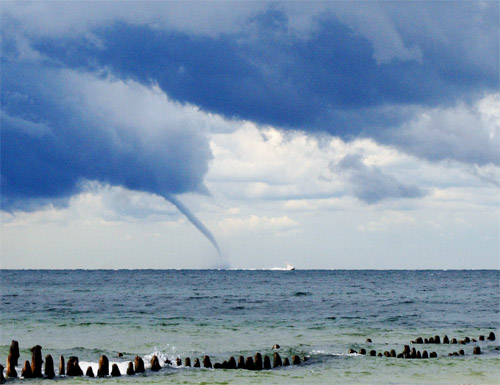
Waterspout from Oval Beach in Saugatuck, photo by Jim Thias

I’m not sure where exactly I should link to for Jim, so here’s his great pictures on railpictures.net.

The archived article on Waterspouts on Lake Michigan – where I found this photo – from NOAA’s National Weather Service Weather Forecast Office in Grand Rapids has a number of photos taken from Holland & Saugatuck on September 29, 2006. They explain that:

Waterspouts are somewhat common over the Great Lakes in the Fall season. Waterspouts in the fall occur when colder air above the surface moves over the still relatively warmer waters of Lake Michigan. Most waterspouts that occur in this type of scenario typically occur under plain showers and are much weaker than their summer counterparts. This fall type of waterspout is different from waterspouts associated with thunderstorms. They also form differently than waterspouts associated with thunderstorms.

The National Weather Service in Gaylord has a lot more about the science behind waterspout formation that includes a kicking photo of a group of spouts over Lake Huron in the fall of 1999. They say that boaters should take waterspouts seriously and seek immediate shelter when they are forecast. Waterspouts come in two types: tornadic and fair weather.

Tornadic waterspouts generally begin as true tornadoes over land in association with a thunderstorm, and then move out over the water. They can be large and are capable of considerable destruction. Fair weather waterspouts, on the other hand, form only over open water. They develop at the surface of the water and climb skyward in association with warm water temperatures and high humidity in the lowest several thousand feet of the atmosphere. They are usually small, relatively brief, and less dangerous. The fair weather variety of waterspout is much more common than the tornadic.

You can get a lot more great photos in a search for waterspout on the WOOD-TV blogs. I guess I can link over to this waterspout feature on Leelanau.com that includes my own photo of some waterspouts over the Manitou Islands.

Fall Color Tours: Marquette, Negaunee, Au Train

The Start of Autumn by Marjorie Obrien

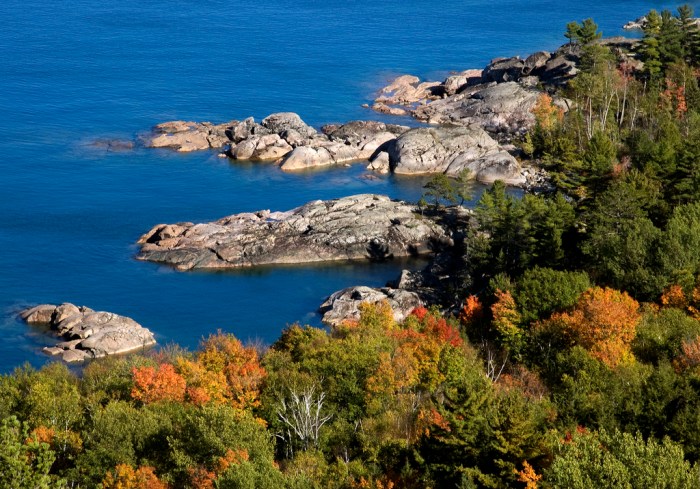
The start of Autumn, photo by I am Jacques Strappe

You can get 100+ more photos of the Upper Peninsula in autumn from Marjorie (slideshow).

Last fall through Absolute Michigan/Michigan in Pictures we started using the great information compiled in Travel Michigan’s Fall Color Tours as a starting point to point you to some great fall color touring (and fall color photos) around the state.  We’re trying to add to what they’ve put together – not rip them off! As always, if you have links to information or photos that we missed, comments or reports, post them in the comments below!

We’ll start with a driving tour of the Central Upper Peninsula that’s best from mid-September to early October and about 185 miles long. The tour starts in the UP’s largest city, Marquette. Marquette features some amazing architecture. You can read about and see pictures of it courtesy of Marjorie’s blog, Michigan Architecture, especially the beautiful red sandstone.

I recommend wandering around downtown for a while to check out the buildings and maybe grab a muffin from Babycakes and some coffee at Dead River Coffee. Travel Michigan (TM) recommends a visit the Marquette Harbor Lighthouse, home of the Marquette Maritime Museum. The lighthouse (pictured right by n. weaver, part of his UP slideshow) was constructed in 1866 and is the oldest significant structure in the city and more importantly, the lighthouse is one of the most historic navigation beacons on Lake Superior. There’s a nice little park behind it where you can swim if you are totally insensitive to temperature.

TM suggests that Presque Isle Park is also worth a visit and it is, offering a slow, brief jaunt along the rugged Superior shore and lots of nice little trails. It’s also a great bike ride along the shore on an excellent bike path from the lighthouse.
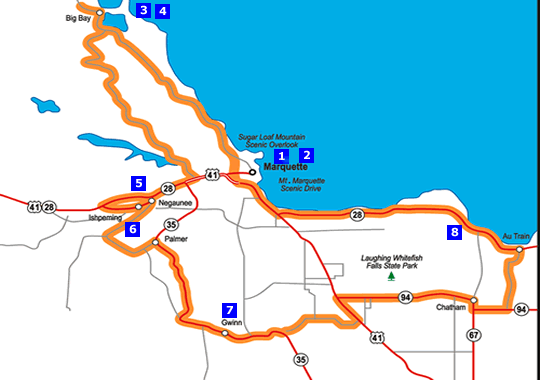
Now’s probably a good time for a map – click TM’s map to see larger. Heading north on County Road 550 to Big Bay takes you on a half hour cruise through some beautiful country rich in trees and views.  You can stop and do the 20 minute or so climb of Sugarloaf Mountain (see some pics from Lake Superior Photo). In Big Bay is the Thunder Bay Inn where you are required by travel writer code to mention  “Anatomy of a Murder” which was filmed there. Unfortunately the Thunder Bay Inn has been shuttered.  You can stop in at some of the other businesses and stay at the Big Bay Point Lighthouse Bed and Breakfast (if you call, they sometimes offer tours).

From Big Bay, head back on County Road 510 through the Huron Mountains and trees that arch over the roadway to form a tunnel of color. At US-41 head right and south into Negaunee (Chippewa word for pioneer) where you can visit the Michigan Iron Industry Museum, site of the first iron forge in the Lake Superior region. Negaunee’s Union Station Depot looks like a neat place to stay.  From Negaunee, continue to Ishpeming, home of the U.S. National Ski & Snowboarding Hall of Fame and the Cliff’s Shaft Mine Museum.

The route takes you down County Road 476 to Palmer and from there on M-35 south to Gwinn. You can enjoy hiking and mountain biking at Anderson Lake West State Forest Campground or continue south on M-35 to Little Lake where you take County Road 456 east to US-41. A left US-41 takes you north to M-94 where you turn right on M-94 to Chatham and can ask “Honey – are you sure we’re not lost?” 3 miles north off M-94 at Sundell are the about 100′ high Laughing Whitefish Falls (photo right by Church of One).

From there it’s east until you reach H-03 located between Chatham and Forest Lake, north on H-03 along the AuTrain River and past AuTrain Lake until you reach the junction of M-28. You can go east 12 miles along the Lake Superior shoreline on 28 to Tyoga Pathway or go west back to Marquette.

Check out more Michigan Fall Color Tours on Michigan in Pictures and also our fall wallpaper collection!

Seney National Wildlife Refuge

Seney, MI

Seney, MI, photo by lilrhgerl.

lilrhgerl took this Holga photo – do yourself a favor and check out her Holga slideshow. She writes that Seney is the most amazing place, and anyone who has spent time there would probably agree.

The Seney National Wildlife Refuge encompasses nearly 100,000 acres in the central Upper Peninsula. Seney was established in 1935 for the protection and production of migratory birds and other wildlife. It supports a variety of wildlife including a profusion of birds: bald eagles, common loons, trumpeter swans, Canada geese, hooded mergansers, mallards, black ducks, ring-necked ducks, wood ducks and sandhill cranes. Animals include black bear, white-tailed deer, coyote, river otter and beaver. There’s also black flies, deer flies, and mosquitoes during warmer months.

The wetlands, which are also known as the Great Manistique Swamp provide a great haven for all these animals and birds have their roots when:

…Over a century ago, lumbering operations altered the landscape of the Upper Peninsula’s great forests. The ring of the lumberman’s axe echoed through the forests as local mills depleted the region’s valuable supply of red and white pine. After the pine forests were cut, mill owners turned their axes and saws to the Refuge’s northern hardwood and swamp conifer communities.Following the lumbering operations, fires were often set to clear away the debris. These fires burned deep into the rich organic soil, damaging its quality and killing the seeds that would have produced a new forest. On many areas of the Refuge, the scars from these lumbering operations remain visible to this day.

After the fires, a land development company dug many miles of drainage ditches throughout Seney. This drained acreage was then sold using extravagant promises of agricultural productivity. But the new owners quickly learned that these promises were unfounded. One by one, the farms were abandoned, and the exploited lands reverted to state ownership.

In 1934, the Michigan Conservation Department recommended to the Federal Government that the Seney area be developed for wildlife. This proposal was accepted and Seney National Wildlife Refuge was established in 1935.

Check out Seney National Wildlife Refuge on the Absolute Michigan map and click for the Seney slideshow from the Absolute Michigan pool!