Lansing Winter, 1935

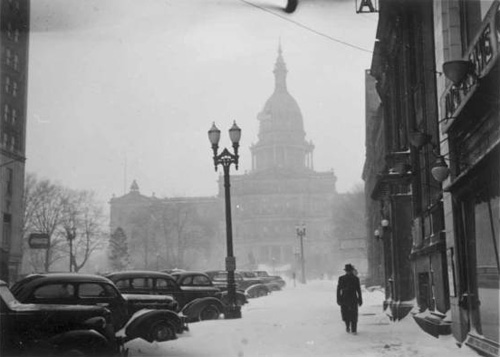
Lansing (Mich.) , photo courtesy Seeking Michigan

I saw this photo of a winter’s day in Lansing in the mid 1930s when I found the photo of the Soo last week. The old cars and the chill wind made me think about how folks in Michigan were probably feeling at the time. This was the depths of the Great Depression, when the Civilian Conservation Corps sought to engage young men in meaningful work, when the UAW was founded and the workers in Flint held their famous sit-down strike – a period of wrenching change for Michigan and the nation.

Probably no time until the present day featured so many people whose way of life had vanished, leaving so much in the way of challenge and so little hope in front of them.

Still, from those dark days Michigan climbed to previously unthinkable heights, led by entrepreneurs, bold leaders and a citizenry that was willing to work hard to realize their dreams.

I hope that gives you the same measure of hope that it gives me.

You can see this photo bigger if you click through and choose “Printable Version”.

Happy Holidays, Michigan

Untitled, photo by caterpillars

Hope you’re warm, dry and with the ones you love, whatever holiday you are or are not celebrating.

See this bigger in Laura’s slideshow.

A pocket full of sunshine

A pocket full of sunshine
A pocket full of sunshine, photo by cae3 – Anita

The other day Anita wrote:

It is freezing cold here in Michigan, and I was going through my summer archives and found this one. Ah…how I really miss summer right about now.

However much I love winter, I feel the same way some days. Hope you’re staying warm & sunny. See this bigger in her slideshow.

Night Moves: Homeless in Michigan

Night Moves

Night Moves, photo by SGallagh.

At this time of year, the thought of all the people without homes weighs heavily on me. The Michigan Coalition Against Homelessness is a nonprofit association of emergency shelters, transitional housing programs, nonprofit housing and service programs, government programs and concerned citizens from across the state. Visit their web site for information about organizations & events across Michigan where your money or time can make a huge difference.

While reading some of the articles on their web site, I found it surprising that families make up more than half the homeless in Michigan. 77% of families are homeless due to a lack of affordable housing, and one out of every 3 homeless persons is a child. Here’s a Michigan Radio series on homeless teens in Michigan and a Free Press feature on first-time homelessness in MIchigan that I think are worth your time.

Check out this photo from Bay City bigger or in Sean’s Street set (slideshow).

Speaking of streets, Sean is the photo of the day editor for a cool new site for Saginaw/Bay City/Midland and beyond called 360 Main Street.

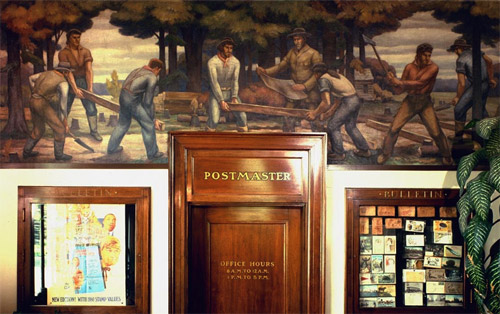
WPA Art in Michigan: Blissfield Post Office

Blissfield, Michigan Post Office, photo © Dirk Bakker

The latest feature from the Michigan Radio Picture Project is WPA Art in Michigan, featuring the photography of Dirk Bakker, who photographed over over fifty Michigan WPA projects for a book from Wayne State University Press (that was actually never published):

Among the bold experimental programs that President Franklin Delano Roosevelt enlisted to aid the profoundly depressed U.S. economy of the early 1930s were “public works” programs to aggressively move people back to work. There was the Civilian Conservation Corp that put young unemployed men to work planting trees to reforest America. The Civilian Works Administration put people to work building or rebuilding the infrastructure of the country by teaching, or by building roads, bridges and dams.

George Biddel, a classmate of Roosevelt’s from Harvard and an artist himself, suggested that FDR follow Mexico’s lead and employ artists to paint murals on government buildings. Roosevelt was convinced and in 1933 founded the “Public Works of Art Project,” funded by the Civilian Works Administration. It was succeeded by numerous other federally aided projects that, in addition to the visual arts, funded theater, music and writing projects.

One of the most productive as well as controversial programs was the Treasury Section of Fine Arts, which selected artists by jury and commissioned them to paint murals in U.S. Post Offices. The State of Michigan was the beneficiary of more than fifty Section post office “murals,” as well as numerous other institutional painting and sculpture commissions.

The Michigan Radio Picture Project is a new site from Michigan Radio that aims to be a forum for photographs that address Michigan people, places, events, and issues. They hope to develop a broad mixture of photo essays to expand on stories from Michigan Radio and to go deeper into Michigan historical photographs, fine art photography and pictures from various archives and collections. Have an idea? Pitch their website coordinators Eric Smith, Doug Aikenhead, and Tamar Charney at michiganradiopictureproject@umich.edu.

You can also check out a cool WPA-themed poster contest over on Absolute Michigan!

Michigan farming and other success stories

Leelanau County Farmland

Leelanau County Farmland, photo by kuku4manitou.

The Center for Michigan has a feature on the growth of Michigan agriculture in recent years. It’s the latest in their series of Michigan success stories and like the other stories in the series, it makes for inspiring reading in these days when all we seem to hear is what’s broken in Michigan.

Check this out bigger and check out more photos from Joe’s June flight over Leelanau County.

Here’s many more Michigan farms from the Absolute Michigan pool.

Blue Reflections: Comerica Tower loses Comerica

Blue reflections

Blue reflections, photo by eYe_image.

Crain’s Detroit reports that Comerica Inc. will move its remaining Detroit employees out of Comerica Tower at 500 Woodward and renovate a building it owns on Lafayette Avenue. The move follows Comerica’s moving of its HQ to Dallas and will leave the building 70% vacant. It does allow some enterprising entity to put their name on the 2nd tallest building in Michigan.

Wikipedia’s Comerica Tower entry says that:

The building was designed by noted architects John Burgee & Philip Johnson, partners influential in postmodern architecture. One Detroit Center was constructed from 1991 to 1993. To form a stylistic link to the past, it was designed in a historicist fashion, with Flemish-inspired spires.

…The building is famous for its postmodern architectural design topped with neo-gothic spires. It uses a large amount of granite. Sometimes called a “twin gothic structure”, for its pairs of spires, it is oriented North-South and East-West (as named on a plaque along the Windsor waterfront park). One Detroit Center won the Award of Excellence for its design in 1996.

A twin tower dubbed Two Detroit Center was proposed to be built directly east of the tower when the One Detroit Center was proposed, but a soft office market killed the plans, and Two Detroit Center was put on hold, indefinitely.

The photo shows the Renaissance Center (GM headquarters and Michigan’s tallest skyscraper) with Comerica Tower reflected. Be sure to check it out bigger and in Larry’s Abstract Architecture set (slideshow).

You might also enjoy the Comerica Tower slideshow from the Absolute Michigan pool.

Schrunchsicle

Schrunchsicle

Schrunchsicle, photo by The ClayTaurus.

Check this out bigger and in Chris’s Other’s Favorites set (slideshow).

Here’s the icicle slideshow from the Absolute Michigan pool.

The William Peter Mansion in Columbiaville

William Peter Mansion
William Peter Mansion, photo by Sentrawoods

The latest in our series of Mansions Where You Can Spend the Night features the William Peter Mansion. The William Peter Mansion Bed & Breakfast site says that:

William Peter came to Columbiaville in the mid 1800’s as a German immigrant working for the lumber industry. Though he was young and spoke little English, he was a man who worked hard, saved big, and took advantage of the opportunities that came his way.

In 1852 he married a girl by the name of Roxannea Clute. Just 17 at the time her father strongly disapproved of the union due to Peter’s citizenship. Having no other choice the couple decided to elope. They worked hard over the years and built much of the town we know as Columbiaville. With business interests in the town of Toledo the couple decided to move. It was there that they bore and raised two children, Harriet and Alvin.

In 1892 the Peter’s decided to move back to Columbiaville and the Mansion was begun. The materials used in the Mansion’s construction came from Peter’s own lumber yards. Peter’s hired craftsmen and artists from all over to finish the woods and paint the walls and ceilings with gorgeous designs, birds, and flowers. The sixteen room Mansion took four years to complete.

The Mansion possesses a unique architectural style featuring the cubic form of the Italiante which was popular during that time. The main hall and entrance feature a rich paneled oak on the walls with a beautiful parquet floor made from hard oak. Mr. Peter was an expert on timber and enjoyed surrounding himself with its fine specimens.

You can see it bigger and check out the historic marker from Sentrawoods.

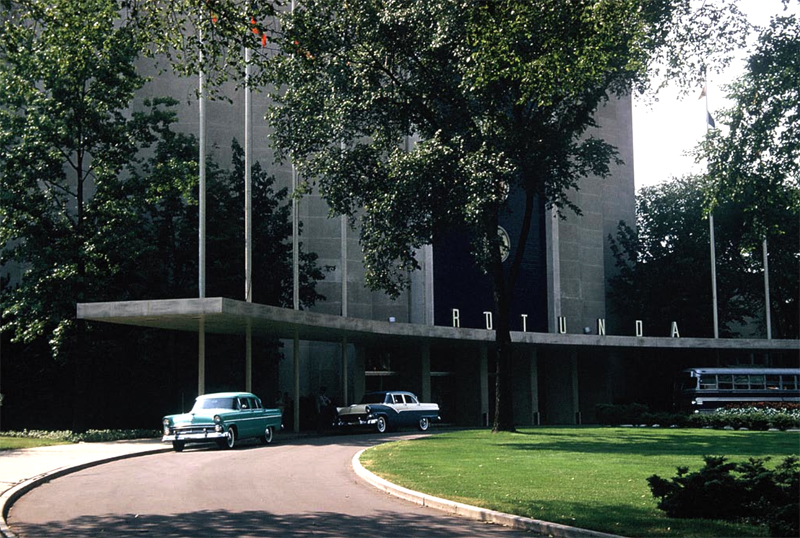
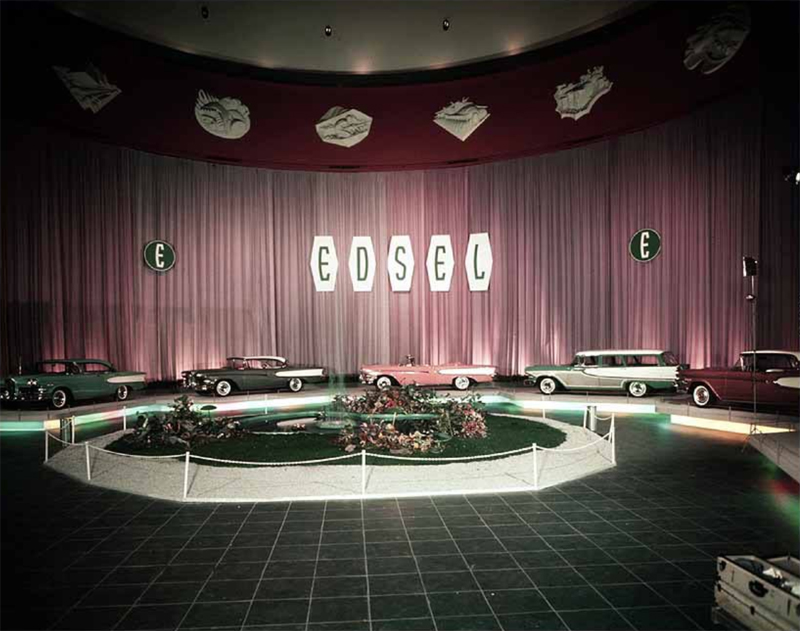
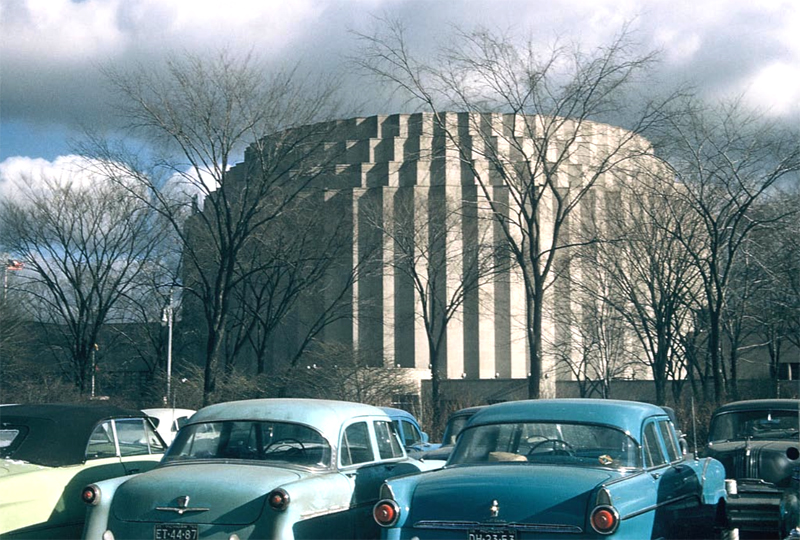
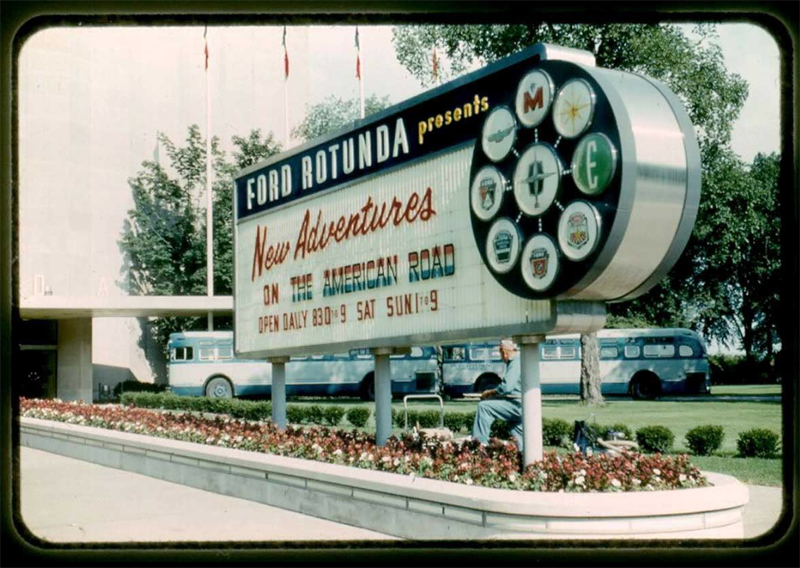
The Ford Rotunda

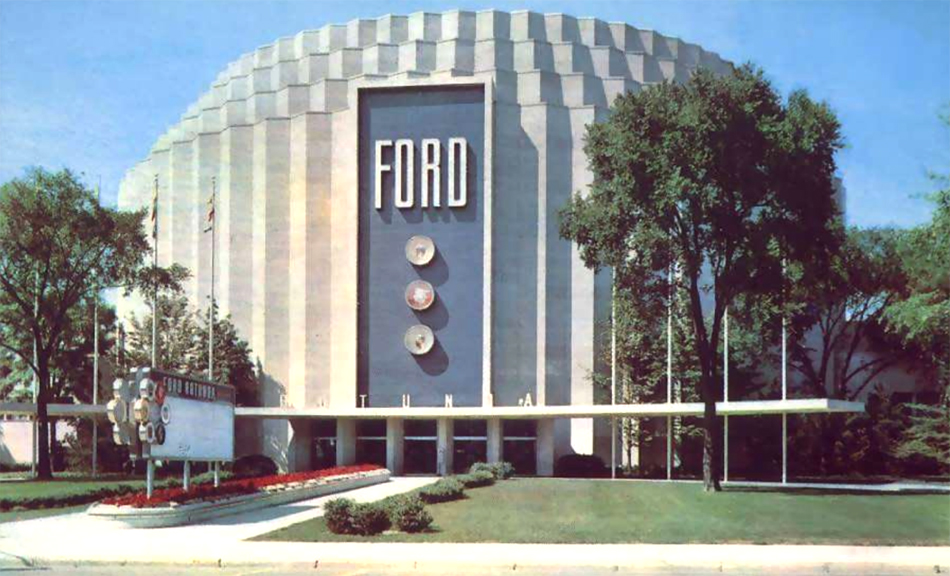
The Ford Rotunda – Dearborn, Michigan, photographer unknown

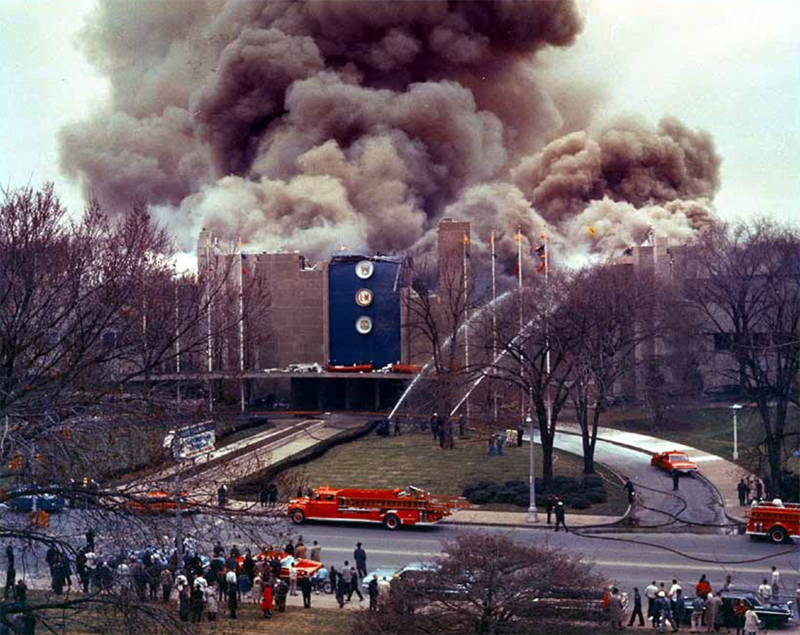
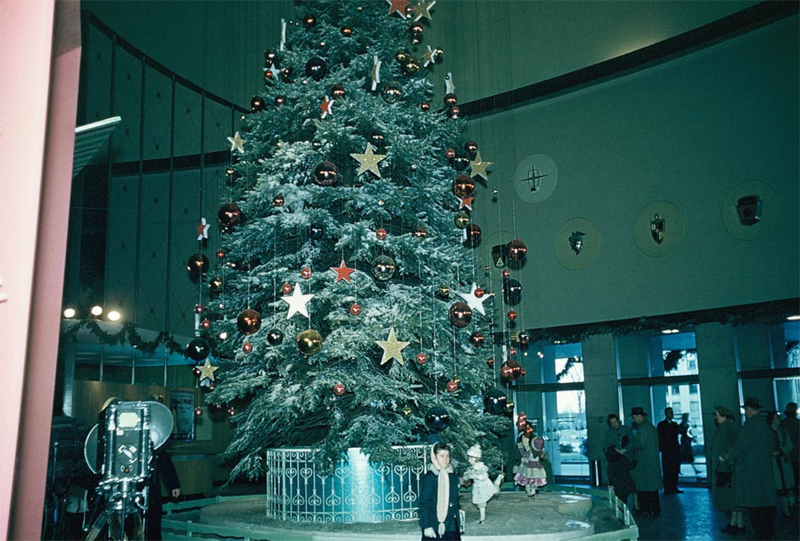
Michigan in Pictures regular Matt passed an email about the Ford Rotunda along that had some cool pictures I thought folks would like to see. When flames consumed a Christmas fantasy from the Detroit News Rearview Mirror begins:

From 1936 to 1962, the gear-shaped Ford Rotunda attracted visitors from around the world. It was the fifth most popular tourist destination in the United States in the 1950s.

The building had its roots in the 1933 Chicago World’s Fair, known as the Century of Progress Exposition, which opened in May of 1933 and attracted more than 40 million visitors over its two-year run. One of the major attractions at the fair was Ford Motor Company’s Rotunda, which was disassembled after the fair and brought back to Dearborn, where it was reconstructed using more permanent materials. Designed to be the showcase of the auto industry, the Ford Rotunda was opened to the public on May 14, 1936.

…In 1960, the Rotunda ranked behind only Niagara Falls, the Great Smoky Mountains National Park, The Smithsonian Institution and the Lincoln Memorial as a national tourist destination. It was more popular than Yellowstone, Mount Vernon, the Washington Monument and the Statue of Liberty.

Read on for the sad tale of how it burned to the ground on November 9, 1962.

Television History – The First 75 Years might be the photographer – there’s some of the same shots there and they write about their parents taking them to see Santa during the Christmas Season at the Rotunda. They also have a nice aerial of how the Ford Rotunda was located in relation to the Rouge Plant.