The People of Detroit: Journaturalist

The People of Detroit: Journaturalist

The People of Detroit: Journaturalist, photo by Noah Stephens.

I briefly mentioned Noah Stephens’ project, The People of Detroit, a few weeks ago. If you haven’t checked it out yet, you need too – it’s one of the best blogs in Michigan right now. He says that his ongoing photo essay series is dedicated to the motor city’s residents. It’s not meant to be positive or negative, simply to examine the people who played in serrated crabgrass and never got cut. (too badly, at least).

About this photo he writes:

jour·nat·u·ra·list (jur-nāch’ər-ə-lĭst), noun

1. A portmanteau word formed from “journal” and “naturalist” commonly used to describe a young woman who grew up in South America, lives in Detroit, works as a journalist and has a strong affinity for nature (exemplified by the ability and willingness to milk goats and weed urban gardens with a machete).

see also: Minehaha Forman.

Check out his whole People of Detroit set on Flickr or view the slideshow.

Twirl

Twirl
Twirl, photo by Rudy Malmquist

Hope your weekend is bright and beautiful!

Check Rudy’s photo out bigger and in his slideshow.

Orange Hibiscus

Orange Hibiscus

Orange Hibiscus, photo by designsbykari.

Check this out in all its oversized orange glory and see more in Kari’s Michigan set (slideshow).

Hope your weekend is this bright and beautiful!

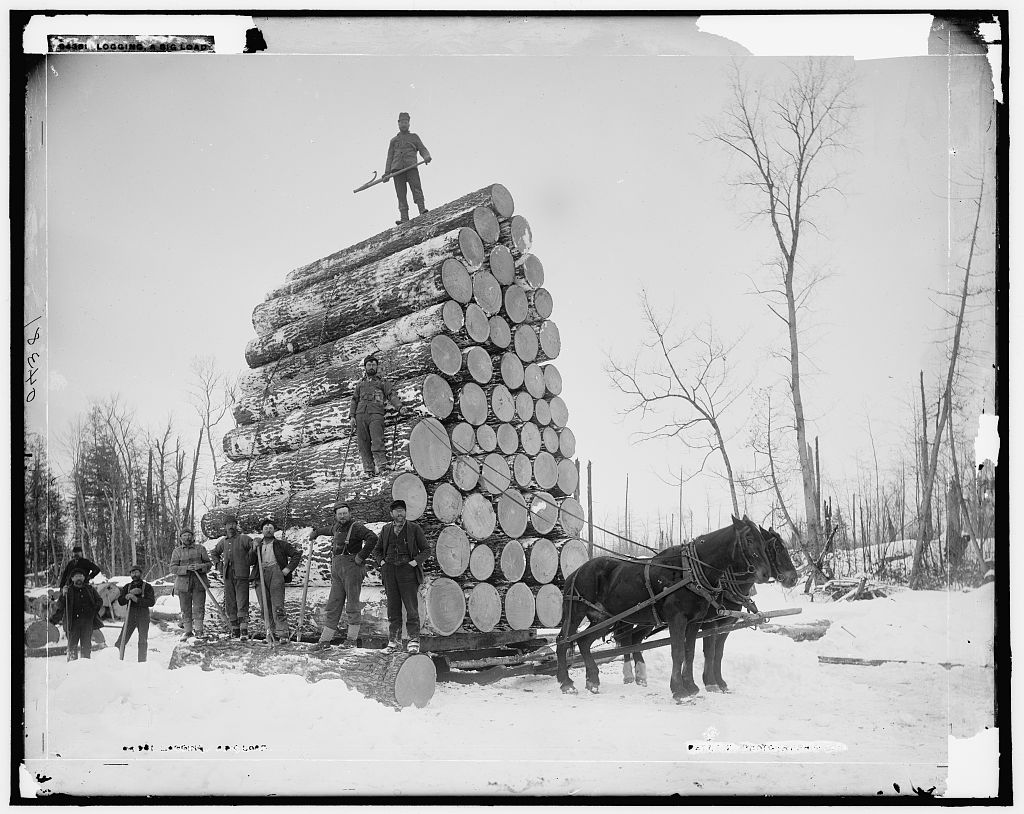
Logging Michigan’s White Pines


Logging a big load, photo courtesy Library of Congress/Detroit Publishing Co

The above photo was taken somewhere in Michigan in the late 1800s. Click to view it bigger.

Once upon a time, much of the state of Michigan was covered by a vast, white pine forest.  If you want to get a taste of what old growth pines were like, and also a very cool logging camp, consider a trip to Hartwick Pines.

Seeking Michigan has a great feature about Life in a Logging Camp that includes some cool photos. It begins:

Michigan’s Lumber Boom

In the 1840s, Eastern states were beginning to exhaust their timber resources, and information about Michigan pine began to spread. Lumbermen began flocking to the Great Lakes State. According to George S. May’s revised edition of Willis Dunbar’s Michigan: A History of the Wolverine State, Michigan’s lumber boom peaked around 1880. Dunbar and May also note that lower peninsula forests were “virtually all cutover” by 1900 and that Upper Peninsula lumber production began to decline a few years after that. Conservation techniques and selective cutting increased productivity later in the twentieth century. By then, however, the “hey day” of the lumber industry was unquestionably over.

The Nature of a Logging Camp

For much of its history, logging was a winter activity. In winter, logs could be easily transported to river banks via bob sleds (or, in later years, by railroad.). In spring, when the ice melted, logs were floated down the river to saw mills. Log marks (the logging equivalent of “cattle brands”) determined ownership. Due to the seasonal nature of the business, logging camps tended to be temporary.

In “Michigan’s White Pine Era, 1840-1900” (Michigan History vol. 43, December 1959), Rolland H. Maybee describes a typical Michigan lumber camp, circa 1875-1900. Many camps of this era accommodated sixty to one hundred men. Typically, there would be five or six main buildings, all made of logs. A bunkhouse, a cookshanty, a barn, a blacksmith shop, and a camp office and store would be among the buildings. The camp office and store typically included living quarters for the foreman and log scaler.

Read on at Seeking Michigan!

Summer’s here – hope you get a chance to dive in!

Untitled, photo by racheldubbs.

Rachel took this with the awesomely awesome Supersampler camera, hailed the “Queen of all Multi-Lensed Cameras”:

One look at the quirky-looking Supersampler and you know that it’s a camera like no other! This ultra-lightweight, low-maintenance 35mm camera fits perfectly in your hand for spontaneous shooting! Aim the Supersampler at your moving (or non-moving) subject, pull the ripcord, press the tiny button – and voila! You have just “sampled” your subject into four panoramic panels. So how on earth is this possible?! See those four beady eyes nestled in front of its plastic body? Those are the ultra-talented, super-sharp lenses that slice your image into four panels. Results are wickedly cool if your subject is in hyperactive motion, or if you prefer to shoot non-moving objects, you’ll have to do the jumping and moving!

Check it out background bigalicious and don’t miss her supersampler slideshow.

Need more? You’re in luck! Michigan in Pictures has more supersampleration!

The Dime Building in Detroit

Inside the Dime Building Dime Building
Inside the Dime Building and Dime Building, photos by Adore707

Detroit 1701’s page on The Dime Building relates how Daniel Hudson Burnham found fame as a city planner and was influential in the founding of the City Beautiful Movement. His architectural firm, Root and Burnham, designed the 20-story Masonic Temple Building in Chicago in 1893, one of the nation’s first skyscrapers, and they were tapped by Dime Bank:

The Dime Bank wanted an appropriate building for their facilities. The first floor was to serve as a banking floor where patrons would make their deposits and withdrawals. The higher levels in this 23-story building provided the many offices the bank needed for business, undoubtedly growing as the vehicle industry boomed in Detroit. Burnham designed the attractive lobby that you see with its skylight and numerous decorations. Electric elevators for tall buildings were first successfully installed in the 1890s, so they were still a new invention when Burnham designed this Dime Building…

Air conditioning was unavailable in 1910 and electric lights were, apparently, less efficient than the ones we have today. This motivated Burnham to incorporate a design that provided a window for ventilation and light in every office. You will notice the light well as soon as you enter the lobby of the Dime Building. This one faces Griswold and clearly illustrates this typical feature of Burnham’s Chicago style skyscrapers. Just to the east on Griswold, you will see the Ford Building that Burnham designed for its 1909 opening. In that one, Burnham’s light well is invisible from Griswold.

The Dime Building has its own web site and there’s a little more about the Dime Building on Wikipedia. You can see an old photo of the Dime Building from Wikipedia and another of the Dime from the early 20th Century at Shorpy.

See these other other photos bigger in his Detroit MI slideshow.

Boat Night and a boatload of Michigan July Events!

Boat Night
Boat Night, photo by Jon DeBoer

“Deep summer is when laziness finds respectability.”
~Sam Keen

Every month, we feature some of the coolest events in Michigan on Absolute Michigan. Our July Michigan Event Calendar features big events you probably know like the Ann Arbor Summer Festival, Common Ground in Lansing and Blissfest in Cross Village and some less well-known ones including Jackson’s Michigan Shakespeare Festival and the Michigan Elvisfest in Ypsilanti. Head over for all these and many more!

One event we didn’t have was Boat Night in Port Huron. It’s held every year on Black River in Port Huron on the Friday night before the Port Huron to Mackinac sailing race. The race is Saturday, July 17th, making Boat Night Friday the 16th.

Check this out bigger in Port Huron, MI + surrounding areas slideshow and get out and enjoy some Michigan July!

How about a little independence for Independence Day?

elevator watching

elevator watching, photo by gsgeorge.

Geoff writes: Renaissance Center elevator, holding at the 72nd floor for fireworks spectators. They passed out 3D glasses for whatever reason. Maybe the future was so bright it needed to be in 3D? See this bigger in his Detroit slideshow and also check out the Independence Day slideshow from the Absolute Michigan pool.

Wikipedia says that Independence Day alias Fourth of July alias The Glorious Fourth alias The Fourth is a federal holiday commemorating the adoption of the Declaration of Independence on July 4, 1776. Of the signing of the Declaration, John Adams wrote to Abigail:

I am apt to believe that it will be celebrated by succeeding generations as the great anniversary festival. It ought to be commemorated as the day of deliverance, by solemn acts of devotion to God Almighty. It ought to be solemnized with pomp and parade, with shows, games, sports, guns, bells, bonfires, and illuminations, from one end of this continent to the other, from this time forward forever more.

Thomas Jefferson, served with Adams on the Committee of Five that drafted the Declaration of Independence and observed that a groups of people from great nations to town councils will always have disagreements. He nonetheless spent much of his life serving the cause of creating an enduring nation. He made a point that I think could serve governments who are locked in petty disagreements while our country and citizenry face serious threats at home and abroad, economically and environmentally that require action immediately:

Do you want to know who you are? Don’t ask. Act! Action will delineate and define you.

Hope you all get out and have fun, and if you have a chance to talk to an elected official at a parade, let them know what you’re looking for. And whether you have that chance or not, take some time to work to make the world become what you think it should.

Red river fireworks

Red river fireworks

Red river fireworks, photo by JohnnyRR.

John says this was shot from the Liberty Bridge in Bay City. You can see a great video titled Fireworks Melee that he took from there as well!

Hope you have a safe and happy 4th of July!

Roadside Ramblings in the Michigan Radio Picture Project

towers
towers, photo by mfophotos

This “castle” in Owosso was actually a place used for entertainment and a writing studio for James Oliver Curwood. Now owned by the city of Owosso, it overlooks the Shiawassee River. Curwood made a living as a writer of wilderness adventure stories, some of which became screenplays for early movies. The castle was constructed to resemble a French chateau. August, 2009.

The above picture is one of many in the latest photo essay at the Michigan Radio Picture Project: Roadside Ramblings, the photography of Mark F. O’Brien. Mark is a regular on Michigan in Pictures (as is his daughter Marjorie) and shoots with all kinds of cameras. He writes:

Michigan is a state criss-crossed with highways. As the home state for the auto industry, the roads have played an important part in connecting communities, bringing in tourism, as well as being the main thoroughfare for commerce. Exploring Michigan’s roads, whether the major highways or the gravel backroads, has become one of my photographic pursuits. I often shoot with a “toy camera” — simply a plastic camera with a cheap plastic lens, limited exposure control, and infinite possibilities for photography. While I use all kinds of really nice cameras, it’s the Holgas, Dianas, and thrift-shop wonders that produce many of my most memorable and endearing photographs.

A full tank of gas, some maps, and a few cameras inevitably leads to a long day traversing some part of the state. If one is curious enough, just traveling all of the roads in a single county can take a long time to complete. Driving around and letting serendipity take its course is one way of learning about my state, as well as coming back with some photographs that sometimes offer a surreal aspect of what’s off the side of the road.

Click through to see the photos and I hope you get to do some roadside rambling of your own this weekend or soon!

Be sure to check this out bigger and also his whole Michigan Roadsides set (slideshow).