Deer Camp … and beer

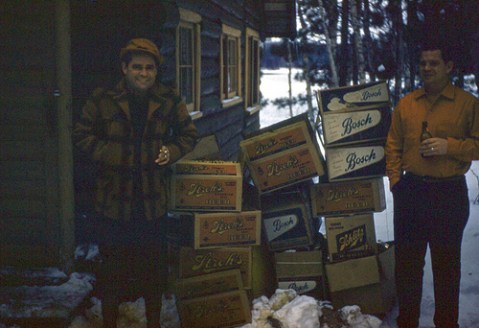
Empty Beer Boxes
Empty Beer Boxes, photo by U.S. Highway 12

Today is the opening day of deer season, and around much of Michigan businesses, schools and streets will be empty as people head to the woods in search of whitetail deer. Deer season, however, is about more than just filling the freezer with venison: it’s about deer camp. And deer camp, as Ronnie writes (and this photo show), is often about beer:

We all know that when men work hard, we tend to develop a mighty thirst. Just ask anyone who loves to go deer hunting, and they will tell you that just thinking about the next day’s hunt, can make your mouth feel dryer than a Georgia cotton plantation, during a scorching heat wave with a 10 year drought already in place. Therefore, its imperative that one must procure plenty of liquid refreshment to prevent dehydration during these primeval events. Such was always the case whenever my Uncle Bob went deer hunting in Michigan’s Upper Peninsula.

Everyone who went hunting with my uncle, chipped in on a beer fund to help offset the total costs. More often than not, someone would have to drive into the nearest town and buy even more by mid-week. Nevertheless, check out these vintage beer boxes from Bosch, Schlitz, and Stroh’s. The former of the three has a very interesting story. You can read more about the colorful and interesting history of the Bosch Brewing Company, once located in Michigan’s Keewenaw Peninsula until its demise in 1973.

The photo was shot Little Shag Lake near Gwen Lake, outside of Negaunee, Michigan on November 15, 1956 and you can see it (and others) bigger in Ronnie’s slideshow.

About Lake Huron … and a double rainbow

double rainbow

double rainbow, photo by Morganshev.

Wikipedia’s entry for Lake Huron says that Lac Huron was named by early French explorers after the Huron people inhabiting the region. Lake Huron is the second largest of the Great Lakes and the third largest fresh water lake on earth with a surface area of 23,010 sq mi, a volume of 850 cubic miles and a shoreline length of 3,827 mi.

The Great Lakes Information Network page on Lake Huron pegs it as the 5th largest lake in the world and adds:

  • It has the longest shoreline of the Great Lakes, counting the shorelines of its 30,000 islands.
  • It contains Manitoulin Island, largest freshwater island in the world.
  • Georgian Bay and Saginaw Bay are the two largest bays on the Great Lakes.
  • Huron was the first of the Great Lakes to be discovered by European explorers. Since its French discoverers knew nothing as yet of the other lakes, they called it La Mer Douce, the sweet or fresh-water sea. A Sanson map in 1656 refers to the lake as Karegnondi, simply meaning “lake” in the Petan Indian language.

I found a cool site by the Lake Huron Lore Marine Society that has a great page on early steamships and sailing vessels on the Lake. Check it out!

See this out bigger in Morgan’s slideshow or see it in the Lake Huron Rolls Group slideshow!

Hope you find that pot of gold today and check out more at absolutemichigan.com/Lake Huron and explore Lake Huron on Michigan in Pictures.

Michigan’s Tallest: The Renaissance Center in Detroit

renaissance center detroit

renaissance center detroit, photo by Detroitmi97.

The list of the tallest buildings in Michigan says that the title of tallest building in Michigan belongs to the Renaissance Center at 77 stories and 722 feet tall. It also has the distinction of being the tallest all-hotel skyscraper in the Western Hemisphere.

The RenCen is owned by General Motors and Wikipedia says that the Ren Cen was conceived as a catalyst for Detroit’s economy by Henery Ford II and investors, and that it generated in excess of $1 billion in economic growth for downtown Detroit in its first year of operation.

John Portman was the principal architect for the original design. The first phase constructed a five tower rosette rising from a common base. Four 39-story office towers surround the 73-story hotel rising from a square-shaped podium which includes a shopping center, restaurants, brokerage firms, banks, a four-screen movie theatre, private clubs.The first phase officially opened in March 1977. Portman’s design renewed attention to city architecture, constructing the world’s tallest hotel at the time. Two additional 21-story office towers (known as Tower 500 and Tower 600) opened in 1981. This type of complex has been termed a city within a city.

…The architects’ initial design for the Renaissance Center focused on creating secure interior spaces, while its design later expanded and improved to connect with the exterior spaces and waterfront through a reconfigured interior, open glass entryways, and a Wintergarden.

While it might be a little over-photographed, it’s an amazing space for photographers to explore, inside and out.

Mark says he can see the whole world from here – can you? Check it out background boomtacular and see some other shots from high up in the RenCen in his detroit top slideshow.

More Renaissance Center and don’t miss the RenCen slideshow from the Absolute Michigan pool!

More of Michigan’s tallest on Michigan in Pictures.

Veterans Day

Veteran's Day 2009

Veteran’s Day 2009, photo by Andy_Tanguay.

When our perils are past, shall our gratitude sleep?
~George Canning

Today and this weekend there will be ceremonies and parades honoring those who have fallen in defense of our nation. Here’s a listing of Michigan Veteran’s Day events and our Veterans Day post on Absolute Michigan has some great interview with Michigan veterans.

See it bigger in Andy’s slideshow.

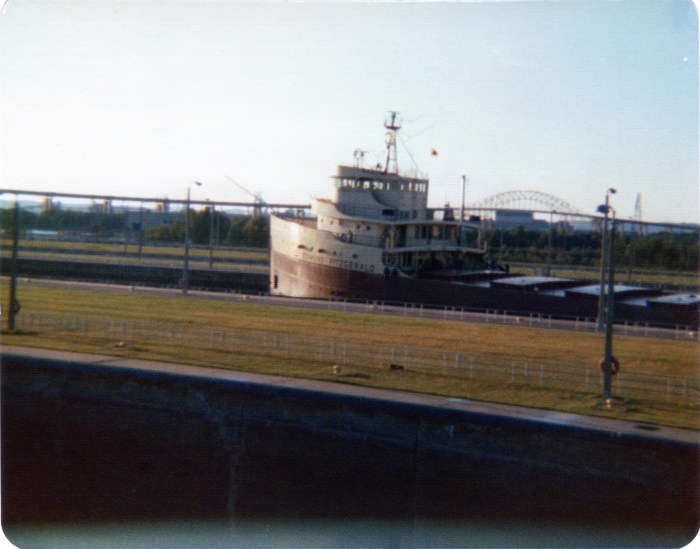
The Edmund Fitzgerald in the Soo Locks

Never before published photo of the Edmund Fitzgerald, taken only months before it was lost with all hands in Lake Superior. Remember, you saw if first on Flickr! My father-in-law took this shot. He told my wife that he wasn't taking a picture of the Big Fitz; he just wanted a photo of the locks, and this happened to be in the photo. Unfortunately, the negative is long gone and this photo was printed on some sort of rough-coated matte paper so that it could be mailed as a postcard. My father-in-law didn't realize until months after the sinking that he had a picture of this vessel. The photo was taken in August 1975; the Edmund Fitgerald sank in November of that year. It was, ironically, the sinking that made this ship famous. After it was built it was the largest ship on the Great Lakes, but other than that, it was just another anonymous working vessel plying the waters between Wisconsin and Michigan.

The Edmund Fitzgerald in the Soo Locks, photo by bill.d.

Through Gordon Lightfoot’s song, the Edmund Fitzgerald has become an icon for the power of the Great Lakes. Nowhere can you see it better than Joseph Fulton’s video of The Wreck of the Edmund Fitzgerald, a fantastic piece of film-making that you need to see if you haven’t already.

What I suspect that a lot of people forget (because I know I do) is that the S.S. Edmund Fitzgerald was just one of many ships plying the Great Lakes. About the photo above, Bill writes:

My father-in-law took this shot. He told my wife that he wasn’t taking a picture of the Big Fitz; he just wanted a photo of the locks, and this happened to be in the photo. Unfortunately, the negative is long gone and this photo was printed on some sort of rough-coated matte paper so that it could be mailed as a postcard.

My father-in-law didn’t realize until months after the sinking that he had a picture of this vessel.

The photo was taken in August 1975; the Edmund Fitzgerald sank November 10th of that year. It was, ironically, the sinking that made this ship famous. After it was built in 1958, until 1971, it was the largest ship on the Great Lakes, but other than that, it was just another anonymous working vessel plying the waters between Wisconsin and Michigan.

Check it out background big and see the back of the postcard. Visit the links below for more about the SS Edmund Fitzgerald:

More shipwrecks on Absolute Michigan and Michigan in Pictures.

Taconite

Taconite

Taconite, photo by PhotoYoop.

In some new pics of the Edmund Fitzgerald on the floor of Lake Superior that someone sent my way yesterday you can see some of the taconite that was its last cargo. According to SSEdmundFitzgerald.com, the Fitz was carrying about 26,116 long tons of National Taconite Pellets to Zug Island in Detroit in her 860,950-cubic-foot cargo hold.

Wikipedia’s entry on Taconite says that taconite is an iron-bearing sedimentary rock in which the iron minerals are interlayered with quartz, chert, or carbonate.

The term was coined by Minnesota State Geologist Newton Horace Winchell during his pioneering investigations of the Precambrian Biwabik Iron Formation of northeastern Minnesota due to its superficial resemblance to iron-bearing rocks he was familiar with in the Taconic Mountains of New York. The iron content of taconite, commonly present as finely dispersed magnetite, is generally 25 to 30%. In the late 19th and early 20th centuries, available iron ore was of such high quality that taconite was considered an uneconomic waste product. After World War II, much of the high grade iron ore in the United States had been mined, and taconite became a new source of iron.

Check this out bigger in Cory’s Random slideshow.

Fury: The White Hurricane of 1913

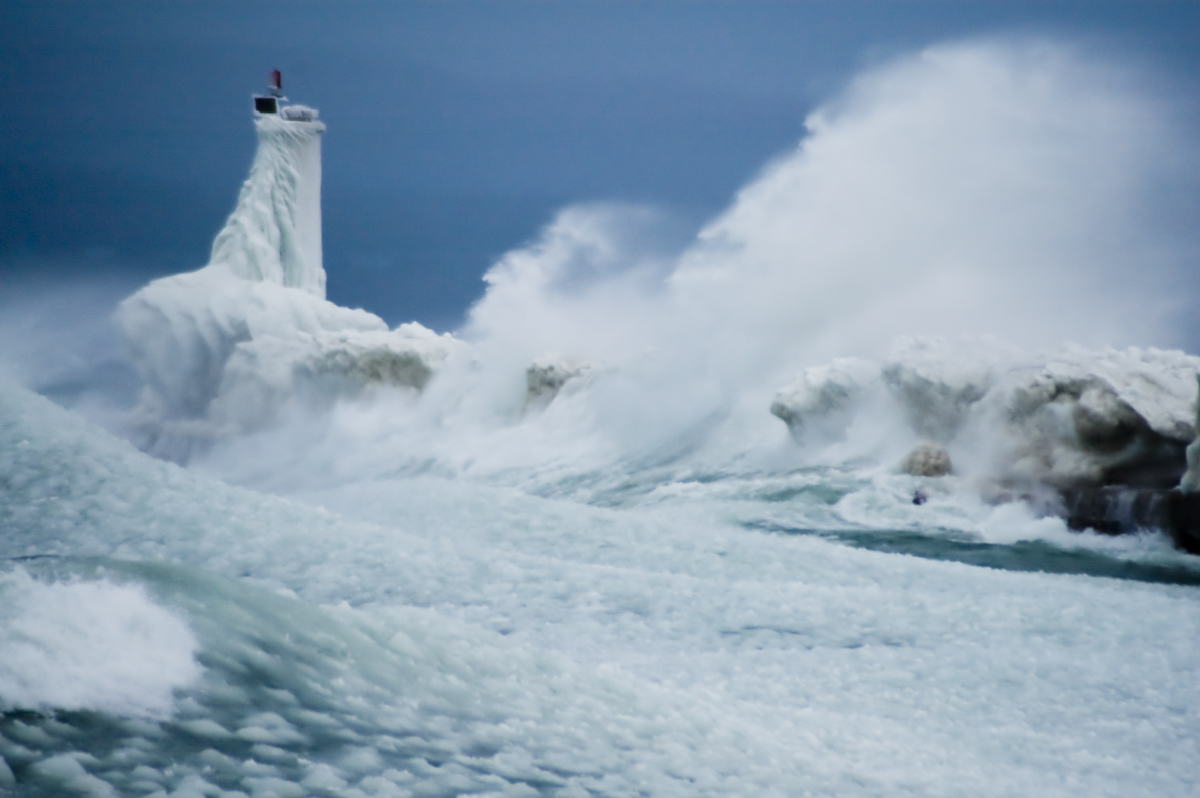
Furious Lake Michigan

Furious Lake Michigan Petoskey, photo by Odalaigh.

“No lake master can recall in all his experience a storm of such unprecedented violence with such rapid changes in the direction of the wind and its gusts of such fearful speed! Storms ordinarily of that velocity do not last over four or five hours, but this storm raged for sixteen hours continuously at an average velocity of sixty miles per hour, with frequent spurts of seventy and over.

Obviously, with a wind of such long duration, the seas that were made were such that the lakes are not ordinarily acquainted with. The testimony of masters is that the waves were at least 35 feet high and followed each other in quick succession, three waves ordinarily coming one right after the other.

~Report from the Lake Carriers Association in the wake of the Great Lakes “White Hurricane”

97 years ago the Great Lakes region reeled under the deadliest storm in its history. Known as the “Big Blow” and the “Freshwater Fury”, was a blizzard with hurricane-force winds that devastated the Great Lakes Basin in the Midwestern United States and the Canadian province of Ontario from November 7 through November 10, 1913. Read on for more!

Check this out bigger and in Charles’ Petoskey Storm Photos slideshow. He also has video of this storm.

Freshwater Fury: The Great Storm of 1913

Dear wife and Children. We were left up here in Lake Michigan by McKinnon, captain James H. Martin tug, at anchor. He went away and never said goodbye or anything to us. Lost one man yesterday. We have been out in storm forty hours. Goodbye dear ones, I might see you in Heaven. Pray for me. / Chris K. / P.S. I felt so bad I had another man write for me. Goodbye forever.

~A message found in a bottle 11 days after Plymouth disappeared, dictated by Chris Keenan, federal marshal in charge of the barge.

Wikipedia says that the Great Lakes Storm of 1913, also known as the “Freshwater Fury“or the “White Hurricane”, was a blizzard with hurricane-force winds that ravaged the Great Lakes November 7-10, 1913. With the sinking of 19 ships, the stranding of another 19 and a death toll of at least 250, it remains the deadliest and most destructive natural disaster in Great Lakes history.

Major shipwrecks occurred on all but Lake Ontario, with most happening on southern and western Lake Huron. Lake masters recounted that waves reached at least 35 feet (11 m) in height. Being shorter in length than waves ordinarily formed by gales, they occurred in rapid succession, with three waves frequently striking in succession. Masters also stated that the wind often blew in directions opposite to the waves below. This was the result of the storm’s cyclonic motion*, a phenomenon rarely seen on the Great Lakes.

In the late afternoon of November 10, an unknown vessel was spotted floating upside-down in about 60 feet (18 m) of water on the eastern coast of Michigan, within sight of Huronia Beach and the mouth of the St. Clair River. Determining the identity of this “mystery ship” became of regional interest, resulting in daily front-page newspaper articles. The ship eventually sank, and it was not until early Saturday morning, November 15, that it was finally identified as the Charles S. Price. The front page of that day’s Port Huron Times-Herald extra edition read, “BOAT IS PRICE” DIVER IS BAKER “SECRET KNOWN”. Milton Smith, the assistant engineer who decided at the last moment not to join his crew on premonition of disaster, aided in identifying any bodies that were found.

More shipwrecks on Michigan in Pictures!

Support Michigan in Pictures with Patreon

Broken Souls: Wilson Tavern

Wilson Tavern

Wilson Tavern, photo by Marty Hogan.

Handmade dwellings with forgotten dreams is what Marty writes about his massive Broken Souls set of photos.

Check this out big as a house and in his Broken Souls slideshow. If you’d like to follow along, Marty posted the itinerary for his October Photo Trip.

Michigan in Pictures has a lot more photos from Marty.

Sparky Anderson, a Detroit Tigers Legend

Sparky Anderson

Sparky Anderson, photo by Baseball Images.

Remembering Tiger Manager George “Sparky” Anderson on Absolute Michigan recounts how the Hall of Fame coach who managed the Tigers from 1979-1995 and was the first manager to win a World Series for both a National League and American League team. His 1,331 wins are the most in Tigers’ history

Read on for all kinds of columns and video about this Detroit Tiger legend.

See it bigger in Baseball Images’ Detroit Tigers slideshow.

More Detroit Tigers from Michigan in Pictures.

Wind, Water & Light: Turn your photos into energy

Wind on the Water

Wind on the Water, photo by jimflix!.

GE has an interesting project under their $10 billion dollar Ecoimagination initiative. The Ecoimagination Photo Project lets you upload photos to Flickr tagged with “Wind,” “Water,” or “Light”. For each photo, they donate a certain amount to three related charities to help build fresh water wells, donate solar powered lanterns, and build small-scale wind turbines for communities in need.

Click the photo project link above to see the photos and click for the ecomagination photo project group on Flickr.

Jim took this photo at the Sleeping Bear Dunes National Lakeshore in October. He writes:

Late evening light on the bluffs of the Sleeping Bear Sand Dunes. About 30 minutes after a storm, and there’s still lots of wind coming in. At over 400 feet above Lake Michigan, it takes 30 seconds to run down this bluff, but often takes 30 minutes or more to climb back up! Those are the Empire Bluffs down the coast on the left. And the distant point on the right is Point Betsie.

A complement to this photo, and here’s a photo in the middle.

Check it out background bigtacular and in his Sleeping Bear Dunes slideshow.