The Legend of Sleeping Bear and the Sleeping Bear

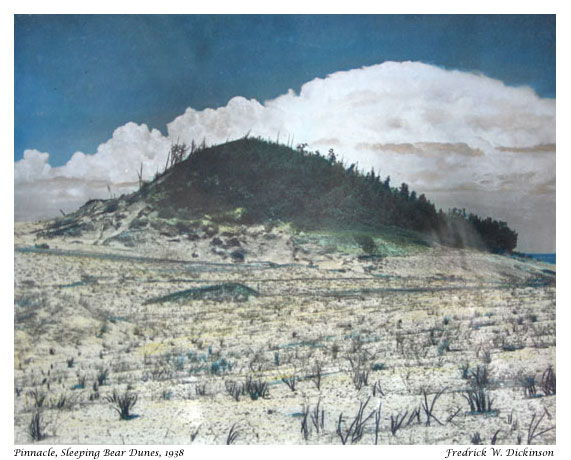
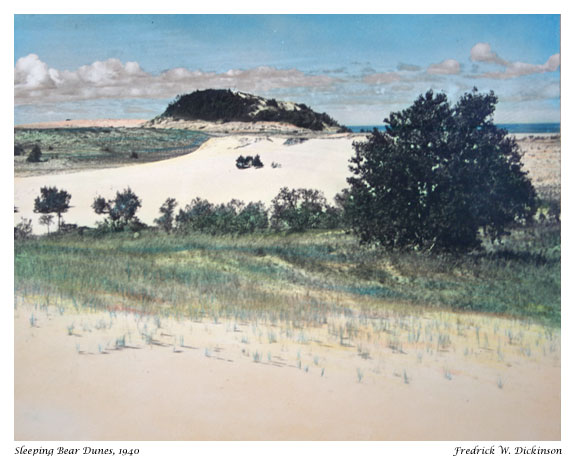
Sleeping Bear Dunes, 1940, photo by Fred Dickinson/Dickinson Photography

As we know, my laziness knows no bounds, so here’s the story behind “the Bear” on the Sleeping Bear Dunes that I wrote for Leelanau.com this morning!

The other day we posted the Legend of the Sleeping Bear to Leelanau.com. After thinking about it, I wondered if folks knew that “the Bear” was also an actual formation atop a dune about a mile north of the Pierce Stocking Overlook. The Sleeping Bear Dunes National Lakeshore says that the formation pictured above known as “the Bear”…

…hardly looks like a bear now, for it has been changing rapidly in recent years. At the turn of the century, it was a round knob completely covered with trees and shrubs. You can still see some of the thick vegetation that gave it a dark shaggy appearance.

…For a long time, the sleeping Bear Dune stood at about 234 feet high with a dense plant cover. However, trough most of the twentieth century, erosion has prevailed. By 1961, the dune was only 132 feet high, and by 1980, it was down to 103 feet. The process is a continuing one. The major cause of the dune’s erosion was wave action wearing away the base of the plateau on which the dune rests. As the west side of the dune loses its support, it cascades down the hill. The wind, too, is a major agent of erosion, removing sand and destroying the dune’s plant cover.

The photo above was taken by Leelanau photographer Fred Dickinson. You can see a closer view right here and definitely check out the Dickinson Photo Gallery to view & purchase great photography of the dunes and other Leelanau spots by Fred and his daughter Grace. On Michigan in Pictures there’s a photo of Fishtown in 1940 that explains Dickinson’s hand coloration technique and another shot by Fred of some folks taking a break from a Sleeping Bear Dune ride.

You can see a couple more photos of the Bear from MSU and don’t forget to click over to Leelanau.com for the Legend of the Sleeping Bear!

rolling fog at the mackinac bridge

rolling fog

rolling fog, photo by Through My Eyes. [nicole wamsley]. astra_amara.

Much more of Mackinac and the Mackinac Bridge on Michigan in Pictures.

Check this out bigger in Nicole’s if by sea… slideshow.

Tri-Centennial State Park Lighthouse, Detroit Michigan: Velvia Version

Tri-Centennial State Park Lighthouse, Detroit Michigan: Velvia Version

Tri-Centennial State Park Lighthouse, Detroit Michigan: Velvia Version, photo by friday1970.

Tri-Centennial State Park is now known as the William G. Milliken State Park and Harbor. It was the first urban park in Michigan, and covers 31 acres on the banks of the Detroit River.

This 63-foot lighthouse is a scaled down replica of the Tawas Point Lighthouse, the only true Victorian-era style station on the Great Lakes.

Be sure to check this out background boomtacular and in his slideshow.

Many more Michigan lighthouses on Michigan in Pictures!

Women and children first: The Sea Scouts near Mackinac

Sea Scout whaleboat

Sea Scout whaleboat photo by otisourcat

As a Sea Scout, I promise to do my best
To guard against water accidents;
To know the location and proper use of the lifesaving devices on every boat I board;
To be prepared to render aid to those in need and;
To seek to preserve the motto of the sea, “Women and children first.”
~Sea Scout Motto (via Wikipedia)

otisourcat writes that this shows a ship’s boat used in the 1920’s by the Sea Scouts. The photo was taken somewhere near Mackinac. See it (and many more) in his amazing Photographica Nauticalia set (slideshow).

Indian Village and the 12 Days of Christmas in Detroit

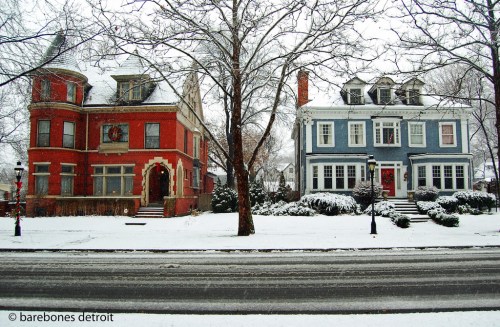
Untitled, photo by BareBonesDetroit

The folks at BareBones Detroit are doing the Twelve Days of Christmas in Detroit, a series on some of the best things to do and see around the holidays. Check their set out on Flickr at the link above (view slideshow) and don’t miss their cool map of Detroit! Of this photo they write:

Day 2: Indian Village. There’s never a better time to take a drive through Detroit’s historic Indian Village neighborhood. Just east of downtown, many of these homes were owned by some of the city’s most prominent, wealthy families. Grab some hot chocolate, turn the radio to 100.3 WNIC and tour some of the Detroit’s most historic homes lit up for the season.

Detroit’s historic Indian Village by Zena Simmons of The Detroit News says that the architecturally diverse Indian Village was home to famous Detroiters including Edsel Ford & Bernard Stroh. Their homes were designed by some of Detroit’s most renowned architects including Albert Kahn, Louis Kamper and William Stratton. The first Village home was built in 1895 at Jefferson and Iroquois and later became the headquarters for WXYZ and the home of the Lone Ranger.

According to the Indian Village Historical Collections, originally, the land belonged to Francois Rivard and Jacques St. Aubin, recipients of French land-grant “ribbon” farms, long narrow strips of land that gave each farmer some river frontage. Abraham Cook acquired the farms between 1811 and 1815. The area consisted mostly of farms, and a couple of upper-class river cottages, but the main attraction was a mile long oval race track. The track was the site of several Michigan State Fairs during the 1860s and was known as the Hamtramck Race Course.

Around 1893, Cook’s heirs formed the Cook Farm Company, Ltd. to develop a “first class residential district on a generous scale”, and the prices were set high so that only the wealthy could build there.

Many assumed that at one time Indians lived on the land. That may be, but John Owen Jr., a key player in the development of the area, selected the name “Indian Village” because he felt the romantic title would add to the sales appeal.

You can also check out Wikipedia’s entry for the Indian Village Historic District and the Historic Indian Village neighborhood site.

The Best of the Detroit Lions: Barry Sanders

barry barry

barry barry, photo by daveraoul.

Yahoo has a feature on the five greatest Detroit Lions players. Though them might have missed the tackle on kick-returner Mel Gray (Charlie Sanders anyone?), they definitely nailed the rest with defensive back Dick “Night Train” Lane, linebacker Joe Schmidt, quarterback Bobby Layne and their unquestioned #1, Hall of Fame running back Barry Sanders.

The Barry Sanders entry at the Pro Football Hall of Fame begins:

One of the game’s most electrifying runners, Barry Sanders rushed for more than 1,000 yards in each of his 10 seasons with the Detroit Lions (1989-1998). He was the first running back ever to do so. The 1988 Heisman Trophy winner was also just the third person to gain more than 2,000 yards in a season, a feat he accomplished in 1997.

Sanders, after forgoing his senior season at Oklahoma State, made his pro debut just three days after signing with the Lions, who had made him their first-round pick and the third overall pick in the 1989 draft. He absolutely dazzled a Pontiac Silverdome crowd when he dashed for an 18-yard gain on his first carry as an NFL running back. But that was just the beginning. His 1,470 yards rushing that season, a-then Lions record, fell just 10 yards short of the league’s best for the year.

Read the rest and if you want to put a little jingle in Barry’s probably already jingling pockets, head over to barrysanders.com. If you need a little Barry to wash the Lions dismal decade out of your thoughts, head over to YouTube for the Barry Sanders highlight reel.

Dave writes that he misses this guy. Check the photo out bigger and in his slideshow.

Exit 180: Blizzard Version

Exit 180

Exit 180, photo by isopleth.

Today’s post goes out to Blizzard Baby Bradley, born Sunday morning at the peak of last weekend’s blizzard in northern Michigan.

Check this photo from near Cadillac out bigger and in David’s slideshow.

More winter on Michigan in Pictures.

Rough-legged Hawk (Light Morph)

rough-legged hawk light morph

rough-legged hawk light morph, photo by Sherri & Dan.

Bird Web’s entry on Rough-legged Hawks (Buteo lagopus) says these birds:

…are variable in plumage, with light and dark color phases and variations in between. Dark phases account for only ten percent of western Rough-legged Hawks. Adults are generally mottled light-and-dark underneath, with dark patches at the wrists. Seen from below, the tails of both phases appear light with a dark terminal band. Seen from above, both phases appear mostly dark, but the light phase shows a light tail with a dark terminal band, and the tail of the dark phase appears dark all over. The adult male can have several dark bands at the tip of its tail as compared to the female, which only has one band. The light phase has a distinctive light-colored head, in contrast to its dark upperside. The Rough-legged Hawk’s bill and feet are relatively small.

Read more about these hawks at Rough-legged Hawk (Dark Morph) on Michigan in Pictures.

Check this out background big and in Sherri & Dan’s Animals slideshow.

Many more Michigan birds on Michigan in Pictures!

Biggest Hockey Game Ever: The Big Chill at the Big House

The Big Chill

The Big Chill, photo by andykee.

On Saturday, December 11 2010 the University of Michigan Wolverines met the Michigan State University Spartans in The Big Chill at the Big House (Wikipedia entry). AnnArbor.com pegs the crowd at a world-record smashing 113,411 who saw the Wolverines pummel the Spartans 5-0.

It’s not the first time UM/MSU have set the record. In October of 2001, the 2 programs met at Spartan Stadium in The Cold War which drew almost 75,000 who saw the teams skate to a 3-3 tie. Check out this video of the record-setting crowd and here’s the highlight reel from the game.

See the photo bigger in Andy’s slideshow and check out AnnArbor.com’s slideshow from the event.

Adrift

Adrift

Adrift, photo by dthurau.

…as in Don’t worry, even though I forgot to blog a picture this morning, this blog isn’t adrift.

Check it out bigger in Dave’s Misc slideshow, and here’s hoping tomorrow’s storm doesn’t set you adrift!

More boats on Michigan in Pictures.