Renewable energy in Michigan costs less than expected

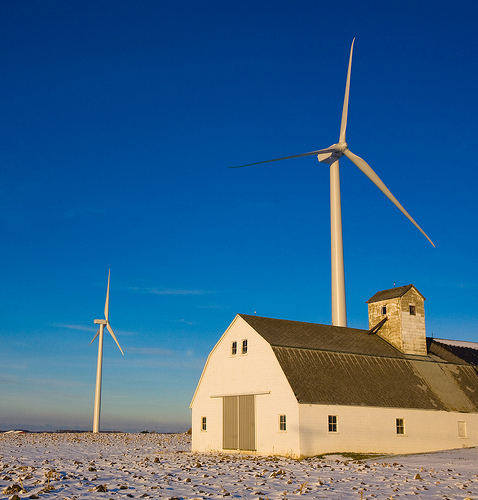
Wind farm in Ubly Michigan, photo by Ray Dumas RTD Photography

An in-depth article on the cost of renewable energy in Michigan in the Muskegon Chronicle notes that although a common argument from wind turbine opponents is that wind farms will significantly increase our electric bills, the State of Michigan reports initial contracts show significantly lower costs than the power generated from new coal plants. This excellent feature on the hard numbers and debate on renewable energy is well worth a read.

State regulators find the current cost of a new coal power plant over the life of the facility is $133 per mega watt hour of production.

Based on more than two dozen actual renewable energy contracts for solar, wind and bio-gas generated electricity, the average price is about $100 per mega watt hour of production. Bio-mass incineration is at $98, wind $101, landfill gas $113, digesters $128 and several small-scale solar installations at approximately $500.

“Wind is competitive with coal and natural gas on cost as long as you find the best winds,” said Paul Isely, the head of Grand Valley State University’s economic department.

See this photo and others from the wind farm in Ubly bigger in Ray’s alternative energy slideshow.

Ice Woman: Lake Superior in March

Ice Woman

Ice Woman, photo by evenstar22.

Today’s photo comes to you from the “For real??!!” department.

Kate says that yes, she actually did this. See it on black, and here’s hoping that you are living life to the fullest!

A Rough and Icy Great Lake, Velvia Edition

A Rough and Icy Great Lake, Velvia Edition

A Rough and Icy Great Lake, Velvia Edition, photo by friday1970.

About this photo from Burtchville near Lakeport in the Thumb, Tim writes:

A very windy night produced large waves for Lake Huron, causing the ice shelves built up along shore to break up and float down the coast. About 50 ft out were these mushroom shaped mounds of ice, which served as a subject in this photo.

Just before I shot this, a wave splashed up and instantly froze to my camera. I had to quickly scrape/wipe the ice from the lens to capture the sun behind the clouds while it lasted. The filters threads were covered in ice, so I hand held the GND in place during the shot.
A photographer’s version of drama?

Check this out background bigtastic and see this and another shot from the day in his slideshow.

More Lake Huron on Michigan in Pictures.

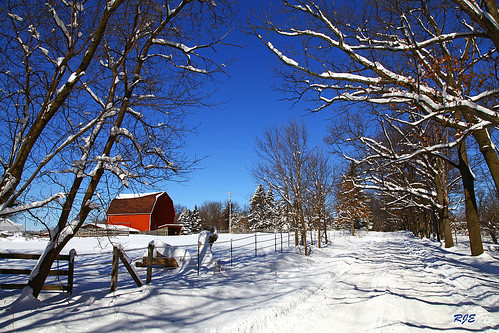
Country road in red, white & blue

Country road

Country road, photo by R.J.E..

Check this out bigger and in R.J.E.’s slideshow. (seriously – his slideshow is off the hook!)

See more barns on Michigan in Pictures, and I hope everyone has a really great weekend too!

That’s a job creation engine out there…

Layers of Michigan Winter

Layers of Michigan Winter, photo by nasunto.

The Wall Street Journal reports:

An analysis by Michigan Sea Grant at the University of Michigan says more than 1.5 million U.S. jobs and $62 billion in annual wages are linked directly to the Great Lakes.

The study was released Thursday. It says Michigan has 525,886 jobs connected to the Great Lakes, more than any other state. Illinois ranks second with 380,786, followed by Ohio with 178,621.

Most of the jobs are in manufacturing. Others are in tourism and recreation, shipping, agriculture and other sectors of the economy.

Jim Diana, director of Michigan Sea Grant, says the study illustrates that protecting the lakes is crucial to attracting and retaining businesses and jobs.

That’s a lot of jobs … and at an estimated $62 billion in wages, it’s a very compelling argument for Michigan to take a leadership role in protecting the Great Lakes. Here’s the news release from Sea Grant and the PDF of the Great Lakes Jobs Report.

About the photo Nina writes On the shore of Lake Michigan: Cold sand and a layer of ice. In the distance, snow, ice, whitecaps on the beautiful and temperamental lake, and a cloud-filled sky. Check it out background big and in her Lake Michigan slideshow.

Keweenaw County: Tops in the Nation for Water!

Red Ridge

Red Ridge, photo by We Are CS.

This morning I found out that my native Leelanau County is the 2nd watery-est in America. Wikipedia’s Keweenaw County entry says that Michigan’s northernmost county holds the title though:

Keweenaw County is the northernmost county in Michigan. According to the U.S. Census Bureau, the county has a total area of 5,966 square miles (15,451.9 km2), of which 541 square miles (1,401.2 km2) is land and 5,425 square miles (14,050.7 km2) (90.932%) is water. Of all counties (or county-equivalents) in the United States, Keweenaw County has the highest proportion of water area to total area.

In essence, 90.932 percent of the county consists of a significant part of Lake Superior, while only 9.068 percent is actually land. Isle Royale is its northernmost section. It is the largest county in the largest state east of the Mississippi River.

Check this out big as … well … Michigan’s biggest county and see many more in Kyle’s massive Keweenaw Peninsula slideshow!

Seussian Scene, Yooper Style

Untitled, photo by Blondieyooper.

The last Wednesday of every month is a Weird Wednesday on Absolute Michigan. In honor of that, here’s a funny little still life from the UP.

Check it out big as a blueberrishroom and in April’s Dr Seussish File slideshow!

National Cherry Month means only 5 months to fresh Michigan cherries!

Untitled, photo by Christina**.

February is National Cherry Month and Absolute Michigan has your cherry goodness including a neat four season cherry photo essay by Megan @ American Spoon.

See this bigger in Christina’s slideshow and also check out her photography website.

The Trestle Bridge at Hamilton

The Trestle Bridge at Hamilton

The Trestle Bridge at Hamilton, photo by bill.d.

Hope you enjoyed your morning commute…

Check this out big as a bridge and in Bill’s Allegan County slideshow.

Miles more bridges on Michigan in Pictures.

U.S. Coast Guard Icebreakers and the Great Lakes

International Partners

International Partners, photo by KathysPix.

Icebreakers and the U.S. Coast Guard is a great article from the Coast Guard Historian’s Office says that the origin of icebreaking in the United States came in the 1830s as side-wheel steamers with reinforced bows were found to be excellent for clearing harbor ice. This page tells the story of CG icebreaking around the country, and the Great Lakes were certainly a part of that. The Escanaba class light icebreakers in the early 20th century didn’t get the job done, but World War II made icebreaking an essential technology and led to the development of the Wind class vessels. In addition to to these four ships, a fifth was built in 1944, the icebreaker Mackinaw:

The final heavy icebreaker built during the war was the Mackinaw, a ship specifically for Great Lakes use. She was, according to Admiral Thiele, a “squashed down” Wind class vessel, with greater beam and length, but shallower draft than those vessels. Her powerplant and general design were those of the Wind class, but her hull was of mild steel, for fresh water operations. (The ocean going cutters were of high tensile steel.) This vessel was designed to extend the operating season in Great Lakes ports, a strategically important task considering the essential raw materials originating on the Lakes: iron ore, coal, limestone, etc.

In 2006, the Mackinaw was decommissioned and replaced by the new USCG Mackinaw, which we see in the picture above.

You can see more of what was involved in freeing a stuck freighter in Kathy’s Coast Guard Cutters slideshow.