
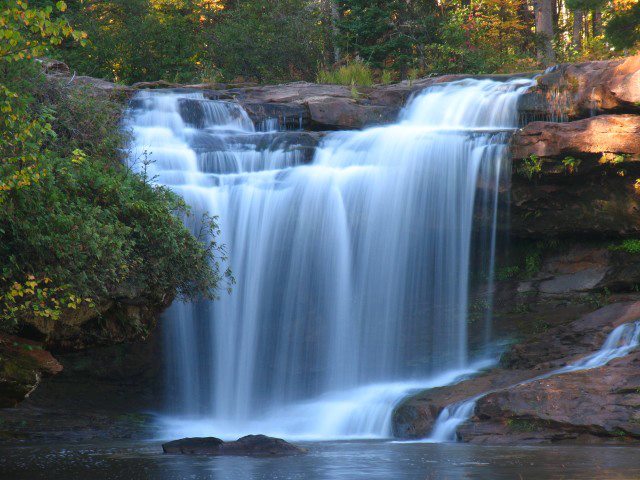
Don’t lose your bowl at O Kun de Kun Falls!

O Kun de Kun Falls, photo by Splash of Sunset Photography

Go Waterfalling says that O Kun de Kun Falls 

O Kun de Kun Falls is one of the largest of the waterfalls in Ontanagon county. It is not as large as Bond Falls or Agate Falls, but it is just as scenic and far wilder. It is a mile plus hike to O Kun de Kun Falls and there are no fences or signs. The waterfall is also unusual in that it is an actual plunge falls. Only a handful of the many waterfalls around Lake Superior are plunge falls. You can go behind the falls if you want, but you need to be careful and sure footed.

The trail head to the falls is located on the east side of US 45 about 8 miles north of Bruce Crossing. There are signs for the parking area. The trail to the falls is part of the North Country Trail. It is a 1.3 mile fairly level hike to the falls. Before you reach the main falls you will reach a smaller 10′ plunge upstream. Keep going! The first time I tried to visit O Kun de Kun I stopped at the upper falls, thinking I had reached my destination. The real falls is just a short distance downstream. The trail crosses a suspension bridge below the falls. If you have not gone far enough to see the bridge, keep going.

If you’re wondering about the name of the falls, it was after a famous chief. If you’re wondering about the title of this post, Pasty.com explains:

The name “Ontonagon” is derived from the Ojibway word “nontounagon,” which means “I lost my bowl.” Local legend surrounding the name stems from the story that a member of Chief O-Kun-De-Kun’s band was washing bowls near the mouth of the river when she was startled by an unkempt stranger in a canoe. The woman inadvertently dropped one of the bowls into the river and exclaimed “nontounagon”. The white man took her declaration to be a reply to his question about the name of the area.

Check this out bigger and in Matthew’s great Waterfalls of the Western UP album.

Learn about Bond Falls, Agate Falls abd more Michigan Waterfalls on Michigan in Pictures!

Michigan Blueberries are ready for market!

Michigan Blueberries

Michigan Blueberries, photo by Mi Bob.

Taste the Local Difference has a nice feature on Michigan Blueberries that says (in part):

Native Americans gathered blueberries for centuries, and much folklore developed around them, as they were considered a highly valuable food source. The elders of a tribe would tell the story of how the Great Spirit sent “star berries” to relieve the children’s hunger during a famine. The star refers to the perfect five-pointed star on the blossom end of each berry. Blueberry juice and tea were used as medicines, and as an excellent dye for baskets and clothing. They were also used in soups and stews and in a beef jerky that was eaten year round.

The Wampanoag Indians taught the early colonists how to gather blueberries, dry them, and preserve them, which helped people survive the long winters. It is believed that dried, crushed blueberries were used in a simple corn pudding that was served at the first Thanksgiving feast.

A beverage made with blueberries was an important staple for Civil War soldiers.

Much more including health benefits from Taste the Local Difference. Also see Eat Local: Michigan Blueberries on Absolute Michigan and find more blueberry info from Real Time Farms.

See this on black and in his slideshow.


More yummy Michigan Food on Michigan in Pictures!

Summery Sunset bokeh

Summery Sunset bokeh

Summery Sunset bokeh, photo by Spring Noel.

Sometimes, it’s just the photo.

Check this out on black and see lots more in Spring’s Summer slideshow.

Traverse City Film Festival: Be Your Dreams

Traverse City Film Festival Opening Night 2011 - 6 by Mark O'Shaughnessy

Traverse City Film Festival Opening Night 2011 – 6 by Mark O’Shaughnessy, photo by tcfilmfest.

All week I’m working on the Traverse City Film Festival (TCFF) through Absolute Michigan. One of the neat features of the festival is nightly free movies on the BIG screen along Grand Traverse Bay. On Tuesday night and thanks to George Lucas, TCFF had an unprecedented showing of The Empire Strikes Back. I say unprecedented because this just doesn’t happen with Star Wars. However, festival co-founder Michael Moore asked, and Lucas said OK. That’s kind of been how TCFF has gone over 7 years. Nothing about it, from convincing the community that a festival celebrating film would fly in Traverse City to producing an almost 100% volunteer run festival, has been likely or easy. It has been fun & exciting though!

You can get a flavor of the action in Traverse City’s thank you to Lucas.

Mark O’Shaughnessy is one of the many photographers working the Traverse City Film Festival. Check out the epic battle that ensued and more shots in the July 26: Opening slideshow.

Yippee!

Yippee!

Yippee!, photo by jimmb1.

Hope you get a chance to have this much fun sometime soon!

Check it out background big and see the likely cause of this photo in Jim’s slideshow.

More fun stuff on Michigan in Pictures…

USCGC Mackinaw at the Grand Haven Coast Guard Festival

USCGC Mackinaw

USCGC Mackinaw, photo by loomisman.

The Grand Haven Coast Guard Festival (July 29 – August 7, 2011) has been held every year in Grand Haven. It features a parade of ships and a couple street parades, music, carnival, fireworks and all kinds of events and exhibits about the history of the United States Coast Guard. They explain:

The festival unofficially began in 1924 as a Coast Guard personnel only picnic when the local Coast Guard station held rowing competitions for those service members stationed in Grand Haven. Today the Grand Haven Coast Guard Festival has become a premier event with attendance of over 350,000 people including the nations highest ranking Coast Guard dignitaries from Washington, D.C.

The focus of the annual Grand Haven Coast Guard Festival is the National Coast Guard Memorial Service honoring those who sacrificed their lives in the service of their country while fulfilling their motto “SEMPER PARATUS” (“Always Ready”). Each year since the first picnic in 1924 and the first festival in 1937, we have celebrated our heroes, the men and women of the United States Coast Guard with fun filled family events at the annual Grand Haven Coast Guard Festival. Grand Haven is honored by its designation as “Coast Guard City, USA” by an Act of Congress and signed by the President of the United States on November 13th, 1998.

Check this out bigger in in Drew’s Grand Haven Coast Guard Festival slideshow.

Michigan in Pictures has more about the US Coast Guard Cutter Mackinaw.

Sunset over Cecil Bay

Wilderness State Park, MI

Wilderness State Park, MI, photo by Matthew Hart Photography.

at Wilderness State Park.

Check this out background big and in Matthew’s Mackinac/Wilderness State Park slideshow.

More black & white photography on Michigan in Pictures.

Jonathan Livingston Seagull Returns

Jonathan Livingston Seagull Returns

Jonathan Livingston Seagull Returns, photo by LadyDragonflyCC – Flowers, WE NEED Rain!.

Christine writes:

Jonathan Livingston Seagull is concerned with a young seagull’s efforts to rise above the ordinary. In a flock where individuality is frowned upon, Jonathan finds himself a loner and an outcast. After performing feats of tremendous courage and skill, Jonathan is expelled from the flock. This gives him the freedom to develop his skills, and in so doing he reaches a higher plane of achievement, a heaven of sorts. The lessons that Jonathan learns in his travels reflect both a greater peace of mind and a freedom to be himself. Jonathan continues the cycle, by returning to the flock…

She also linked to a video from the movie. The movie is based on the book of the same name, and what Christine may not know is that the author, Richard Bach spent a fair amount of time on Michigan’s Leelanau Peninsula. No idea if our Michigan gulls influenced the tale.

You can read the complete Jonathan Livingston Seagull online.

Check it out big as the sky and in Christine’s slideshow.

Fly high.

The Bow and the Marquette Ore Dock

The Bow

The Bow, photo by p.Gordon.

Hunt’s Guide to the UP has this to say about the Lower Harbor Ore Dock in Marquette:

Once rail cars moved onto this massive sandstone dock to unload iron ore into the holds of waiting ore carriers via “pockets” or chutes. After a 1971 strike the Lake Superior & Ishpeming rail line through downtown was no longer used. The newer ore dock by Presque Isle was enough to meet later needs. As part of a plan to redevelop the Lower Harbor and South Rail Yards, the 3,000-foot trestle approaching the docks was torn down, removing a longtime landmark across Front Street and opening up a long waterfront corridor for public use.

via the YouTube you can see a super-sweet video of a stand up paddleboarder making a complete circuit of the ore dock

Check this out big as a freighter and in p Gordon’s Great Lakes Ships slideshow.

More Marquette on Michigan in Pictures.

Grand Marais Harbor Light

Grand Marais Harbor Light

Grand Marais Harbor Light, photo by James Marvin Phelps.

I looked for a winter lighthouse photo … I hope it reminds us all to be thankful for summer’s warmth…

The Grand Marais Light page from Terry Pepper says:

“Big Marsh” is the direct translation of the French “Grand Marais.” While the name was given by Voyageurs in the early seventeenth century, many subsequent observers were puzzled, since no marshes have ever been known to exist here. However, it is believed that the Voyageurs had their own unique vocabulary, and it is likely that “Marais” referred to a cove, or harbor of refuge.

…While the fur trade declined, lumber camps began to spring up along Superior’s south shore, and Grand Marais soon found itself in the center of a lumbering boom, with stacks of lumber on its docks awaiting the arrival of vessels to carry the forest’s bounty to the southern lakes.

With the associated increase in maritime traffic through the late 1870’s, the absence of a safe haven for mariners coasting the treacherous waters between Whitefish Bay and Grand Island became a matter of grave concern to maritime interests. Deducing that the natural harbor could be modified to serve as an excellent harbor of refuge, the Army Corps of Engineers embarked on an ambitious harbor improvement project at Grand Marais in 1881. Work continued over the following ten years, with the construction of a 5,770-foot timber pile breakwater stretching across the bay from Lonesome Point to a dredged channel at the western shore. Two protective piers were constructed on each side of the channel, and the protected harbor area dredged to a depth of 40 feet, allowing access to the protection of the harbor by the largest vessels of the day.

There’s much, much more at the link above (including historical photos). Also see The Grand Marais Lifesaving Station on Michigan in Pictures.

Check this out biggerand in James’ Grand Marais slideshow. You can purchase a print right here!