Mittengate in the Mitten State

Michigan at the Archive of Michigan

Michigan at the Archive of Michigan, photo by farlane

“Sometimes you got to put your foot down, or your mitten, so to speak.”
~Dave Lorenz, Travel Michigan

Last week the state of Wisconsin touched off a firestorm – snowstorm? – by suggesting that they might in fact qualify as a mitten state, prompting Pure Michigan to ask Who is the Real Mitten State? that for some reason we are only winning 83% – 17%. mLive has a look at the controversy that includes a the Badger’s case for Mittenhood (which appears to be no more than Mitten envy) and a really cool Vernor’s commercial with former Red Wing Petr Klima demonstrating “where it is on the hand.”

My good friend Jacob Wheeler has an excellent rundown on the Mitten Wars in which he notes that:

…the Badger state did have reason to be peeved at the Wolverine state. In 1835-36, Michigan and Ohio “fought” the Toledo War, a completely bloodless boundary dispute that resulted in Ohio getting the narrow stretch of land where the Mud Hens now play baseball, and Michigan getting three-quarters of what’s now the Upper Peninsula from Congress (it was previously considered “Indian territory”). Michigan’s gain was Wisconsin’s loss, as the western part of the U.P. would yield untold mineral wealth — and the historic Calumet Theater — over the next century and a half.

Wisconsin became a U.S. state in 1848, and contented itself with the cheese curd as its gourmet food favorite, and not the meat and potato-filled pasty, which the Finnish immigrants to the U.P. carried with them into the mines. Wisconsin’s bitterness simmered, for 175 years, like Golum clutching the ring deep in the caves of Middle Earth.

That angst finally boiled over this week when the Travel Wisconsin website posted a knit mitten shaped like the state of Wisconsin on its website as part of a winter tourism promotion campaign. Michiganders who identify themselves in the world beyond with an open-faced right hand, took the news as a humorous, yet serious, challenge.

“People in Michigan, we do identify ourselves so closely with the Mitten State,” Alex Beaton of the Awesome Mitten website told the Washington Post (seriously, the Washington Post?). We’re America’s high five!”

Jacob adds that  Wisconsin PR pro Tom Lyons suggested that “Wisconsin is the left mitten. Michigan is the right mitten. Even children know that one mitten doesn’t cut it when it comes to Midwestern winters.” Lorenz (who seems to be on fire right now) shot back “We’re not going to take this lying down. Wisconsin already took the Rose Bowl from us this year. They’re not going to take the Mitten State status from us.” Amen. Definitely read on at the Sun for more including a Michigan vs. Wisconsin matchup.

I took this photo of the 4-story map showing Michigan’s topography at the Michigan Historical Museum in Lansing several years ago. I was never able to find out who designed it, but you can see another view and check out the online tour of the museum. View this photo background big and see more from the museum in the Michigan Historical Center group slideshow.

Remembering Michigan’s legendary architect Albert Kahn

Albert Kahn's legacy

Albert Kahn’s legacy, photo by .brianday.

“Architecture is 90 percent business and 10 percent art.”
~Albert Kahn

Legendary Detroit architect Albert Kahn died on December 8, 1942. The Albert Kahn entry at Wikipedia begins:

Kahn was born on March 21, 1869 in Rhaunen, Rhineland-Palatinate, Germany. Kahn came to Detroit in 1880 at the age of 11. His father Joseph was trained as a rabbi. His mother Rosalie had a talent for the visual arts and music. As a teenager, he got a job at the architectural firm of Mason and Rice. Kahn won a year’s scholarship to study abroad in Europe, where he toured with another young architecture student, Henry Bacon, who would later design the Lincoln Memorial in Washington, D.C.

The architectural firm Albert Kahn Associates was founded in 1895. He developed a new style of construction where reinforced concrete replaced wood in factory walls, roofs, and supports. This gave better fire protection and allowed large volumes of unobstructed interior. Packard Motor Car Company’s factory built in 1907 was the first development of this principle.
The success of the Packard plant interested Henry Ford in Kahn’s designs. Kahn designed Ford Motor Company’s Highland Park plant, begun in 1909, where Ford consolidated production of the Ford Model T and perfected the assembly line. On Bob-Lo Island, Henry Ford had a dance hall designed and built by Albert Kahn, which was billed as the second largest in the world in a 1903 account…

Ten Albert Kahn designed buildings are recognized with Michigan historical markers:

    • Battle Creek Post Office
    • The Dearborn Inn
    • Detroit Arsenal Tank Plant in Warren, Michigan
    • Edsel and Eleanor Ford House in Grosse Pointe Shores, Michigan
    • Fisher Building
    • Delta Upsilon Fraternity, 1331 Hill St., Ann Arbor
    • Packard Motor Car Company factory
    • The Detroit News
    • The Detroit Free Press
    • Willow Run

Get the complete list of his firm’s buildings (including the Russell Industrial Center) at Wikipedia. The company that Kahn founded in 1895 is still in the business. There’s an interesting biography of Albert Kahn from Ford that notes that a Detroit sculptor recognized Albert’s artistic talent and allowed him to attend his art school free. However, after discovering that Kahn was color blind, the artist encouraged him to become an architect and secured him a job as an office boy.

Check this photo out bigger and see more in Brian’s Detroit Flavor slideshow. Coincidentally enough, Brian just let me know that this photo is being hung in a gallery today along with 10 other prints from Brian (and another 10 from two other michpics regulars,  Jon DeBoer and Jeff Gaydash) at Studio Couture gallery, 1433 Woodward Avenue. Opening night for the exhibition will be this Saturday from 6pm-9pm. Details right here!

More Michigan architects & architecture from Michigan in Pictures.

Hasselblad: White Fish Falls

White Fish Falls

White Fish Falls, photo by Sean Depuydt.

I think these are the lower falls on the Laughing Whitefish River in the U.P. Read more about Laughing Whitefish Falls from Michigan in Pictures.

Check this out on black and in Sean’s gorgeous Hasselblad slideshow.

More black & white photography on Michigan in Pictures.

A long shot in Vehicle City

A long shot

A long shot, photo by flintstoner.

Editor’s note: Midway through writing this post, I realized that I had blogged about the Vehicle City arches four years ago. I figured that if I had forgotten, most of you probably would have forgotten too or never seen it, so here you go.

Last week Governor Rick Snyder appointed Michael Brown as Emergency Manager for Flint. You can read all about that (including some interviews) on Absolute Michigan.

When I was looking at photos for that feature, this one with all the arches on Saginaw street caught my eye so I decided to learn a little more about them. Flinn’s Journal (which is a really cool site by the way that has a dynamic Facebook page) has a column on the Flint Arches that explains:

On November 29, 2003, a part of downtown Flint’s past officially returned to become part of Flint’s present and future when the replicated Flint Vehicle City arches were dedicated and lit for the first time. The arches are reminders of Flint’s glorious past as “The Vehicle City” as the city faces an uncertain future.

The vehicles which were made in Flint when the original arches were built were horse-drawn carriages. The leading maker of horse-drawn carriages in Flint was the Durant-Dort Carriage Company which was co-founded by William C. Durant and J. Dallas Dort and was in business from 1886 to 1917. Both men would also start companies which made horseless carriages. Dort founded the Dort Motor Car Company which was in business from 1915 to 1923. Dort Highway was named in his honor. Durant took over the then-small Buick Motor Company in 1904 and made it the leading motorcar company in 1908, the year that Durant founded Buick’s parent company General Motors Corporation. The first arches were erected in 1899 and built by Genesee Iron Works.

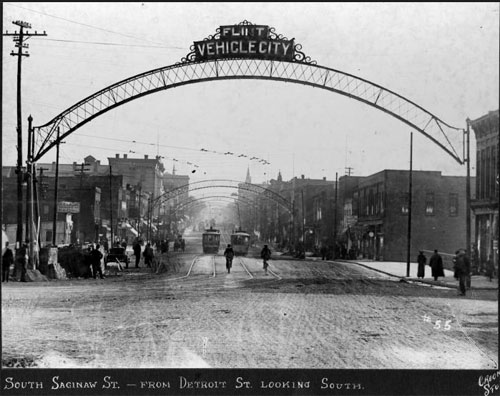
The arches were each fitted with 50 light bulbs which were illuminated at night. The arches replaced gas lighting. To celebrate Flint’s Golden Jubilee in 1905, an additional arch was erected near the point where Saginaw Street and Detroit Street (now M.L. King Ave.) split off north of the bridge over the Flint River. This arch was topped off by an illuminated sign saying “FLINT VEHICLE CITY”. For the Christmas holiday season, the regular light bulbs were replaced by multicolored light bulbs.

Click above to read more and see some photos. The arches were fabricated by Bristol Steel of Davison Michigan – check their site for photos and video of the installation. You can see some cool old photos at the Flint Vehicle City Arches site too.

Check this out background bigtacular and in flintstoner’s Flickriver.

Below is a photo by Arthur Crooks from the excellent Making of Modern Michigan gallery showing the Vehicle City Arch erected in 1905 as part of the City’s 50th anniversary. The caption of the photo says “South Saginaw St from Detroit Street looking South” while the description says it’s on Saginaw Street looking north. Can anyone clarify this?

The Grand Traverse Lighthouse

The Grand Traverse Lighthouse [2/2]

The Grand Traverse Lighthouse [2/2], photo by jimflix!.

The Grand Traverse Lighthouse is located at the tip of the Leelanau Peninsula in Leelanau State Park. If you have a lighthouse buff on your holiday list, you might consider a volunteer lightkeeper position in winter or summer at the light.

Construction of the Lighthouse was approved in 1849 at the northern tip of the Leelanau Peninsula at Cathead Point, the northern point of the important Manitou Passage and Grand Traverse Bay.

The Grand Traverse Lighthouse page from Terry Pepper’s Seeing the Light notes that – as was often the case with lighthouses constructed under the “fiscally tight-fisted Pleasonton administration” – work was shoddy and:

The old tower and dwelling were demolished in 1858, and a work on a new structure began on higher ground on the point. Over that summer a dirt-floored cellar with rubble stone walls was excavated and a two-story Cream City Brick keepers dwelling took shape. A short square wooden tower with white painted clapboard siding was integrally mounted at the center of the roof ridge, and both floors contained four rooms, with a centrally located entryway with stairs connecting the two floors. A narrower second set of stairs on the second floor led through the attic into the tower. The building featured first-class construction, with hardwood floors throughout and varnished wooden trim and wainscoting.

Atop the tower, a cast iron lantern with copper sheathed roof contained a new fixed white Fifth Order Fresnel lens illuminated with a sperm oil fueled lamp. With its ventilator ball standing 48 feet above the structure’s foundation, the building’s location on high ground provided a focal plane of 103 feet, and a range of visibility of 12 miles in clear weather.

Read on for much more and some historic photos. You can see more old photos of the Grand Traverse Light in the Lighthouse collection at the Michigan Arvchives.

Check this out background big and in Jim’s Lighthouses slideshow.

There’s a whole bunch more Michigan lighthouses at Michigan in Pictures!

Where does Michigan begin?

Perkins + WIll 35
Perkins + WIll 35, photo by orijinal

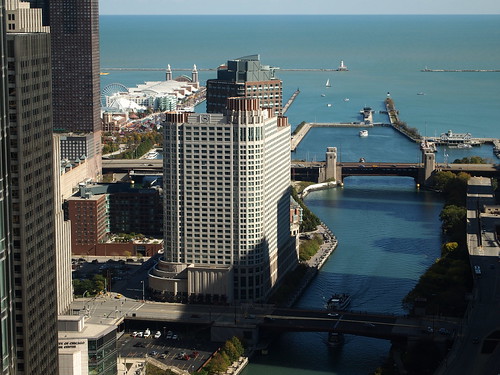
The headline of Gary Wilson’s editorial at the Great Lakes Echo caught my eye this morning: Great Lakes: A ship with no name in search of a captain. Gary begins:

In the past two weeks Chicago has been the center of a rare commodity in the Great Lakes region: Forward-looking thought. And I mean the future, not just until the next election or fiscal year.

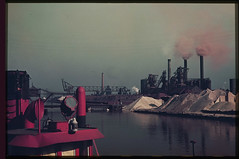
P-17= Steel Mills at mouth of Calumet river Chicago. Fire and boat at left. C.W. Cushman Nedill
Steel Mills at mouth of Calumet river Chicago by IMLS DCC

First, architect and MacArthur Foundation “Genius Award” winner Jeanne Gang presented her vision for transforming the Chicago River from that of an “open sewer” and invasive species highway to becoming a model of a 21st century urban waterway.

Gang’s proposal is conceptual, not an engineering plan. It’s meant to generate interest by the public and discussion that has been lacking. And judging by the large crowd that came to hear her speak, that interest exists.

At the same time Chicago Public Radio was also looking to the future.

Its Front & Center series that focuses on the Great Lakes hosted a one hour program about whether the region can truly collaborate for the greater good of the eight Great Lake states. Or will it continue to play in a zero sum economic game by competing with each other while the region’s combined strengths go untapped?

The consensus of the expert commentators is that the region’s governors see no political gain by collaborating. They’re focused on winning the jobs takeaway game that makes for nice press releases and ribbon cutting ceremonies when they win, but does nothing to strengthen the region.

Excellent questions. Read on for his thoughts about where the leadership to protect the amazingly interconnected wonder that are Lakes Michigan, Huron, Superior, Erie and Ontario may (or may not) come from .

There’s no doubt that it will take all the states on the lakes and the governments of the United States and Canada and their citizenry to do it. I’m pretty confident that the character & vision of our leaders and all of us on the Great Lakes will be important to generations yet unborn.

Turning Basin
Turning Basin by mindfrieze, photo by mindfrieze

Editor’s note: this isn’t the first time that Michigan in Pictures has featured multiple photos – more in the Sunday Study section. These also aren’t the first photos from outside of Michigan’s borders to appear on Michigan in Pictures – at least one is the Christmas Ship at the dock in Chicago.

Get Ready for a Cold Winter, Michigan

Untitled

Untitled, photo by Anapko.

“Harsh, brutal, snowy and cold. What other adjectives can I use?”
~AccuWeather.com meteorologist Henry Margusity

I’ve been sitting on this Detroit News feature that says Old Man Winter will pack a wallop in Michigan this year. The Farmers Almanac winter outlook for the upper Midwest says:

Winter will be colder than normal, especially in February. Other cold periods will occur in mid- and late December and mid- and late January. Precipitation and snowfall will be below normal in the east and above normal in the west. The snowiest periods will be in early and mid-December, early to mid-February, and mid-March.

Get your computer background ready for the season with Michigan Winter Wallpaper from Michigan in Pictures!

Check this out background big and in Anapko’s Ice Storm 2011 slideshow.

Eastern Black Walnut and Thousand Cankers Disease

Walnut Tree, Looking Up (Michigan)

Walnut Tree, Looking Up (Michigan), photo by Philosopher Queen.

Just a little Editor’s note rant to say that I grew up with a simply gorgeous black walnut tree in my yard, and it really upsets me when I have to write about yet another species that I love under threat of destruction by our out-of-control ecology. Some days it feels like all we’ll have left is squirrels, asian carp, emerald ash borers and kudzu. Also, sorry this is so long … I just kept learning stuff.

The Great Lakes Echo has a feature on Thousand Cankers Disease that attacks black walnut trees. The disease is caused by the walnut twig beetle and a newly identified fungus, geosmithia morbida, that act together to destroy walnut trees and is especially deadly to eastern black walnut. Both beetle and fungus prefer warm weather, and the theory is that it could be spreading north because of temperature. It has already been found in Pennsylvania, and Michigan and other states have a quarantine. (we know how well that worked for ash trees though)

Wikipedia’s entry for Juglans nigra aka Eastern Black walnut says that black walnut is a deciduous, flowering tree in the hickory family that is native to eastern North America. It can reach heights over 100 feet, growing tall and straight in the forest or spreading with a large crown in the open. The history of black walnut at the Walnut Council says that:

The tree once grew abundantly in the eastern bottomland forests, where the soil was deep and rich. Trees 150 feet tall with 50-foot clear stems and 6-foot diameters were not uncommon. Black walnut was the number one prized fine hardwood in America at a time before the use of veneers. Early colonists exported the wood to England from Virginia as early as 1610. Solid walnut wood was used in every sort of homemade furniture imaginable, during the Colonial and Federal periods, but rarely was the fine grain appreciated. Most pieces were covered with a coat of paint. The rage for walnut as a fine furniture wood occurred in a period from 1830-1860, during the popularity of the Empire, Victorian, and Revival styles. Unfortunately by this time, black walnut wood was already becoming scarce.

During pioneer times in the Midwest states, black walnut was still very abundant, although the extremely large trees were already gone. The tree was often cut for rudimentary things as split rail fences. Millions of railroad ties were made from walnut, since it resisted rot when in contact with the soil…

Black walnut never faltered in its use as gunstock material. It is unsurpassed, since no other wood has less jar or recoil, it doesn’t warp, shrink or splinter, and it is light in proportion to its strength. The smooth, satiny surface makes it easy to handle. The U.S. Government used black walnut gunstocks for generations and it is still the favored wood for shotguns and rifles used by hunters and sportsmen.

In a 1993 Michigan forest inventory, it was estimated that there are about 8.5 million walnut trees in Michigan’s forests. Mike has a nice detail of walnuts on the tree, Julie has a cool shot of a cardinal in a walnut tree, and you can see a gorgeous photo of a walnut tree in France on Wikipedia that really shows the spread of the tree and is big enough to make a great background! There are also some photos and drawings in the USDA Plant Profile for black walnut. If you have a wheelbarrow full of walnuts, you might want to read about growing & harvesting walnuts or watch this video. And finally, if you’re looking to plant some walnut trees, click that link!

View Cynthia’s photo on black and in her Trees slideshow.

MSU Spartans face Wisconsin Badgers in first-ever Big Ten Championship!

SPARTANS!

SPARTANS!, photo by Mario.Q
Drew Sharp writes that while the Legends and Leaders divisions were designed to showcase “the Big Four” of UM, Ohio State, Nebraska and Penn State, it’s two of the afterthoughts who meet in the first ever Big Ten title game this Saturday night (Dec 3) at 8:17 PM on FOX.

With a record of 7-1, MSU won the Legends Division this year. Their wins included a surprise upset in the first meeting with the Wisconsin Badgers, and you can relive the miracle catch on YouTube. You might also enjoy MSU Head Coach Mark Dantonio’s press conference yesterday and this preview from Green & White.

Mario took this shot at the MSU/Wisconsin game. Check it out bigger and in his slideshow.

More MSU on Michigan in Pictures!

Brighter Days Ahead

Brighter Days Ahead

Brighter Days Ahead, photo by Kim.Kozlowski.

Great sentiment, great photo. Learn about the Renaissance Center on Michigan in Pictures.

Check it out bigger and in Kim’s Detroit Slideshow.