“Winter’s palette” at Tawas Point State Park

"Winter's palette" Tawas Point State Park - East Tawas, Michigan

“Winter’s palette” Tawas Point State Park – East Tawas, Michigan, photo by Michigan Nut.

On another photo from Tawas Point John writes:

Anywhere you live in Michigan, you can’t be more than 85 miles from a Great Lakes Shoreline, and you cant be more than 6 miles from a natural water source; Michigan has 64,980 inland lakes.

I can’t imagine living anywhere else. But I know, others feel the same about their own paradise.

I can’t imagine living anywhere else either. Here’s the state’s Tawas Point State Park page.

Check John’s photo out on black and see some more stunning photos by John from Tawas Point (including the lighthouse) in his slideshow and definitely tune into Michigan Nut Photography on Facebook!

Hell Froze Over!!!

Hell Froze Over!!!

Hell Froze Over!!!, photo by Kathy~.

Winter 2012 has been a huge bust so far. The Detroit News notes that so far this winter, Metro Detroit has only recorded 6.7 inches of snow compared with a normal of about 15 inches, including less than 1/2 an inch in January!

While for the most part it’s a boon for cities and towns strapped for funds in some areas, it’s a whole different story for others. Brian Bienowski at the Great Lakes Echo wrote about how No snow, no ice means no business for some, saying that:

…while some rejoice the mild winter, the late ice and warmer temperatures hurt regional economies and could lower springtime water levels.

“Ice and snow are a real boon for our local businesses,” said Linda Tuck, executive director of the Houghton Lake Chamber of Commerce. Houghton Lake is in Michigan’s northern Lower Peninsula.

“We have one of the most popular fishing lakes in the state, in the summer and winter, and this winter we’re seeing a real downturn,” Tuck said.

…Joy VanDrie, executive director of the Cadillac Area Visitors Bureau, said the late winter hurts the northern Michigan town.

“Snowmobile dealers, ski shops, lodging facilities … they all rely on the weather getting cold and snowy,” VanDrie said.

The good news is that Hell has frozen over and snow is falling in many areas and slated to start soon in others.

Check Kathy’s photo out bigger and dive into her Flickr Explore slideshow.

Have a fun and safe weekend everyone!

Dead River Falls

Dead River Falls

Dead River Falls, photo by johndecember.

The Waterfall Record, a new discovery for me, has this to say about Dead River Falls:

There are some waterfalls that I’ve visited where I’ve had high expectations, and it’s not that I’m terribly disappointed, but not I’m not always sure what the attraction is. On the other hand, there are other waterfalls where my expectations are very low, and I am overwhelmed when I finally see the waterfall. There are two very impressive waterfalls on the Dead River right near Marquette.

I wasn’t expecting much because of the description I read in the book about Michigan waterfalls. I hadn’t seen any pictures, so I really didn’t know what to expect. The first waterfall is not that exciting, but wow, the 2nd waterfall is truly amazing. I wasn’t sure whether to keep walking along, but I did. The 3rd waterfall is small, but I decided to keep going. There was one turn along the trail where I suddenly realized that the 4th waterfall was going to be spectacular. It was early May, and the amount of snow melt created a great surprise. The waterfall is maybe 30′ tall or so, but the amount of water flowing over the falls was amazing. This group of waterfalls isn’t advertised that much, so you’ll likely be alone.

Also, I should mention, if I haven’t already, that the trail leading to the falls, while not terribly dangerous, would be best described as precarious at a few specific points. At one point, you’ll be hugging the dirt trail that is only feet from a river that is flowing VERY fast, at least in May. If you’re not careful, you’ll be carried away by the very swift current. As long as you’re paying close attention, I think you’ll be ok.

Read on for directions and a photo of the indeed impressive Upper Falls, and also to check out over 60 more Michigan waterfalls. Note that the site author says that on a June 2011 visit he encountered a No Trespassing sign due to work at the falls so maybe call the Marquette CVB to check before making the trek…

Check this photo out bigger and check out the area on John’s map.

Many (many) more Michigan waterfalls on Michigan in Pictures.

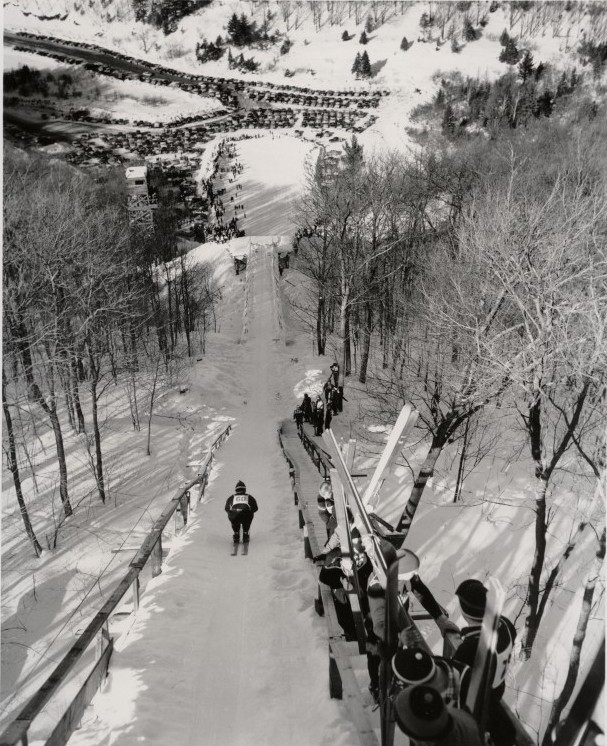
Ishpeming’s Suicide Hill

A skier glides down Suicide Hill, circa 1959, photo by Michigan Tourist Council

On Absolute Michigan we regularly feature articles & photos from the Archives of Michigan and their great web site Seeking Michigan. When Bob Garrett posted this feature, however, I knew that I couldn’t let Absolute Michigan have all the fun! 

Suicide Hill by Bob Garrett

Suicide Hill’s very name intimidates skiers. The Ishpeming Ski Club, however, describes it as “fine, competitive and safe” (See the Ishpeming Ski Club Web Site). Ski jump enthusiasts hold the hill – and its rich history – in high esteem.

In the Beginning

The Norden Ski Club – renamed the Ishpeming Ski Club in 1901 – held its first formal ski jump competition in 1888. The competition site was south of Lake Angeline, near Ishpeming, Michigan. An annual tradition did not immediately follow. The Club did, however, host competitions in some subsequent years. Various hills in the Ishpeming region served as competition sites.

In 1925, the Ishpeming Ski Club launched a search for a new hill. Peter Handberg and Leonard Flaa, then officers of the Club, found what would be called Suicide Hill. The Hill is located off what is now M-28, between Ishpeming and Negaunee. The Cleveland Cliffs mining company owned the land, and a lease was quickly negotiated.

In the autumn of 1925, development work began on the hill. It proved a community effort. Local citizens donated materials and volunteered their labor. The hill was cleared, graded and shaped. Finally, the Ishpeming Ski Club announced the first competition on the hill. This occurred on February 26, 1926.

“A Little Color”

Ted Butler, a local newspaper reporter, apparently gave the hill its nickname. An Ishpeming skier named Walter “Huns” Anderson was injured a few days before the 1926 meet. Butler wrote about this, using the phrase “Suicide Hill” in his story. “Sure, it’s a good hill, but why not add a little color to it?,” he reportedly said. James Flaa of the Ishpeming Ski Club protested the name, claiming that it created a bad impression and kept skiers away.

Today, eighty-six years later, skiers are still coming to Suicide Hill. They come from many countries and gather for the annual competitions, traditionally held in February.

The annual Suicide Hill Ski Tournament will be held next on February 8, 2012. Suicide Hill waits quietly for the day, ready to challenge a new wave of daring skiers.

Editor’s note: we found a great video of a jump at Suicide Hill and another from the point of view of the jumper

Sources

“Flying into the Future” by Jane Nordberg. Michigan History Magazine, March/April 2002, pp. 6-11.

Ishpeming Ski Club Web Site

For a related article, click Ishpeming winter events

January Ice

January Ice

January Ice, photo by ER Post.

January ice frames the Grand Haven Pier Light.

Check this out bigger and in Terry’s Michigan Lighthouses slideshow.

Old Moon, January Moon, Wolf Moon … and wolves in Michigan

January full moon

January full moon, photo by KatheD

Amid the cold and deep snows of midwinter, the wolf packs howled hungrily outside Indian villages. Thus, the name for January’s full Moon. Sometimes it was also referred to as the Old Moon, or the Moon After Yule. Some called it the Full Snow Moon, but most tribes applied that name to the next Moon.
~Old Farmer’s Almanac.

Speaking of wolves and January, last month the US Fish & Wildlife Service removed wolves in the western Great Lakes region from the federal endangered species list. Wolves are now managed by states in the region and the ruling takes effect on Friday, January, 2012. A release from the Michigan DNR about wolf de-listing says:

Returning wolves to state management will allow the DNR to more effectively manage the species under Michigan’s highly regarded Wolf Management Plan, which was created through a roundtable process involving interested parties representing viewpoints from all sides of the wolf issue.

“This is great news for the state’s wolf population and for Michigan citizens who have been affected by this issue,” said DNR Director Rodney Stokes. “Treating wolves as an endangered species, when the population has exceeded federal recovery goals in Michigan for more than a decade, has negatively impacted public opinion in areas of Michigan where wolves are established on the landscape. I firmly believe that the more flexible management options allowed under the state’s Wolf Management Plan will help increase social acceptance of the species while maintaining a healthy, sustainable wolf population.”

…After the wolf is taken off the federal endangered species list, the animal will remain a protected species in Michigan. There is no public hunting or trapping of wolves allowed in Michigan. The DNR and the U.S. Fish and Wildlife Service will investigate and continue vigorous prosecution of any wolf poaching cases..

You can find a lot more from the Western Great Lakes Wolf page, and the Michigan DNR’s Wolves in Michigan section has the Wolf Management Plan and a lot of information about the Gray Wolf (Canis lupus). Also see The Timber Wolf (canis lupus) in Michigan on Michigan in Pictures.

Check this out on black and this and another view in her winter slideshow.

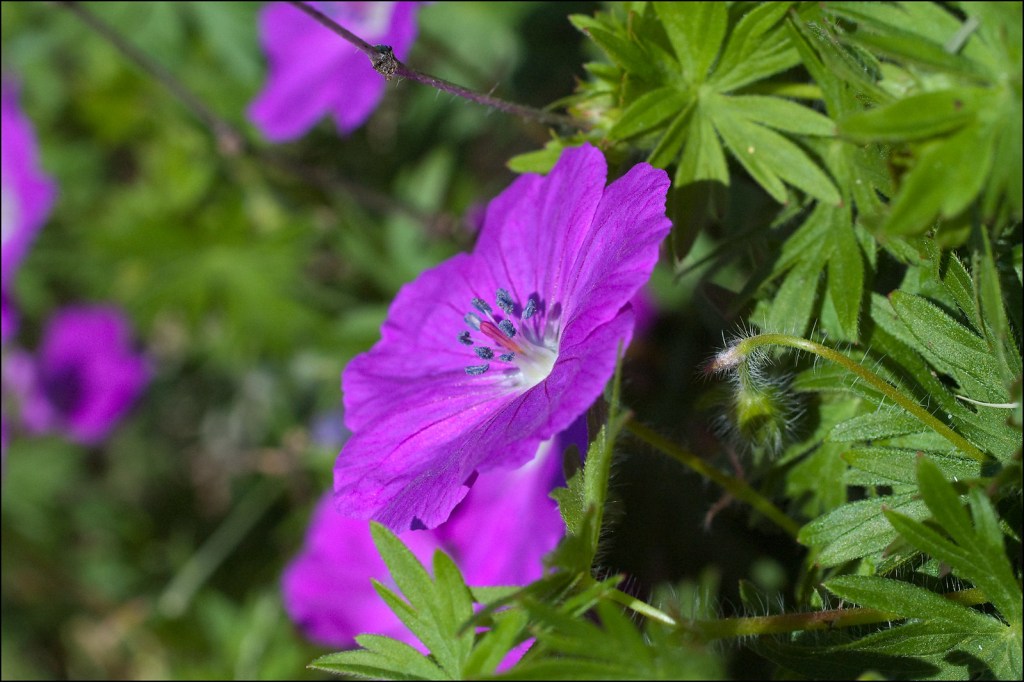
A Flower a Day for January: Cranesbill

Cranesbill, photo by joeldinda.

Because we need flowers in January.
~Joel Dinda

One of my favorite things about Michigan in Pictures is that sometimes I learn things that I really am not intending to learn. Such is the case today when I picked my favorite of Joel’s photos to highlight this year’s edition of his perennial feature, A Flower a Day for January. Joel started this in January of 2006, and every day he posts another flower to his flickr photostream.

The Wikipedia entry for Geranium sanguineum explains that it’s the county flower of Northumberland, commonly called Bloody Cranesbill or Bloody Geranium. The Geranium entry says that the genus name is derived from the Greek géranos meaning crane) and has a note:

The genus name is derived from the Greek γέρανος, géranos (meaning crane). The English name “cranesbill” derives from the appearance of the fruit capsule of some of the species. Species in the Geranium genus have a distinctive mechanism for seed dispersal. This consists of a beak-like column which springs open when ripe and casts the seeds some distance. The fruit capsule consists of five cells each containing one seed, joined to a column produced from the centre of the old flower. The common name cranesbill comes from the shape of the un-sprung column, which in some species is long and looks like the bill of a crane. Many species in this genus do not have a long beak-like column.

…Confusingly, “geranium” is also the common name of members of the genus Pelargonium (commonly known as ‘storksbill’ in distinction from ‘cranesbill’), which are also in the Geraniaceae family. Linnaeus (Swedish botanist Carl Linnaeus) originally included all the species in one genus, Geranium, but they were later separated into two genera by Charles L’Héritier in 1789.

Check this out background bigtacular More Flower a Day posts on Michigan in Pictures & see more in Joel’s 137 photo and growing A Flower a Day for January (x5) slideshow.

Support Michigan in Pictures with Patreon

Get Ready to ROAR!

PP_Zoo_0132-2-2 Lion web

PP_Zoo_0132-2-2 Lion web, photo by alj70.

The Detroit Lions travel to New Orleans tomorrow to face the New Orleans Saints in their first playoff appearance of this century.

My favorite sports blog, the Bleacher Report, has a nice preview of what should be a high scoring and exciting affair. Here’s a fantastic highlight video to get you roaring!

Check it out on black and in Alan’s slideshow … and GO LIONS!!

Powder Day … Month … State!

Powder Day - 2.19.09 #13

Powder Day – 2.19.09 #13, photo by CrystalMountainImages.

All January Absolute Michigan is celebrating Michigan skiing with and features on downhill and cross-country skiing, snowboarding along with photos and videos that take you up close and personal with the Michigan ski experience. We’re also giving away 4 pairs of tickets to 4 great Michigan ski resorts: Boyne Mountain, The Homestead, Shanty Creek and Crystal Mountain!

Michigan has 41 ski areas with 840 runs, more than 40 terrain parks and hundreds of kilometers of groomed cross-country trails, and January is the perfect month to enjoy it all. Head over to Absolute Michigan’s skiing page for all the details!

Check this out on black and see more in Crystal Mountain’s powder slideshow!

Into the Icy Void at the Eben Ice Caves

Into the icy void

Into the icy void, photo by Anapko.

I know that winter is here when the searchers start showing up – 50 or 100 or more each day – for the Eben Ice Caves. In our first post on the Eben ice caves, Northern Michigan University professor Dr. John Anderton (who I got to know by chance this spring) explained that the Eben Ices Caves are located just a few miles north of the little town of Eben, within the Rock River Canyon Wilderness Area.

Within its interior there are two short user-developed trails (totaling about 1.75 miles) leading to Rock River Falls and the Eben Ice Caves. An estimated 1,700 people visit the area annually (USFS records) …

The Ice Caves are not true caves at all. They consist of walls or vertical sheets of ice that form across the face of overhanging rock outcrops. In the summer, small unimpressive waterfalls and groundwater seeps may found along the overhangs. In the winter, however, the water hits the cold air, drips downward under the influence of gravity and freezes, creating spectacular ice caves. Each winter they look a little different, but typically there are openings in the ice that allow you to walk behind the ice walls.

The rock overhangs, where the ice caves form, consist of outcrops of Munising Formation (Cambrian) with a capstone of AuTrain Formation (Ordovician). The outcrops are found along the south side of the valley of Silver Creek, which is part of a network of secondary glacial drainage channels that formed during the Marquette Advance (about 10,000 years ago). Theses secondary drainage channels flowed easterly into the AuTrain-Whitefish Channel, a primary glacial meltwater channel that flowed south to the Lake Michigan basin. Groundwater naturally seeps from these rocks, providing the water necessary to form the ice caves in the winter.

Check this out background big and definitely do not miss Anapko’s Eben Ice Caves slideshow which includes a lot of great, wallpaper sized views and also a sign with more about this incredible natural wonder!