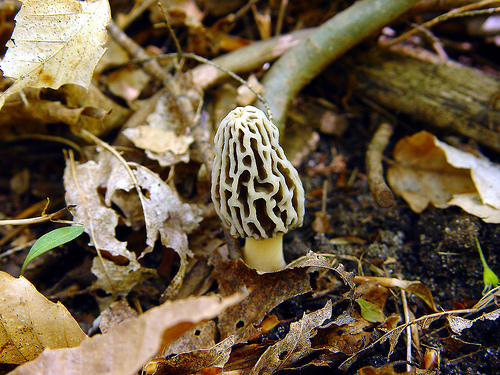
Morel Season in Michigan in March??

A real pretty White Morel

A real pretty White Morel, photo by rickrjw.

“We are seeing the unusual becoming the norm.”
~Nate Fuller, Southwest Michigan Land Conservancy

Michigan’s strange “Summer Spring” has seen magnolias, cherries, trillium, daffodils and all manner of plants blooming more or less at once under the pressure cooker of a week of 70 and 80 degree days. For some reason the news that morel mushrooms are being found already in Southwest Michigan has been the most shocking to me of all the action of so far. Hunters from further north in Manistee & Traverse City reported finding tiny ones as well at morels.com.

You can usually set your clock to morels in late April to early May, but it appears we have to revise our The general wisdom appears to be that although it is very early and pretty dry out there, forecast rain over the next few days could bring these delicious woodland treasures out.

Rick found this beauty last year around Boyne City. Check it out background bigilicious and see more in his mushroom slideshow.

Much more Michigan morel info on Michigan in Pictures.

South Fox Island Lighthouse

South Fox Island ... tower view, spring panorama

South Fox Island … tower view, spring panorama, photo by Ken Scott

The South Fox Lighthouse Association maintains this light, has lots of great history and photos and is a worthy target for your donations.

Recently, I made the acquaintance of Terry Pepper. Terry’s Seeing the Light is hands-down the best Great Lakes Lighthouse website out there and I’ve used him as a resource for years in dozens of lighthouse features on Michigan in Pictures. Terry told me I could lean on him (even more) for photos and information. It seems a shame to waste that gift, so here goes. On his South Fox Island Lighthouse page he begins:

South Fox Island is located approximately seventeen miles off Cat’s Head Point, at the tip of the Leelanau Peninsula. The story of this Island light began with Congress’s appropriation of $18,000 for the construction of a lighthouse there on March 2, 1867.

Work on the light station began immediately, with the construction of the Cream City brick tower. With walls thirteen inches in thickness, the square tower topped-out at forty-five feet in height, and contained a forty-eight step cast iron spiral staircase leading to the lantern room.

The lantern was outfitted with a flashing red Fourth Order Fresnel lens, and the station’s first keeper Henry J. Roe climbed the tower steps to exhibit the light for the first time on November 1, 1867.

Read on for much more including Keeper Warner’s battle with drifting sands and snow that piled so high as to interfere with access to the station’s buildings and more about that Cream City brick from Milwaukee.

View Ken’s photo bigger and see more in his slideshow from South Fox Island.

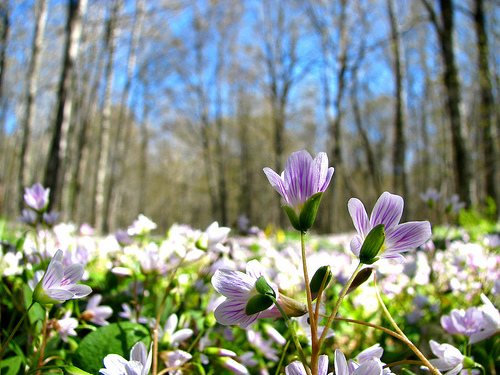
Spring Beauties say welcome spring!

tinyflowers_vista

tinyflowers_vista, photo by CreateWithKim

Wikipedia’s entry for the season of Spring says that the  vernal equinox, the point when the earth is straight on its axis and the sun passes directly over the equator. That put the official start of spring at 1:14 AM EST this morning. As the northern hemisphere tilts sunward, temperatures begin to warm and all kinds of good stuff starts growing and popping. A few of my personal favorites are daffodils, crocuses and yes, spring beauties. Yours?

According to the University of Michigan Herbarium, Michigan is home to two native species of ClaytoniaClaytonia caroliniana and Claytonia virginica:

The two native species of Claytonia only rarely grow side by side in the same forests in Michigan. When they do, C. virginica reaches the peak of its flowering later by at most a few days than C. caroliniana. The vegetative parts of both turn yellowish after a short flowering and fruiting season in the spring, and soon the plants are no longer seen above ground in forests which may have been carpeted with them a month previously. Both native species are extremely variable in leaf shape and size as well as in other characters, such as the aberrant presence of extra leaves on the stem. The petals are usually pale pink with deeper colored veins, but the ground color ranges from white to very deep pink; the corolla may be as much as 27 mm broad.

The photo above looks like virginica, but Kim shot this on the Pictured Rocks National Lakeshore and the Herbarium doesn’t list Alger as one of the counties it is found in.

Check this photo out bigger and in her Mostly Wildflowers slideshow.

March is the new May

Beach

Beach, photo by Second Glance Photos Kevin Ryan.

What a crazy weekend, with sunny & 70s recorded all over Michigan on St Patrick’s Day weekend and record temps set in many places yesterday including 82 degrees in my home of Traverse City.

82. In March. Add to that mosquitos biting, forsythia blooming and even spring peepers peeping and it’s clear that March IS the new May!!

Kevin shot this on Saturday in 75 degree weather at the beach in Grand Haven. Check this out bigger and in his pier/sunset slideshow.

Corktown, the Irish and St. Patrick’s Day in Michigan

Saint Patrick's Day Parade

Saint Patrick’s Day Parade, photo by *Alysa*.

May your blessings outnumber the shamrocks that grow,
And may trouble avoid you wherever you go.
~Irish Blessing

Happy St. Patrick’s Day everyone! Detroit had their parade last weekend but there are events on tap today and tomorrow in Bay City, Clare, Flint, Kalamazoo, Grand Ledge,  Saugatuck, Traverse City and Muskegon.

Ground zero for the Irish in Michigan is Corktown. Wikipedia notes that it is Detroit’s oldest neighborhood explaining:

The roots of Corktown lie in the Great Irish Potato Famine of the 1840s. The Irish immigrated to the United States in droves, and by the middle of the 19th century, they were the largest ethnic group settling in Detroit. Many of these newcomers settled on the west side of the city; they were primarily from County Cork, and thus the neighborhood came to be known as Corktown. By the early 1850’s, half of the population of the 8th Ward (which contained Corktown) were of Irish descent

The Corktown Historical Society has a cool slideshow of historic photos and brochure images and you might want to check out the Corktown Explorer blog.

The Irish in Michigan from Seeking Michigan has some information about Corktown but adds that:

Irish immigrants to Michigan certainly did not limit themselves to settling in the urban hub of Detroit, with many of them making their way up north. In the 1830s, Irish immigrants settled in fishing camps on Mackinac and Beaver Islands. Today, a large portion of Beaver Island’s year-round residents are of Irish descent. Wexford, Clare, Emmet and Antrim counties in the northern Lower Peninsula are all named after counties in Ireland. Irish immigrants were also instrumental to the copper mining boom in the Upper Peninsula. Nearly one-third of the area’s foreign-born population was from Ireland in 1870, though the Irish population would decline by 1920. Many small Irish communities could also be found scattered throughout the Lower Peninsula in the 1800s and early 1900s.

Wherever you are and whoever your ancestors were, here’s hoping you have a fun and safe St. Patrick’s Day holiday!

Check this out bigger and in Ann Lysa’s slideshow.

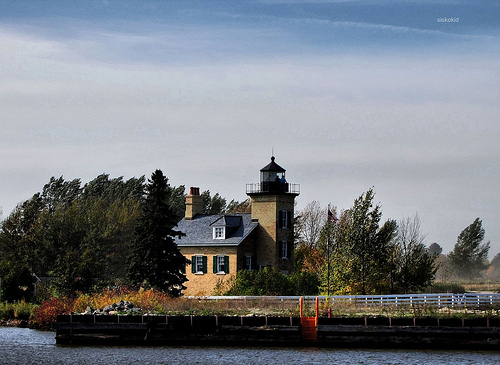
Ontonagon Lighthouse: Gateway to Copper Country

Ontonagon Lighthouse

Ontonagon Lighthouse, photo by siskokid

The Ontonagon Lighthouse is part of the Ontonagon Museum. Their page on the lighthouse explains that:

America’s first mineral rush began in earnest with the opening of the Copper District in Michigan’s Upper Peninsula to the prospectors and mining developers following the Treaty of 1842 with the Ojibwe nation. Suddenly there was a great need for navigational aids. Among the first five lighthouses established on Lake Superior was the one at the mouth of the Ontonagon River, the largest river that flows into Lake Superior from the south shore. In 1851, a wooden lighthouse was constructed on the west side of the river’s mouth to guide ships to the port from which copper was being shipped from the mines upriver. In 1857, the Winslow Lewis light was replaced with a 5th order Fresnel lens, the latest thing in lighting technology.

At that time, there was a sand bar across the river’s mouth, so only smaller craft could enter the bowl-shaped harbor (the name Ontonagon is a corrupted Ojibwe word that infers a bowl or bowl shape). With the opening of the first Soo Lock in 1855, shipping volume increased dramatically. Permanent breakwaters were constructed at Ontonagon, the sandbar was dredged out, and Ontonagon became the busiest port on Lake Superior.

You can get lots more information and photos about the Ontonagon Lighthouse and the copper boom in the region from Terry Pepper’s Seeing the Light.

Jim adds that the light was deactivated in 1963 after an automatic foghorn was installed on the west pier and a battery light was located at the end of the east pier at the  entrance into the Ontonagon harbor and marina. See his photo bigger and see more in his Lake Superior Lighthouses slideshow.


Michigan’s Hemlock Trees and the Hemlock Woolly Adelgid

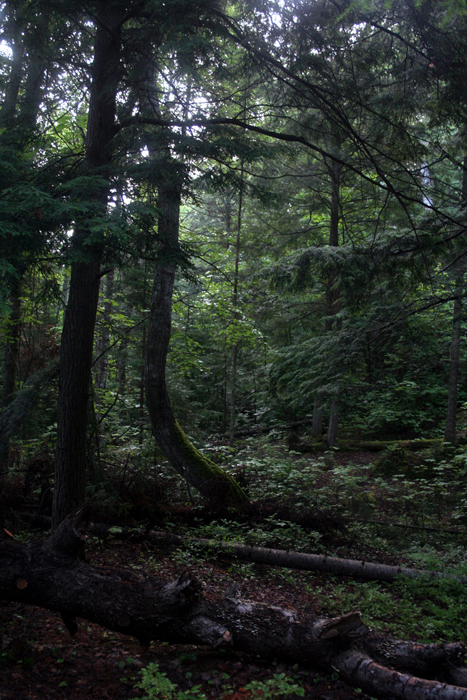
Curving Hemlock

Curving Hemlock, photo by Allison | SenecaCreekPhotography.com

Welcome to the latest in our ongoing Michigan Trees in Peril series (see below). Yesterday I came across an article on the Great Lakes Echo about an invasive pest that is making inroads in Ohio. The article notes that it’s in Michigan too, and answers my question of “What the heck is that bug?” from last fall.

The DNR page on the Hemlock Woolly Adelgid page from the Michigan DNR explains:

The hemlock woolly adelgid (Adelges tsugae Annand) is a small aphid-like insect that feeds on several species of hemlock (Tsuga spp.) in Asia, its homeland, and in North America since 1924. This insect is easily recognized during most of the year by the presence of a dry, white woolly substance on the young twigs. The “wool” is most abundant and conspicuous during spring. An egg mass resembles the tip of a cotton swab, although somewhat smaller. It is particularly noticeable on the underside of the young twigs.

There’s a lot more information on that page about the pest and efforts to combat it – click through for more. Wikipedia’s entry on Tsuga canadensis (Eastern Hemlock) says that:

The eastern hemlock grows well in shade and is very long lived, with the oldest recorded specimen being at least 554 years old. The tree generally reaches heights of about 31 meters (100 feet), but exceptional trees have been recorded up to 53 metres (173 feet).

The diameter of the trunk at breast height is often 1.5 metres (5 feet), but again, outstanding trees have been recorded up to 1.75 meters (6 feet). The trunk is usually straight and monopodial, but very rarely is forked. The crown is broadly conic, while the brownish bark is scaly and deeply fissured, especially with age.

Allison took this at the Twelvemile Beach Campground in the Pictured Rocks National Lakeshore. See it on black or in her Forest and Trees slideshow. You can also purchase through her photography website

A couple other trees in peril…

Into the Maelstrom: Winter Surfing in Frankfort

Frankfort Winter Surfing

Frankfort Winter Surfing, photo by lomeranger.

Sure, you’re crazy. But are you crazy enough for 17′ waves and 40 degree water?

See this photo from Frankfort bigger and purchase if you want at Jason’s Zenfolio.

More Michigan surfing on Michigan in Pictures!

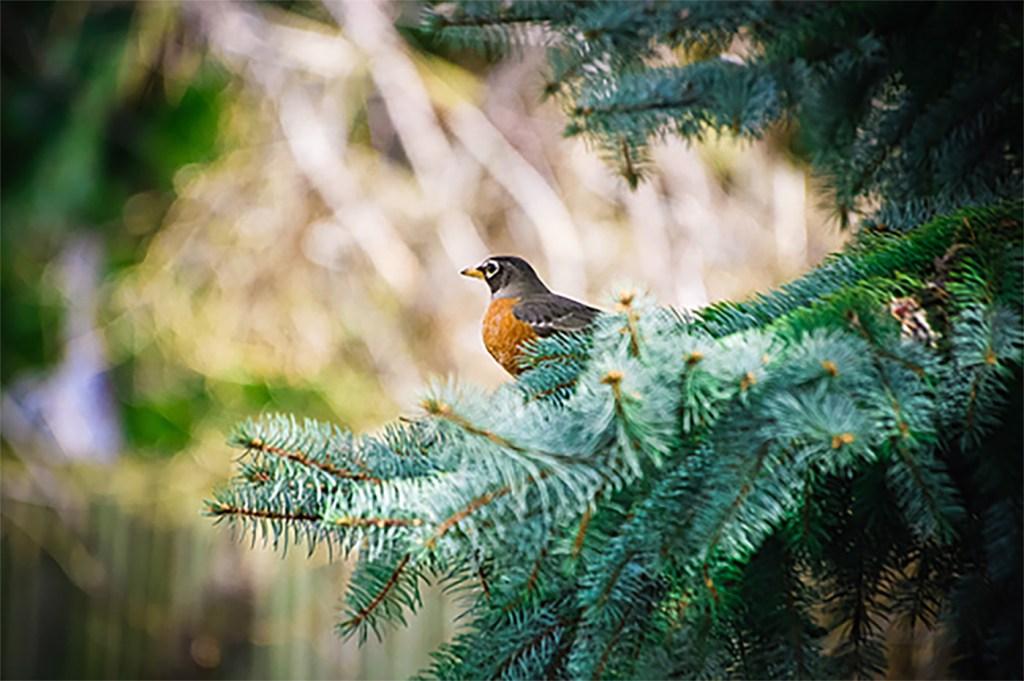
Michigan’s State Bird: The American Robin

American Robin by ShannenOMalley

American Robin by ShannenOMalley

“WHEREAS, A widely and generally conducted contest to choose a State bird, carried on by the Michigan Audubon Society, resulted in nearly 200,000 votes being cast, of which Robin Red Breast received many more votes than any other bird as the most popular bird in Michigan; and WHEREAS, The robin is the best known and best loved of all the birds in the State of Michigan; therefore BE IT RESOLVED BY THE HOUSE OF REPRESENTATIVES (THE SENATE CONCURRING), That the robin be and the same is hereby designated and adopted as the official State bird of the State of Michigan.”
~Michigan House & Concurrent Resolution, April 8, 1931

A sign of spring in Michigan is the sighting of your first robin. Like daffodils, they’ve showed up early this year. American Robin (Turdus migratorius) at All About Birds has some great facts and photos about our state bird:

The quintessential early bird, American Robins are common sights on lawns across North America, where you often see them tugging earthworms out of the ground. Robins are popular birds for their warm orange breast, cheery song, and early appearance at the end of winter…

  • An American Robin can produce three successful broods in one year. On average, though, only 40 percent of nests successfully produce young. Only 25 percent of those fledged young survive to November. From that point on, about half of the robins alive in any year will make it to the next. Despite the fact that a lucky robin can live to be 14 years old, the entire population turns over on average every six years.
  • Although robins are considered harbingers of spring, many American Robins spend the whole winter in their breeding range. But because they spend more time roosting in trees and less time in your yard, you’re much less likely to see them. The number of robins present in the northern parts of the range varies each year with the local conditions.
  • Robins eat a lot of fruit in fall and winter. When they eat honeysuckle berries exclusively, they sometimes become intoxicated.
  • Robin roosts can be huge, sometimes including a quarter-million birds during winter. In summer, females sleep at their nests and males gather at roosts. As young robins become independent, they join the males. Female adults go to the roosts only after they have finished nesting.
  • Robins eat different types of food depending on the time of day: more earthworms in the morning and more fruit later in the day. Because the robin forages largely on lawns, it is vulnerable to pesticide poisoning and can be an important indicator of chemical pollution.
  • The oldest recorded American Robin was 13 years and 11 months old.

Read on for more including the various songs of the robin and some video. More photos and info from Turdus migratorius (American robin) at UM Animal Diversity Web and at American Robin on Wikipedia. Also don’t miss A blue like no other: Robin’s Egg Blue on Michigan in Pictures.

More Michigan state symbols on Michigan in Pictures.

Support Michigan in Pictures with Patreon

Set your backgrounds for spring

Macro Crocus

Macro Crocus, photo by MightyBoyBrian.

Brian shot this on yesterday’s toasty-warm and not very March-like Sunday and writes:

Go ahead, set your background. I declare that it’s spring. The flowers think so and I do too.

I was slithering around on the ground with my new macro lens (EF format vs EF-S with canon full-frame) to get up in close with this patch of crocuses.

Here’s a tip: instead of a typical green or brown backgound, position yourself so that other flowers are in the background of the scene giving their color to the awesomeness.

Good advice, Brian, and with highs predicted for Wednesday in the SEVENTIES around Michigan, you might need to find us a strawberry so we can go directly to summer…

Check his photo out background big or settle back for his bokeh slideshow.