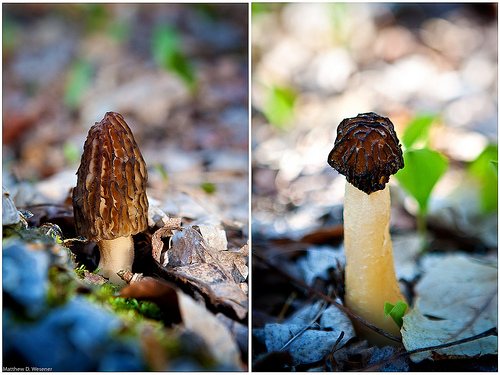
True/False (morel)

True | False

True | False, photo by M_Wesener

When in doubt, throw it out!
~The Mushroom Hunter’s Mantra

When you’re out looking for morels, this is one True or False question you want to get right! The False Morel page at The Great Morel exlains:

The “False Morel” has several species which carry scientific names such as Gyromitra esculenta, Verpa, Hellvella, and Disciotis. The Verpa and gyromitrin species are the most often mis-identified variety. The gyroomitrin is oten referred to as the “red mushroom”, the “beefsteak mushroom” or the “lorchel”. There are several true species of the false morel, and while some will say they can prepare and eat the false morel with no problem, others have a drastically opposite reaction to them. Hence, The Great Morel suggests that you do not attempt to digest this particular mushroom.

Research shows this species of the morel family is said to contain a toxic chemical called Gyromitrin, a toxic and possible carcinogenic chemical.

…The texture or makeup of the cap or head can typically have brain-like features, with folds in the caps, which some might describe as wrinkles, and are often brittle to the touch. The color will appear reddish or a brownish red, and will darken to almost a blackish red as the false morel ages. You can see some of this darkening beginning to take place on the image below. Sizes can vary from 2 inches to 10 inches.

One of the easiest ways of determining the false morel is by slicing it long ways. See the image below of a crosscut sectioning and note the meaty texture of the stem. False morels are not hollow, which is the most definite tip that you have stumbled up one of these ugly bad boys. The false morel shown in this image is also quite heavy as it is almost solid in the stem and meaty, and often referred to as “cottony”. Some expert mycologists go into greater detail in defining the relationship of the cap and the stem.

You can click through for some helpful photos and also check out the morel identification page at MichiganMorels.com.

Check this out bigger and in M Wesener’s slideshow.
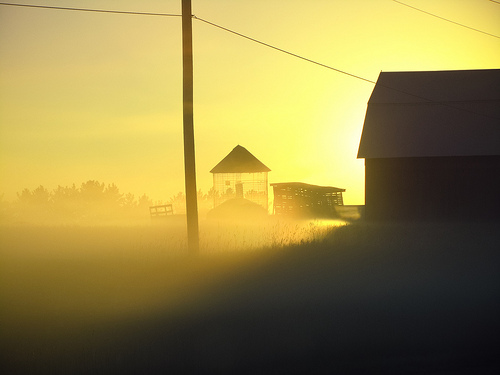
Welcome to May in Michigan

may light break through

may light break through, photo by beaconsoul

This morning the perfectly titled photo was posted to our Absolute Michigan pool on Flickr, and while it’s actually from August, it definitely captures the light and promise of warmth that May brings.

Over on Absolute Michigan we’ve posted our May Event Calendar for Michigan that is packed full of all kinds of fun across Michigan celebrating new life and the beginning of summer in the Great Lakes State.

Check this photo out bigger and in beaconsoul’s morning slideshow.

Detroit’s First Amusement Park: Electric Park

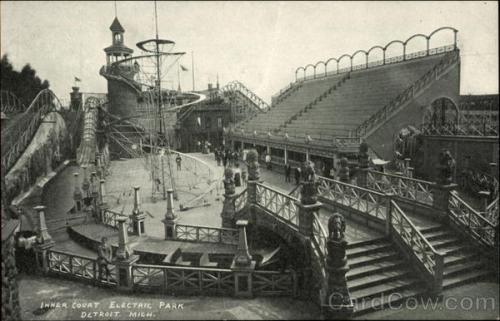
Inner Court Electric Park Detroit, Mich, photo by H.C. Hawkins

Today on Absolute Michigan we’re featuring a new festival called DLECTRICITY that is slated for October 5-6, 2012 on Detroit. DLECTRICITY organizers said that the name for the festival was inspired by Detroit’s first amusement park. The Detroit News Rearview Mirror page on Electric Park explains:

Electric Park, Detroit’s first mammoth amusement enterprise, opened May 26, 1906, near the Belle Isle Bridge approach. The Free Press heralded the opening of the park, “Detroit’s new Electric Park will be one of the largest in the world. Rome, with its seven hills will be a poor second to the roller coaster which is to be installed on the western site of the park. Here will be found l4 hills and any amount of hilarious fun my be derived within the enclosure.”

Owned by the Arthur Gaulker family, Electric Park, before it closed in 1928, went through many name changes and lengthy court battles over property rights. Some oldtimers remember the park’s nicknames: “Pike’s Peak, Lunar Park, Riverside or Granada.” Many of these names came from concessions located along the riverfront grounds.

You can read some more and see a whole bunch of great old photos at Electric Park on Water Winter Wonderland.

Northern Lights squared at Point Iroquois Lighthouse

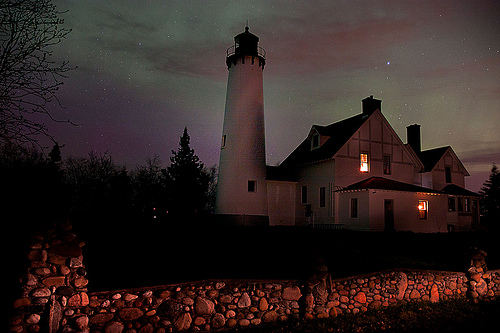
Iriquois Point Light and th Northern Lights

Iroquois Point Light and the Northern Lights, photo by yooper1949

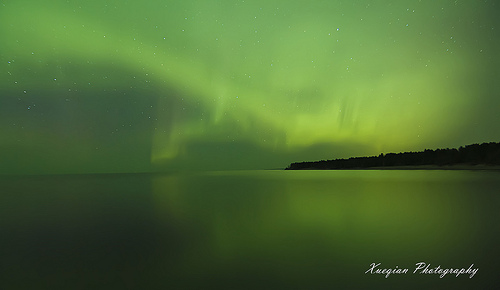
It’s hard to let the Northern Lights go when they come for a visit as they did earlier this week, so here’s one more shot! You can read all about Point Iroquois Light from Terry Pepper’s Seeing the Light.

The Iroquois tribe made their home far away in New York. Point Iroquois is located at the east end of Lake Superior, where the lake narrows into the St. Mary’s River. If you’re wondering like I was how this point came to bear their name, the brochure for Point Iroquois has the answer:

The area around Sault Ste. Marie (“The Soo”), including Whitefish Bay, has been called the “Heartland” of the Chippewa Indians. This tribe is also called Ojibwa, and sometimes refer to themselves as “Anishinabeg,” which is their word for “original people.” The Iroquois lived about 400 miles away, mostly in what is now western New York. In the 1600’s these nations were at war, at least in part because of European influence and fur trade competition. The Iroquois often sent expeditions far from their homeland and attempted to control the trade routes leading east from the Great Lakes.

Accounts of an important battle at Point Iroquois in 1662 have been passed down for over 300 years. They tell how an Iroquois war party camped near the point where the lighthouse now stands, and how the Chippewa secretly watched their movements and mounted a surprise attack near dawn. The Iroquois were defeated decisively, and apparently never again ventured this far west.

Here’s information on visiting Point Iroquois Lighthouse and you can also see it on Google Maps.

Carl seems to have a knack for shooting the Northern Lights at the lighthouses of Northern Michigan. Check it out background bigtacular and see a ton more in his Lighthouse slideshow.

Much more northern lights and lighthouses on Michigan in Pictures!

Arbor Day’s Michigan Roots

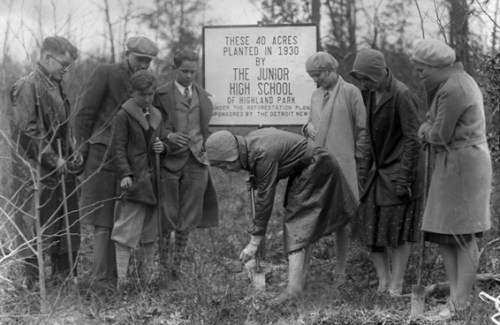
Highland Park Junior High School students plant trees, 1930, courtesy Walter P. Reuther Library, Wayne State University

We plant trees not for ourselves, but for future generations.”
– Caecilius

The Michigan Arbor Day Alliance explains that the first Arbor Day was celebrated in Nebraska on April 10, 1872. It was the brainchild of pioneer & journalist J. Sterling Morton to help restore plains that had been cleared for building materials, fuel and farming. Nebraskans planted over 1 million trees on that first Arbor Day, and Arbor Day became a legal holiday in Nebraska in 1885. Morton’s birthday of April 22 was selected as its observance and the holiday soon spread to other states.

Today, the most common date of state observance for Arbor Day is the last Friday in April, and several U.S. presidents have proclaimed a national Arbor Day on that Friday.

J. Sterling Morton’s love for trees came from his life in Michigan. Morton’s family lived in Detroit and he attended public school in Monroe, then later Albion College (Class of 1850) and the University of Michigan (Class of 1854). Morton missed the array of vibrant green trees he grew up with in Michigan and continued to plant them throughout his life.

…In 1885, the Michigan Legislature resolved “that the Governor is hereby requested to call the attention of the people of the state to the importance of planting trees for ornament and by naming a day upon which the work shall be given special attention to be known as Arbor Day.”

Until 1965, the Upper and Lower Peninsula had separate Arbor Days in the spring because of the difference in weather conditions for tree planting. Governor George Romney proclaimed an Arbor Week for the last week in April 1966. In his proclamation, Governor Romney broke with the traditional one day, “Because of the increased interest in and the importance of the statewide ‘Keep Michigan Beautiful’ program, one or two days do not afford enough time and opportunity for a full and proper observance of Arbor Day.”

“It is well that we bring attention to our trees and the need to continue to plant them about our homes, our places of business, our industries, our schools, our highways, and throughout the landscape so that their majesty will reflect our appreciation of the grandeur of nature and further the culture and economy of our state.”

Each year the Governor and Michigan Legislature proclaim the last week in April as Arbor Week and Arbor Day as the last Friday of that week.

The Michigan Arbor Day Alliance has a photo gallery of tree plantings from all over Michigan, monthly newsletters and their calendar has all kinds of events from across the state.

The photo above is from a great article about reforestation efforts in Michigan from Seeking Michigan.

Michigan’s State Tree: White Pine (Pinus strobus)

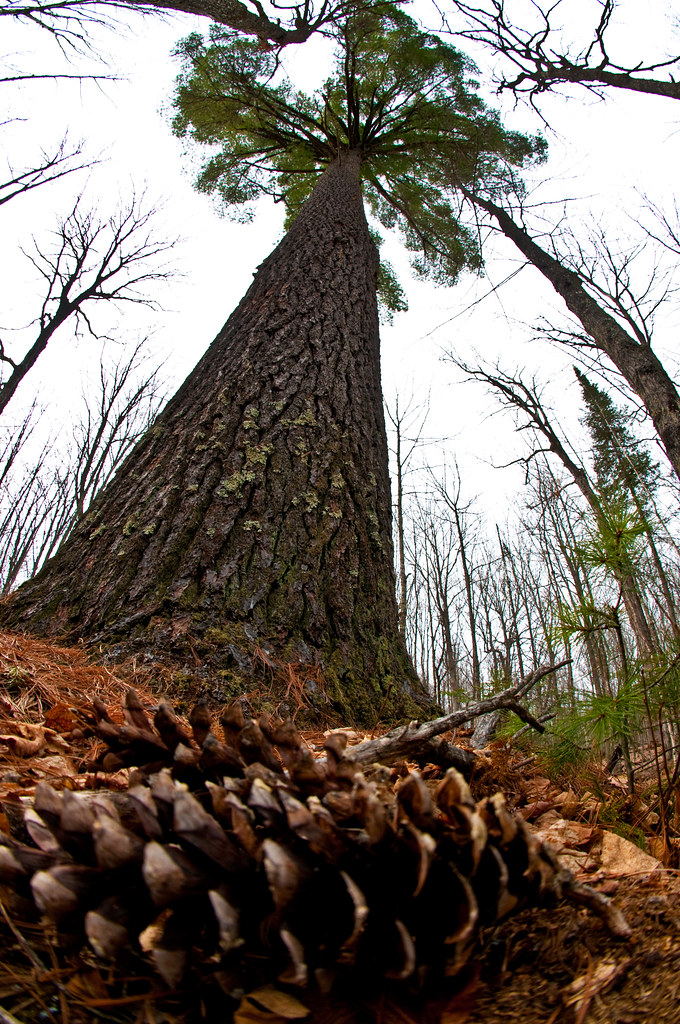
Michigan Wite Pine by Sven

13/52 by Sven

This week is Arbor Week, a week dedicated to celebrating and planting trees. One tree for Michiganders to celebrate is the eastern White Pine (Pinus strobus), which was adopted as our official State Tree by Act 7 on March 4, 1955. Here’s an edited summary of what I’ve learned about white pines.

The eastern white pine, is also known as “soft pine.” It was called the Tree of Peace by the Iroquois and in Ojibway, Zhingwaak. Mature white pines can easily live 200+ years of age, with some Michigan trees that have approached 500 years in age. The eastern white pine has the distinction of being the tallest tree in eastern North America, and pre-colonial stands were reported over 200′ in height.

It was said that when settlers arrived, a squirrel could travel in the forest canopy from one side of the state to the other. With this amazing resource, Michigan led the nation in lumber production in the 1880s and 1890s, and by the early 1900s, over 100 million of Michigan pine trees worth more than all the gold mined in California had been felled in the Lower Peninsula. Most of that value was in white pine, an when the forest was depleted, timber companies moved to the UP.

Small white pines are popular as Christmas trees due to their ability to hold needles, while large white pines were prized as ship masts and known as mast pines by the British navy. These trees were marked with a broad arrow by agents of the crown, a very controversial action that was one of the factors leading to the Revolutionary War. The original masts on the USS Constitution (aka Old Ironsides) were single trees before they realized that laminated trees were better about to withstand cannon fire.

More about the White Pine in Michigan

Scott writes that this mighty 200+ year old White Pine was spared the lumberjack’s axe, but he’s glad to have this remnant of the forest that once covered Upper Michigan standing sentinel in the forest surrounding his cabin. Check it out bigger and in his Fisheye slideshow. More of Scott’s work on his Facebook.

More of Michigan’s tallest things and more Michigan state symbols on Michigan in Pictures.

Support Michigan in Pictures with Patreon

April Northern Lights over Michigan

Reflection

Reflection, photo by Xavist on the colorful way

Quite a number of photographers in our Absolute Michigan pool caught photos of the aurora borealis. More including a great video over on Absolute Michigan.

See Xavist’s photo background bigtacular, catch another that is currently the cover of our Absolute Michigan Facebook or enjoy some great photos from the U.P. in his slideshow.

Much (much) more northern lights information & photos on Michigan in Pictures.

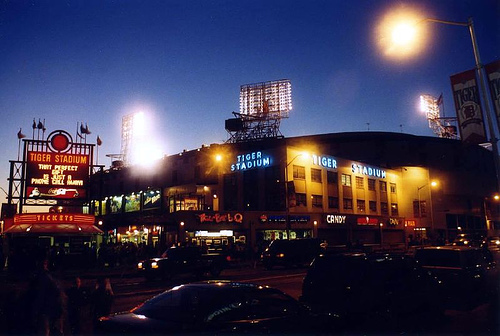
At the Corner: 100 Years at Tiger Stadium

at the corner

at the corner, photo by 1ManWithACamera

“It was the most famous address in Michigan. Not the number, but everyone knows the location. The corner of Michigan and Trumbull was a connection for everyone all over Michigan to the city of Detroit”
~Charley Marcuse, former hot dog vendor at Tiger Stadium

The above is a quotation from a heartbreaking feature on the 100th anniversary of Tiger Stadium that we are linking to today from 100 years at Tiger Stadium on Absolute Michigan. It’s chock full of great links, photos and a video narrated by Jeff Daniels and featuring Tiger greats Al Kaline, George Kell and Ernie Harwell.

The feature was especially heartbreaking for me as I was as guilty as most of the rest of the media that let this historic milestone pass unmarked. Don’t get me wrong – I think Comerica Park is a fantastic place to play baseball and a fitting home for the Tigers. To me, the shame lies in the manner in which one of the finest ballparks in all of baseball was cast aside by a city that seemed more interested in squeezing one last dime from the stadium at Michigan & Trumbull than celebrating and honoring her rich legacy.

Check this out bigger and in Larry’s great Detroit Tigers and their ballparks slideshow.

Much more on Tiger Stadium and the Detroit Tigers at Michigan in Pictures.

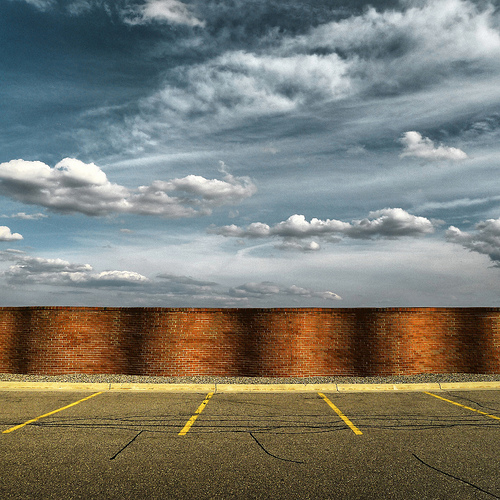
Henry’s Wavy Wall

Henry's WavyWall 2

Henry’s WavyWall 2, photo by swatzo

Check it out bigger and in Steve’s Panasonic LX-5 slideshow.

Earth Day, are you doing it?

Come On Everybody Is Doing It

Come On Everybody Is Doing It, photo by B0nes

Sunday (April 22) is the 42nd Earth Day. You can read about Earth Day’s Michigan roots and much more on Michigan in Pictures. Here’s a few more links:

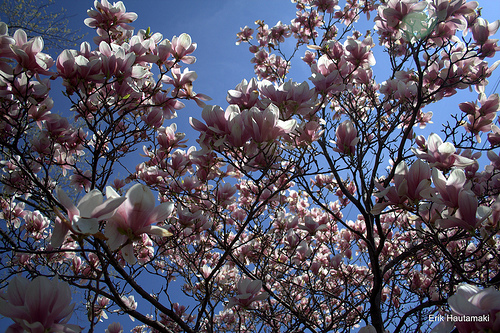
Erik took this on Earth Day in 2010. Check it out bigger and in his Spring slideshow.