The Gray Treefrog doesn’t care if you’re confused

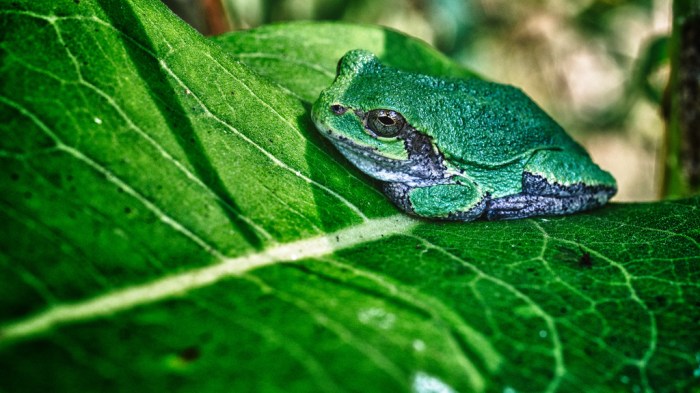
Gray Tree Frog

You Can’t See Me, photo by MacDonald_Photo (Formerly Sl33stak)

Michigan has two species of Gray Treefrog – the Eastern (Hyla versicolor) and Cope’s (H. chrysoscelis) that are hard to distinguish, sometimes even sharing the same ponds. Check out the Hyla versicolor page at the UM Animal Diversity Web for a bit about that. Their color spans a range of gray, green or brown according to environment or activity. See a collection of photos showing their wide range of color at the UM Animal Diversity Web.

They can be found in woods, swamps and your own backyard. Their ability to climb vertically & horizontally is due to their specially adapted toe pads, and you’ll sometimes find them on your screen windows at night. You’ll hear their short musical trill on warm spring & summer nights.

Jamie writes that he walked 20′ into the woods off a heavily used path and ran into this little guy – small as his thumb and sitting on a milkweed. Check this out background bigtacular and see more in his Fauna slideshow.

More Michigan frogs on Michigan in Pictures. Or, for something different, here’s what we have for green!

Unchaining a River: Restoring the Boardman River

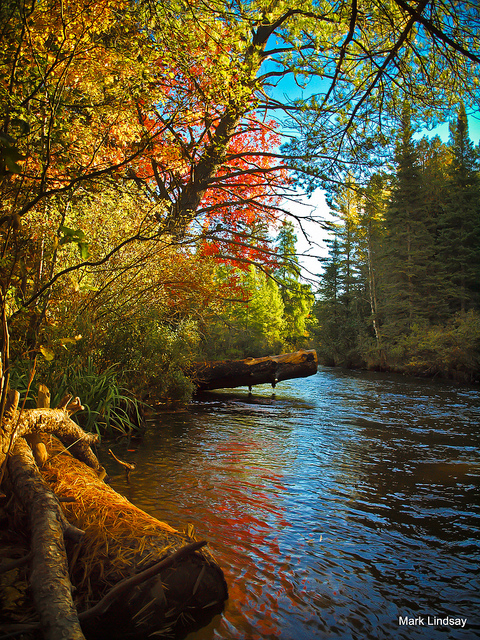
Poetry of Nature, photo by Mark Lindsey

“We’re healing one of Mother Earth’s arteries. I think she’s been hurting for a long time.”
~Hank Bailey, Grand Traverse Band Natural Resources Official

The Boardman River watershed encompasses 291 square miles and flows 179 miles from its origin in Kalkaska County to West Grand Traverse Bay in Traverse City. Last Wednesday, the process of removing three no longer used hydro-electric dams from the Boardman began at Brown Bridge Dam. The removal of the three Boardman River dams (Brown Bridge, Sabin & Boarman) will be the largest dam removal project in Michigan’s history, and the largest wetlands restoration in the Great Lakes Basin. It will allow the Boardman to return to a more natural state as a free-flowing, cold-water river. You can read all about the dam removal on the Boardman River website which explains:

The Boardman River was formed after the last retreat of glaciers covering Northern Michigan approximately 10,000 years ago. The proto-Boardman River was a tributary of the Manistee River and flowed south to Lake Michigan. The course of the river changed as early headwaters streams cut through glacial deposits and joined with the proto-Boardman River. This allowed the Boardman River to flow north and empty into Grand Traverse Bay. Glacial deposits, in particular the Kalkaska series soil, are responsible for the high quality of the Boardman River.

…Americans living in the area knew the River by another name. They valued the river as an important transportation route as well as a source of sustenance. Early European settlers called the river the “Ottawa” after the local band of Native Americans. Things changed when Captain Harry Boardman came to the area around 1848, established a sawmill, and acquired timber rights for the area. Captain Boardman stored logs for his sawmill in a natural lake on the Ottawa River, which became known as “Boardman’s Lake.” In time, the entire river became known as the “Boardman River.” In 1852 Captain Boardman sold his timber rights to the real timber barons of time, Perry Hanna & Tracy Lay. The Boardman River played a vital role in the economic growth of the region as it was cleared of debris in order to drive logs downriver to the mills. This process fueled a growing city but was devastating to the river’s aquatic habitat, contributing to the extirpation of Michigan Grayling in the river. After the logging era, several dams were constructed to provide power for the growing needs of Traverse City. These hydroelectric dams originally supplied a large percentage of the city’s electrical needs, but this declined over time. Before being decommissioned in 2005, these dams only provided 3.4% of the power used by Traverse City Light & Power customers each year.

Of approximately 179 miles of stream in the Boardman River Watershed, 36 are designated as “Blue Ribbon” trout habitat. These areas, located upstream of the Beitner Road crossing are premier fish habitat and important to anglers. Boardman River anglers have an important economic impact on the region. The entire watershed is also used for activities such as canoeing, tubing, kayaking, hiking, hunting, and bird watching. These uses make it a destination for an estimated 2 million Recreational User Days annually.

This project seems to me to be an excellent example of “government done right” – an adequately funded effort that leverages a wide range of scientific experts to protect property owners while restoring a natural resource to its natural state. There’s also a Boardman River Prosperity Plan that will seek to turn a solid environmental decision into a sound economic one was well.

Also see this feature on IPR News Radio and a cool video about the dam removals produced for The Grand Vision Natural Resource Network by Miles Chisholm of the Grand Traverse Band of Ottawa and Chippewa Indians. The video includes some great old photos of activity on the river.

Mark took this photo in October 2010 when the colors were callin’ – see it on black and see more in his Explored slideshow.

Have you gotten your dose of Vitamin N today?

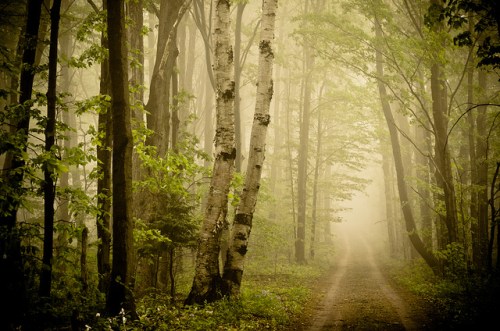
Green Point in Fog

Green Point in Fog, photo by *ojoyous1*

I was paging through a copy of the AARP Bulletin (not mine … yet) and came across an interesting little article about the benefits of spending time in nature by Richard Louv. Louv wrote the book Last Child in the Woods, which introduced the concept of “nature-deficit disorder”. He writes:

A growing body of research links more time in nature — or in home, work or hospital environments enhanced through nature-based design — with reduction of stress and depression, faster healing time and less need for pain medication.

Health care professionals are taking note. In 2010, a pilot program in Portland, Ore., began pairing physicians with park professionals, who helped children and families get their green exercise or, as I call it, their dose of “vitamin N.”

Other benefits of vitamin N include enhanced use of the senses and higher work productivity. In 2008, University of Michigan researchers demonstrated that, after just an hour interacting with nature, memory performance and attention spans improved by 20 percent. In April, researchers at the University of Kansas reported a 50 percent boost in creativity for people who were steeped in nature for a few days.

Michigan is blessed with an amazing amount of opportunities to slip into nature for ten minutes or ten days so what’s stopping you?? Check out books and more at Richard Louv’s website.

Joy took this photo at the Green Point Nature Reserve near Elberta. Check it out bigger and in her Up North slideshow.

More nature on Michigan in Pictures!

Farmland Sundown

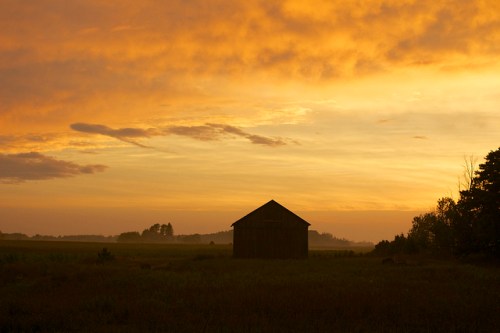
Farmland Sundown

Farmland Sundown, photo by karstenphoto

Near Montague. Check this out background bigilicious or in Steven’s sunset slideshow.

More sunset wallpaper on Michigan in Pictures.

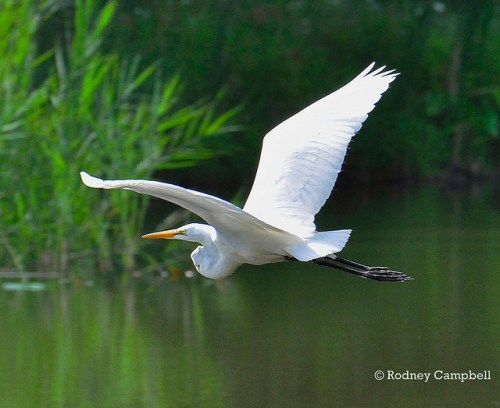
Great Egret (Ardea alba) in Flight

Great Egret (Ardea alba) in Flight

Great Egret (Ardea alba) in Flight, photo by AcrylicArtist

The Michigan Bird Atlas has a nice document on the Great Egret in Michigan that says (in part):

Today, the Great Egret is a powerful symbol of early conservation efforts mounted to safeguard it and other species from overhunting for their feathers in the 1800s. Protection in the early 1900s is credited with population recovery and establishment of the Great Egret as a breeding species in Michigan approximately 50 years ago.

…Great Egrets reach the northern edge of their U.S. distribution in Michigan. Historically, there is no evidence that this species nested in Michigan until the 1950s. For example, Barrows (1912) and Wood (1951) did not report Great Egrets as breeders in Michigan at the time of their studies, but Kelley et al. (1963) confirmed nesting in 1954 by nine pairs on Stoney Island (Detroit River) and seven on Dickinson Island (Lake St. Clair). These colonies appear to have persisted into the mid-1970s when W. Scharf et al. (1978) documented egrets at these sites in 1976. Although these colonies were no longer active at the time of the 1989-91 Great Lakes Colonial Waterbird Census, Sharf and Shugart (1998) reported new colonies in Saginaw Bay and at Pte. Mouillee State Game Area, Monroe Co.

The UM Animal Diversity Web has some information, calls and photos for Ardea alba, and also Great Egret (Ardea alba) on Michigan in Pictures.

Check this photo out background big and see more in Rodney’s Animals slideshow.

More Michigan birds on Michigan in Pictures.

Start your (lake effect snow) engines?

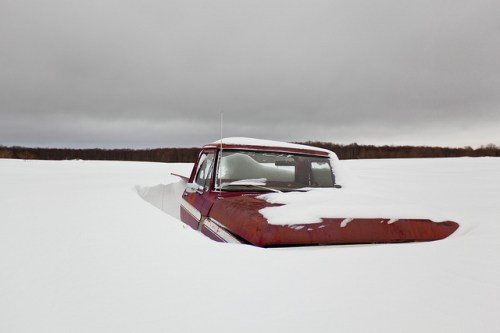
Parked for the Season

Parked for the Season, photo by Rudy Malmquist

Jennifer Kalish of the Great Lakes Echo writes that our summer heat could produce more winter snow:

The record high temperatures this summer could mean some Great Lakes coastal residents will get buried in snow this winter.

“There’s certainly a lot of evidence to suggest that we will go into this fall with warmer than normal lake temperatures,” said Jeff Andresen, state climatologist for Michigan. “That could lead to an increase in the amount of lake-effect precipitation we see, but it isn’t certain.”

Lake-effect snow happens when cold dry air that moves south over Canada meets the warm waters of the Great Lakes, Andresen said.

The cold air picks up moisture as the warm water evaporates from the lake, forms into clouds and then dumps snow onto nearby cities and towns, Andresen said. The greater the difference in temperature between the warm water and cold air, the more snow will fall.

That means the warm summer is only part of the recipe for lots of lake-effect snow.

Read on at the Echo.

Check this photo out bigger and see more in Rudy’s snow slideshow.

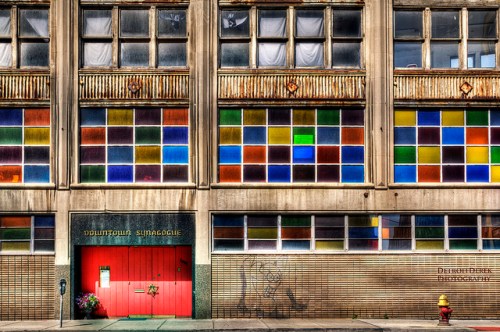
Downtown Synagogue of Detroit

An Amassment of Colors

An Amassment of Colors, photo by DetroitDerek Photography

The Isaac Agree Downtown Synagogue (of Detroit) explains that:

The Isaac Agree Downtown Synagogue (IADS) was established in 1921, at a time when there were many synagogues located in Detroit. Its principal mission was to address the unmet needs of the Jewish community ― particularly for those who worked downtown, were unaffiliated with another synagogue, or were visiting the city―by providing a traditional (Conservative) Jewish presence in the heart of Detroit.

…As much of the Jewish community migrated to suburban Detroit, the IADS―like the city itself―has suffered from a shrinking population and a depletion of resources. In recent years, daily services have, of necessity, been eliminated. However, the Downtown Synagogue proudly continues to offer weekly Sabbath services, as well as High-Holiday services, the latter of which attracts hundreds of worshippers.

The Synagogue is currently housed in a historic four-story building, a building that it has occupied and owned since the early 1960s. Located at 1457 Griswold Street, it is well situated, but is in serious need of major repair. Currently, parts of it are unusable. However, the unique triangular design creates an uncomparable, interesting space. The potential for this building is far from being realized.

This Sunday (August 19), they are offering J-Cycle, a bicycle tour of historic Jewish Detroit. A portion of the proceeds will be donated to the Back Alley Bike Project, at the Hub of Detroit, a non-profit organization providing cycling education and services with a focus on youth development, sustainable practices and community access.

See Derek’s photo on black and in his massive and amazing Detroit slideshow.

Also see a few more pics from the Absolute Michigan pool.

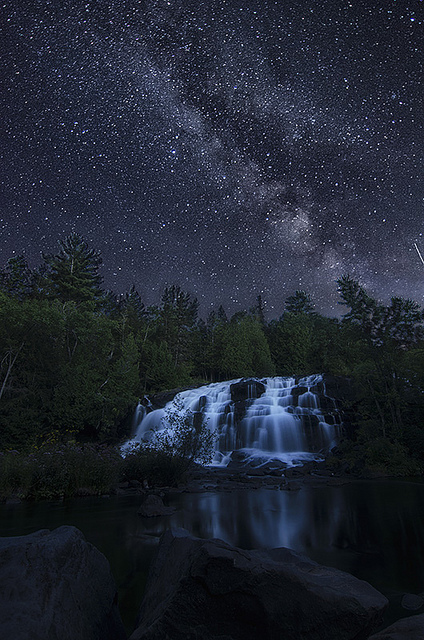
The Bond Falls under the Milky Way

The Bond Falls under the Milky Way

The Bond Falls under the Milky Way, photo by adonyvan

Jiqing Fan takes some incredible photos, some of which we’ve featured on Michigan in Pictures.

Definitely check this shot from the Perseid Meteor Shower out on black and in his Houghton & UP MI slideshow.

More about Bond Falls and the surrounding area and also the Perseid shower (which you’ll still be able to catch all week) on Michigan in Pictures.

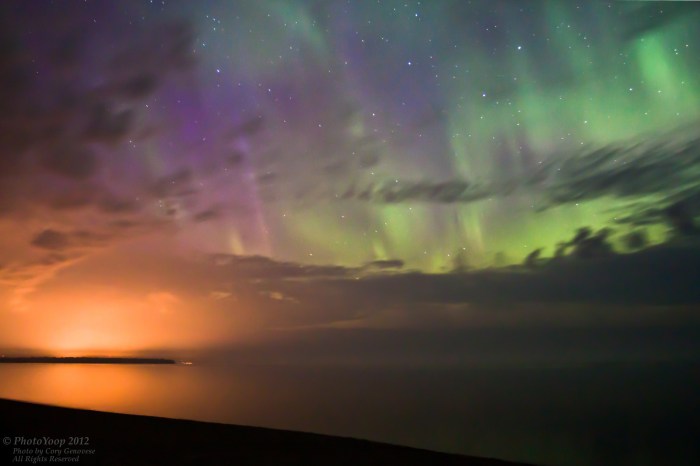
The Northern Lights of Superior

The Northern Lights of Superior

The Northern Lights of Superior, photo by PhotoYoop

Happy Saturday – I hope that lots of you are getting out to see the Perseid meteor shower tonight and tomorrow night!

Cory took this a couple of weeks ago in another auroral outburst in what has been a great year for the northern lights in Michigan.

Check it out on black, see a couple more shots in his slideshow or check out more of Cory’s great photos from after dark in his Night Time slideshow.

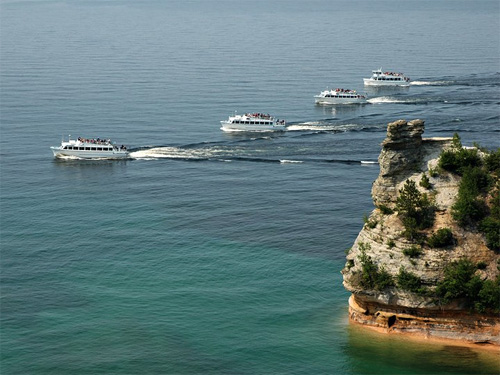
Pictured Rocks fleet at Miners Castle

Pictured Rocks fleet at Miners Castle, photo by ExploreMunising.com

The above photo was posted to the ExploreMunising.com Facebook last July. It shows four boats from the Pictured Rocks fleet passing Miner’s Castle in the Pictured Rocks National Lakeshore.

The tour boats are a great way to see the many formations the Lakeshore offers. Visit their website for tour highlights and also a nice photo gallery.

More Miner’s Castle photos on Michigan in Pictures.