Eastern Chipmunk (Tamias striatus)

Untitled

Untitled, photo by kdclarkfarm1

The newly redesigned University of Michigan Animal Diversity Web says that Tamias striatus (eastern chipmunk):

Eastern chipmunks live in shallow burrows in the ground. They are partial to areas near rocky crevices, decayed tree trunks, and fence corners. They do not like dense forests where no sunlight reaches the ground. Burrows are made by digging and carrying away the dirt in their pouched mouths. Unlike prairie dogs and other sciurids, eastern chipmunks do not leave the dirt in mounds near the entrances of their burrows. This makes it harder for predators to find chipmunks in their homes. These burrows can be up to 30 ft. in length with several different exits and tunnels. Eastern chipmunks conceal the exits with leaves and rocks. They may inhabit these burrows for several years.

Eastern chipmunks are larger than most chipmunks. They are reddish brown in color with 5 black stripes on their backs. These stripes are separated by brown, white, or grey fur stripes. They also have white and dark markings around their eyes. The stomach is usually a yellowish brown or white color. Their tails are reddish brown and furry, but not bushy like common squirrels. Like many rodents, Tamias striatus has 4 toes on the front feet and 5 toes on the rear feet.

…Eastern chipmunks have excellent vision, hearing, and sense of smell. They communicate with each other by making a variety of sounds, including the ‘chip’ for which they are named.

Tamias striatus eats a wide variety of foods including nuts, acorns, seeds, mushrooms, fruits, berries, and corn. They also eat insects, bird eggs, and sometimes small vertebrates such as young mice.

Read more and see a bunch more photos of chipmunks as well!

Check this out background big (which is decidedly bigger than a chipmunk) and see more in Diane’s slideshow.

More Michigan animals right here.

Singing along in Michigan

Pure Michigan Statewide Singalong in Flint, photo by Rob Bliss

via Absolute Michigan

Rob Bliss & Jeff Barrett, creators of the fantastic Grand Rapids lip dub video premiered their Pure Michigan Statewide Sing-along at halftime of the Lions game on Sunday. It was filmed in 50 Michigan cities in 7 days. It’s a pretty cool travelogue of the Great Lakes State in under 4 minutes.

Check out the finished video on YouTube and also don’t miss the behind the scenes blog from PureMichigan.org.

The biggest apple in Michigan … and the smallest crop

Biggest apple in Michigan. Wolf River apple. 1996

Biggest apple in Michigan. Wolf River apple. 1996, photo by vostok71

Orange Pippin says that the Wolf River apple (first discovered along the river of the same name in Wisconsin) is:

A well-known American cooking apple, notable for its large size. Wolf River is mainly used for cooking, and it keeps its shape when cooked. It is fairly sweet and doesn’t need much sugar added.

Wolf River has a very high natural resistance to the disease apple scab, and good resistance to fireblight and mildew. It is also very cold hardy, making it a good choice for growing in the northern part of North America.

The Freep notes that the extreme damage to Michigan’s 2012 apple crop has created problems for those in the apple business:

Prices will vary, but consumers can expect fresh apple prices to be about 30% to 50% higher than last year, according to Bob Tritten, Michigan State University Extension Service fruit educator for southeast Michigan. Cider prices are up about 50%.

Last year’s Michigan apple crop was about 26 million bushels, said Dawn Drake, manager of the Michigan Processing Apple Growers Division, a branch of the Michigan Farm Bureau. But early warm weather forced the apple blossoms out early, and that was followed by several days of freezes, which killed most of the tender young blooms.

“This year they’ll be lucky to have 2 (million bushels),” Drake said.

Sergei didn’t think much of the taste when he tried it at the Tree-Mendus Fruit Farm in Eau Claire, but I read that the Wolf River doesn’t reach full flavor unless it gets hit by frost. Check it out bigger and see more in his Fall slideshow.

The Quincy Copper Smelter

Abandoned Quincy Copper Smelter Pano / See the set.

Abandoned Quincy Copper Smelter Pano, photo by Whitney Lake

The Quincy Smelter Association says:

The Quincy Smelter is the only remaining copper smelter in the Lake Superior Region. Built by the Quincy Mining Company, the smelter used heat and chemical processes to turn copper ore into ingots. The ingots were then sold and shipped to factories where they were turned into products such as copper wire or tubing.

From 1898 to 1967 the Quincy Mining Company Smelter at Ripley processed copper, first from its mines and then later from its reclamation plant. The smelter complex is built on the stamp sand of the Pewabic mines’ mill. It continued to melt scrap copper until 1971.

Among the buildings remaining on the site are the three-story blast furnace, built in 1898, with additions in 1904 and again in 1910. The sandstone faced mineral warehouse built in 1904 is reached by a 460-foot trestle. The site also includes three rectangular warehouses, a concrete block briquetting plant built in 1906, a powerhouse, a casting house, carpenter and cooper shop for making barrels, as well as a machine shop, and laboratory.

The Copper Country Explorer has an incredible, multi-part tour of the Quincy Smelter that is rich with history and photography new & old. I can’t recommend that link enough! You can get some interesting stories of life at the smelter and the machines they used from the Quincy Smelter blog. The Keweenaw National Historical Park continues the story in Quincy Smelter Stabilization and Rehabilitation, saying that the smelter is now owned by Franklin Township:

The smelter complex is unique in the country and, perhaps, the world in the number and types of 19th and early 20th century buildings and landscape features that survive.

The continued survival of these structures is tenuous. Preservation of the complex is proving challenging. Since the final shutdown of the smelter in 1971, little has been done to maintain it. Severe winters and neglect have taken a sizeable toll; some buildings have collapsed, others are nearly so. Franklin Township took on the property as a preservation-friendly owner, and has endeavored to find new uses for the historic complex, including simply opening it as a heritage attraction as part of Keweenaw National Historical Park.

They also have a report on conditions at the site and plans for the future (includes a nice map of the site). If you’re interested in Michigan’s mining heritage, the Keweenaw National Historical Park (established 1992) is a relatively new and interesting project of the NPS.

Definitely check this photo out on black and see more in Whitney Lake’s Quincy Smelter / Michigan slideshow.

More from the Keweenaw National Historic Park on Michigan in Pictures.

God’s Duck

SQUASH DUCK

SQUASH DUCK, photo by marsha*morningstar

Here’s the latest in the always popular Michigan in Pictures Duckie Series.

Marsha writes:

Seriously, untouched—-exactly how it grew and the markings are natural…just a little saturation of color and edging but this is really Gods duck.

See it bigger and in Marsha’s slideshow.

The Edge of Isaac

The Edge of Isaac

The Edge of Isaac, photo by StacyN – MichiganMoments

Hurricane Isaac’s northern push as see at sunset at Ludington State Park (or see the DNR site). I know this is twice in a week for Stacy, but I guess that’s just how it is sometimes.

Check this out bigger and in her Most Interesting slideshow.

More Michigan weather on Michigan in Pictures.

Purple Martins (and Mosquitos)

Decoy Upside down

Decoy Upside down, photo by F. D. Richards

Putting up a Purple Martin house is like installing a miniature neighborhood in your backyard. In the East, dark, glossy-blue males and brown females will peer from the entrances and chirp from the rooftops all summer … Our largest swallows, Purple Martins perform aerial acrobatics to snap up flying insects.
~ All About Birds

The Purple Martin Conservation Association says that Purple Martins (Progne subis) are the largest member of the swallow family in North America, measuring 7 1/2 inches (19 cm) long and weighing 1.9 ounces (55 grams). Of the three races (subspecies), the ones we see in Michigan are Progne subis subis. The PMCA page on Attracting & Managing Purple Martins says:

Purple Martins spend the non-breeding season in Brazil then migrate to North America to nest. East of the Rockies they are totally dependent on human-supplied housing. West of the Rockies and in the deserts they largely nest in their ancestral ways, in abandoned woodpecker nest cavities. In the Pacific northwest, Martins are beginning to use gourds and clusters of single-unit boxes for nesting.

The pair-bond of the Purple Martin is monogamous. The male and female cooperate equally in building the nest out of mud, grass and twigs. The female lays two to seven pure-white eggs at a rate of one egg per day. The female incubates the clutch for approximately fifteen days, then the young hatch. The parents both feed the young continuously for a period of 26-32 days until the young fledge. The young continue to be dependent on their parents for food and training for an additional one to two weeks after fledging. It’s not uncommon for the fledglings to return to their human-supplied housing at night to sleep during this period. (Click to see an animation of the growth of a nestling purple martin.)

Martins, like all swallows, are aerial insectivores. They eat only flying insects, which they catch in flight. Their diet is diverse, including dragonflies, damselflies, flies, midges, mayflies, stinkbugs, leafhoppers, Japanese beetles, June bugs, butterflies, moths, grasshoppers, cicadas, bees, wasps, flying ants, and ballooning spiders. Martins are not, however, prodigious consumers of mosquitoes as is so often claimed by companies that manufacture martin housing. An intensive 7-year diet study conducted at PMCA headquarters in Edinboro, PA, failed to find a single mosquito among the 500 diet samples collected from parent martins bringing beakfuls of insects to their young. The samples were collected from martins during all hours of the day, all season long, and in numerous habitats, including mosquito-infested ones. Purple Martins and freshwater mosquitoes rarely ever cross paths. Martins are daytime feeders, and feed high in the sky; mosquitoes, on the other hand, stay low in damp places during daylight hours, or only come out at night.

While it sounds like purple martins aren’t the mosquito machine that they’re sometimes billed as, it does sound like they’d make a great addition to your yard!  Read on to learn about all kinds of things you can do to make your martin house a home. Also check out their songs page and get a lot more info and photos from the All About Birds Purple Martin page.

Check this photo out background big and in F.D.’s Birds slideshow.

Aboard the Friends Good Will

P5115272_4639

Untitled, photo by bvriesem

“We have met the enemy and they are ours: Two Ships, two brigs, one schooner and one sloop.”
~United States Commodore Oliver Perry

The sloop was Friends Good Will, captured by the British briefly. The story of the Friends Good Will begins:

Oliver Williams was born in Roxbury, Massachusetts, a village near Boston, in 1774. Undoubtedly, he grew up aware of, and hearing stories about, the birth of his young nation.

Oliver Williams later saw opportunity in the vast Northwest Territory. He opened a dry goods store in Detroit, Michigan Territory, in 1808. The inventory for his store, like nearly all finished goods, came from the east. He made two trips each year, overland. The trips were slow and the resources he expended were never anything more than a continuing drain against whatever profits early businesses in the cash starved frontier would permit.

In 1810, Oliver Williams took a chance. The gamble was not particularly unusual for men of his nature. Men did not conduct business on the frontier without an entrepreneurial instinct. He decided to build a ship. The vessel would use the only “highway” available – Lake Erie; Buffalo to Detroit, non-stop, direct. His inventory would arrive faster, and in greater quantity, and while the vessel was a substantial capital outlay, she would sail for years and could earn money by shipping goods the length of each shipping season. Other vessels plying the Lakes were finding cargoes and the steady stream of settlers assured volumes of cargo and demand for the ship would only grow with each coming season.

Oliver Williams built his ship at the River Rouge, on the banks of the Detroit River. A private shipyard was laid out adjacent to the Federal yard, where the army transport snow Adams, the only government vessel on the upper Lakes, was built years before. Other ships sailed past while this new vessel took shape, the schooners Salina and Ellen and the sloop Contractor. The sight of each of them only encouraged Oliver Williams. His idea had merit; his gamble would pay.

The new ship slid down the ways, in early 1811. He christened her Friends Good Will. While no one knows for certain the origin of the name, a coincidence seems too obvious to ignore. The name may well have been in honor of an earlier Friends Good Will, which transported the first wave of Irish immigrants from Larne to Boston in 1717. It is likely Oliver Williams knew her story and borrowed her name. His vessel, he likely hoped, would also bring waves of settlers to a new land of opportunity ­ the Michigan Territory.

Read on for much more of the story of the remarkable story of the Friends Good Will including her capture by the British and subsequent adventures. See a video right here and definitely visit the Michigan Maritime Museum, online and when you’re South Haven for much more of Michigan’s maritime history.

Check this out background big and take a trip in Bill’s May 2012 Aboard the Friends Good Will slideshow.

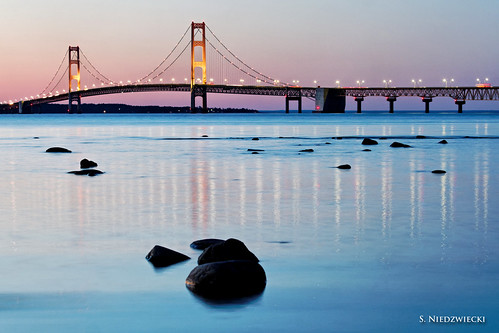
The Mackinac Bridge takes center stage on Labor Day

Bridge at Twilight 1562-12

Bridge at Twilight 1562-12, photo by StacyN – MichiganMoments

Right now thousands of people are participating in the Mackinac Bridge Walk, an Michigan tradition that began on Labor Day of 1958 and has continued every year since then. While just 68 people made that first walk, it now averages over 50,000 people. You can tune in for some shots from the Mackinac Bridge Cam and see one from this morning on the Michigan in Pictures Facebook.

If you’d like a little Labor Day reading, I heartily recommend How Labor Won Its Day from the Detroit News Rearview Mirror.

See Stacy’s photo bigger and see some more cool shots of this Michigan icon in her Mackinac Bridge slideshow.

Much (much) more about the Mackinac Bridge on Michigan in Pictures!

What’s in a Name? Tahquamenon Falls edition

Tahquamenon Falls

Tahquamenon Falls, photo by AndrewH324

We’ll close out Waterfall Week on Michigan in Pictures with this photo that has been the cover photo on the Absolute Michigan Facebook all week. Here’s hoping that you get a chance to enjoy one of Michigan’s nearly 200 waterfalls soon!

With a drop of nearly 50 feet, a width of over 200 feet and a maximum flow of more than 50,000 gallons of water, the Upper Tahquamenon Falls are one of the largest waterfalls east of the Mississippi. Pronounced about how it looks – like “phenomenon,” the falls gained fame way back in 1856 in Henry Wadsworth Longfellow’s Song of Hiawatha:

Lay aside your cloak, O Birch-tree! lay aside your white-skin wrapper,
For the Summer-time is coming, and the sun is warm in heaven,
And you need no white-skin wrapper!” thus aloud cried Hiawatha
In the solitary forest, by the rushing Taquamenaw

A feature back in 2006 from the Chicago Tribune offers one popular theory for the name:

The river and its two falls (the smaller Lower Falls are further downstream) are located in the northeast part of Michigan’s Upper Peninsula, just miles from Lake Superior, in the 46,000-acre Tahquamenon Falls State Park. The Upper Falls is one of the largest waterfalls this side of the Mississippi in the United States. (Niagara–shared with Canada–is the largest.)The park is dense with both hardwoods and pine and filled with wildlife. Sightings of moose, gray wolves, black bears, American martens and river otters are typical, and have always been an attraction for nature lovers–including Henry Wadsworth Longfellow, whose poem about this area recounts how Hiawatha built his canoe “by the rushing Tahquamenaw.” The spelling was a variation of Tahquamenon, which comes from an Ojibwa word meaning “dark berry.”

Origins of the Name from the Michigan DNR suggests an alternative root of the name:

The word Tahquamenon has not been as easy to trace. There have been many theories to the origins of this name, such as the color of the water of the Tahquamenon River or meaning the place of the blueberry swamps.

In his book, “Lake Superior Place Names: From Bawating to the Montreal,” Dr. Bernard C. Peters sheds additional light on the subject. Peters suggests the word Tahquamenon comes from the word Outakouaminan, which appears on a 1671 Jesuit map. The key is its location on the map. Because it is shown near an island in what now is Whitefish Bay, Peters believes the name actually refers to a shortcut across the bay.

Wherever the name came from, there’s no doubt that this is a “can’t miss” waterfall. You can get the 411 on Tahquamenon Falls at Go Waterfalling.com and see a video of the case for the falls as one of the Seven Wonders of Michigan. Also check out this great video of the falls from 1950 and see a cool old photo of the falls right here.

Check this photo out background bigtacular and in Andrew’s Upper Peninsula slideshow.

Lots more Tahquamenon Falls on Michigan in Pictures.