111 Years of over the river at Hines Park

Hines Park, Livonia, MI, November, 2012

Hines Park, Livonia, MI, September, 2012, photo by Norm Powell (napowell30d)

Nice shot from Hines Park in Livonia. Here’s hoping everyone and their guests have safe travels this holiday whether you’re headed over the river, through the woods or somewhere else.

Check this out background big and see more in Norm’s slideshow.

More bridges on Absolute Michigan.

Chestnut season

Scoring the Chestnuts

Scoring the Chestnuts, photo by DarrylW4

Michigan in Pictures had a great feature on chestnuts last year that has a lot of information on this traditional Thanksgiving food.

With 54 farms encompassing 813 acres, Michigan ranks first in the nation in chestnut plantings. As you plan your Thanksgiving dinner, consider Michigan chestnuts and other local products. Over on Absolute Michigan we have a feature that can help you do just that – make it a Michigan Thanksgiving.

If you want to put chestnuts on your holiday menu, MyNorth has a recipe for a Michigan Chestnut Pie. Or, if you prefer your chestnuts in liquid form, how about a Jolly Pumpkin Fuego del Otono (Autumn Fire)? Every year Jolly Pumpkin makes a limited amount of this seasonal Belgian ale brewed with chestnuts and spices and it’s delicious!

Check this out on black and see more in Darryl’s slideshow.

More food on Michigan in Pictures.

Snow Bound: Winter 2013 forecast to be cold & snowy for Michigan

Snow Bound

Snow Bound, photo by siskokid

Some of the first snows of the 2012-2013 winter have visited Michigan, so it’s probably a good time to have a look at what Old Man Winter might have up his sleeve this winter. The Winter 2013 forecast from “Caleb Weatherbee”* of the Farmer’s Almanac is calling for a split in the nation’s weather with warmer and drier conditions in the West and cold & snow in the East & Midwest. The Freep takes a closer look at the winter forecast saying:

In a forecast sure to delight Michigan’s snow sport industries, the almanac is predicting plenty of snow, with temperatures 2 to 4 degrees colder than average. It estimates the first snow will come Nov. 7 in some parts of the Great Lakes — and a major storm of up to 8 inches will blast the Great Lakes on Jan. 20-23.

So far, so good I guess. While I’m not a meteorologist, it seems like warm, dry air in the west and colder, wetter air in the east could make for some exciting weather for Michigan. Someone who is a meteorologist is Dr. Jeff Masters of the Weather Underground. In his interesting and informative Forecast for Winter 2012-2013, Jeff notes that NOAA’s predictions suggest the same warmer & drier conditions for the west (with a wider area covered). He walks through the many factors that can affect winter weather, ultimately concluding:

I’m often asked by friends and neighbors what my forecast for the coming winter is, but I tell them to flip a coin, or catch some woolley bear caterpillars for me so I can count their stripes and make a woolley bear winter forecast (this year’s Woolley Worm Festival in Banner Elk, North Carolina is this weekend, so we’ll know then what the official Woolley Worm winter forecast is.) Making an accurate winter forecast is very difficult, as the interplay between El Niño, the AO/NAO, the AMO, Arctic sea ice loss, and the 11-year sunspot cycle is complex and poorly understood. I’ve learned to expect the unexpected and unprecedented from our weather over the past few winters; perhaps the most unexpected thing would be a very average winter during 2012 – 2013.

View this photo on black and see more in Jim’s 50+ Faves slideshow.

*FYI, Caleb Weatherbee is the official forecaster for the Farmers’ Almanac. His name is actually a pseudonym that has been passed down & shared by generations of Almanac prognosticators.

Remembering Helen Milliken

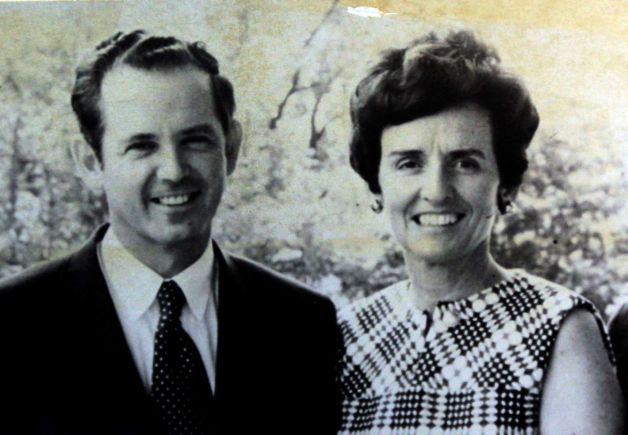
Bill and Helen Milliken, photo from AP archives

My beliefs are not particularly unique. It’s just that I’m now in a position to do something about them.
~Helen Milliken

Yesterday Helen Wallbank Milliken passed away at the age of 89 in Traverse City. Helen was the wife of Michigan’s longest serving Governor William Milliken. Her entry in the Michigan Women’s Hall of Fame says in part:

Helen Milliken, wife of the former Governor of Michigan, has long been identified with women’s issues and concerns. She was a distinguished national co-chair of ERAmerica and traveled throughout the country speaking on behalf of the Equal Rights Amendment. She also freely gave her time and energy to raising needed funds to support this major cause. In addition, she was a convener of the International Women’s Year Delegation in Michigan and a member of the delegation to the IWY Conference, which met in Houston in 1977. She is associated with The Women’s Research in Education Institute in Washington, D.C., and chaired the National Women’s Conference Committee.

Helen Milliken has been a major patron of the arts in Michigan. She was in no small measure responsible for the development of a state public arts project and for the growth in public support of the arts.

…Independent, committed, and principled, Helen Milliken never sought, but never shrank from controversy. When her commitment to equality conflicted with her political loyalties, she clearly chose the former. Her choice, her service, and her spirit have enriched the lives of countless Michigan citizens.

The Detroit Free Press has an excellent article that includes a photo gallery of Helen Milliken. along with reminisces by those who worked with her in public life.  One of these, former press secretary & chief of staff to Gov. Milliken George Weeks,  looks at the many causes Helen championed.

The Michigan Land Use Institute has a page where some of the people who remember their longtime board member and supporter Helen Milliken – click to view it.

Brad Keselowski poised to become Michigan’s first NASCAR champion

IMG_6536

IMG_6536, photo by PDA.PHOTO

In Michigan native Brad Keselowski on the verge of NASCAR glory, the Freep Mike Brudenell writes:

Keselowski, the tough-as-nails, unflinching NASCAR driver from Rochester Hills, is one race away from making sports history in this state.

Should the hard-charging 28-year-old driver survive a torrid 400-mile stock car race in south Florida on Sunday afternoon — against some of the most unforgiving drivers in the world — he will become the new NASCAR Sprint Cup champion for 2012, the first person born in Michigan to do so.

…Keselowski races for Penske, the legendary Birmingham team owner, and needs only to finish 15th or better at Homestead-Miami Speedway in the last race on the Cup schedule to capture the title.

More at Brad Keselowski Racing and while he probably won’t be tweeting from this race, you can also follow him on Twitter.

Check it out background bigtacular and see more in Parker’s NASCAR slideshow.

Deer Season in Michigan: 2012 Edition

IMG_9524

IMG_9524, photo by flickaway1

Today is Opening Day, a de facto holiday that will bring hundreds of thousands of deer hunters to the woods & swamps of the Great Lakes State. As almost all of the state is potentially open to hunting, you’re advised to take extreme care for the next two weeks during the November 15-30 Deer Hunting Season.

Read all about the 2012 Michigan Deer Season at Absolute Michigan.

Check this out big as a buck and see more deer shots in Brent’s slideshow.

Remembering Detroit Boxing Legend Emanuel Steward

Emanuel Steward's boxing clinic

Emanuel Steward’s boxing clinic, photo by yousef_anani

Boxing legend Emanuel Steward, one of the greatest trainers ever, was remembered yesterday in Detroit. The entry for Emanuel Steward at the International Boxing Hall of Fame begins:

Steward, who was born in West Virginia in 1944, has been one one of the most successful trainers and managers in the last two decades of the 20th century.

Like many young men, he started boxing after receiving a pair of boxing gloves as a gift. The youngster boxed in informal matches that his father set up. When his parents separated, he moved with his mother to Detroit. By age 12, he was training at the Brewster Recreation Center, which had been the boxing home of Joe Louis and Eddie Futch. As an amateur, he ran up a record of 94-3, which culminated with a 1963 National Golden Gloves title. Steward than began training amateur fighters, but eventually gave that up and found full-time employment as an electrician.

But boxing was in his blood. In 1971, he was asked to look after his half-brother James, who was 15 at the time. Steward took him to a nearby gym called, the Kronk. It wasn’t long before Emanuel was coaching again. In 1971, his charges dominated the Detroit Golden Gloves, winning seven championships. A year later, he left the security of a full-time electrician’s job, and turned his attention to boxing, and the Kronk.

By the mid-70s he had built the gym into a national power, and two of his charges, Thomas Hearns and Hilmer Kenty came close to making the ’76 Olympic Team. A year later, the two turned pro with Steward serving double duty as their trainer and manager. On March 2, 1980, Kenty became Steward’s first world champion when stopped Ernesto Espana in the fourth round to win the WBA lightweight crown.

Five months later Hall of Famer Thomas Hearns stopped Pipino Cuevas with a blistering second-round kayo to become champion No. 2.

Wikipedia’s Emanuel Steward entry lists some of the fighters he trained including Hearns, Evander Holyfield, Wladimir Klitschko, Lennox Lewis and Julio César Chávez. It adds that his heavyweight fighters had a record of 34-2-1 combined in title fights. The Freep has a nice video with boxers Thomas Hearns, Sugar Ray Leonard and Lennox Lewis remembering Steward that also includes a bit of Aretha Franklin singing. You may also want to read this article in the New York Times or watch this ESPN tribute to Steward.

Yousef Anani took this photo at an Emanuel Steward’s boxing clinic in London last year. See it bigger and view more in his Emanuel Steward slideshow.

Up Close at Hidden Lake Gardens

Detail

Detail, photo by corinne.schwarz

Corinne took this photo at Hidden Lake Gardens, a property just west of Tecumseh (map) that was donated to Michigan State University (then Michigan State College) in 1945 by Harry A. Fee, an Adrian businessman. They explain that:

He had always dreamed of owning a lake, and, upon his retirement in 1926, he purchased Hidden Lake along with 200 acres of land surrounding it. He repaired and refurbished the old farmhouse, built a greenhouse, and began farming. He soon realized that the land was not suitable to conventional farming or raising livestock and so he began to grow nursery stock. Not wanting to compete with local nurseries during the depression he planted the stock on his own land in an effort to create a “series of pictures,” a philosophy that we continue to strive for today. Mr. Fee described Hidden Lake Gardens as a “dream as you go development”…

“When the idea that I was making a series of beautiful scenic pictures available to the Public and just when I decided to dedicate the Gardens to public service I do not remember …. all subsequent work has been and should be continued with the prime object of its being for the Benefit of the Public…” Mr. Fee donated Hidden Lake Gardens to Michigan State University (then Michigan State College) in 1945 and his wish that the Gardens be for the benefit and education of the public has continued through the years. He was actively involved in decision making at the Gardens until his death in 1955.

With his generous endowment under the direction of MSU’s Horticulture Department, the Division of Campus Parks and Planning and presently Land Management, the Gardens has continued to develop with land acquisitions, construction of buildings, and the establishment of educational programs. The original 200 acres have grown to 755 acres! This includes a 120 acre arboretum that was begun in 1962 and consists of plant groups such as crabapples, lilacs, maples, evergreens, and shrubs.

Garden highlights include an extensive arboretum, a collection of dwarf trees and rare conifers, a Bonsai courtyard and a Conservatory featuring three distinct climates. They host weddings & events as well.

Check this out background big and see more in Corinne’s Hidden Lake Gardens slideshow and more of her photography on her Facebook page.

Tahquamenon Falls are pretty big

Tahquamenon Falls Panorama

Tahquamenon Falls Panorama, photo by Unified Photography

Wikipedia’s Tahquamenon Falls entry says that the upper Tahquamenon Falls in Tahquamenon Falls State Park are more than 200 feet across with a drop of approximately 48 feet. In the spring, the falls can push as much as 50,000 gallons of water per second. That makes it the third most voluminous vertical waterfall east of the Mississippi, after Niagara Falls and Cohoes Falls in New York.

As you can see, they are impressive even during times of lower flow. I thought this shot did a great job of conveying the size of these magnificent falls and really hope you get a chance to see them!

Check this out big as a waterfall and see more in Kenneth’s Pure Michigan slideshow.

Much more about Tahquamenon Falls on Michigan in Pictures!

The Armistice Day Storm of 1940

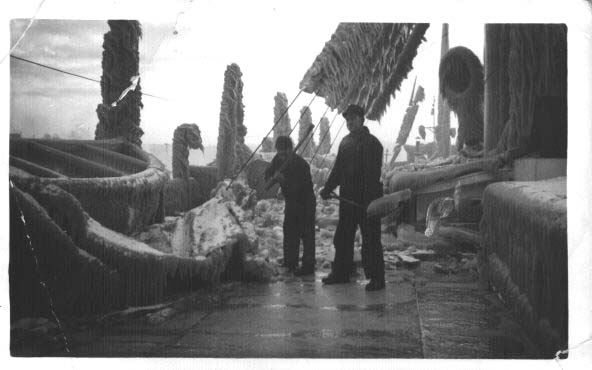
Chipping ice from the City of Flint

Chipping Ice on the City of Flint, photo by Captain John Meissner

Wikipedia explains that the Armistice Day Blizzard struck November 11  (Armistice Day) and November 12, 1940. The intense early-season “Panhandle hook” winter storm cut a 1,000-mile-wide path through the middle of the country from Kansas to Michigan.  Carferries.com has a great article on The Armistice Day Storm of 1940 that begins:

The “storm” of November 11, 1940 was one of the worst storms in the recorded history of Lake Michigan. In all, the storm claimed 5 vessels, and 66 lives. The storm occurred on Armistice Day, which celebrated the end of World War I in 1918.

The storm hit late Monday afternoon, November 11th, with winds of hurricane proportions. The winds struck suddenly from the southwest at about 2:30 P.M. and were accompanied by drenching rain, which later changed to snow. The winds reached peak velocities of 75 miles per hour, the highest in local maritime history. Telephone and power lines were down by the hundreds around Mason County. Several local firms had “gaping” holes where roofs once were. Trees were uprooted, small buildings were overturned, and brick walls were toppled, causing at least 1 serious injury. Very few places escaped without damage. Ludington, on the morning of November 12th, appeared to be a deserted city.

The Pere Marquette carferry City of Flint 32, attempted to make the harbor but wound up on the beach about 300 yards from the shore. She was ordered by her relief captain, Jens Vevang, to be scuttled to avoid being pounded by the incoming seas. On November 12th, a breeches buoy was strung and 27 year old crewman Ernest Delotowski of 406 First Street, Ludington, was brought ashore. Delatowski made a good portion of the trip in the icy waters of Lake Michigan. As a precautionary measure, he was taken to Paulina Stearns Hospital and was released later that day. He said he carried a message with him, but it got lost in the water. Later the buoy was used to carry a message to the ship, and then crewman Luther Ryder of S. Washington Avenue (Ludington) was brought ashore.

You can read more including first-hand recollections of the storm and also see more photos taken by Captain John Meissner and also photos of the grounding and other wrecks as a result of the storm at carferries.com.

More shipwrecks on Michigan in Pictures.