Great Lakes Ice at near-record lows

Winter 2011 - Lake Ice

Winter 2011 – Lake Ice, photo by danbruell

The Great Lakes Echo reports that:

composite map of the Great Lakes produced by NOAA’s CoastWatch organization shows near-historic low ice coverage across the region.

The map, known as the Great Lakes Surface Environmental Analysis, is a composite of data taken from NOAA satellites orbiting the earth’s poles and radar scans of the lakes by the National Ice Center. The resulting image shows surface water temperature and ice coverage, important data for region scientists, fishermen and boaters. The map’s data is updated daily.

“Previously, the lowest ice coverage year was 2002,” CoastWatch manager George Leshkevich said. “2012 came very close to 2002, and this year is looking very similar to last year.”

Lack of ice cover leads to increased water evaporation, a serious concern in light of already-low lake levels.

You can read more about last year’s ice cover and impacts on Absolute Michigan.

Check Dan’s photo out background bigtacular and see more in his Lake Ice slideshow.

More winter wallpaper on Michigan in Pictures!

The Michigan Moose Lift

Like posts like this? Please consider supporting Michigan in Pictures through Patreon!

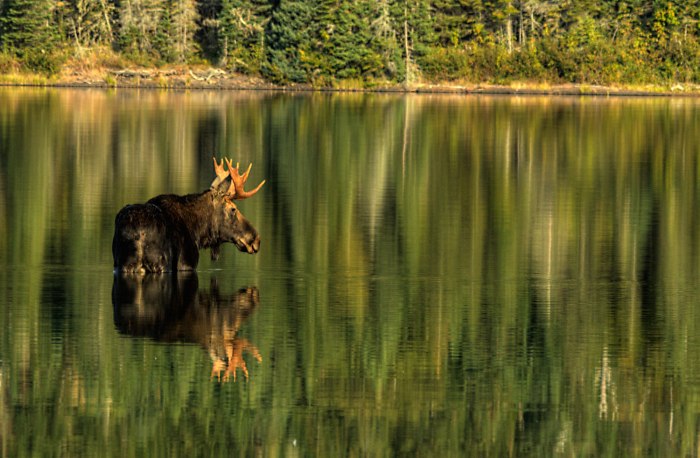
Michigan Moose Reflections

Moose Reflections, photo by yooper1949

NOTE: I’ve edited this post because the State of Michigan removed it from the internet. Thank you archive.org for saving it via The Wayback Machine so I could share it in its entirely!

Remembering Michigan’s Historic Moose Lift from the Michigan DNR says:

On Jan. 20, 1985, separate convoys carrying men and equipment set out from Michigan on a mission to reach the 3,000-square-mile Algonquin Provincial Park in Ontario, Canada.

Over the next two weeks, this team of wildlife biologists and veterinarians from the Michigan Department of Natural Resources, working with a team of Canadian specialists from the Ontario Ministry of Natural Resources, would locate, capture, transport and release a number of wild moose to form the nucleus of a new population in Michigan’s Upper Peninsula.

It was an unprecedented, historic operation. The wind chill at times approached 100 degrees below zero. Utilizing helicopters, tranquilizing dart guns and slings, some moose were air-lifted as far as 14 miles from the capture area to base camp.

At base camp, each animal was subjected to thorough medical testing and was fitted with a sophisticated radio collar, before being lifted into a shipping crate and placed onto a transport truck for the non-stop 600-mile overnight journey back to Michigan.

The remarkable effort was called “moose lift.” A total of 29 moose (10 bulls, 19 cows), ranging in size from 750 to 1,250 pounds, survived the arduous journey.

Crowds assembled each day at the release site north of Lake Michigamme in Marquette County. Despite temperatures well below zero, a welcoming committee of U.P. residents always showed up to greet the new “American” citizens.

As we mark the 20th anniversary of the first moose lift, the most common question that arises is, “How are the moose doing now?”.

“The department’s goal was to produce a self-sustaining population of free-ranging moose, and we have that,” said Dean Beyer, wildlife research biologist for the Michigan Department of Natural Resources.

Since the first moose lift in 1985, and a similar effort two years later when another 30 moose were released in the same area, the DNR has closely monitored the reintroduced moose population.

“At first, the size and growth of the herd was determined through a simple process–similar to balancing a checkbook,” Beyer said. “Because all moose were radio-collared, biologists could monitor each animal and tell when it died, and they could follow cows to record any births. The population could be tracked simply by adding the number of calves born and subtracting the number of animals that died.”

As the population grew, the new animals in the herd did not have radio collars.

“Over time, maintaining an adequate sample of radio-collared animals for the population would not be feasible,” Beyer said.

So in 1996 and 1997, the DNR conducted aerial surveys, which are the most common method of estimating moose numbers. Unfortunately, the population estimates from the aerial surveys were lower than estimates from the population model.

“At that point we knew we needed to conduct a more intensive study of the reintroduced population,” Beyer said. “And we also wanted to determine a more accurate picture of what’s reasonable growth for this population.”

With the help of the Michigan Involvement Committee of Safari Club International, which also provided the single largest financial contribution to the first moose lift, the DNR began a more intensive study of the reintroduced population in 1999, in cooperation with Michigan State University.

“Our research team is developing a technique to estimate the size of the population by estimating the probability of seeing moose from an airplane given the group size; behavior, whether the animal is standing or bedded; and the amount of canopy cover,” Beyer said.

When the moose were reintroduced into the western Upper Peninsula, biologists hoped the population would grow to 1,000 animals by the year 2000. Although that objective was not reached, results of the current study indicate the population is growing, on average, between five and ten percent each year. The research also has shown that poaching, moose/car accidents, brainworm and wolves are not major factors influencing the moose population at this time.

According to Beyer, the herd ranges over approximately 1,800 square miles in Marquette, Baraga and Iron counties. Moose also are found in several parts of the eastern U.P., most notably around the Tahquamenon River.

“Moose in this region have not been studied in detail,” he said.

Although records from the early explorers show that moose were common throughout Michigan, by the late 1800s moose numbers were very low. Moose soon disappeared from the Lower Peninsula and only a small number survived in the U.P., perhaps supplemented by animals coming in from Minnesota and Canada.

Thanks to the vision and hard work of many DNR biologists a generation ago, moose are once again establishing themselves as a premiere Michigan mammal.

Several U.P. communities, in fact, now vie over the self-proclaimed title, “Moose Capital of Michigan.” Mascots, motels, restaurants, candy and even ice cream are named after the mighty moose. Its image is common on billboards, television, artwork and printed materials. But most importantly, moose are alive and well, and rambling about in the wilds of Michigan’s Upper Peninsula once more.

Here’s a great video about the Moose Lift – highly recommended!

The last DNR moose survey pegs the UP’s moose population at about 500 with another 750 on Isle Royale.

Carl took this shot on Isle Royale in September. Check it out big as a moose and see much more (including some more moose shots) from one of Michigan’s coolest parks in his Isle Royale slideshow.

More moose on Michigan in Pictures!

NAIAS: 2013 Detroit Auto Show roars into town

LFA

LFA by JSFauxtaugraphy, photo by JSFauxtaugraphy

Snapshots from the 2013 North American International Auto Show aka NAIAS 2013 aka the Detroit Auto Show started yesterday for media & industry. The public show runs Saturday, January 19 through Saturday, January 26. Here are a few quick hits:

Check this out background bigtacular and see more in Joseph’s NAIAS 2012 slideshow.

More NAIAS on Michigan in Pictures.

Michigan Wild & Scenic Rivers: Manistee River

Manistee River, near Sharon, Michigan

Manistee River, near Sharon, Michigan, photo by gregorydseman

It is hereby declared to be the policy of the United States that certain selected rivers of the Nation which, with their immediate environments, possess outstandingly remarkable scenic, recreational, geologic, fish and wildlife, historic, cultural or other similar values, shall be preserved in free-flowing condition, and that they and their immediate environments shall be protected for the benefit and enjoyment of present and future generations.
~Wild & Scenic Rivers Act, October 2, 1968

Michigan has 16 nationally designated Wild & Scenic Rivers. The stretch of the Manistee River from the DNR boat ramp below Tippy Dam to the Michigan State Highway 55 Bridge is the designated stretch (click for map and river management plan). They explain:

The Manistee Wild and Scenic River is well known for beautiful scenery, excellent fishing and a variety of recreational activities. In the spring and fall, high numbers of anglers are attracted to the superb salmon and steelhead runs. During the summer, walleye and pike fishing become the primary recreational activity. The river supports a variety of other recreational uses including wildlife viewing, hiking, canoeing and hunting.

Private businesses and government agencies have developed a variety of facilities and services to meet the expanding recreation demands of the public. Commercial guided fishing is one of the most popular activities on the Manistee River. The amount of recreational use fluctuates from year to year, mostly based on the fishing runs and local economic factors. There are eight developed river access sites within the wild and scenic river corridor. The Forest Service maintains sites at High Bridge, Bear Creek, Rainbow Bend and Blacksmith Bayou. The state of Michigan operates a river access site at Tippy Dam. Private recreation sites include Big Manistee Riverview Campground and Coho Bend Campground. The U.S. Forest Service developed recreation sites along the Manistee River require a vehicle parking pass under the Recreation Enhancement Act.

Greg says he took this photo back in 1998 when the river had more water – check it out bigger and see more in his slideshow.

More Wild & Scenic Rivers on Michigan in Pictures!

Northern Lights likely this week!

Northern Lights

Northern Lights, photo by BeaverTripp

The Space Weather Prediction Center of the National Oceanic and Atmospheric Administration says that minor to moderate auroral activity is likely through January 20th. Translation? Northern Lights are likely this week!

You can click to register for space weather alerts and also view the current space weather.

Stephen captured this photo in July of 2012 on Moss Lake in the U.P. Check his photo out as big as the sky and in his Northern Lights slideshow.

Much (much) more Aurora Borealis information & photos on Michigan in Pictures!

Superior Light Show

Superior Light Show_1283

Superior Light Show_1283, photo by Mike Hainstock

Light shows in the UP are typically of the Northern Lights variety, but Mike has captured a stunning view that I think is the lights of Baraga as seen from L’Anse though  it could be the other way around. Update – Mike comments below that it is L’Anse from Baraga. 

In any case, it’s awesome. Be sure to check this out on black and see more in Mike’s slideshow.

PS: Nice matching shot for Thursday’s photo too!

Know Your Michigan Waterfalls: Morgan Falls Edition

Calming Currents - Morgan Falls (Marquette, MI)

Calming Currents – Morgan Falls (Marquette, MI), photo by Aaron C. Jors

GoWaterfalling’s page on Morgan Falls explains that:

Morgan Creek tumbles 20 feet into the Carp River, creating this small wild waterfall. This is one of the more accessible of the Marquette waterfalls. The more impressive, but much hard to visit Carp River Falls are half a mile away.

Morgan Falls is located about two miles south of the city of Marquette. Of the many waterfalls in Marquette county this is one of the easier to visit, especially if you have four wheel drive. The waterfall is located at the confluence of Morgan Creek and the Carp River. The creek cascades down 20 feet to join up with the Carp.

…There is some disagreement about the name of this falls. According to some Morgan Falls is actually a cascade further upstream, and this is just an unnamed waterfall. This is the more distinctive and photogenic of the two features.

Read on for more information including directions.

You can view this photo on black. Aaron has several more great waterfall shots on Michigan in Pictures and even more in his Michigan waterfalls slideshow.

There are even more Michigan waterfalls on Michigan in Pictures too!

Detroit Panorama: City Lights Mix

Detroit, MI

Detroit, MI, photo by w4nd3rl0st (InspiredinDesMoines)

Jason put this photo together from about a dozen HDR images taken from a large park in Windsor. He notes that if you make the trek across the Detroit River, the Tunnel BBQ in Windsor is tasty and affordable.

For a real treat, view his photo background bigtacular and see more in his Detroit & Michigan slideshow.

Lots more from Detroit on Michigan in Pictures.

Eben Ice Caves in the Rock River Wilderness

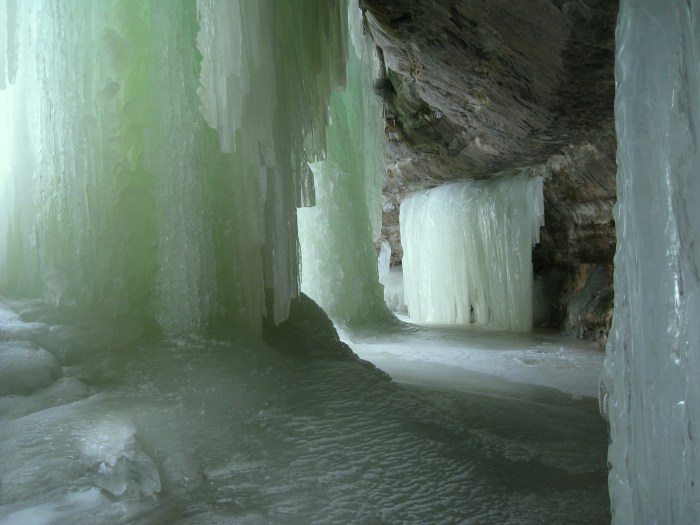
A Healthy Green Glow

A Healthy Green Glow, photo by nasunto

I know it’s wintertime when I start seeing a lot of people asking about the Eben Ice Caves. Like many of the subjects on Michigan in Pictures, I don’t know much more than what I write on the blog. Recently, however, a good-hearted soul created the Eben Ice Caves Facebook page to serve as a hub for information about this wintertime wonder of Michigan.

Nina Asunto writes one of my favorite blogs, Black Coffee at Sunrise, a delightful wander through some of Michigan’s most fascinating places. Nina’s feature on the Eben Ice Caves explains that they are located in the Rock River Wilderness in the western section of Hiawatha National Forest.

Rock River Canyon is 150 feet deep and lined with sandstone outcrops, which have been eroded to form concave overhangs. During winter, ground water seeps over the edge and down through the sandstone where it freezes, creating huge curtains of ice and closing off the front of the outcrops to form caves.

In winter it is possible to access the ice caves from the south side of the wilderness area. A few miles north of Eben Junction, visitors can park their cars by the side of the road and cross an open field to the forest. The field is private property, but the owner allows for its use in winter to access the ice caves…

We had both seen a few photos of the ice caves, but none of them really captured the size of this phenomenon…

What we weren’t able to capture, however, was the amazing sound inside the cave. The drips of water falling from above created wonderful echoes and added to the cave atmosphere. There is much variation of color and texture to the ice in different parts of the cave. Some formations were smooth and clear, others were bumpy and hollow-sounding, and there were some columns that looked like dripping candle wax.

Read on for many more photos. You can also view this photo background bigtacular and see more in her fantastic Eben Ice Caves slideshow on Flickr!

More Eben Ice Caves on Michigan in Pictures.

Bald Eagle in Michigan

Eagle turning

Eagle turning, photo by Deirdre Honner

I think this is one of the best bald eagle photos I’ve ever seen. The Michigan DNR’s bald eagle page explains that before European settlement, bald eagles probably nested in all regions of Michigan.

In the early 1900s they were described as being “generally distributed,” but “nowhere abundant.” A decline through the early and mid-1900s was probably related to slow but consistent loss of suitable habitat and available food, and predator control by humans. These eagles are so disturbed by the presence of humans near their nest that they may be induced to abandon the nest, or even chicks that have already hatched. By 1959, the species was considered, “largely restricted to the northern half of the state.”

…Nests are usually constructed near seacoasts, lakes or large rivers to be near their most common food supply: fish. Although they are quite capable of catching their own, sometimes even wading in shallow water to stalk fish like herons, they have often been seen stealing fish from other birds such as osprey. When fish are not available, such as in winter, eagles will also feed on waterfowl, small mammals (up to rabbit-size) and carrion (even road-kill).

During Michigan winters, bald eagles are seen throughout the state (almost all counties), while they nest mainly in the Upper Peninsula (especially the western portion) and the northern portion of the Lower Peninsula. These eagles don’t really migrate, they just move south enough to stay ahead of the ice and congregate near open water. Immature birds may move further south.

Lots more about bald eagles at All About Birds and you can also view recent Michigan bald eagle sightings.

Check this out background big and see more including a shot of the eagle in flight  in Deirdre’s slideshow.

More Michigan birds on Michigan in Pictures.