Crocus kind of mood

DSC08382

DSC08382, photo by ansonredford

Crocuses have to be one of my favorite flowers. In addition to being beautiful, they are also one of the leading harbingers of spring in Michigan!

Check this out background bigtacular, get yourself in a springtime mood with Donald’s Flowers slideshow and see more of his photos on Michigan in Pictures.

More flowers on Michigan in Pictures, and if you want to be particular, here’s just the crocuses!

Spring storm in the “D”

Spring storm in the "D"

Spring storm in the “D”, photo by Malena †

Check this out on black and see more in Malena’s Detroit slideshow.

More Detroit on Michigan in Pictures.

Wind, Water & Warmth

DSC00936

Untitled, photo by Jben21

As the air heats up we will get these warm and wave-tossing winds in the Great Lakes. The Chicago Tribune explains why spring brings us stronger lake breezes, the coastal wind that blows from the lake to land:

It’s powered by differences in density between warm (less dense) air over land and cool (more dense) air over Lake Michigan. Because temperature greatly affects air density, a lake breeze is most likely to form (and it will blow most strongly) when large temperature differences exist between the “land air” and “lake air.” Those temperature differences are greatest in April and May when the lake air is chilly because Lake Michigan waters still retain much of winter’s cold and the land air is warming strongly in response to the strengthening spring sun.

Check this photo from last April near Muskegon out big as the Big Lake and see more in Jben’s Sunsets on Lake Michigan slideshow. It’s also the cover of the Michigan in Pictures Facebook!

More spring wallpaper on Michigan in Pictures and also lots more cool wind photos!

Maple Syrup: Not for the lazy!

Maple syrup 2

Maple syrup 2, photo by Deb Perry Studio

One of the best things about spring for my money is that it’s the one time of year that you can make maple syrup! Michigan ranks 5th in the US in maple syrup production, and the Michigan Maple Syrup Producers Association has a page about the history of maple syrup production that shows we’ve been a maple syrup player for a long time:

Native Americans have many wonderful stories about how they began making maple syrup. The first is the legend of Glooskap. Many, many, many years ago the Creator had made life much easier for man. In fact, in those days the maple tree was filed with syrup and all man had to do was cut a hole in the maple tree and the syrup dripped out. One day the young prince Glooskap (known by other names in other tribes) came upon a village of his people that was strangely silent. There were no dogs barking, no children playing, no women minding the cook fires, and no men getting ready to go hunting! Glooskap looked and looked and finally found everyone in the nearby maple grove. They were all lying at the bases of the trees and letting the sweet syrup drip into their mouths. Even the dogs were enjoying the syrup. “Get up, you people,” Glooskap called. “There is work to be done!” But no-one moved.

Now Glooskap had special powers, and he used these powers to make a large bark container. He flew to the lake, filled the container with water and flew back to the maple grove. When he poured the water over the trees it diluted the syrup so it was no longer sweet. ”Now, get up you people! Because you have been so lazy the trees no longer hold syrup, but only sap. Now you will have to work for your syrup by boiling the sap. What’s more, the sap will soon run dry. You will only be able to make syrup in the early spring of the year!”

…The Chippewas and Ottawas of Michigan tell a similar story of the god NenawBozhoo, who cast a spell on the sugar maple tree many moons ago, turning the near pure syrup into what is now called sap. He did this because he loved his people and feared they would become indolent and destroy themselves if nature’s gifts were given too freely. This legend is unique in that, in various forms, it can be found almost universally throughout the Eastern Woodland Indian tribes. This is unusual for cultures that did not have a written history.

Read on for more about how the process and techniques have evolved through the years. Michigan in Pictures has a ton of photos documenting the process of making maple syrup. that you’ll want to check out as well!

See Deb’s photo on black and see how it fits together in her maple syrup slideshow.

Spring in a drop of water

Untitled

Untitled, photo by ~Abby

I feel certain that spring is about to break over us in a warm & refreshing way … I just wish I hadn’t felt this way for 3 weeks.

Check it out on black and see more in Abby’s Water slideshow.

More spring on Michigan in Pictures!

April 4th: The Battle for Wexford County

manton-michigan

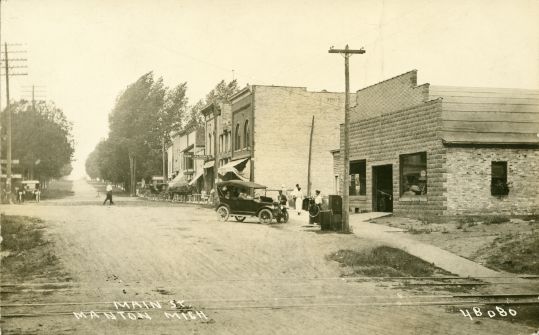
Main Street in Manton, circa 1915, photo courtesy Seeking Michigan

Battle for Wexford County by Brenda Irish of Seeking Michigan begins:

The fight for the Wexford County seat is a story of bribery, corruption, intimidation, inebriated county officials and the organization of illegal townships to boost votes.

Cadillac’s decade-long struggle for the county seat came to a head on April 4, 1882, when ballots were cast throughout the county to determine whether the coveted prize should be moved from Manton to Cadillac. Twelve months earlier, residents of Cadillac and Manton had united to remove the county seat from Sherman to Manton. Now Cadillac was determined to secure the prize for itself.

Feeling duped by Cadillac, Manton residents were furious. A couple of townships destroyed their ballots, refusing to make a return. But when the “official” count of the April 4 vote was totaled, the results were overwhelming: 1,363 “yes” voters favored moving the county seat to Cadillac, while 309 voted “no.”

In the early dawn following the election, a train left Cadillac with the sheriff and twenty “specially deputized” men and headed to Manton to collect the county property. Legend has it that the train backed quietly into a sleeping Manton, coming to a halt in front of the courthouse. Within a half hour, most of the county records and much of the furniture was aboard the train. As the Cadillac faction attempted to remove the first of three safes from the courthouse, however, Manton residents awoke…

Read on at Seeking Michigan for the contested conclusion and more photos from Wexford County.

More history on Michigan in Pictures.

Don’t mess with a Dragonfly

DragOnFly

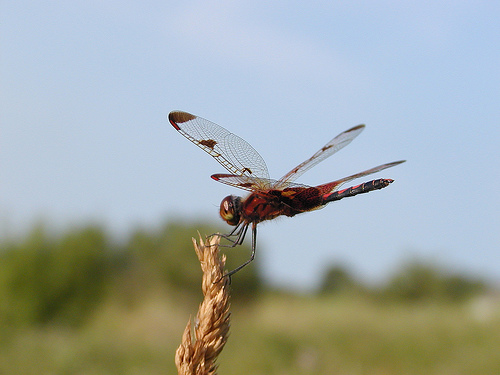
DragOnFly, photo by farlane

Yesterday Michigan in Pictures regular Mark O’Brien shared Nature’s Drone, Pretty and Deadly. The article says that although lions (25% hunting success rate) and great white sharks (50% success) look deadly, the dainty dragonfly may be the most effective hunter in the animal kingdom:

When setting off to feed on other flying insects, dragonflies manage to snatch their targets in midair more than 95 percent of the time, often wolfishly consuming the fresh meat on the spur without bothering to alight. “They’ll tear up the prey and mash it into a glob, munch, munch, munch,” said Michael L. May, an emeritus professor of entomology at Rutgers. “It almost looks like a wad of snuff in the mouth before they swallow it.”

Next step: grab more food. Dragonflies may be bantam, but their appetite is bottomless. Stacey Combes, who studies the biomechanics of dragonfly flight at Harvard, once watched a laboratory dragonfly eat 30 flies in a row. “It would have happily kept eating,” she said, “if there had been more food available.”

In a string of recent papers, scientists have pinpointed key features of the dragonfly’s brain, eyes and wings that allow it to hunt so unerringly. One research team has determined that the nervous system of a dragonfly displays an almost human capacity for selective attention, able to focus on a single prey as it flies amid a cloud of similarly fluttering insects, just as a guest at a party can attend to a friend’s words while ignoring the background chatter.

Read on for more including some very cool videos of dragonflies in action.

I don’t usually use my own photos on Michigan in Pictures, but I really like this one. Check it out background big and see more in my Leelanau slideshow.

More science on Michigan in Pictures!

Spring Return: Eastern Redbud

I'll Return With Spring

I’ll Return With Spring, photo by MightyBoyBrian

On AnnArbor.com Rick Meader writes:

When you think about popular, colorful ornamentals, Eastern Redbud (Cercis canadensis) often comes to mind. It’s a real crowd-pleaser, with a graceful, ornamental shape that puts out a “bouquet on a stem” look, with thousands of tiny pink/purple flowers lining its branches in early spring before its leaves emerge.

And, the best thing about it is, it’s native to southern Michigan, as well as most of the eastern half of the United States south of here. Furthermore, as a member of the Pea family (Fabaceae) it’s a cousin to the previous pod-producers we’ve learned about, Honeylocust (Gleditsia triacanthos) and Kentucky Coffeetree (Gymnocladus dioica).

As mentioned before, Eastern redbud is native to southern Michigan, occurring naturally up to a line across the lower peninsula from Kent County to Genesee County.

…If you want to use it in your landscape, it is fairly flexible in terms of where it will grow. It naturally occurs in rich soil along stream and river banks but is tolerant of a wider range of conditions. It likes sun or partial shade and can do well in most soils except waterlogged soils and dry, sandy soils.

Read on for more including Rick’s advice to make sure your tree comes from a northern nursery because trees from southern nurseries often are killed off by Michigan’s cold winters.

Brian’s photo is the first background we selected for the new Absolute Michigan, and  as you can see from past features of his work on Michigan in Pictures, he’s a really talented photographer who uploads big enough for backgrounds. See this shot from April of last year background bigilicious and see more in his Nature slideshow.

More spring wallpaper on Michigan in Pictures!

Give me a home, where the dinosaurs roam

blah blah blah about being bigger than oneself

blah blah blah about being bigger than oneself, photo by hardyc

Is it just me or has the cloning of extinct species gone too far?

Check this out big as a brachiosaur and see more in Chris’s slideshow!

More April 1 fun on Absolute Michigan today!

Happy Easter(n) Cottontail!

ANIMALS

ANIMALS, photo by John E Heintz Jr.

Wishing everyone a Happy Easter or a happy weekend!

If you do see an Easter Bunny this weekend, he will probably be one of these guys. Sylvilagus floridanus (eastern cottontail) on the University of Michigan Animal Diversity Web explains (in part) that:

Eastern cottontails are solitary animals, and they tend to be intolerant of each other. Their home range is dependent on terrain and food supply. It is usually between 5 and 8 acres, increasing during the breeding season. Males generally have a larger home range than females. The eastern cottontail has keen senses of sight, smell and hearing. It is crepuscular (active at dawn & dusk) and nocturnal, and is active all winter. During daylight hours, the eastern cottontail remains crouched in a hollow under a log or in a thicket or brushpile. Here it naps and grooms itself. The cottontail sometimes checks the surroundings by standing on its hind legs with its forepaws tucked next to its chest.

Escape methods of the eastern cottontail include freezing and/or “flushing” (Chapman et al., 1980). Flushing consists of escaping to cover by a rapid and zig-zag series of bounds. The cottontail is a quick runner and can reach speeds up to 18 miles per hour. Vocalizations of the eastern cottontail include distress cries (to startle an enemy and warn others of danger), squeals (during copulation) and grunts (if predators approach a nesting doe and her litter). Eastern cottontails are short-lived; most do not survive beyond their third year. Enemies include hawks, owls, foxes, coyotes, weasels and man.

…The eastern cottontail is a vegetarian, with the majority of its diet made up of complex carbohydrates and cellulose. The digestion of these substances is made possible by caecal fermentation. The cottontail must reingest fecal pellets to reabsorb nutrients from its food after this process. Their diet varies between seasons due to availability. In the summer, green plants are favored. About 50% of the cottontail’s intake is grasses, including bluegrass and wild rye. Other summer favorites are wild strawberry, clover and garden vegetables. In the winter, the cottontail subsists on woody plant parts, including the twigs, bark and buds of oak, dogwood, sumac, maple and birch.

Click through to ADW for more (including pictures). Also see the Michigan DNR page on Eastern Cottontail and the BioKids cottontail page at UM, which appears to have exactly the same information as ADW, proving that I am not smarter than a 4th grader.

John started adding pics to the Absolute Michigan pool on Flickr about a month ago. He has some really great animal shots – so good in fact that I wonder if he has some Doolittle blood! See his photo on black and see more in his Animal Photography slideshow.

More Michigan animals on Michigan in Pictures.