Apples on the Ridge push through Mothers Day frost

empire apple tree blossoming 4/4 2013

empire apple tree blossoming, photo by Alissa Holland

NPR’s Noah Adams visited “The Ridge” to see how the apple crop was faring in 2013 after the devastation of 2012. The engaging 4 minute piece looks at methods they use to battle frost and how last year’s 99% wipeout hurt farmers. It’s well worth your time, but if you’re looking for the punch-line, the crop appears to have the potential for full harvest.

The Ridge Economic Agricultural Partners (REAP) explain:

Fruit Ridge or “the Ridge” is a topographical land feature located NW of Grand Rapids, Michigan and considered to be an agricultural mecca. The glaciers of long ago left behind gently rolling slopes. The deposits were fertile clay loam soils with excellent moisture holding qualities that provided great soil and terrain for the growing of premium fruits, vegetables and the raising of livestock, including buffalo.

Approximately 8 miles wide by 20 miles long, the Fruit Ridge is regarded as one of the prime fruit-growing regions in the world. Elevations greater than 800 feet and its location (about 25 miles from Lake Michigan), creates a unique climate (ideal growing and moderate winters) for fruit production. The Ridge supplies 60% of the states (Michigan) apples. An estimated 66% of the Ridge lies in Kent County, all within 20 miles of downtown Grand Rapids.

“The Ridge” is an area of 158 square miles (8 miles wide and 20 miles long) covering 7 townships and 4 counties: Kent (Alpine, Sparta, Tyrone), Newago (Ashland), Muskegon (Casnovia) and Ottawa (Chester and Wright).

Click through for more about the growers and markets and also see Fruit Ridge on Wikipedia.

Alissa took this photo of a blossoming Empire apple tree in her backyard on May 7th. See it bigger on black and view many more in her how my garden grows slideshow.

More apples and more farms on on Michigan in Pictures.

Lady ducks, take notice (of the Mallard)

Lady ducks take notice

Lady ducks take notice, photo by R.J.E.

It’s been too long since I’ve added to the Michigan in Pictures Duckie Gallery. The All about Birds entry for Mallard Anas platyrhynchos explains:

Mallards are large ducks with hefty bodies, rounded heads, and wide, flat bills. Like many “dabbling ducks” the body is long and the tail rides high out of the water, giving a blunt shape. In flight their wings are broad and set back toward the rear.

Male Mallards have a dark, iridescent-green head and bright yellow bill. The gray body is sandwiched between a brown breast and black rear. Females and juveniles are mottled brown with orange-and-brown bills. Both sexes have a white-bordered, blue “speculum” patch in the wing.

Mallards are “dabbling ducks”—they feed in the water by tipping forward and grazing on underwater plants. They almost never dive. They can be very tame ducks especially in city ponds, and often group together with other Mallards and other species of dabbling ducks.

Read on for more including photos and some fun facts:

  • The Mallard is the ancestor of nearly all domestic duck breeds (everything except the Muscovy Duck).
  • Mallard pairs are generally monogamous, but paired males pursue females other than their mates. So-called “extra-pair copulations” are common among birds and in many species are consensual, but male Mallards often force these copulations, with several males chasing a single female and then mating with her.
  • Mallard pairs form long before the spring breeding season. Pairing takes place in the fall, but courtship can be seen all winter. Only the female incubates the eggs and takes care of the ducklings.
  • The standard duck’s quack is the sound of a female Mallard. Males don’t quack; they make a quieter, rasping sound.
  • Mallards, like other ducks, shed all their flight feathers at the end of the breeding season and are flightless for 3–4 weeks. They are secretive during this vulnerable time, and their body feathers molt into a concealing “eclipse” plumage that can make them hard to identify.
  • The oldest known Mallard lived to be at least 27 years 7 months old.

Check this photo out bigger and in R.J.E.’s slideshow.

Frozen Fruit? May freeze puts Michigan’s fruit crops in peril

Cherry Orchard ... spring snow

Cherry Orchard … spring snow, photo by Ken Scott

The National Weather Service noted that the high temperature yesterday at the Otsego County Airport in Gaylord only reached 35 degrees – a new record for the coldest high temperature for the date that crushed the previous record of 44 degrees from 2003. It was also the coldest high temperature ever recorded in the month of May for Gaylord. They notched a record snowfall of 2 inches as well, beating the old record of 1 inch from 1971.

Temperatures dipped into the 20s across the state last night. Although the word isn’t in yet about the effect those temps have had, an mLive article about the apple crop on Fruit Ridge explains:

As fruit trees begin to develop and blossom each spring, their ability to withstand cold temperatures is greatly reduced. As bloom nears, temperatures in the upper 20-degree can cause considerable damage to early blooming crop varieties.

Currently on the area’s Fruit Ridge — a band of ideal growing land northwest of Grand Rapids — several different varieties of apples are in bloom, said Armock. Also, sweet cherries are nearly past bloom in some areas, he said. Tart cherries are in the flowering stage of bloom, as well as some varieties of strawberries and blueberries.

In fact, across the state, growers have been making preparations for “potentially the largest crop of apples and cherries that we’ve ever seen,” said Armock, who estimated the 2013 crop could yield between 30 and 34 million bushels of apples this year, from Traverse City down to the state line.

Read on for more, and here’s hoping their efforts at bringing in helicopters last night paid off. After the near total destruction of the apple, tart cherry and other crops last year, it would be a hard blow to stand.

View Ken’s photo on black and see more in his massive Leelanau slideshow.


Turnip Rock in Lake Huron

Turnip Rock

Turnip Rock, photo by SimsShots Photography

A page about the Point Aux Barques – Turnip Rock geocache had the best information I found about this Lake Huron Landmark. The author explains:

This cache is accessible by a kayak, canoe, jet ski or boat on Lake Huron. Port Austin is the closest harbor which is approximately three miles west. The land around this feature is a gated community. I must stress that this cache is only accessible by a water craft via Lake Huron. If you are not comfortable navigating the waters of Lake Huron, do not attempt to do this cache. Lake Huron can be dangerous at times for small water craft such as kayaks or canoes.

…Everyone that received their grade school education in Michigan learned that glaciers pushed their way over Michigan several times. The result is glacial drift averaging 200 to 300 feet deep covering on top of the bedrock. The thickness of drift has measured over 1,000 feet in a few Michigan locations. Rarely can we see exposed bedrock that has been sculptured by non glacier forces. This is one of the locations in southern Michigan where the sandstone bedrock is exposed at the surface. The amount of shoreline that has exposed sandstone is about one mile, but a lot of beauty has been sculptured in the stone.

The locals call the main structure here “Turnip Rock”, because of it’s shape. Geologists call it a “Sea Stack”. A definition of a sea stack is an isolated pillar-like rocky island or mass near a cliff shore, detached from a headland by wave erosion assisted by weathering. Waves force air and small pieces of rock into small cracks, future opening them. The cracks then gradually get larger and turn into a small cave. When the cave wears through the headland, an arch forms. Further erosion causes the arch to collapse. This causes a pillar of hard rock standing away from the coast. Generally occurring in sedimentary rocks, sea stacks can occur in any rock type.

Read on for more and also see the Atlas Obscura entry for Turnip Rock has a map and photos. Michigan in Pictures favorite Lars Jensen has some great photos of Turnip Rock as well, and you should definitely check out Jason Glazer’s panoramic photos of Turnip Rock.

Check this out background big and see more in Rob’s Landmarks slideshow.

More Michigan landmarks on Michigan in Pictures.

Gorge Falls on the Black River Scenic Byway

gorge falls-black river, gogebic county, MI

gorge falls-black river, gogebic county, MI, photo by Northwoods Apparition

I’m always happy when someone shares a photo of a waterfall I’ve never seen. Michigan in Pictures has a ton of Michigan waterfall photos, so it’s not often that this happens! The GoWaterfalling.com entry for Gorge Falls explains:

Gorge Falls is named for the deep and narrow gorge above and below the falls. This was my personal favorite of Black River Scenic Byway waterfalls. It is also one of the easier waterfalls to visit, being only a short distance from the parking area. There are a fair number of stairs to the falls overlook. It is only a short walk upstream to see Potawatomi Falls.

I do not know how hard it would be to get to the east side of the gorge, or what the views are like.

The Black River Scenic Byway starts north of US 2 near Bessemer. There are signs on US 2. Gorge Falls is about 14.5 miles north of US 2. The scenic area is on the right and is clearly marked.

Click through for more and see a map of the Black River Scenic Byway.

Check Kirk’s photo out background bigtacular and see more great shots in his slideshow!

Sault Ste. Marie International Railroad Bridge

international railroad bridge, sault ste. marie, ontario / michigan

international railroad bridge, sault ste. marie, ontario / michigan, photo by twurdemann

The Library of Congress page on the Sault Ste. Marie International Railroad Bridge that spans the Soo Locks from Michigan to Canada at St. Marys Falls explains that:

The Sault Ste. Marie International Railroad Bridge has nine camelback truss spans crossing the St. Marys River with bascule and vertical lift bridge components crossing the American Locks at the St. Marys Falls Canal. It is the only bridge in the United States known to include these three types of spans in a single structure to use an interlocking mechanism to connect the leaves of the double-leaf bascule span.

It is Michigan’s most significant railroad bridge from an engineering history standpoint and is eligible for listing in the National Register of Historic Places.

Click through for some great old photos of the bridge and explore the various sections through Historic Bridges.

Check this photo out on black and see more great shots in twurdemann’s Sault Ste. Marie 2012-2013 slideshow.

More Michigan bridges on Michigan in Pictures.

Over the Moon with a Sandhill Crane

Over the moon

Over the moon, photo by TBPICKS

The 1896 book Myths and Legends of our Own Land by Charles M. Skinner relates a rather gruesome version of the tale of the origin of Whitefish, which this photo reminded me of.

An Indian who lived far in the north was so devoted to the chase that he was never at home for the whole of a day, to the sorrow of his two boys, who liked nothing so much as to sport with him and to be allowed to practise with his weapons. Their mother told them that on no account were they to speak to him of the young man who visited the lodge while their father was away, and it was not until they were well grown and knew what the duty of wives should be that they resolved to disobey her. The hunter struck the woman dead when he learned of her perfidy. So greatly did her spirit trouble them, however, that they could no longer abide in their old home in peace and comfort, and they left the country and journeyed southward until they came to the Sault Sainte Marie.

As they stood beside the falls a head came rolling toward them on the earth—the head of the dead woman. At that moment, too, a crane was seen riding on the surface of the water, whirling about in its strongest eddies, and when one of the boys called to it, “O Grandfather, we are persecuted by a spirit; take us across the falls,” the crane flew to them. “Cling to my back and do not touch my head,” it said to them, and landed them safely on the farther shore.

But now the head screamed, “Come, grandfather, and carry me over, for I have lost my children and am sorely distressed,” and the bird flew to her likewise. “Be careful not to touch my head,” it said. The head promised obedience, but succumbed to curiosity when half-way over and touched the bird’s head to see what was the matter with him. With a lurch the crane flung off his burden and it fell into the rapids. As it swept down, bumping against the rocks, the brains were pounded out and strewn over the water. “You were useless in life,” cried the crane. “You shall not be so in death. Become fish!” And the bits of brain changed to roe that presently hatched to a delicate white fish, the flesh whereof is esteemed by Indians of the lakes, and white men, likewise. The family pitched a lodge near the spot and took the crane as their totem or name-mark. Many of their descendants bear it to this day.

The version I read in one of my all-time favorite books, Lore of the Great Turtle : Indian Legends of Mackinac Retold by Dirk Gringhuis is pretty dark as well. Michigan in Pictures has a post with all the information about Sandhill Cranes in Michigan, and you can also check out Sandhill Crane (Grus canadensis) from the Michigan DNR.

View this out on black and see more in Todd’s slideshow.

More birds on Michigan in Pictures.

Cherry Blossom Season all across Michigan

Cherry Blossoms II

Cherry Blossoms II, photo by leelanau2010

A run of warm weather has the cherry trees in Michigan ready to blossom. Due to their pent up demand to bloom, we should see blossoms all across the state this weekend. Up here in the “Cherry Capital of the World” near Traverse City, we saw leaves pushing out over the weekend and the first buds are getting ready to burst. The same is true in Southwest Michigan.

Even better news is that despite a little flirting with the 30s expected for the coming weekend, we aren’t likely to see full-on frost in 2013. This is a welcome change from 2012 when Michigan saw near total losses across a broad range of fruit crops due to our “summer in March.”

Check David’s photo out background bigtacular and see more in his Spring 2008 in Leelanau slideshow.

More blossoms and also more spring wallpaper on Michigan in Pictures.

North Country Dreamland

North-Country-Dreamland-at-Miners-Castle-by-Shawn-Malone


North Country Dreamland at Miners Castle, photo by Shawn Malone / lakesuperiorphoto.com

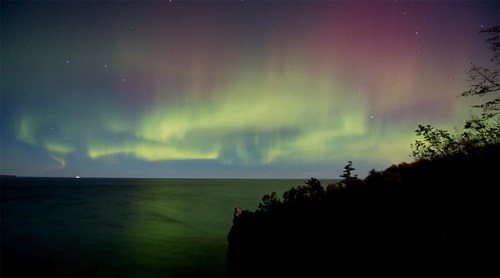
Last night I got an alert of a moderately strong solar flare with the possibility of generating northern lights. When I went looking to see if anyone had photographed them, I discovered that Michigan in Pictures regular Shawn Malone has just released a truly stunning video featuring a series of time-lapses of the night skies of northern Michigan! She writes:

Rare pairings caught on camera include ribbons of aurora above a full moon fogbow on the horizon of Lake Superior, the aurora and an isolated singular lightning storm cloud over Lake Superior, and the aurora and Milky Way in several scenes including Copper Harbor, Marquette, Isle Royale, Pictured Rocks, and Eagle Harbor Lighthouse.

…All scenes are within 200 miles or so of my home in Marquette, Mi. and I feel very blessed to live where I do and to share the beauty that I see ‘in my own backyard’ with you. I hope it inspires others to take time to find the beauty that is everywhere around us and also to raise an awareness about the importance of preserving our night wondrous starlit skies.

You can read about it and see it on Absolute Michigan or head over to Vimeo to watch it.

The shot above is one of 33 different scenes in the video and shows Miners Castle in the Pictured Rocks National Lakeshore. See it bigger in the video and see a lot more on the Lake Superior Photo Facebook.

Much more from Shawn on Michigan in Pictures.

Sign of spring #77: Trillium in the Woods!

Trillium

Trillium, photo by karstenphoto

One of the many signs of spring in Michigan is the appearance of the endangered trillium flower in the woods. In Plant Focus: Trillium, George Papadelis of the Michigan Gardener writes that for hundreds of years, this plant and its name have been used to symbolize purity, simplicity, elegance, and beauty.

In Ohio, where all 88 counties have masses of wild trillium, it was selected as the state’s official wildflower. Its flowers have twice graced a U.S. postage stamp. Even our Canadian friends across the bridge have declared white trillium (Trillium grandiflorum) the official provincial flower of Ontario. Other parts of the world share our passionate admiration for this plant. In Europe, where trilliums are not found in nature, gardeners dedicate vast amounts of time and money acquiring them, especially rare species. In Japan, a cult-like interest has developed towards trillium.

The most readily available species is Trillium grandiflorum or white wake-robin. This has large, pure white flowers up to 5 inches across. These develop in great abundance throughout the northeastern U.S. Its flowers usually fade to a dull pink and sometimes red. Trillium erectum is a much more diverse species with flowers ranging from red to purple to yellow-green and beige. It also grows wild in the Northeast and Michigan. Trillium luteum is the most common yellow species. It originates from areas around eastern Tennessee. One of its most notable features is the beautiful dark green leaves decorated with pale green markings. The flowers are relatively small. Trillium recurvatum bears maroon-purple to clear yellow flowers with strongly curved petals.

Read on for information about how to legally grow trillium.

Check this out background bigtacular, check out his Spring slideshow and see more from Steve on Michigan in Pictures.

More spring wallpaper