Miners Falls in the Pictured Rocks National Lakeshore

Wide view of Miners Falls

Wide view of Miners Falls, photo by ChiliFrei64

GoWaterfalling is the go-to place for Michigan waterfalls.  About Miners Falls they write:

Miners Falls is located in Pictured Rocks National Lakeshore. To reach the Falls, take H58 west from Munising. Take H13 north 3.5 miles towards Miners Castle. There is a dirt road on the right that leads to falls. There is a sign marking the road. The dirt road is less than a mile and leads to a parking area. The walk through the woods to the falls is about 20 minutes. There are stairs at the end. The viewing area is a little frustrating. I do not know if there is an easy way into the gorge.

Little Miners Falls is about a mile downstream but you would have to bushwack to reach it. Chapel Falls, Spray Falls and Sable Falls are also in Pictured Rocks. Wagner Falls, Munising Falls, and others are in nearby Munising.

Be sure to also check out How Miners Falls Got Its Name on Michigan in Pictures and a Panormio/Google map of the area.

Dan writes that he was striving for a view he hadn’t seen of the falls. He got one!! Check this photo out bigger, see more in his Water slideshow and also check out Dan Frei Photography on Facebook.

Many more Michigan waterfalls on Michigan in Pictures!
Lake Superior Sea Cow

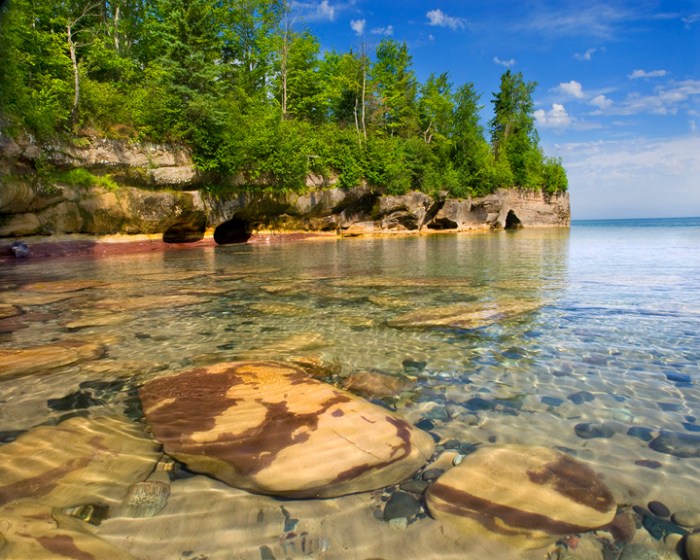
Sea Cow photo by Tim Trombley

Sea Cow, photo by Tim Trombley

Tim Trombley of GreatLakesPhotography.net regularly features his photos on the Great Lakes Echo. They write:

He entitled this picture “Sea Cow,” as the pattern of the rocks along the shallows of Lake Superior resembles the markings commonly seen on cows.

“I’m always so amazed by the clarity of the water in Lake Superior, as seen in this photo,” Trombley said. “A kayak is the best way to spend time on this lake when the conditions permit.”

You can check out more of Tim’s work at Great Lakes Photography.

Moo!

Remembering Michigan author Elmore Leonard

Detroit-Author-Elmore-Leonard

Elmore Leonard, The Dickens of Detroit, photo courtesy Archives of Michigan

“After 58 years you’d think writing would get easier. It doesn’t. If you’re lucky, you become harder to please. That’s all right, it’s still a pleasure.”
~Elmore Leonard

Legendary Michigan author Elmore “Dutch” Leonard passed away Tuesday at the age of 87. Leonard was the author of many best-selling crime novels including Get Shorty, Freaky Deaky and Killshot. Another great Michigan author, Jim Harrison, wrote:

“Elmore was the opposite of the loudmouthed, big shot novelist. He was graceful, fairly quiet and poignantly intelligent. We have lost our best. No one wrote better dialogue in America.”

The photo above appeared in The Dickens of Detroit from Seeking Michigan on Leonard’s birthday (October 11, 2011). They do a nice job of hitting the highlights of an illustrious career:

Leonard was born in New Orleans in 1925. He has made the Detroit area his home since 1934, when his family moved there. The city of Detroit often serves as the main character in his novels. As a result, fans often refer to Elmore Leonard as the ‘Dickens of Detroit.”

Leonard graduated from University of Detroit Jesuit High School in 1943. He then immediately joined the Navy, where he served with the Seabees. After his service, he enrolled at the University of Detroit and graduated in 1950 with a degree in English and Philosophy. Leonard started his writing career as a copywriter at the Campbell-Ewald Advertising Agency. Writing on the side, he was able to publish his first novel, The Bounty Hunters in 1953. In his early career, he focused on writing pulp Westerns, because that was what was selling at the time. Leonard eventually moved on to specialize in crime fiction and suspense thrillers. A large number of his books have been turned into movies or television programs.

Critics praise Leonard for his effective use of dialogue and the gritty realism in his books. His unique ear for dialogue and the ability to capture it on the page is rarely matched. Concise and plot driven, his stories are stuffed with colorful characters and tricky, often humorous plot twists.

Read on for more. Here are a few of the best features I found – please feel free to post more in the comments:

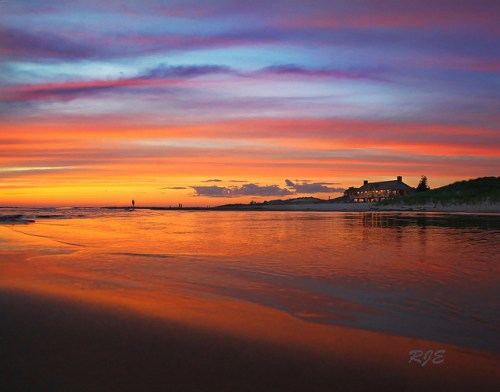
Ludington State Park Beach House

Ludington State Park beachhouse

Ludington State Park beachhouse, photo by R.J.E.

This page from the DNR has a vintage photo of the beachhouse.

Visit Ludington tells a little about the historic Beach House at Ludington State Park.

The Beach House has a long history of weathering the changing Michigan seasons within the Ludington State Park. This landmark has now received a makeover, and it’s a real showplace for the state park system. Built by the Civilian Conservation Corps in 1935, the Lake Michigan Beach at 116 ft. long and 35 ft. wide, has been a familiar sight for visitors to Lake Michigan within the State Park.

…The Lake Michigan Beach House is unique in nature due to the fact it is the only Arts-and-Craft inspired design bathhouse found on the shores of Lake Michigan. Also of significance is the role the CCC played in its construction–from architect Ralph B. Herrick to all the CCC workers who built the Beach House from recycled brick and pressed mortar. This style has not been found at any other state park in Michigan…and it is the largest and most intact of the CCC-built structures within the Ludington State Park.

Check it out background big and see more in R.J.E.’s Ludington, MI slideshow.

More from Ludington on Michigan in Pictures!

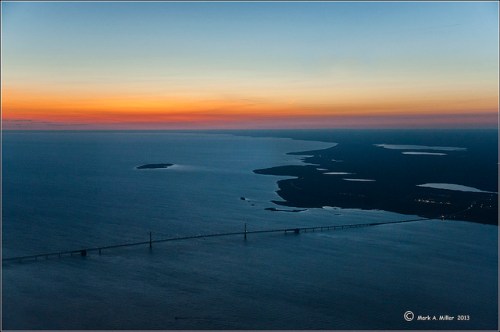
Sunset over the Straits of Mackinac

Straits of Mackinac

Straits of Mackinac, photo by GLASman1

A gorgeous view of a beautiful bridge. Definitely check it out bigger and see more in Mark’s slideshow.

Much more about the Mackinac Bridge on Michigan in Pictures!

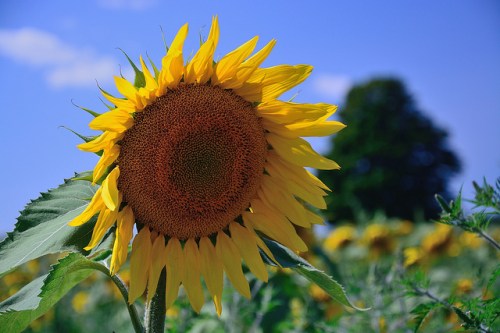
Mr. Sunshine: Sunflowers in Michigan

Mr. Sunshine . . .

Mr. Sunshine…, photo by Dr. Farnsworth

Michigan Gardener is a fantastic site that can give you all kinds of help with what to put in your garden and how to make it grow. They have a nice article about sunflowers featuring Bob Koenders, owner of the Backyard Bouquet Farm. It begins:

According to the Michigan Department of Agriculture, in 1997 there were 32 farms growing sunflowers on 1,522 acres, and by 2002 there were 91 farms with 2,275 acres. Most of the fields of open sunflowers are oil seed type, grown for oil or seed (for birds or humans). Their heads were bred to hang down, making it more difficult for birds to eat the seeds and rain to ruin the harvest.

…According to the National Sunflower Association, the wild sunflower is native to North America, but commercialization of the plant was done by Russia. It was only somewhat recently that the sunflower plant “returned” to America. Native Americans first developed the wild sunflower into a single-headed plant with a variety of seed colors including black, red, white, and striped black and white. Some archeologists suggest that sunflowers may have been domesticated before corn. The Native Americans used the sunflower seed for grinding into flour, trail snacks, purple dyes, body painting, ceremonial, and medicinal uses. Sunflower oil was used for making bread, as well as on skin and hair. The dried stalks were even used for building materials.

They add some fun facts about sunflowers:

  • Sunflower’s scientific name is Helianthus; Helios meaning “sun” and anthos meaning “flower.”
  • Sunflower heads track the sun’s movement; this phenomenon is called heliotropism.
  • Sunflowers can grow up to 12 inches a day during the peak of the growing season. They are more photosynthetic than many other plants and better utilize the sun for growth.
  • Sunflower stems were used as filling for life jackets.
  • Sunflower leaves are cupped to channel the water down the stem.
  • Sunflower heads consist of 1,000 to 2,000 individual flowers joined by a receptacle base. The large petals around the edge of the sunflower head are individual ray flowers which do not develop into seed.
  • The world record sunflower with the most heads (837) was grown in Michigan in 2001.

Read on for lots more including tips about growing sunflowers and get tons more sunflower info from the National Sunflower Association.

Check Dale’s photo out background bigtacular and see more in his Flower slideshow.

Eastern Tiger Swallowtail Butterfly

Eastern Tiger Swallowtail Butterfly (Saline, Michigan)

Eastern Tiger Swallowtail Butterfly (Saline, Michigan), photo by cseeman

The University of Michigan Animal Diversity Web entry for the eastern tiger swallowtail butterfly (Papilio glaucus) says in part:

The eastern tiger swallowtail ranges from Alaska and the Hudsonian zone of Canada to the southern United States, east of the Rocky Mountains.

This species occurs in nearly every area where deciduous woods are present, including towns and cities. It is most numerous along streams and river, and in wooded swamps.

As with most butterflies, Eastern tiger swallowtails tend to be solitary. Males “patrol” for a mate, flying from place to place actively searching for females. “Patrolling” male tiger swallowtails can recognize areas of high moisture absorbtion by the sodium ion concentration of the area. It is believed that the moisture found by these males helps cool them by initiating an active-transport pump. Both male and female tiger swallowtails are known to be high fliers. Groups of fifty butterflies have been spotted in Maryland flying 50 meters high, around the tops of tulip trees.

The tiger swallowtail is thought of as the American insect, in much the same way as the Bald Eagle is thought of as the American bird. It was the first American insect pictured in Europe; a drawing was sent to England from Sir Walter Raleighs’ third expedition to Virginia.

You can read on for more including photos. I also found a page with a listing of Michigan butterflies and apparently we have eight species of swallowtail butterfly. You can also see some great eastern swallowtail photos from Butterflies & Moths. Spoiler alert: the female can look a lot different.

Corey writes that he got this shot at the butterfly bush he planted this year. Check it out background big and see more great shots of this fellow in his butterfly slideshow.

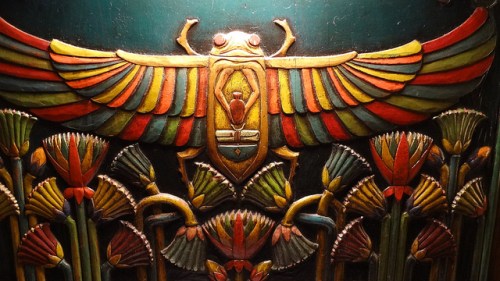
The Scarab Club

Scarab Club Detroit

Scarab Club Detroit, photo by Vasenka Photography

The Scarab Club explains that:

The Scarab Club was founded in 1907 by a group of artists and art lovers who enjoyed meeting regularly to discuss art and socialize. The desire to form an arts organization in Detroit during the first third of the 20th century was partially intertwined with the birth of automotive design and the evolution of advertising art inspired by the burgeoning automobile industry. Although generally viewed as a heavily industrial city, Detroit’s artistic community thrived from the success of the automobile.

Many of the original founding members of the Scarab Club consisted of automotive designers, advertising illustrators, graphic artists, photographers, architects, and automobile company owners. Scarab Club members inspired each others’ artistic spirit by entering their artwork in the Annual Exhibition of Michigan Artists held at the Detroit Institute of Arts under the auspices of the Scarab Club from 1911 to 1928 and the DIA from 1929 to 1974.

The club’s themed costumed balls, which began in 1917, were a significant social event in Detroit. Life Magazine covered the 1937 Ball featuring a two-page photo spread. The Detroit News and The Detroit Free Press published two pages of photogravures of costumed guests beginning in 1917.

The energy of the Club continues to the present day, hosting events like the costumed Scarab Club balls, art lectures & openings, live music and more. Read on at scarabclub.org where you can check out some of their photos of the building and the artwork and a great timeline of the club. I dug up an old video of one of their costumed balls that was themed “Inferno” that’s pretty cool.

Check out Vasenka’s photo background bigtacular and jump into his slideshow for more great shots from this cultural treasure.

More art on Michigan in Pictures.

Sugar Loaf Rock on Mackinac Island

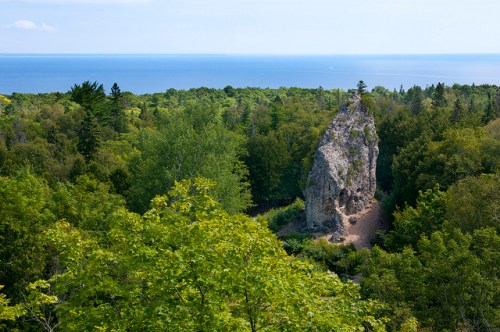
Untitled

Untitled, photo by *Alysa*

I was surprised to learn that I haven’t posted anything about Sugar Loaf on Mackinac Island. Here’s a summary with help from Wikipedia’s entry for Sugar Loaf Rock, the Mackinac State Historic Parks geology page and some other sources I’ve linked to.

Located not far from the shoreline on the east side of Mackinac Island, Sugar Loaf is a 75′ breccia limestone stack. Thousands of years ago Lake Algonquin covered all but the center of Mackinac Island. When it receded, this tower of rock remained. The people of the region packed maple sugar into cone-shaped baskets of birchbark, and Sugar Loaf Rock was named for its resemblance to one of these cones.

Sugar Loaf was said by some to be the home of Gitchi Manitou, while another tale explains that the rock was the final form taken by a man who asked for immortality and received it, albiet not as he expected. A distinct profile remains in the limestone face of Sugar Loaf Rock. The rock was also used as a site of ritual burials. In 1831, Alexis de Tocqueville and his friend Gustave de Beaumont visited Mackinac Island. De Beaumont reported that the rock was filled with “crevices and faults where the Indians sometimes deposed the bones of the dead.” A natural cave passes through Sugar Loaf from side to side, but it’s too small for any but children.

Check out Anna Lysa’s photo out bigger and see more in her Mackinac Island slideshow.

More from Mackinac on Michigan in Pictures!

Chasing the Perseids at Bond Falls

Chasing the Perseids

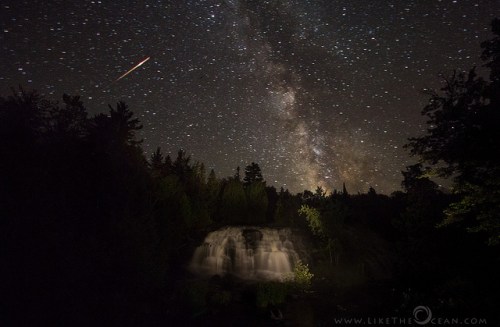
Milky Way over Milky Falls with a dash of Perseids, photo by Like The Ocean

“I am beginning to love the stars too fondly to be fearful of the night.”
~Sathya R.

I hope that you had a chance to catch the annual show that is the Perseid Meteor Shower. In Chasing the Perseids at his blog Like the Ocean, Saytha writes:

45 hours on the road with just few hours of sleep, in search of that one spot to capture the Perseids. The lashing rain, the forecasted aurora that never turned up and the hide and seek with the clouds – it was all fun. Was it all worth it, you bet! The road trip took me to one of the darkest skies of Mid Western US – Bond Falls. Would like to share with you a moment in time from that night. This was one of the two meteor I was able to capture on frame, but loved how everything came together in this shot. I do love when a plan comes together :)

The deafening sound of 500 gallons of water / second from 50 feet
The tranquil silence of the dark night
Milky way adorning the skies
A (Perseids) meteor fireball streaking across the horizon
Definitely a moment of serenity and one I would cherish!

Read on at Like the Ocean Photography, check this photo out bigger and see more in his awesome Nightscape slideshow.

More about Bond Falls at Michigan in Pictures.