The Great Thumb Fire and the Birth of the Red Cross

Eaton County Courthouse 089.jpg

Eaton County Courthouse, photo by joshames

In 1871, the Thumb area of Michigan was ravaged by The Great Michigan Fire, part of a series of fires across the Midwest that included the Chicago Fire.  The Michigan DNR’s History & Ecology of Fire in Michigan explains that 10 years later on September 5, 1881, another devastating fire rolled through the Thumb area.

…the fire of September 1881, commonly known as the Thumb fire, was more severe and did more damage since settlers had begun pouring into the region and logging had gotten underway. As a result, more people were rendered homeless and the loss was greater. It is estimated that this fire burned well over one million acres, cost 282 lives, and did more than $2,250,000 worth of damage. ($55,834,321 adjusted for inflation)

Like the 1871 fire, the fire of 1881 came at the end of an extremely severe drought and was the result of hundreds of land-clearing fires whipped into a seething cauldron of flame by high winds. It was worse in the Saginaw Valley and Thumb region where it burned over much of the same territory that had burned ten years before.

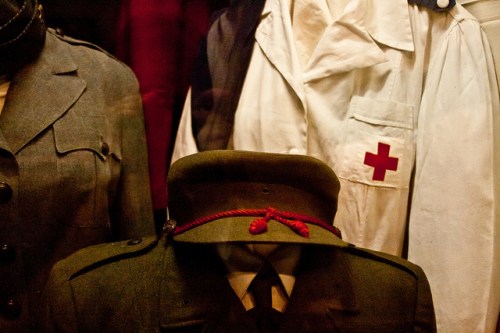
In 1881 Clara Barton founded the American Red Cross. The organization’s first meeting had taken place in Washington DC  at the home of Sen. Omar D. Conger of Michigan. Their first official disaster relief operation was the response to the Thumb Fire, and the Red Cross provided money, clothes and household items to victims of the fire.

Check Josh’s photo out bigger and see more in his slideshow.


Grand Mere Dunes is cooler than you think

Grand Mere Dunes

Grand Mere Dunes, photo by mswan777

Grand Mere State Park is located on the southwestern shore of Lake Michigan near Stevensville. The Environmental Protection Agency’s Sand Mine Restoration Plan explains that Grand Mere:

…contains some of the most unique sand dune features in the world. The park also contains three lakes, called North, Middle, and South Lake, and has over one mile of Lake Michigan frontage. The sand dunes within the park are part of the largest freshwater dune system in the world, lining the shores of the Great Lakes. These dunes historically supported a wide array of natural communities, including dry-mesic southern (oak-hickory) forest, rich conifer (cedar) swamp, southern (mixed hardwood) swamp, wetpanne and interdunal wetland (shrub swamp/emergent marsh), open dunes, and a wooded dune and swale complex.

The dunes at Grand Mere fall within a state-designated “Critical Dune Area.” The area containing the present-day park was also designated a National Natural Landmark in 1968. The park was first created on 393 acres of land in 1973, and more than doubled in size with the acquisition of 490 additional acres in 1986. The master plan for Grand Mere State Park, approved in 1986, cited “sand dune preservation” as the primary management objective for the park. A highly diverse flora exists at Grand Mere, with over 550 species of plants documented within the park. Furthermore, Grand Mere lies in a unique place on the southern shore of Lake Michigan where plants typical of both northern and southern temperate latitudes grow together in the same community. Because of the unique flora, fauna, and geology of the dune and wetland features at Grand Mere, the park has long been used as an “outdoor laboratory” for natural resource teaching and research.

…Within the park, the dominant landforms are the sand dunes along the shore of Lake Michigan. A large  bay of the glacial Great Lakes was present where Grand Mere State Park is today. During Algonquin  Great Lakes time (roughly 12,000 years ago), a large spit formed from the south along the west side of the  bay, nearly cutting it off from the glacial lake (Tague 1947). Most of the dunes at Grand Mere formed on  this Algonquin sand spit during the later Nipissing Great Lakes period, approximately 4,500 years ago.  During the more recent post-Algoma period (3,000 years ago until present), a smaller spit from the north  merged with the larger, dune covered southern spit, closing off the bay. As water levels fell, five lakes  formed in this bay. The two southern lakes have subsequently filled in and have become the present-day  tamarack swamp south of South Lake. While the lakes were forming in the bay as water levels fell, some  smaller foredunes were formed along the shoreline of Lake Michigan. The topography and sandy soils of  the park can be attributed to this glacial history.

Read on for more about the history & geology of this unique park, and check out Grand Mere State Park on the Absolute Michigan Map.

View Mark’s photo background big and see more in his Michigan –  Color slideshow.

More dunes on Michigan in Pictures.

a language we all understand

a language we all understand

a language we all understand, photo by mlephotos

About this photo she shot a few years ago at the Detroit Electronic Music Festival, Meghan writes:

Detroit has produced some of music’s most highly regarded and historically important figures. Home to the Queen of Soul, Motown, the birth of techno, numerous top 40 hits and one-hit wonders, Detroit’s musical influence can be heard around the world in every genre of music. Detroit artists and musicians have won countless awards, topped the Billboard charts, sold millions of records, and many have been inducted into the Rock & Roll Hall of Fame. Legendary and iconic artists Marvin Gaye, Diana Ross, Stevie Wonder, Madonna, Eminem, Kid Rock, Iggy and the Stooges, MC5, Ted Nugent, Bob Seger, The White Stripes, Kevin Saunderson, Juan Atkins, Derrick May, Parliament featuring George Clinton, and The Romantics all emerged from the area. Rock on, Detroit!

With a heritage like that, it’s no surprise that music is a $1 billion a year industry in Motown. Click the link for the story from Crain’s Detroit Business.

Check her photo out bigger and see more in Meghan’s i like {my fave 30} slideshow.

Labor Day traditions in Detroit

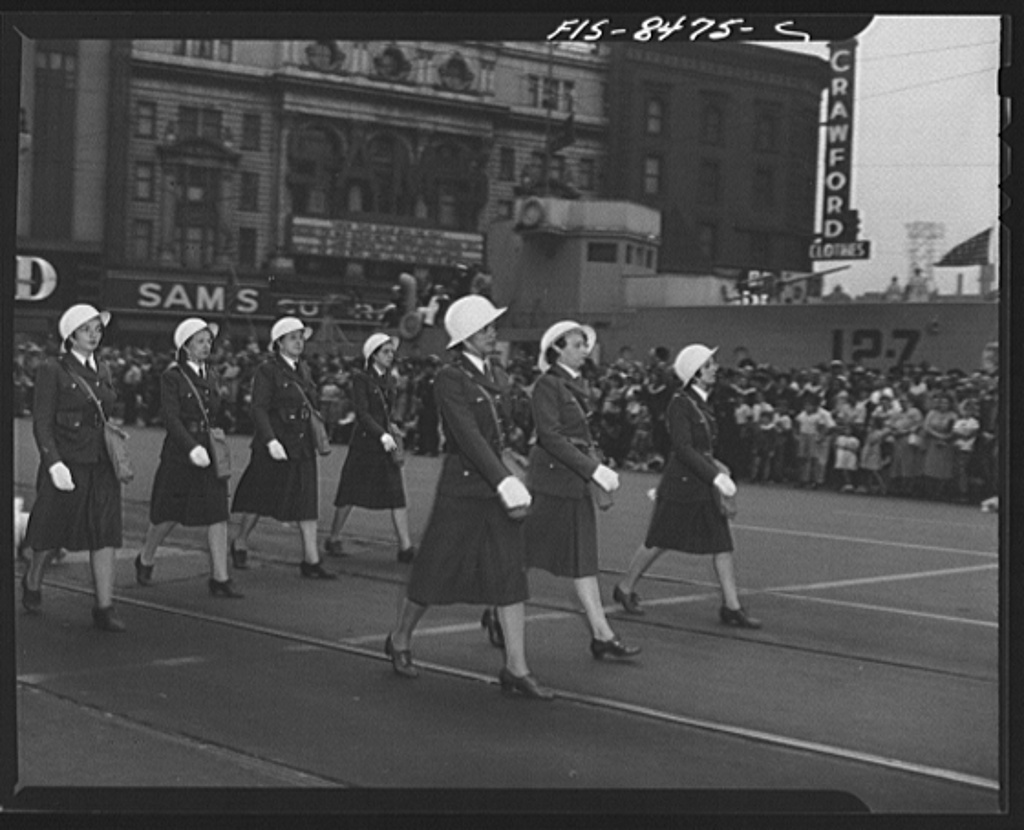
Labor Day 1942

The Detroit News Feature “Holiday for Labor” that provides an excellent look at the traditions of labor and labor day parades in Detroit:

The Detroit Trade Assembly’s labor parades in 1865 formed a part of established parades and gatherings on national holidays, such as the Fourth of July or Washington’s birthday. The unions gathered at Campus Martius, each carrying a banner with a name and symbol of their occupation. Many wore all white with matched hats or aprons. The names of their unions sound a bit quaint today: blacksmiths, iron molders, ship carpenters, caulkers, joiners, coopers, cigar packers, tailors, broommakers, stovemounters, bricklayers, shoemakers, painters, bakers, tinsmiths, cabinet makers, and saddle, trunk and harness makers.

In all about 9,000 people were involved and ended up having parties “gypsy-style” in the Bella Hubbard Grove at Vinewood and 25th Street, with shuttle trips to Belle Isle and Grosse Ile and moonlight excursions to Lake Erie on the ship T.F. Park.

…At that time, almost everyone worked at least 10 hours a day and, for many, 12 hours. Huge strikes for eight-hour work days shook the nation, and independent labor political parties surfaced in community after community. Many of the strikes and parades drew thousands and ended in violence.

…In those years, Labor Day was seen as a welcome holiday for working men and women who labored before the concept of sick days, paid leave, weekends and paid vacations. A Detroit News editorial from Sept. 5, 1927 put it this way:

“In America no man need be apologetic because he works; he needs to explain if he does not. Accordingly, Labor Day is not the peculiar property of some group, but is the holiday which recognizes that this great country of ours with all its glorious achievements, ideals and purposes is a vindication of a whole people’s pride in labor.”

Read on more MUCH more!

This is part of a series of photos taken at the 1942 Labor Day Parade in Detroit by Arthur S. Siegel. Check them all out at the Library of Congress.

Lots more Labor Day on Michigan in Pictures.

Going for the gold

SUP'rs ... going for the 'gold'

SUP’rs … going for the ‘gold’, photo by Ken Scott

It’s hard to believe that Summer 2013 is almost in the books. I hope you’ve had fun and that you get a chance to grab a little more “summer gold” this weekend!!

Check this out bigger and see more in Ken’s Benzie slideshow.

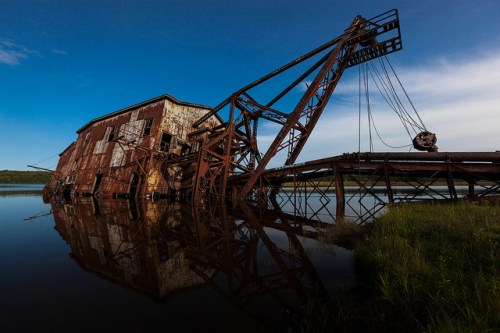
Quincy Dredge No. 2 is actually C&H Dredge No. 1

signature

signature, photo by Marty Hogan

The Copper Country Explorer has an excellent feature on The Mining of Torch Lake begins:

Early stamp methodology was a very simple and archaic one – nothing more than a simple process of smashing rock down into small pieces and sorting out the copper. Everything that remained would then be dumped into tailing ponds as waste. In the Copper Country the largest of these tailing ponds was Torch Lake, where no less than five mines dumped millions of tons of waste rock into its depths. Unfortunately, these waste tailings often contained a great deal of copper which the jigs and wash tables of the mills failed to remove. Copper that ended up in Torch Lake.

As copper prices dropped and milling technology improved, mine companies began to take a second look at these copper bearing deposits in Torch Lake. It was now possible – and economically advantageous – for mines to retrieve those tailings and remove the copper that they still contained. The process was known as reclamation, and was first undertaken in earnest by C&H around 1920. Towards that end C&H built itself a dredge that could suck up those sands from the lake bottom and send them out to the reclamation plant on shore. This first dredge – known as C&H Dredge No. 1 – would be responsible for retrieving over 48 million tons of C&H sands in its lifetime, yielding over 423 million pounds of copper for the company.

The Quincy Mine got into the reclamation game several decades later – in 1943 – after failing to make a profit on its underground operation. In 1953 the C&H Dredge No. 1 was bought by Quincy to supplement its own dredge. It turned out to be exceptional foresight, as Quincy’s first dredge ended up sinking in Torch Lake in 1956. Its roof top can still be seen sticking up from the center of the lake. As for Quincy Dredge No. 2, it continued to mine Torch Lake for several more decades until it too sank in 1967.

Read on for a detailed account of the workings of the dredge, lots of views of the dredge and some great historical photos.

Check Marty’s photo out background big and see more in his 2012 August Road Trip slideshow.

More Michigan industry on Michigan in Pictures.

2013 Mackinac Bridge Walk … and a chance to get to the top of the bridge!!

FULL

FULL, photo by ddt_uul

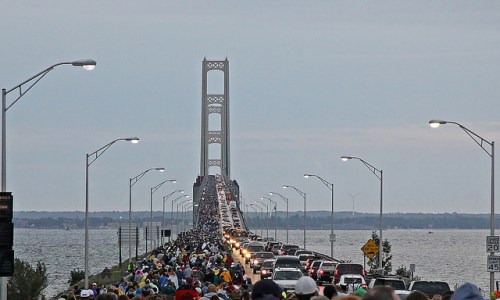
The annual Labor Day Bridge walk across the Mackinac Bridge takes place this Monday (September 2, 2013). UpNorthLive reports that you can turn your Labor Day bridge walk into a one of a kind experience with a trip to the top of the Mighty Mac!

More than 40,000 people are expected to participate in the 56th Annual Labor Day Bridge Walk which will take on Monday, Sept. 2.

For the second year in a row, the Michigan Department of Transportation and the Mackinac Bridge Authority are asking the public to share their Labor Day Mackinac Bridge Walk experiences on social media with photos and videos. One person sharing their memories will be chosen at random to receive a once-in-a-lifetime tour to the top of the Mackinac Bridge.

Through Monday, Sept. 9, you can post your memories of walking the bridge, either this year or in a previous year, on Instagram and Twitter using the hashtag #MightyMacWalk13. Memories can include photos or videos.

A lucky person whose entry is chosen at random by computer will receive a tour for two to the top of the bridge, courtesy of the MBA. The person who travels the furthest to walk the bridge this year and post a memory will win a Pure Michigan gift pack, courtesy of the Michigan Economic Development Corp.

Read on for more and check out the pics on Twitter and Instagram. Get all the details on the annual Mackinac Bridge Walk from the Mackinac Bridge Authority. If you want to see what it looks like from the top, check out my friend Spike’s Mackinac Bridge slideshow!

Dave took this shot on Labor Day, 2010. Check it out background big and see more in his great Mackinac Bridge Walk slideshow.

Much more on the Mackinac Bridge at Michigan in Pictures!

Ford-Wyoming Drive-in Theater in Dearborn

_MG_2576 tmlF

Ford-Wyoming Drive-in, photo by Gallopping Geezer

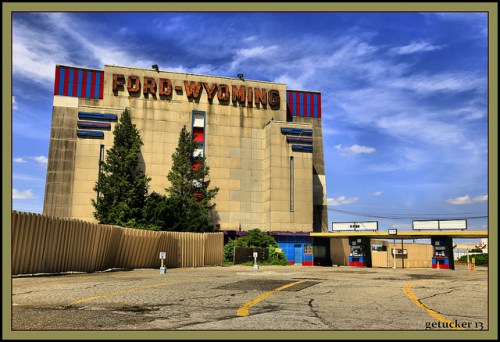
When I first saw this pic I thought it was yet another abandoned drive-in, but it turns out that the Ford Drive-in in Dearborn is open nightly with 5 screens! Their website just lists movies, but the Ford Drive-in entry at Cinema Treasures explains:

Opened in 1950, as a single-screener, with a colossal, late Streamline-style screen, the Ford-Wyoming could originally accommodate around 750 cars. It also once advertised a kiddie playground and boat rides for children.

The drive-in was acquired by Wayne Amusements in 1981, and by 1990, and grown to five screens. Another four screens were built during the early-1990’s.

Today, the still-very popular drive-in is the largest in the United States, parking-wise, with space for over 3,000 cars. (The largest drive-in screen-wise is the Thunderbird in Fort Lauderdale, Florida with 13 screens).

The Ford-Wyoming is open year-round, a rarity for drive-ins, and supplies car heaters along with speakers during the winter season.

Screens 6-9 were closed and demolished in May 2010, and in June 2010 it was renamed Ford Drive-In

WaterWinterWonderland has an entry with tons more information and photos  of the Ford-Wyoming Drive-in including some nice aerial views.

Check Gary’s photo out big as a drive-in screen and see more in his Ford-Wyoming slideshow.

More Michigan movie pics on Michigan in Pictures including a feature on another metro Detroit drive-in, the Wayne Drive-in.


Michigan Apples Bounce Back!

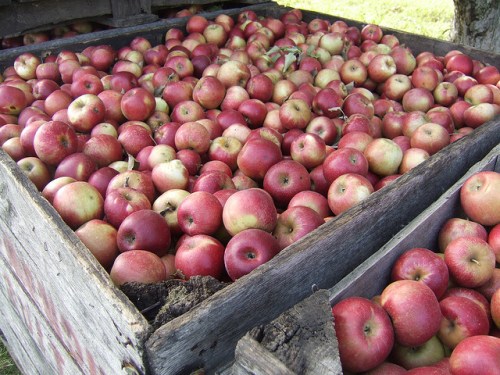
Red McIntosh apples

Red McIntosh apples, photo by vostok71

The Detroit Free Press writes that Michigan apples are back – and in a big way.

This year’s harvest could be one of the largest Michigan has ever seen, the Michigan Apple Committee said Friday after the U.S. Apple Association released its estimate for Michigan’s 2013 apple crop. The 30-million-bushel projection was welcome news after last year’s wacky spring weather devastated 90% of the overall apple crop, which yielded just 2.7 million bushels. The state averages about 20 million bushels a year, the committee said.

“Our growers, packers and shippers are already moving Michigan apples into the marketplace and are thrilled with the estimates for this year’s crop,” said Diane Smith, executive director of the Michigan Apple Committee, who was in attendance at the USApple announcement in Chicago. “There’s a lot of buzz around the estimate here in Chicago and in our state.”

The Apple Committee said a crop like this year’s could pump as much as $900 million into the state’s economy, and industry experts say perfect weather conditions are to thank.

Good news for everyone who was left cider-less and apple-less last fall! Read on at the Freep and get lots more about Michigan’s largest fruit crop from the Michigan Apple Committee or their Facebook page.

Last year I used a photo Sergei took of the Wolf River apple (Michigan’s largest) on a post about our smallest crop ever, so it’s fitting to return to celebrate! Check his photo out background bigtacular and see more in his apple slideshow.

More apples on Michigan in Pictures.

Manabozho and His Toe … and his waterfall

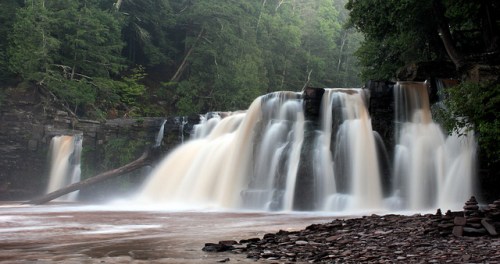
Manabezo Falls.

Manabezo Falls., photo by one lost backpacker

The stories of the people native to Michigan are among my favorite. One reason is for the pervasive humor that enriches them. Manabozho was definitely a trickster, one of four divine brothers in Algonquin tales. Via the Literature Network, here’s Manabozho and His Toe:

Manabozho was so powerful that he began to think there was nothing he could not do. Very wonderful were many of his feats, and he grew more conceited day by day. Now it chanced that one day he was walking about amusing himself by exercising his extraordinary powers, and at length he came to an encampment where one of the first things he noticed was a child lying in the sunshine, curled up with its toe in its mouth.

Manabozho looked at the child for some time, and wondered at its extraordinary posture.

“I have never seen a child before lie like that,” said he to himself, “but I could lie like it.”

So saying, he put himself down beside the child, and, taking his right foot in his hand, drew it towards his mouth. When he had brought it as near as he could it was yet a considerable distance away from his lips.

“I will try the left foot,” said Manabozho. He did so and found that he was no better off, neither of his feet could he get to his mouth. He curled and twisted, and bent his large limbs, and gnashed his teeth in rage to find that he could not get his toe to his mouth. All, however, was vain.

At length he rose, worn out with his exertions and passion, and walked slowly away in a very ill humour, which was not lessened by the sound of the child’s laughter, for Manabozho’s efforts had awakened it.

“Ah, ah!” said Manabozho, “shall I be mocked by a child?”

He did not, however, revenge himself on his victor, but on his way homeward, meeting a boy who did not treat him with proper respect, he transformed him into a cedar-tree.

“At least,” said Manabozho, “I can do something.”

If you’d like more of Manabohzo, check out Manabohzo and the Ultimate Fish Story which might make you a bit more kindly disposed to seagulls.

Check out Randy’s photo background bigtacular and see more in his amazing Michigan Upepr Peninsula 2013 slideshow.

More about Manabezho Falls on Michigan in Pictures.