I tend to keep my advocacy to myself on Michigan in Pictures, but when a friend shared the Climate Hope tumblr with me last week, I felt compelled to share it with you.
Michigan for me is defined by our water. On the heels of the disastrous million gallon oil spill on the Kalamazoo River, I feel that Michiganders have a sacred duty to protect our water today and for future generations. Climate Hope is submitting pictures shared with them as public comment by the March 7, 2014 deadline.
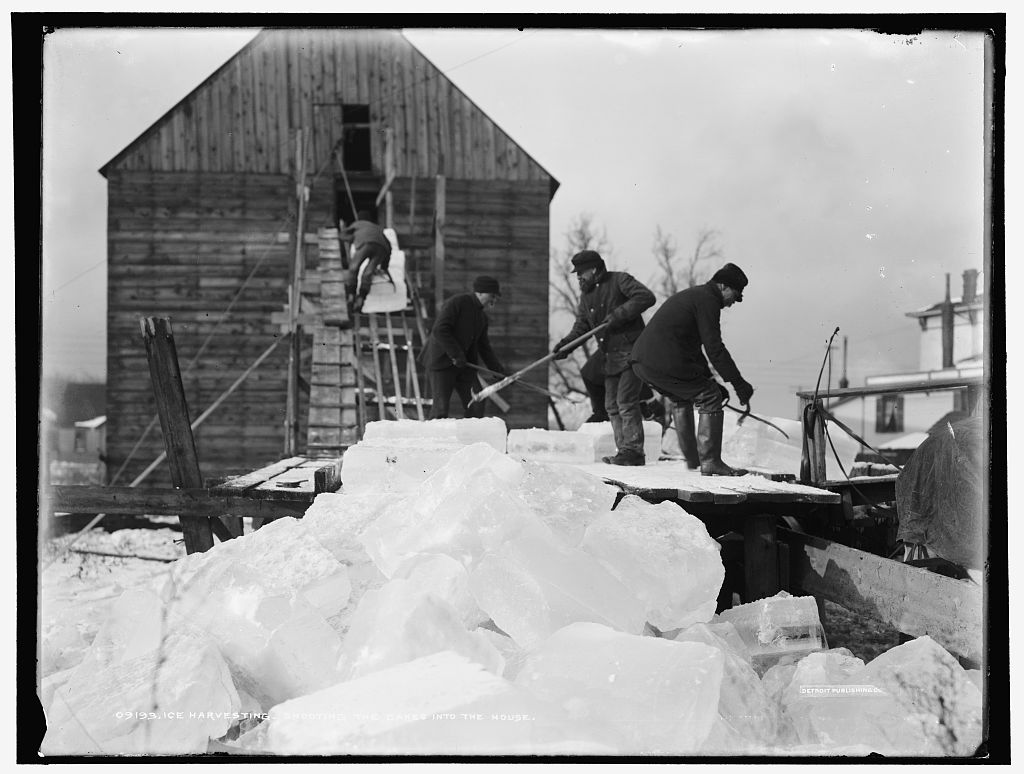
There was a time when the winter ice harvest was as critical as any other harvest, allowing folks in Michigan and elsewhere to enjoy & keep fresh food in summertime. Knowlton’s Ice Museum of North America in Port Huron is dedicated to chronicling what was once a huge industry for Michigan that is now almost forgotten. They explain:
Michigan was one of the main sources of ice harvesting because in those times people cherished the clear hard ice harvested from the beautiful Great Lakes. In the winter months farmers would make money to feed their families by working on the ice fields (rivers, ponds and lakes). Using primitive ice tools they would scrape snow off of the field, measure ice thickness, and saw ice cakes or blocks of ice.
The 300 lb. blocks would then be loaded onto horse drawn flat-bed type wagons and moved off the ice field. The horses hauled the load to stick built ice houses created along rivers and lakes where the ice was stored until the summer months when it could be sold. The ice was stacked and packed inside the ice house. Sawdust was used for insulation and placed in between layers of ice. Some ice houses stored over 1,600 ton of ice. The work these men did each long day was dangerous and cold. Once a luxury, ice became a common household and business commodity by 1900. The ice delivery man would weigh ice blocks and deliver ice by horse drawn covered wagon to homes and businesses. Each order was carried into the home and placed into the top shelf of an ice box to keep food fresh.
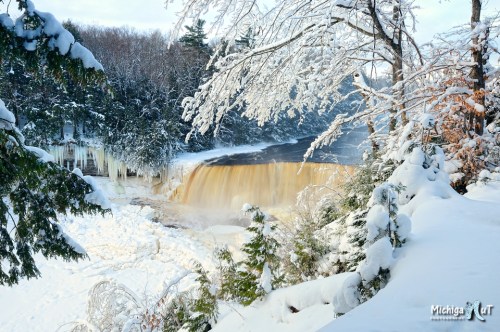
John took this shot a couple of months ago at Michigan’s largest waterfall. Several years the crew from Wild Weekend TV went to the falls in wintertime. They talked with Lark Ludlow, owner of the Tahquamenon Falls Brewery and Pub about the history & lore of the Tahquamenon Falls – click to check it out.
In addition to Michigan in Pictures and building websites & marketing campaigns, my partner Laura & I produce an online publication called eatdrinkTC that profiles Traverse City’s dynamic culinary scene. We feature a lot of the chefs and culinary artisans who make it all happen and engage people in helping to promote all the good things going on.
One way we do that is with our monthly #eatdrinkTC Photo Contest that offers a prize every month for the top photo. This month’s prize is two 3-course dinners at the popular The Cooks’ House, so if your photographic arsenal has some pics from Traverse City or the surrounding area that fit the bill, consider entering.
Lisa was lucky enough to attend a cooking class with chef Myles at The Box last month. It was titled simply “The Pig” and Myles showed the class how to break down half a pig and how to cut, prepare and EAT the many cuts! (we have a full cooking class calendar if you’re interested)
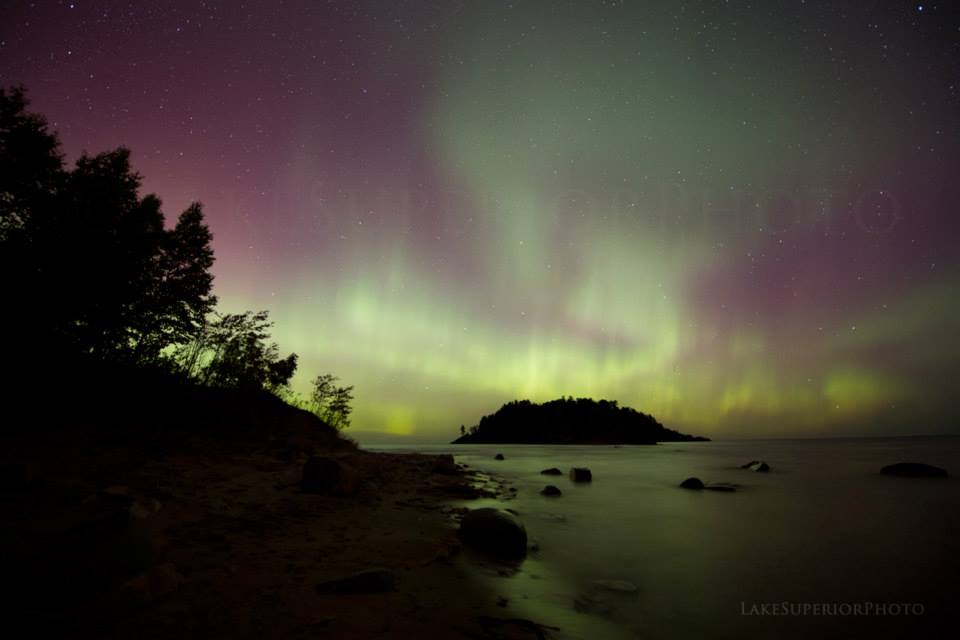
Just in! Shawn told me she just got in from shooting the northern lights last night – check her photo out right here and stay tuned to her Facebook for updates!
Earth is currently under the influence of a coronal mass ejection (CME) and G2 (Moderate) geomagnetic storming has been observed. This is likely the result of what was expected to be a near miss from an event originally observed on the 14th. This CME has a fairly well-organized magnetic field structure so continued G1 (Minor) to G2 (Moderate) storming is certainly possible. Stay tuned for updates as this event unfolds.
The Aurora Borealis was out last night, and I thought it a good time to share Shawn Malone’s Insider Secrets for Northern Lights that she wrote for the Pure Michigan Blog a couple of months ago:
Michigan has a lot of things going for it when it comes to northern lights viewing, the most important being 1). latitude and 2). relatively low light pollution in many areas. Northern Michigan sits in a great location latitude-wise, as the auroral oval dips further south on nights of stronger auroral activity. The Upper Peninsula is blessed with hundreds of miles of shoreline along the south shore of Lake Superior, which provides some of the best northern lights viewing in the lower 48 due to the very dark night skies. When looking north over Lake Superior, one can see right down to the horizon and take in a 180 degree unobstructed view of the night sky. Getting to a location without the obstruction of a treeline or hills is important at our latitude, as many times an auroral display will sit very low on the horizon. Having a dark night sky with little light pollution is necessary when looking for the northern lights, as the light of the aurora is equal to the brightness of starlight.
People often ask me how I’ve been able to see so many northern lights displays over the years and a lot of it has to do with what I mentioned above. I live in Marquette, Michigan which sits centered on the south shore of Lake Superior, and when looking north there’s nothing but lake for hundreds of miles. Marquette and locations nearby have many areas along the lakeshore still publicly accessible, allowing for the opportunity to view the aurora right from the shoreline.
If you’ve never seen the northern lights and want to maximize your opportunity to do so, learn and pay attention to sunspot activity, as that’s what drives the northern lights.
Read on for tips on where to catch these lights, some more photos from Shawn and her incredible, Smithsonian award-winning video Radiance.
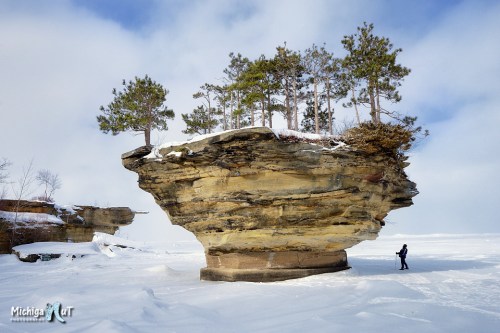
Michigan’s Little Finger has been getting a lot of national media attention for the fantastic ice caves that have formed off the Leelanau Peninsula, but it’s a good time to check out the Thumb as well! Turnip Rock is on private property and reachable in the summer only by boat. In wintertime, however, walking on publicly owned Lake Huron becomes an option.
Everyone that received their grade school education in Michigan learned that glaciers pushed their way over Michigan several times. The result is glacial drift averaging 200 to 300 feet deep covering on top of the bedrock. The thickness of drift has measured over 1,000 feet in a few Michigan locations. Rarely can we see exposed bedrock that has been sculptured by non glacier forces. This is one of the locations in southern Michigan where the sandstone bedrock is exposed at the surface. The amount of shoreline that has exposed sandstone is about one mile, but a lot of beauty has been sculptured in the stone.
The locals call the main structure here “Turnip Rock”, because of it’s shape. Geologists call it a “Sea Stack”. A definition of a sea stack is an isolated pillar-like rocky island or mass near a cliff shore, detached from a headland by wave erosion assisted by weathering. Waves force air and small pieces of rock into small cracks, future opening them. The cracks then gradually get larger and turn into a small cave. When the cave wears through the headland, an arch forms. Further erosion causes the arch to collapse. This causes a pillar of hard rock standing away from the coast. Generally occurring in sedimentary rocks, sea stacks can occur in any rock type.




 Michigan in Pictures