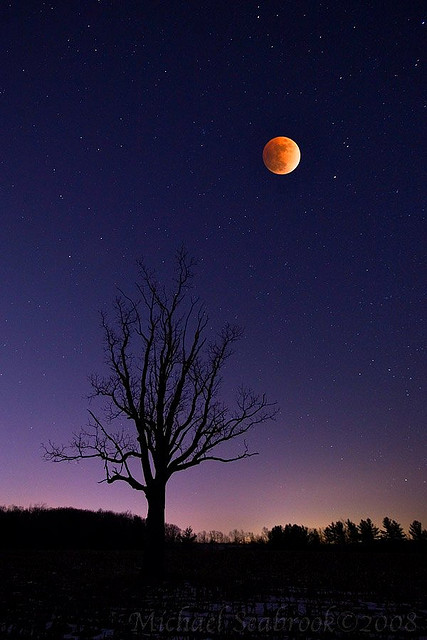
Blood Moon kicks off the Lunar Eclipse Tetrad

Shadow Moon by Michael Seabrook

Shadow Moon, photo by Michael Seabrook

For as long as we know, celestial signs have been read to signify calamity and change, and apparently the total lunar eclipse in the early morning hours of April 15, 2014 that kicks off a two-year tetrad of lunar eclipses is no exception.

In What is a Blood Moon? on one of my favorite blogs, EarthSky, Bruce McClure and Deborah Byrd explain (in part) a subject you might be hearing about this week:

We’ve been receiving a number of inquiries about Blood Moons in 2014 and 2015. The Blood Moons most people are asking about are not part of astronomy. Their origin is religious, at least according to Christian pastor John Hagee, who wrote a 2013 book about Blood Moons. However, both astronomers and some proponents of Christian prophesy are talking about the upcoming lunar tetrad – a series of total lunar eclipses – which begins on the night of April 14-15, 2014. We at EarthSky don’t have any special knowledge about the purported Blood Moons of Biblical prophesy. But, since they’re moons, and since people are asking us, we wanted to reply.

The full moon nearly always appears coppery red during a total lunar eclipse. That’s because the dispersed light from all the Earth’s sunrises and sunsets falls on the face of the moon at mid-eclipse. Thus the term blood moon can be and probably is applied to any and all total lunar eclipses…

Both astronomers and followers of certain Christian pastors are talking about the lunar tetrad of 2014-2015. What is a tetrad? It’s four successive total lunar eclipses, with no partial lunar eclipses in between, each of which is separated from the other by six lunar months (six full moons)

We’re not experts on prophecy of any kind. But we’ll tell you what we know about the new definition for Blood Moon that has raised so many questions recently.

From what we’ve been able to gather, two Christian pastors, Mark Blitz and John Hagee, use the term Blood Moon to apply to the full moons of the upcoming tetrad – four successive total lunar eclipses, with no partial lunar eclipses in between, each of which is separated from the other by six lunar months (six full moons) – in 2014 and 2015. John Hagee appears to have popularized the term in his 2013 book Four Blood Moons: Something is About to Change.

As if we didn’t have enough to look forward to on April 15th! Read on for lots more. The four eclipses are this one, October 8 2014 and April 4 & September 28, 2015. Here’s the eclipse viewing times for Michigan – times for other time zones can be found on EarthSky.

The April 15th eclipse begins at 2 AM Eastern time when the edge of the moon first enters the amber core of Earth’s shadow. Totality occurs during a 78 minute interval beginning around 3 o’clock in the morning on the east coast, midnight on the west coast. Weather permitting, the red moon will be easy to see across the entirety of North America.

Eastern Daylight Time (April 15, 2014)
Partial umbral eclipse begins: 1:58 a.m. EDT on April 15
Total eclipse begins: 3:07 a.m. EDT
Greatest eclipse: 3:46 a.m. EDT
Total eclipse ends: 4:25 a.m. EDT
Partial eclipse ends: 5:33 a.m. EDT

Michael took this photo of the lunar eclipse on February 20, 2008. View it bigger and see more in his The Moon slideshow.

More of the moon on Michigan in Pictures!

Pink Daffodils

Pink Daffodils by Alissa Holland

Pink Daffodils, photo by Alissa Holland

We can dream, right?

View Alissa’s photo bigger and see more in her How My Garden Grows slideshow.

Sometimes, Mother Nature Wins

Cason J Calloway in Lake Superior Ice

Stuck in the ice, eastern Lake Superior, photo courtesy US Coast Guard Cutter Mackinaw

As of yesterday, no ships had passed through the Soo Locks due to the overwhelming mass of ice on the world’s biggest lake. That doesn’t stop them from trying and (in this case) failing. The Cason J. Callaway ended up locked in ice and had to be rescued by the US Coast Guard’s flagship icebreaker Mackinaw.

Soo Today reported yesterday:

Two freighters bound from Duluth, Minn. are battling their way through what a United States Coast Guard spokesperson called “brutal” and “extreme” ice conditions on Lake Superior to reach the Soo Locks.

The vessels, John P. Munson and Cason J. Callaway, are following the USCG Cutter Mackinaw but are making very slow progress.

Randy Elliott, vessel traffic manager with the USCG stationed in Soo Michigan, said Tuesday that the convoy left Duluth around the time the Soo locks opened for traffic on March 25. As of late yesterday, the southbound convoy was located about 40 kilometres south of Michipicoten Island, and were confronting ice three to three and a half feet thick with windrows six feet high in some places.

The three vessels opted not to use their normal route across the lake, and instead are following the north shore of Lake Superior, Elliott said.

No commercial ships, either north or southbound, have locked through since the official opening a week ago.

That also is not normal.

“Usually at this time of the year we would see 12 to 15 vessels north and southbound a day using the locks,” Elliott said.

Read on for more and definitely check out pasty.com’s photos by Callaway wheelsman, Keith Baker.

Thanks Shawn Malone of Lake Superior photo for the find and for the title! Get more on icebreaking on the the Great Lakes on Michigan in Pictures.

Set your background for Spring!

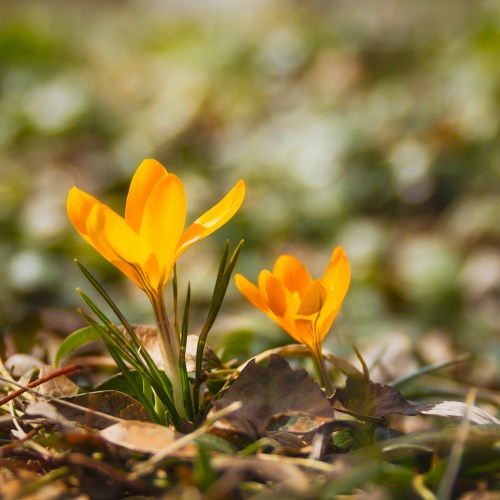
First Flowers of Spring

First Flowers of Spring, photo by Bill Dolak

Although this photo is from a year and two days ago, reports are starting to roll in of crocus sightings. That’s good enough for me – set a course for Spring, Warp 6!

Check it out background bigtacular and see more in Bill’s Flowers slideshow.

There’s more spring wallpaper on Michigan in Pictures and in case you were feeling wimpy after March, UpNorth Live reports that March 2014 was indeed a lion!

In the Month of March the average temperature for these cities were well below normal. March was 10 degrees below normal in Houghton Lake and 11 degrees below normal in Gaylord. This past March was the 3rd coldest on record in Alpena, and in both Gaylord and Houghton Lake it was the coldest on record!

“Pure Michigan” to change name to “Pure Snow”

Rick-Snyder-announces-Pure-Snow

APRIL 1, 2014 – LANSING, MI Governor Rick Snyder traveled to Ishpeming in the Upper Peninsula to announce to a crowd of media, dignitaries and frozen-in-place Michiganders that effective immediately, the “Pure Michigan” tourism campaign will be re-branded as “Pure Snow”.

“Who are we kidding?” Gov. Snyder asked. “Winter 2014 was like something out of the latest Thor movie (which coincidentally cost less to make than this year’s snow plowing bill). Pure Michigan has served the state well for years, but even though it looks like we’re in the clear now – in another six months, it’s back to winter again!”

The state’s $8.4 million dollar re-branding effort will seek to market travel by snowmobilers, skiers and “people without a brain in their head.” The State rock will now be “ice”, the State capital will now be Pellston, the “Ice Box of the North”, the State motto will be “If you seek a pleasant peninsula, what the heck are you doing here?” and the State animal will now be “frozen in a snowdrift”.


Thawing

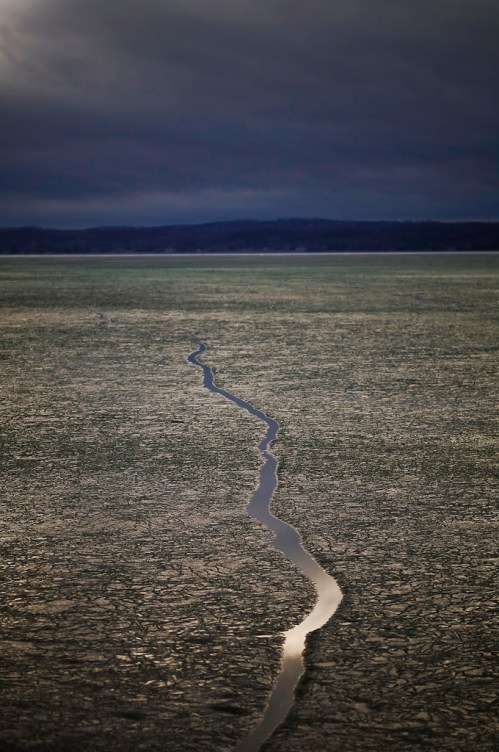
Thawing

Thawing, photo by Jennifer Bruce

A crack in the armor. Down with winter!

View Jennifer’s photo bigger and see more of her Torch Lake photos on Flickr.

Bear Triplets

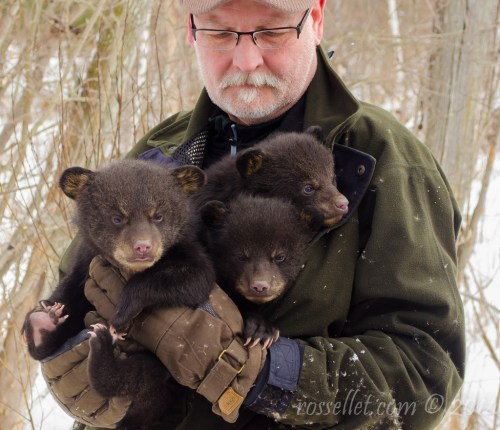
Bear Triplets

Bear Triplets, photo by Ross Ellet

I feel like the one on the left says everything I have to say about snow, cold and Winter. Here’s three facts from the DNR’s Michigan Black Bear Facts page – click through for more:

What is the status of black bear in Michigan?

Approximately 15,000 – 19,000 black bears (including cubs) roam the hardwood and conifer forests of northern Michigan. About 90 percent of the bear live in the Upper Peninsula, while the remaining ten percent are mainly found in the northern Lower Peninsula. However, it is becoming increasingly common to see bear in the southern half of the Lower Peninsula. …

When do bear breed?

Breeding takes place in June and July and cubs are born in early January while females are in dens. A litter may consist of one to four cubs, with two or three cubs being most common. An adult female bear usually breeds every other year, but may mate in consecutive years if cubs are lost before mid summer. A female bear will generally breed for the first time at 2’/z years of age in the northern Lower Peninsula, and at 3’/2 years of age in the Upper Peninsula.

What are bear cubs like?

At birth, bear cubs weigh less than one pound, but mother’s rich milk helps them grow quickly. Mother and cubs emerge from the den in spring, with the cubs weighing up to ten pounds. Cubs are under the watchful eyes of their mother throughout the summer and fall seasons. As autumn nears its end, the female once again searches for a suitable den site for herself and her cubs. After emerging from the den the following spring, the adult female will stay with her offspring until she is ready to breed again in June. At that time, she aggressively discourages the companionship of these now yearling bear and they are forced to fend for themselves.

Lots more about American black bears (Ursus americanus) at the UM Animal diversity web. About the photo Ross writes:

Baby black bears being held during a bear den visit in late March 2014. These baby bears are being counted, measured, weighed and analyzed so researchers can understand more about the overall health of the black bear population in Michigan. Researchers are also tracking their movement as some bears shift into southern Michigan.

View his photo big as a bear, see more in hisNature slideshow and view & purchase photos at rossellet.com.

More animals on Michigan in Pictures.

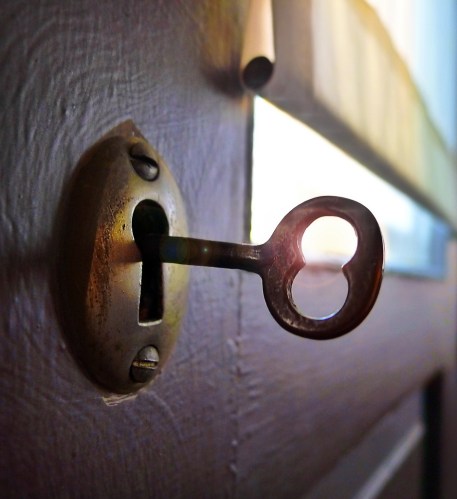
Morning Lock

Morning Lock

Morning Lock, photo by swatzo

View Steve’s photo bigger and see more in his slideshow.

Quiet Opening Day at the Soo Locks in 2014

Coast Guard cutters pass through Soo Locks

Coast Guard cutters pass through Soo Locks, photo by Coast Guard News

Although the Soo Locks opened yesterday, UpNorthLive reports that for the first time in 20 years no ships passed through. Click through for a video story that includes footage from the Locks and an interview with Soo Locks Lock Master Tom Soeltner.

About the photo, the Coast Guard News writes:

The crew of Coast Guard Cutter Mackinaw steers the cutter through the fog as it passed through the Soo Locks in Sault Ste. Marie, Mich., March 21, 2014. The Mackinaw along with the Coast Guard Cutters Morro Bay and Katmai Bay passed through the locks together en route to breaking ice in the St. Marys River and Lake Superior in preparation of the scheduled opening of the Locks, March 25. U.S. Coast Guard photo by Petty Officer 2nd Class Levi Read.

View Levi’s photo background bigtacular and see more at the Coast Guard News’ Soo Locks tag.

There’s more boats and more Sault Ste. Marie, and if you’re interested in the Icebreaker Mackinac and other icebreakers, Michigan in Pictures has that too!

When a young man’s fancy turns to …

I guess it really IS spring . . .

I guess it really IS spring…, phoot by Dr. Farnsworth

Thing number 757 about Michigan that I think is cool: you can ride bikes on lakes.

Dale writes:

…AHH Spring, when a young man’s fancy turns towards . . . riding around the lake ON the lake! Still very much frozen solid in western Michigan! Temps tonight well below freezing, a few inches of snow predicted, and people are riding on the ice on fat bikes! Have a good “spring” week Facebook and Flickr friends!

View his photo from Twin Lakes on his map, background big and see more in massive Best of West Lake slideshow.

More winter wallpaper and more biking on Michigan in Pictures.