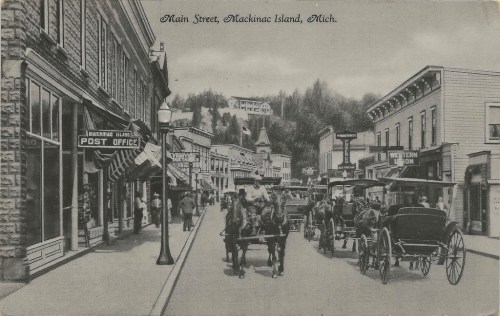
Yesterday & Today on Mackinac Island

Mainstreet Mackinac Island 1930s

NE Mackinac Mackinaw Island MI 1930s, photo by Don … The UpNorth Memories Guy … Harrison

I think that it’s pretty clear that Mackinac Island, a living museum boasting an intact Colonial era fort along with many exhibition buildings, The Grand Hotel and other historic businesses and NO CARS, is Michigan’s coolest state park. Today (June 11, 2015), Pure Michigan will be presenting Mackinac Island to the world (well, the internet at least) in a whole new way. They explain:

As the first state in the United States to ever conduct a real-time virtual guided tour, Pure Michigan is offering you the opportunity to experience Mackinac Island – virtually! We’re partnering with Georama, a real-time vicarious travel platform, so you can virtually tour the island just by simply logging into michigan.org/live on Thursday, June 11 at 12 noon to 4 pm Eastern. Tom Daldin, host of PBS show Under the Radar, will serve as your travel guide and adventure lead in this digital exploration.

…Begin your journey by taking a ferry ride to Mackinac Island before getting an up-close and personal view of the island.

We’ll take you to downtown Mackinac, home to some of the most lovely shops and art galleries in the state, offering you a chance to peek inside as well as interact with people on the streets to get their thoughts on the island known as America’s fudge capital. We’ll also tour Douds Market, America’s oldest family-owned grocery store for 131 years so you can see some of the store’s specialty items and get a history lesson on the market.

From there we’ll visit Fort Mackinac and round out our journey with a trip to the gloriously-designed Grand Hotel. We’ll give you a new perspective of this landmark and invite you to join us as we sip tea on the Grand’s famous front porch all while surrounded by 2,500 gorgeous geraniums.

Click through for more and tune in!

View the photo background big and see more of Don’s Mackinac Island postcards & photos on Flickr. Be sure to follow him on Facebook as well!
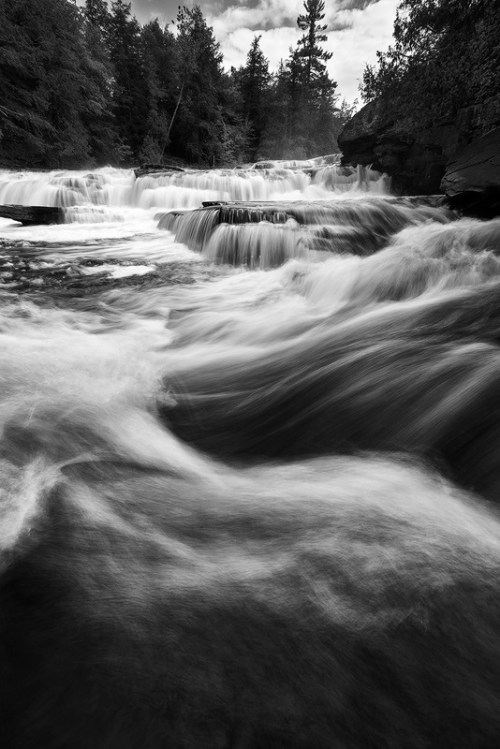
Waterfall Wednesday: Manido Falls in the Porcupine Mountains

Turbulence (Manido Falls, Porcupine Mountain)

Turbulence (Manido Falls, Porcupine Mountain), photo by Jiqing Fan

The Waterfall Record’s entry for Manido Falls says:

Manido Falls did not impress me at first, at least not as much as the downstream Manabezho Falls. After seeing the pictures I had taken, though, I discovered what an amazingly beautiful waterfall Manido Falls is. Its beauty comes from its complexity. The waterfall itself is not very tall at all. It is wide, though. As the Presque Isle River tumbles down toward Lake Superior, it comes to this set of rocks that create a beautifully cascading waterfall. I think what makes me like Manido Falls so much is that the water has taken such an interesting course here, erosion taking its effect in an oddly unique way.

Add to it that the just as spectacular Manabezho Falls is only hundreds of yards away, and Lake Superior not much more distant, this makes for one of the most beautiful waterfall stretches in the Upper Peninsula.

Visit #2: When my father and I visited Mandido Falls in late September 2010, the falls looked completely different due to the significant amounts of rainfall in the weeks previous.

Read on for directions and some photos.

View Jiqing Fan’s photo bigger and see more in his Houghton & UP MI slideshow.

More black & white photography and (many) more Michigan waterfalls on Michigan in Pictures!

Michigan Ghost Towns: Aral at Otter Creek

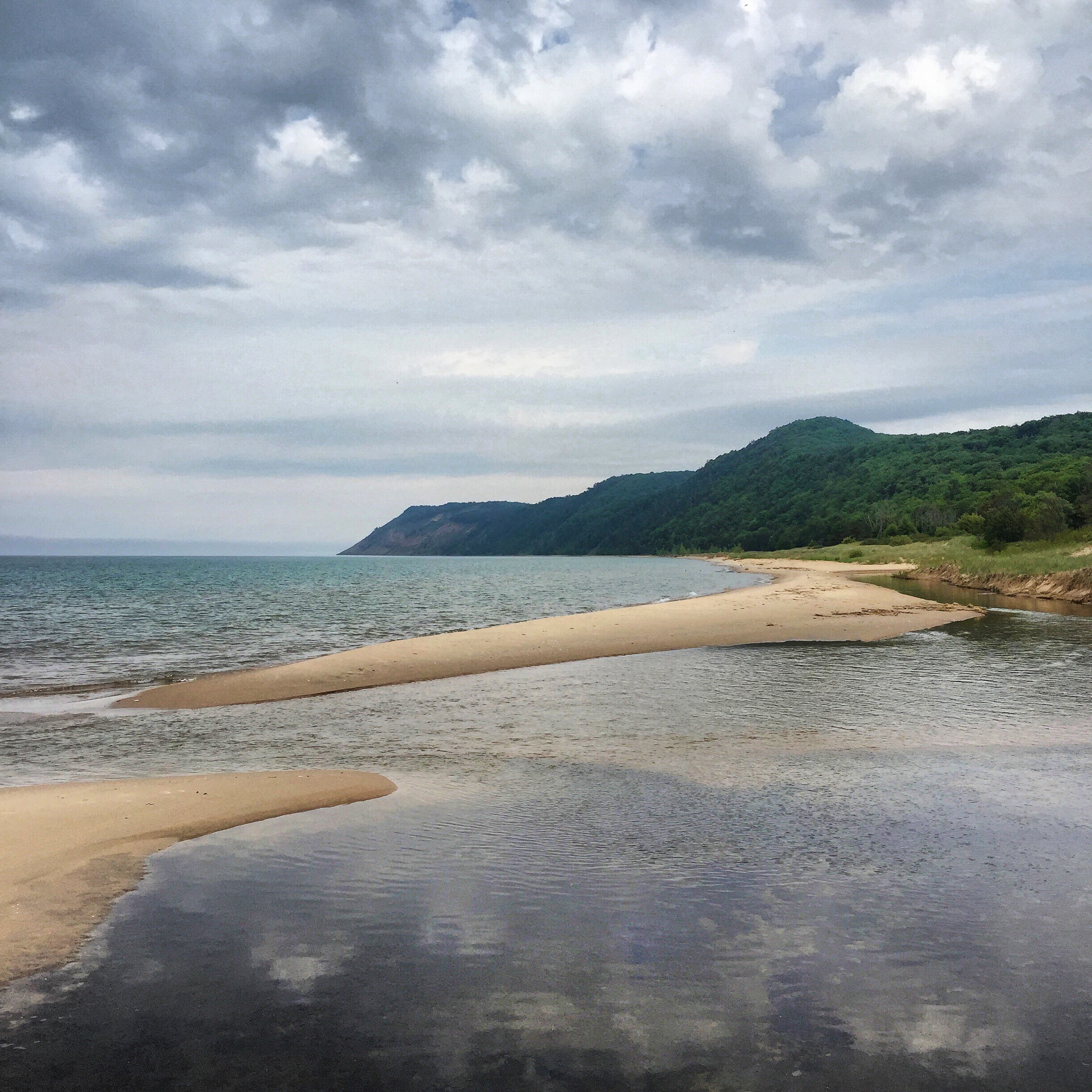
Esch Beach

Esch Beach, Otter Creek, photo by Sara Hunt/oni_one_

The Sleeping Bear Dunes National Lakeshore tells the rich tale of the ghost town Aral:

Aral was located on Lake Michigan where Otter Creek empties into the Lake just south of Esch Road, a few miles south of Empire, MI. Today this is one of the most popular swimming beaches in the Lakeshore, but in the 1880s, Aral was a booming lumber town!

When the United States acquired land, it first had to be surveyed before it was made available to individuals. In the summer of 1849, Orange Risdon was one of the surveyors assigned to the area around Grand Traverse Bay. In 1853 soon after he finished the survey, Risdon and his wife, Sally, bought 122 acres where Otter Creek emptied into Lake Michigan.

The US Civil War began in 1861, and to induce able-bodied men to join the Union forces, the US government offered $100 bounty to men who enlisted. By 1863 the bounty was increased to $300, and finally a draft was instituted. An interesting provision of the draft act allowed drafted men to avoid service by hiring a substitute or by paying $300. One of the men receiving draft notice was Robert F. Bancroft, who was married and 30 years old. He chose to take advantage of this provision by hiring a German immigrant to take his place as a soldier, but interestingly he followed his replacement to the battlefield. Instead of carrying a gun, he brought his camera and became one of the first battlefield photographers.

Following the war, the veterans returned home, and Robert Bancroft settled with his wife Julia and daughter Anna in Traverse City. He began buying land in Platte and Lake townships as investments and in late 1864, he bought the 122 acres from Orange and Sally Risdon of Saline, MI.

Bancroft cleared 20 acres and built a log cabin for his family to live in. Then he planted some black locust trees and an apple orchard around the cabin. Lumber speculators soon arrived looking for stands of white pine. Most of the forest in this area was hardwood, but there were some stands of white pine inland from Otter Lake. By the late 1870s Daniel Thomas bought a 5-acre parcel on Lake Michigan south of Otter Creek, but he decided to build a house across the road from the Bancroft’s. Lumber speculators were on their way north as the forests near Grand Haven and Muskegon were harvested.

…By 1883, the lumber business was booming and the town was growing. A post office was required. The community was known as Otter Creek – the “Krik” by locals. When they applied for a post office, their name was rejected because there was already an “Otter Creek” in Michigan. “Bancroft” was the next suggestion, but again the name had already been used. One of the workers suggested the name “Aral” because of the beautiful Aral Sea in Europe. Locals continued to call it Otter Creek though. Dr. Frank Thurber was named the first postmaster. Keep his name in mind, for he too would play a central role in the murder.

Murder you say? Indeed – read on for lots more…

View Sarah’s photo background bigilicious on Facebook and follow her for lots more at oni_one_ on Instagram.

They came from beneath…

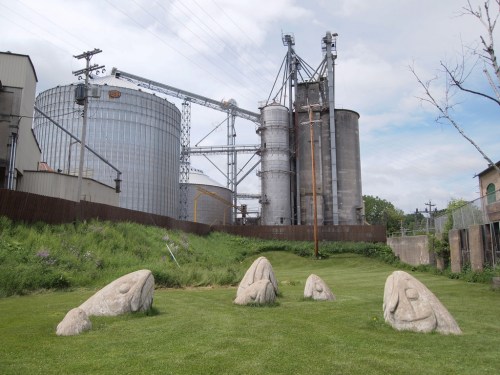
Fish from Beneath

Untitled, photo by otisourcat

These fish heads are located at Newaygo’s Riverside Park. No idea why, but if you want to check them out, Roadside America has the location.

View the photo bigger and see more in otisourcat’s massive Here & Now slideshow.

More fish and more amusing Michigan oddities on Michigan in Pictures.

Chaos & Order: Elberta Breakwall Edition

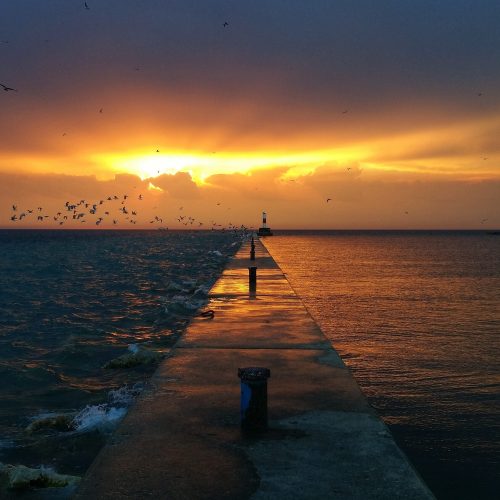
IMG_20150529_122634

Untitled, photo by Noah Sorensen

You really should check out this photo background bigtacular. Lots more in his slideshow and if you do the Instagram thing, Noah is a great follow @mcsorensens.

Fern Friday

Michigan Ferns

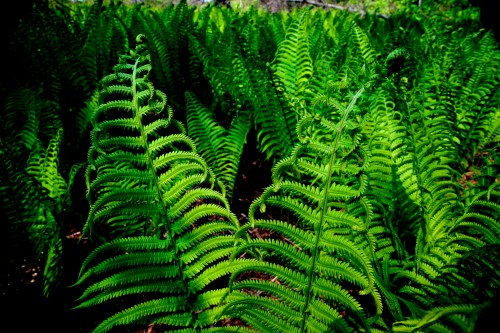
Ferns, photo by Tom Mortenson

The American Fern Society offers A Brief Introduction to Ferns that says (in part):

Ferns have been with us for more than 300 million years and in that time the diversification of their form has been phenomenal. Ferns grow in many different habitats around the world. The ferns were at their height during the Carboniferous Period (the age of ferns) as they were the dominant part of the vegetation at that time. During this era some fern like groups actually evolved seeds (the seed ferns) making up perhaps half of the fern like foliage in Carboniferous forests and much later giving rise to the flowering plants. Most of the ferns of the Carboniferous became extinct but some later evolved into our modern ferns. There are thousands of species in the world today.

…The life cycle of the ferns may seem complicated but it has worked quite successfully for millions of years. Though spores come from fronds of ferns, the fronds do not come directly from the spores. Spores from the parent fall to the ground and with an enormous amount of luck (millions perish for every success) they will find suitable moisture and light. The tiny single-celled organism starts to grow by cell division. Soon orderly arrangements of cells form little green heart shaped plants or Prothallia (gametophytes). These plants go unnoticed by most people as they are only 1/2 inch or less across and lie flat on the ground. This is an independent plant with its own simple “root” system (rhizoids) to provide it with nutrients and water.

Read on for more and you can view native and non-native Michigan ferns at the University of Michigan Herbarium.

Tom took this shot on the Montreal River that forms the Wisconsin/Michigan U.P. border near Superior Falls. Definitely check it out background bigtacular and see more in his slideshow.

You can read more about Superior Falls and check out more  summer wallpaper on Michigan in Pictures!

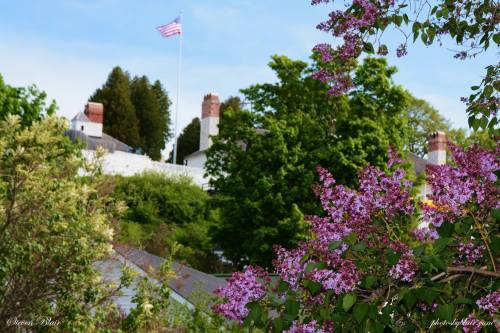
Lilac Island: Mackinac Island’s Lilacs & Lilac Festival

Mackinac Island Lilacs and Lilac Festival

Fort Mackinac & Lilacs, photo by Steven Blair

The 66th annual Mackinac Island Lilac Festival starts tomorrow and runs through June 14th. It celebrates the Island’s historic varieties of lilacs (many from the Colonial era) and equestrian culture and is one of the Island’s biggest attractions.

Apparently it’s “Lissa Edwards Goes to Mackinac Week” on Michigan in Pictures as I turn again to one of my favorite writers for her take on the Lilac Festival.

Metaphors for islanders and their favorite shrubs are easy pickings. Lilacs are tough as native islanders (or native islanders are hearty as these flowers?). Like their human counterparts, lilacs thrive in the cold Straits of Mackinac winters; neither lilacs nor island folk shrink from sinking their roots into the island’s craggy limestone bedrock. In fact, they crave that acidy terra firma. And last but best, lilacs prefer their soil the way these islanders like their beer: well drained.

When the long, cold winter and cool spring finally ends, Mackinac lilacs show their joy by transforming the island into a fairyland of blossoms. Cotton candy–colored tinkerbelles tempt from behind white picket fences. Big bold creamy Madame Lemoine lilacs strut next to a fluttery pink and white Beauty of Moscow in Ste. Anne’s churchyard. Down at the marina, where voyageurs working the Great Lakes fur trade once pulled their canoes, blue President Lincolns wave next to white Betsy Rosses. A froth that includes double pink Elizabeths and dark purple Monge spills out over the rolling green lawn at Marquette Park. And the gauzy backdrop to them all: the anything-but-bourgeois, lilac-colored common lilac.

The island is home to all 23 lilac species, some 400 varieties and thousands of individual plants. In June—and even into July in the case of late-blooming varieties—these flowers radiate their perfume into the windy Straits, where it melts into the aroma of warm fudge wafting from Main Street’s famous fudge shops and fresh horse apples (cars are banned on Mackinac Island) to create a signature Mackinac Island scent.

Read on for lots more.

View Steven’s photo background bigtacular on the Mackinac Island Lilac Festival’s Facebook and see a bunch more lilac photos from Mackinac Island on his Photography by Blair Facebook.

More lilacs and more Mackinac on Michigan in Pictures.

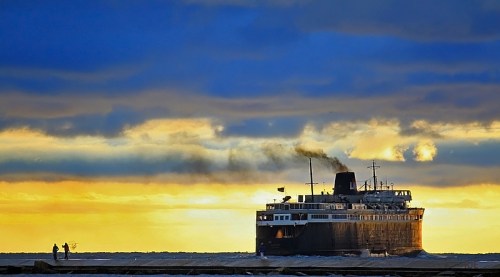
The Badger steams on

S.S. Badger - Ludington Mi.

S.S. Badger – Ludington Mi., photo by RJE

NPR has a feature on the upgrades to the SS Badger that allow the car ferry to continue to operate between Michigan and Wisconsin on Lake Michigan:

A slice of history sails across Lake Michigan, carrying cars between Ludington, Mich., and Manitowoc, Wis. It’s the SS Badger: the largest coal-fired passenger ship still operating in the United States.

For years, the ship was the focus of environmental scrutiny because of its practice of dumping waste coal ash directly into the lake. The pollution nearly stopped the Badger from steaming again — but now, the ash-dumping has ended.

…After decades of letting the Badger pollute the lake, the Environmental Protection Agency issued an ultimatum: Stop dumping or be grounded.

Finally, this off-season, the boat’s owner installed a $2 million solution: a set of blue pipes that collect ash each trip, about 500 tons per year. Once a week, that ash gets trucked to Charlevoix, Mich., for use in making cement products.

You can get all the info on the Badger right here. For an added dose of awesome in your day, check out The Steamer 43 Song by Pete Host, featuring photos of the SS Badger on Absolute Michigan. It’s from a 45 Pete recorded in the early 70s about a sailors life on the C&O carferries out of Ludington, Michigan. With his spare time aboard the Badger, he learned how to play the guitar, and in just a few months, went to Milwaukee Wis. and recorded this song.

View the photo bigger and see a couple more of R.J.E.’s photos of Ludington, Michigan.

More Michigan ships and boats on Michigan in Pictures.

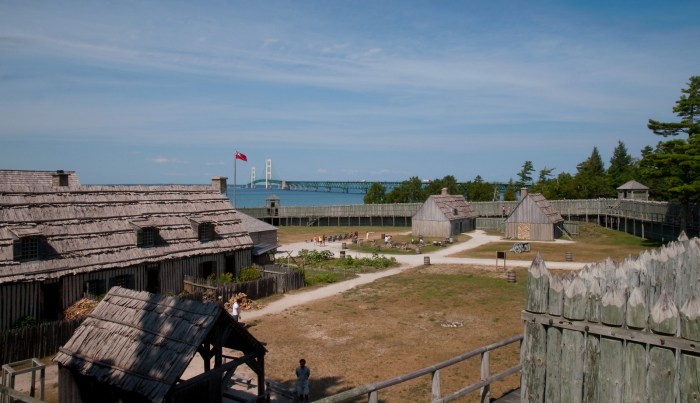
Michilimackinac and Pontiac’s Rebellion

The Fort and the Bridge, photo by Joel Dinda

Mackinac State Historic Parks page on Colonial Michilimackinac says that:

French soldiers constructed the fortified community of Michilimackinac on the south side of the Straits of Mackinac in 1715. The community grew and prospered over the coming years as Michilimackinac became an important center of the Great Lakes fur trade. Every summer, thousands of Native Americans and French-Canadian voyageurs gathered at the post, which served as transfer station for furs trapped in the western Great Lakes and trade goods shipped in from eastern cities such as Montreal and Quebec. Michilimackinac came under British control in 1761, but the fur trade and community life remained relatively unchanged.

Fearful that the post was vulnerable to attack by American rebels, the British disassembled the fort and community and moved it to Mackinac Island in 1779-81.

One factor in the move may also have been an event that happened 252 years ago on June 2, 1763. The fort was captured by Ojibwa & Sauk warriors who gathered to play a huge game of baggatiway. Elizabeth Edwards of Traverse Magazine wrote a great article about the massacre that begins:

Under an unusually hot sun on a late spring day on the Straits of Mackinac, British Major George Etherington, commandant of Fort Michilimackinac, was suffering from an acute case of cultural blindness. And there was no excuse for it. Relaxed at the sidelines of a rousing game of baggatiway (similar to lacrosse) outside the fort, the major should have seen the danger signs in this Ojibwe versus Sauk contest of sweaty, half-naked bodies painted with white clay and charcoal.

The 30-year-old officer was born in the colonies, and most likely grew up on stories of Indian uprisings. He’d even served in the just-ending French and Indian War, in which the English had wrested control of North America from the French—a victory that had put this previously French fort in Etherington’s care. Though the major had been raised on American soil and had fought on it, he was still English. And in that country, a battle was a battle, and a sporting event was a sporting event.

Perhaps that explains why the major missed the clues…

Read on for much more at Traverse, and you can also watch a video on Pontiac’s Rebellion from the History Channel or jump right to the story.

Joel adds that almost every building at Colonial Michilimackinac is a reconstruction, with only two or three minor exceptions. View his photo background bigtacular and see more from the fort and surrounding area in his Straits of Mackinac slideshow.

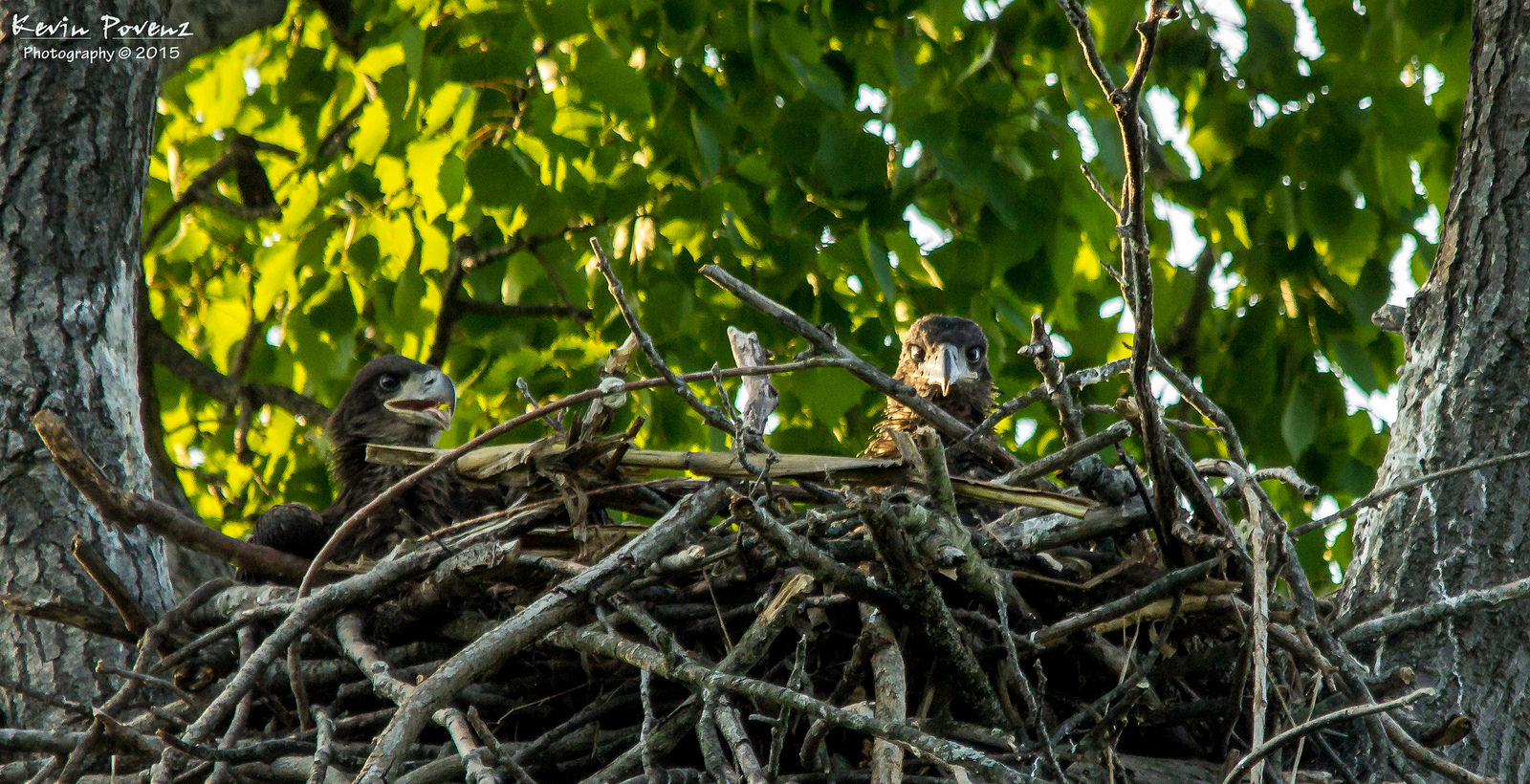
Eaglet Morning

Michigan Eaglets in their Nest

Eaglets, photos by Kevin Povenz

The State of Michigan’s page on Bald Eagles (Haliaeetus leucocephalus) says in part:

When bald eagles reach maturity (at four to five years of age), they select a mate, with whom they probably mate for life. In captivity, they have been known to live to 50 years, but in the wild, they probably don’t reach much more than 20 years of age.

The beginning of the breeding season, from mid-February to mid-March, consists of the establishment of a territory, nest building and mating displays. The mating “cartwheel” display begins high in the air with the two birds darting and diving at each other, until they lock talons and drop in a spinning free fall, until the last possible moment when they separate. The nest is usually located in the tallest tree in the area, often a white pine or dead snag. They are usually made of sticks with a lining of grass and moss. Nests may be added to each year until they reach enormous sizes, up to ten feet in depth and 20 feet across.

From late March to early April, one to four (average two) pure white eggs, approximately twice the size of a chicken egg, are laid. Both males and female bald eagles participate in the incubation, and the feeding of the chicks that hatch around seven weeks later. In about three months, by late summer, the fledglings are ready for flight. When it is time to move for the winter, the young birds are abandoned by their parents.

Kevin is certainly the Official Bald Eagle Photographer of Michigan in Pictures! View his photo bigger and see more (including more of these little ones) in his Birds of Prey slideshow.

More Michigan birds on Michigan in Pictures.