Legend of the Crooked Tree

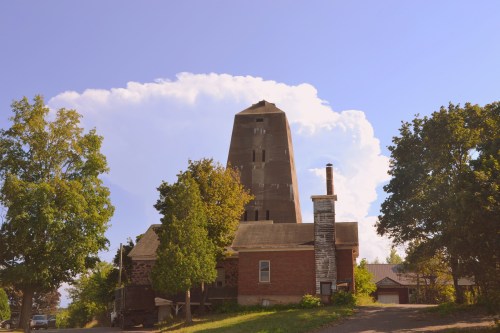
The Crooked Tree Petoskey

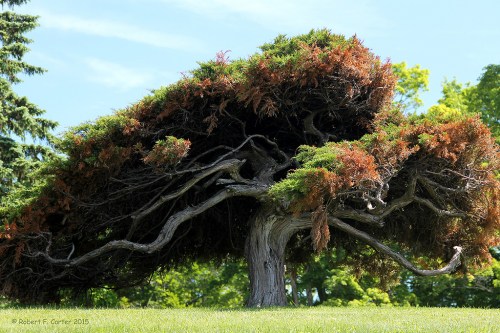
The Crooked Tree, photo by Robert Carter

Robert writes: Huge and ancient . . . this locally famous ‘Crooked Tree’ sits beside one of the roads near my home. “Crooked Tree”: “Crooked Tree Arts Center”, “Crooked Tree Breadworks”, “Crooked Tree Golf Club”, “Crooked Tree Septic Service”, “Crooked Tree This and Crooked Tree That”. This may not be the actual tree from which they take their names . . . but it is the most crooked tree I’ve come across in my travels, and it jumps out at everyone as they drive past.

Robert is correct that this isn’t the original. The Crooked Tree; Indian legends and a short history of the Little Traverse Bay region is available online and tells the story of the original Crooked Tree:

A tall, crooked pine tree overhanging a high bluff, served to designate what was probably the most important Indian village in the north, prior to the advent of the white man. “Wau-go-naw-ki-sa” the Crooked Tree could be seen for many miles by the occupants of approaching canoes. After rounding the northwestern extremity of what is now Emmet county, in the state of Michigan, on their way south, it was a familiar sight, and one that never failed to bring exultations of joy from the brave and daring Ottawas.

Just where the Crooked Tree stood we have been unable to ascertain; but tradition says it was in the vicinity of Middle Village of the present day. According to the legend it was bent by Na-na-bo-jo. Formerly it was straight, but as the great hunter and chieftain was climbing the hill one day at this point, with his canoe over his head, the end of the boat caught on the tree and gave him a bad fall. In anger he struck the tree a blow with his fist and bent it over. Where he hit the trunk a large swelling came out, and henceforward every knot or growth protruding from a tree was called “Na-na-bo-jo’s Fist.”

Read on for some cool stories from the area including some about the tree-punching Na-na-bo-jo!

View Robert’s photo bigger and see more in his My Petoskey slideshow.
The Future of Wolves on Isle Royale

Wolf on Isle Royale

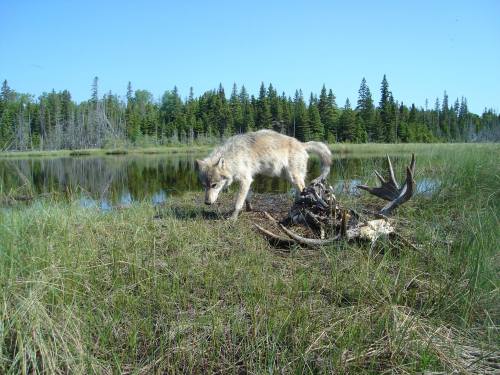
Alpha Male, photo by Rolf Peterson/Wolves and Moose of Isle Royale

The National Park Service has opened a formal public comment period that will close on August 29, 2015 regarding future management options for wolves in Isle Royale National Park. The wolf population has plummeted because of a lack of gene flow from the mainland and park management is considering an array of options. If you have commented before, do it again as anything preceding the current comment period is now considered informal input and won’t be considered further.

Moose have important effects on island vegetation, including forest cover, and wolves are the only moose predator on the island. The wolf population on Isle Royale is very low. With their long-term survival on the island in question, the moose population is likely to increase in the short term (5-10 years), which could result in impacts to vegetation and forest cover because of over-browsing.The six plan options they lay out in this PDF are:

  1. No-action alternative: Current management would continue; the park would not actively manage vegetation or the moose and wolf populations
  2. Introduce wolves once: Reestablish wolves on the island by bringing in new wolves one time to mimic a migration event; no moose management
  3. Maintain both species: Maintain populations of moose and wolves on the island, which could include wolf reintroduction or augmentation
  4. Introduce wolves once and reduce the moose population: Reestablish wolves on the island by bringing in new wolves one time; reduce moose density if/when the wolf population is no longer impacting the moose population and moose herbivory is having a demonstrated impact on park resources
  5. Reduce moose population: No wolf reintroduction or augmentation; reduce moose density if/when the wolf population is no longer impacting the moose population and moose herbivory is having a demonstrated impact on park resources
  6. Intensively manage the moose population: No wolf reintroduction or augmentation; intensively manage moose population to a low level; potential for direct vegetation restoration through seed gathering and planting on offshore islands

Click over for more and to comment.

The Wolf Moose Project on Isle Royale is the longest continuous study of any predator-prey system in the world. Rolf Peterson began leading the wolf moose project in the early 1970s, and remains a world authority on wolves and moose. About this photo he says:

It was a remote camera photo that I set up. It shows the alpha male in the Chippewa Harbor Pack in 2009, revisiting the remains of a moose the pack killed in the adjacent pond the previous autumn.  The wolves managed to yank the remains out of the pond the next summer and consume the rotting carcass.

You can view this photo background bigtacular and follow the Wolves & Moose of Isle Royale on Facebook for updates.

More wolves on Michigan in Pictures.

“A” Shaft at Cliff Shaft Mine Museum

A Shaft at Cliff Shaft Mine Museum, Ishpeming, Mi

“A” Shaft at Cliff Shaft Mine Museum, Ishpeming, Mi., photo by Thom Skelding

The Cliffs Shaft Mine Museum page at Pure Michigan says that the Ishpeming museum is open June – September Tuesdays through Saturdays from 10 am to 4 pm:

Walk back in history to see local historical artifacts representing the local community during the great mining era. View historical displays of miners and mines past and present, headgear & other safety equipment available to miners of yesteryear, and displays on blasting and diamond drilling equipment. Stop in the Ishpeming Rock and Mineral Club’s room and view over 500 minerals from the local area, the Upper Peninsula, Midwest and the world.

Take a guided tour of the tunnels that the miners walked to the base of the C-Shaft and listen to the history of mining from those who worked the mines. Follow up the stairs past old underground iron ore cars with a stop at the blacksmith shop. Go outside to view towers 97’ to 174’ high which were used to lower miners 1250’ into the bowels of the earth. Stand beside a 170-ton Iron Ore Truck with tires 12 feet high.

Don’t forget your camera so you can have a memento of your visit standing inside the 30 ton shovel bucket in front of the Dry building or in front of the 170-ton Iron Ore truck. End your tour in the gift shop to pick up memorabilia of your visit. The museum open with a nominal admission.

Sounds pretty cool to me! Follow the museum on Facebook for the latest (and some old photos).

View Thom’s photo background big and see more in his slideshow.

Lots more Michigan museums and more mining on Michigan in Pictures.

Epic Sable Point

epic-northern-lights-at-big-sable

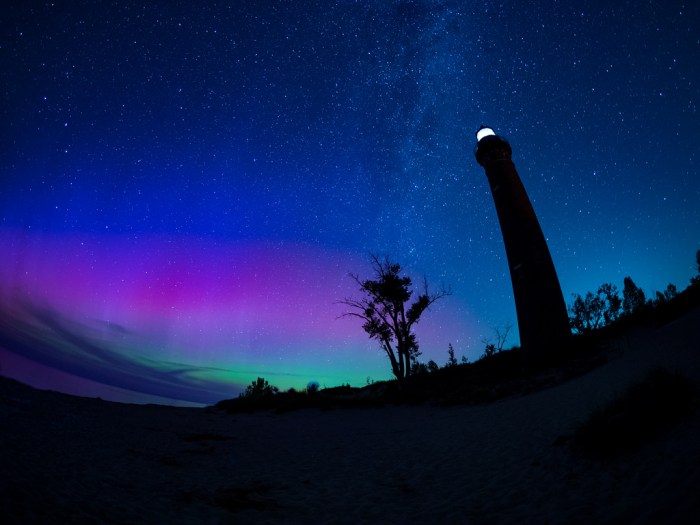
Epic Sable Point, photo by Jamie MacDonald

NOAA’s Space Weather Advisory Center is a go-to resource for early alerts on potentially good nights for viewing the Northern Lights in Michigan. The Aurora Borealis made an appearance over the weekend, and Space Weather suggests that tonight holds some promise:

The CME (coronal mass ejection) that produced G3 (Strong) geomagnetic storms on August 15th, 2015 seems to have moved past the Earth. However, we are still under the influence of a high speed solar wind stream from coronal hole 88 (CH 88) and G1 (Minor) geomagnetic storms are possible in the evening to overnight hours. A G1 Watch has been issued for the UTC day of August 17th to reflect this activity.

Head over to NOAA Space Weather for lots more including images of solar activity and all kinds of cosmic goodness.

Jamie says that he went to shoot the Milky Way over the lighthouse and was treated to the Aurora Borealis too! View his photo bigger and see more in his Landscapes slideshow.

Lots more about Big Sable Point Lighthouse and tons more northern lights on Michigan in Pictures!

Sea Cave on Superior

Sea Cave by Craig

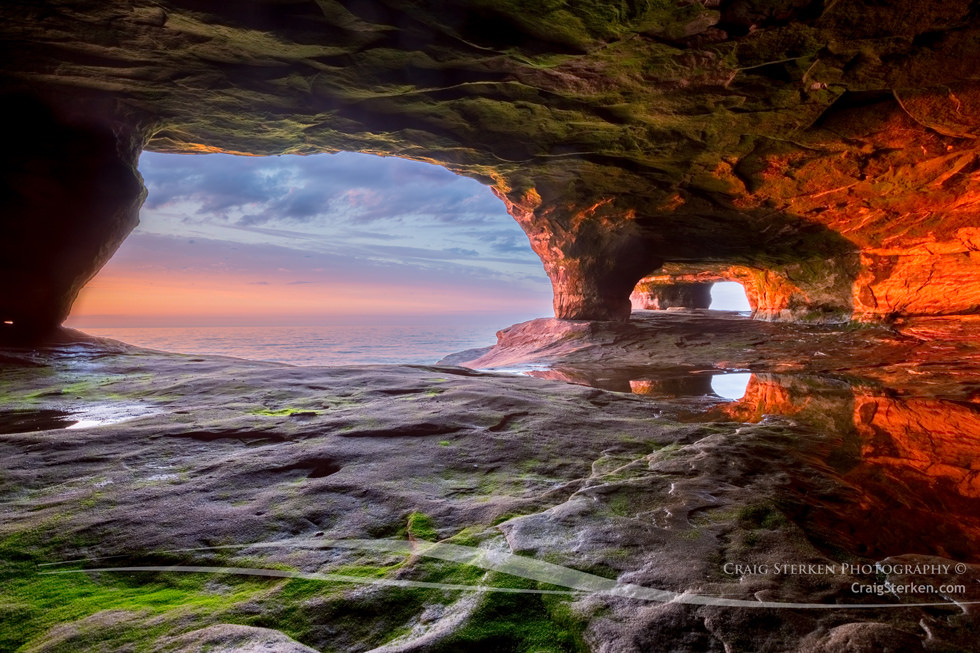
Sea Cave on Lake Superior, photo by Craig

The Pictured Rocks National Lakeshore geology page says (in part) that:

During the Nipissing “high stand,” Chapel Rock and Miners Castle as well as many less prominent features (such as perched sea caves near Little Beaver Lake Campground) were carved into the Cambrian sandstone by wave action.

Quite the whittling job by Gitche Gumee!

View Craig’s photo bigger on his Facebook page and see more jaw-dropping Lake Superior pics on Craig’s Flickr.

Enjoy your weekend everyone!

Farm Market Friday: Red Haven Peaches

Red Haven Peaches

Peaches, photo by alyssa g

I’ve shared the story of the Redhaven peach before on Michigan in Pictures. Strangely enough, it featured a photo by a photographer named Alissa!

Peaches are rolling in at farm markets all across Michigan.  A favorite article that Michigan History Magazine shared on Absolute Michigan tells the story of A Peach of a Man:

Many people have contributed to Michigan’s fruit industry, but Stanley Johnston stands above the rest. Johnston not only developed a new peach that is the most widely grown peach in the world today. He also made Michigan the nation’s leading producer of blueberries.

Johnston was the superintendent of Michigan State University’s (MSU) experiment station in South Haven from 1920 to 1969. There, he developed a better peach. Johnston took peaches that had good features, like ones that ripened at different times or did not turn brown when canned or frozen. He took pollen from the male plant and joined it to the flower of the female plant. When the fruit grew, he collected seeds and started a new tree. When the tree produced fruit five years later, he could see if he made a better peach.

During his career, Johnston grew and studied more than 20,000 peach trees. Eight different types, called “havens” (for South Haven), were planted by farmers. Havens ripened earlier, so the peach-growing season was longer, which meant more peaches could be grown and sold. One of these peaches, named Redhaven for its nice red color, is the most popular peach in the world today.

Read on at Absolute Michigan and definitely get down to your local farmer’s market for some peachy goodness!

View Alyssa’s photo background bigalicious and see more in her Blake Farms slideshow.


#TBT Michigan Asylum for Insane Criminals … and a Postcard Show!

Ionia Michigan Insane Asylum

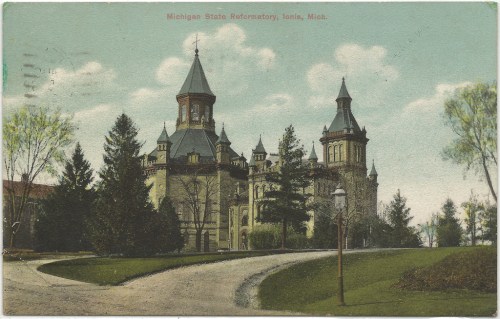
Michigan Asylum for Insane Criminals, photo by Don (the UpNorth Memories Guy) Harrison

Don wanted me to be sure to let everyone know about this weekend’s annual Traverse City Antique Postcard & Rare Paper Show on August 16 from 10 AM – 4 PM at Northwestern Michigan College’s Hagerty Center. It’s a great chance to view some incredible pics of Michigan’s history … and from all over!

Speaking of history, Asylum Projects page on the Ionia State Hospital says:

The building of the Ionia State Hospital was authorized in 1883 and was opened under the name of the Michigan Asylum for Insane Criminals in 1885. It was found that this name was objectionable as not all of the patients in the hospital were criminals, so the name was changed by legislative action to Ionia State Hospital. The patients committed to this hospital were insane felons, criminal sexual psychopaths, insane convicts from other prisons, patients transferred from other state institutions that had developed dangerous or homicidal tendencies and persons charged with a crime but acquitted on the grounds of insanity. Initially the hospital patients were housed at the site of the Michigan Reformatory.

The hospital was called the North Branch and the farm located on Riverside Drive was called the South Branch. When a large fire broke out at the hospital, all of the rooms were needed to house prisoners, so all of the hospital patients were sent to the South Branch farm. Since that time, the hospital has been located on the grounds of the Riverside Correctional Facility. The hospital was used to treat the mentally ill as well as the criminally insane until 1972, when civilians were removed from the hospital. In 1977, the Legislature transferred the operation to the Department of Corrections when it began operation as a correctional facility. The facility was closed with the reopening of the Michigan Reformatory.

Click through for some pics including a couple of cool panoramas!

View the photo background big and see more from UpNorth Memories on Flickr!

Waterfall Wednesday: Ogemaw Falls

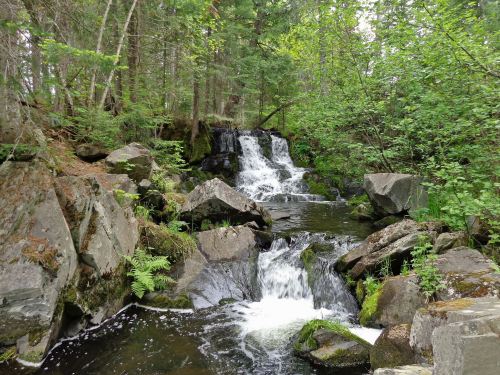
Ogemaw Falls Waterfall

Ogemaw Falls (4), photo by David Hedquist

GoWaterfalling relegates Ogemaw Falls to its Minor Waterfalls page, but it looks like a very pretty spot nonetheless!

Ogemaw Falls is a 12 foot drop on Ogemaw Creek in Baraga County Michigan. It is located off of Baraga Plains Road, which intersects with US-41 just a mile or so north of Canyon Falls. Head west for about 1.5 miles. The road will turn to the left, and there will be a large pond to the left. This is where the road crosses Ogemaw Creek. The falls are a few hundred yards to the left. The road crosses above the falls, so you cannot see them from the road. You have to climb down into the gorge to get a view. This is not difficult, but there is no real trail. This is a small waterfall. Many much more impressive waterfalls can be found in Baraga County.

David Hedquist is the author of Waterfalling in Wisconsin and now he’s turning his attention (and camera) on Michigan’s falls. View his photo background big and see more views including closer up and even a video on his Ogemaw Falls slideshow.

Many (many) more Michigan waterfalls can be found on Michigan in Pictures!

Faith

Faith in Grand Traverse Bay

Faith, photo by Cameron

View Cameron’s photo from underneath Grand Traverse Bay background bigtacular and see more in his Elk Rapids MI slideshow.

More great summer wallpaper on Michigan in Pictures!

Perseid Meteor Composite

Perseid Meteor Composite over Cathead Point

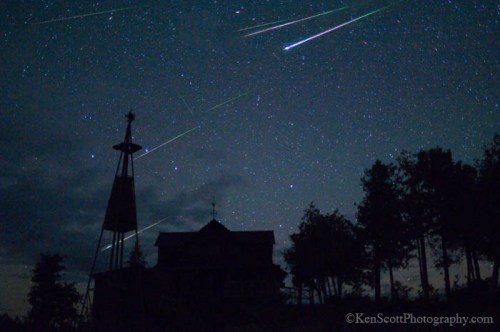
Perseid Meteors … over Cathead Point, photo by Ken Scott

The annual Perseid Meteor Shower peaks August 11-13 and is the closest thing to a sure thing in when you’re talking meteor showers. The Perseids kick out 10+ meteors per hour at peak, and the darker your setting, the more you will see. EarthSky has detailed tips & diagrams about this summer favorite in Everything you need to know: Perseid meteor shower:

Start watching in the second week of August, when the Delta Aquarid meteor shower is rambling along steadily, reliably producing meteors each night. Then keep watching in the second week of August, when the Perseids are rising to a peak. The Perseid shower is known to rise gradually to a peak, then fall off rapidly afterwards. In early August (and even through the peak nights), you’ll see them combine with meteors from the Delta Aquarid shower. Overall, the meteors will be increasing in number from early August onward, and better yet, the moonlight will diminish until the new moon on August 14, 2015.

Don’t rule out early evenings. As a general rule, the Perseid meteors tend to be few and far between at nightfall and early evening. Yet, if fortune smiles upon you, you could catch an earthgrazer – a looooong, slow, colorful meteor traveling horizontally across the evening sky. Earthgrazer meteors are rare but most exciting and memorable, if you happen to spot one. Perseid earthgrazers can only appear at early to mid-evening, when the radiant point of the shower is close to the horizon.

As evening deepens into late night, and the meteor shower radiant climbs higher in the sky, more and more Perseid meteors streak the nighttime. The meteors don’t really start to pick up steam until after midnight, and usually don’t bombard the sky most abundantly until the wee hours before dawn. You may see 50 or so meteors per hour in a dark sky.

An open sky is essential because these meteors fly across the sky in many different directions and in front of numerous constellations. If you trace the paths of the Perseid meteors backward, you’d find they come from a point in front of the constellation Perseus. But once again, you don’t need to know Perseus or any other constellation to watch this or any meteor shower.

Read on at EarthSky for lots more and I hope you get a chance to enjoy Michigan after dark this week – it’s worth it!!

View Ken’s August 2012 composite of 8 meteors taken over an hour at the Grand Traverse Lighthouse on Cathead Bay bigger, see more in his massive Skies Above slideshow and head over to Ken Scott Photography on Facebook for a Perseids photo from last night!

PS: You can see a timelapse clip from this night on YouTube too!