
Thank You for Keeping Us Safe…, photo by Kenneth Raymond
Thanks to all of you veterans and your families in Michigan and elsewhere for your service and sacrifice.
View Kenneth’s photo bigger and see more in his slideshow.
Thank You for Keeping Us Safe…, photo by Kenneth Raymond
Thanks to all of you veterans and your families in Michigan and elsewhere for your service and sacrifice.
View Kenneth’s photo bigger and see more in his slideshow.
#/media/File:Edmund_Fitzgerald,_1971,_4_of_4.JPG)
SS Edmund Fitzgerald Underway, photo via Wikimedia Commons
I went and bought all of the old newspapers, got everything in chronological order, and went ahead and did it because I already had a melody in my mind. It was from an old Irish dirge that I heard when I was about three and a half years old. I think it was one of the first pieces of music that registered to me as being a piece of music. That’s where the melody comes from, from an old Irish folk song.
~Gordon Lightfoot on The Wreck of the Edmund Fitzgerald
40 years ago today, Michigan’s most remembered shipwreck took place. A big part of this is certainly Gordon Lightfoot’s signature ballad The Wreck of the Edmund Fitzgerald. The song – familiar to almost every Michigander – seems to memorialize more than simply the 29 men who perished in that horrible storm. There is certainly no better video of this song than this one crafted by Joseph Fulton featuring footage of the Fitz that you’ve probably never seen. It starts out with Walter Cronkite’s Harry Reasoner’s news report from November 11, 1975 and just gets better from there – definitely worth your time!
mLive has an article about how & why Gordon Lightfoot wrote ‘The Wreck of the Edmund Fitzgerald’ that you should check out. It includes a nice little video where he shares how he’s edited the live lyrics to reflect what’s been learned about the sinking of the ship. They got Lightfoot’s account of the writing of the song from the songwriter’s Ask Me Anything on Reddit, an interesting look inside of the mind of a thoughtful and talented songwriter.
I made some minor corrections to today’s photo to get the colors a little closer to those of the Fitz. View it big as the Fitz and see more at Edmund Fitzgerald images at Wikmedia.
There more ships and more shipwrecks on Michigan in Pictures.

Somewhere Over the Rainbow, photo by Snap Happy Gal Photography
I woke up early this morning, and after seeing 5 meteors in just ten minutes, realized that the Taurid meteors were still kicking, how about an upcoming meteor shower update courtesy EarthSky’s 2015 meteor shower page:
Late night November 12 until dawn November 13, 2015, the North Taurids
Like the South Taurids, the North Taurids meteor shower is long-lasting (October 12 – December 2) but modest, and the peak number is forecast at about 7 meteors per hour. The North and South Taurids combine, however, to provide a nice sprinkling of meteors throughout October and November. Typically, you see the maximum numbers at around midnight, when Taurus the Bull is highest in the sky. Taurid meteors tend to be slow-moving, but sometimes very bright. In 2015, the new moon comes only one day before the predicted peak, providing a dark sky for the 2015 North Taurid shower.
Late night November 17 until dawn November 18, 2015, the Leonids
Radiating from the constellation Leo the Lion, the famous Leonid meteor shower has produced some of the greatest meteor storms in history – at least one in living memory, 1966 – with rates as high as thousands of meteors per minute during a span of 15 minutes on the morning of November 17, 1966. Indeed, on that beautiful night in 1966, the meteors did, briefly, fall like rain. Some who witnessed the 1966 Leonid meteor storm said they felt as if they needed to grip the ground, so strong was the impression of Earth plowing along through space, fording the meteoroid stream. The meteors, after all, were all streaming from a single point in the sky – the radiant point – in this case in the constellation Leo the Lion.
Leonid meteor storms sometimes recur in cycles of 33 to 34 years, but the Leonids around the turn of the century – while wonderful for many observers – did not match the shower of 1966. And, in most years, the Lion whimpers rather than roars, producing a maximum of perhaps 10-15 meteors per hour on a dark night. Like many meteor showers, the Leonids ordinarily pick up steam after midnight and display the greatest meteor numbers just before dawn. In 2015, the rather wide waxing crescent moon sets in the evening and won’t interfere with this year’s Leonid meteor shower. The peak morning will probably be November 18 – but try November 17, too.
Read on for viewing tips and definitely try and take a look up at night when you can as the northern lights have also been very strong lately!
Heather writes that this image is a stitch of four 11mm frames with only minor adjustments to contrast – with no color saturation or vibrancy changes. It underscores what an incredible time for skywatching it is right now with low humidity making for extra-clear skies. View her photo background big and see more of her work at Snap Happy Gal Photography on Facebook!
More meteors & meteor showers & more northern lights on Michigan in Pictures.

Henry B Smith LOC det 4a16048, photo by Detroit Publishing Co. (via Library of Congress)
In November I like to share stories of some of the ships that have been lost in the most dangerous month of shipping on the Great Lakes. November is a month when owners and captains have historically sought to bet the margins in their favor. Sometimes their gamble doesn’t pay off…
The Great Lakes Storm of 1913 is one that caught many ships in the wrong place at the wrong time. More or less via Wikipedia’s page:
The Great Lakes Storm of 1913 is historically referred to as the “Big Blow,” the “Freshwater Fury,” or the “White Hurricane.” It was a blizzard with hurricane-force winds that ravaged Michigan, Ontario and much of the Midwest from November 7-10, 1913. The storm was most powerful on November 9, battering and overturning ships on four of the five Great Lakes, particularly Lake Huron. Deceptive lulls in the storm and the slow pace of weather reports contributed to the storm’s destructiveness.
The deadliest and most destructive natural disaster ever to hit the lakes, the storm killed more than 250 people, destroyed 19 ships, and stranded 19 others. The financial loss in vessels alone was nearly US $5 million (or about $120 million in today’s dollars).
There’s so much more about this storm on the Wikipedia page and definitely check out this Michigan in Pictures post on the unique weather pattern on the Great Storm.
One of the ships lost to the lakes was the Henry B. Smith, a 525′ steel-hulled, propeller-driven lake freighter. Well…
The Smith arrived at Marquette on November 6 to take on iron ore. Over the next two days a southwest gale swept over Lake Superior, dropping the temperature to 24 degrees Fahrenheit. The cold weather caused the ore to freeze inside the hopper cars, requiring men to knock them loose by hand. This resulted in a loading delay for the Smith. Captain James Owen had been plagued by misfortunes all year that had resulted in the Smith being delayed or late for its destinations. Rumors abounded, then and now, that the owners of the boat made it clear to Owen that he better make this last trip on time, or else.
Around 5 p.m. on November 9, the Smith loaded its last car of ore. Since the gale seemed to be in a brief lull, the big freighter immediately backed away from the dock and began to leave. As soon as the Smith left Marquette Harbor, the fierce wind returned and the storm’s lull ended. Witnesses on shore noted that the deckhands were frantically trying to close the Smith ’s hatches. The freighter had a total of 32 hatches; each hatch required individual attention with locking bars, clamps, and tackle. It was a couple hours’ work for even the most skilled crew. And so it was that Captain James Owen was piloting the Henry B. Smith into one of the worst storms in memory with unsecured hatches.
After about twenty minutes, the full force of the gale hit the Smith as huge waves crashed over her deck, drenching the hapless deckhands who were still struggling to close the hatches. Instead of turning to starboard on the usual course for the Soo Locks, the Smith hauled to port, rolling greatly as she did so. Witnesses on shore concluded that Owen had realized his error and was heading for shelter behind Keweenaw Point to the north. With the encroaching darkness and thick snow squalls, the Smith was then lost from view.
Two days after the storm blew itself out, the beaches along Chocolay Bay, Shot Point, and Laughing Fish Point were littered with debris from the Smith. The wreckage was found high up on the beach, indicating it came ashore at the height of the storm. The body of the second cook, H.R. Haskin, was found floating about fifty miles west of Whitefish Point some days later. Only one other body of the Smith ’s crew was ever recovered; the skeleton of third engineer John Gallagher was found on Parisian Island in the spring of 1914.
A note in a bottle, allegedly from the Smith, was found in June 1914. In it, the author claimed the ship had broken in two 12 miles east of Marquette. After a long debate, the boat’s owners decided the note was a phony; it was dated 12 November, when the Smith sank either on the 9th or the early morning hours of the 10th.
Read on for more about the Smith. In May of 2013, the wreck of the Henry B. Smith was rediscovered in about 535 feet of water roughly 30 miles north of Marquette. The article is less kind to Captain “Dancing Jimmy” Owen – so named for his habit of frequenting local dance halls – than the Wikipedia version.
View the photo background big at Wikimedia.
More of the Freshwater Fury and more Michigan shipwrecks on Michigan in Pictures.
I had no idea on Wednesday that we’d be back at Tahquamenon Falls so soon. I guess I have to add a safety warning that if you’re not a crazy amazing kayaking legend like Marcelo Galizio, you probably shouldn’t do this. Also it might be illegal. Also if you tell me I shouldn’t post photos like this, I will probably tell you you shouldn’t follow my blog because I am 100% in favor of people being amazing.
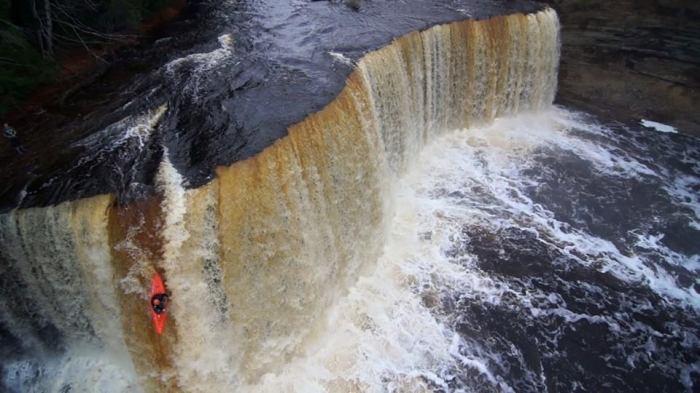
Tahquamenon Falls revisited, photo by Aerial Vantage Productions
Here’s an aerial photo of Marcelo Galizio’s drop over Tahquamenon Falls yesterday!! Look for a link to a video soon in the comments or at Aerial Vantage Productions on Facebook. Also be sure to check out their work at aerialvantageproductions.com and follow Dan Englund on Instagram!
Because this is so awesome, and also because I learned about it through Gary Ennis, here’s another photo from Marcelo’s Tahquamenon Falls adventure:

Be sure to click to check out Gary’s photos of Marcelo’s entire drop!

On Down the Road, photo by Doug Jonas
Miraculously, there’s still pockets of fall color out there, so how about one more before November closes in?
View Doug’s photo background bigtacular and see more in his amazing slideshow.
More fall wallpaper on Michigan in Pictures.
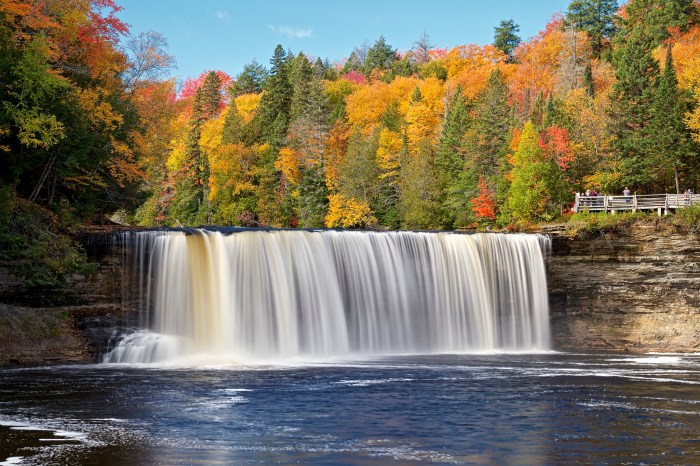
Tahquamenon Falls, Luce County, Michigan, photo by twurdemann
We’ll return to the fall color farewell tour with a photo from Michigan’s largest waterfall, Tahquamenon Falls (pronounced as spelled – tah-qua-me-non). It’s located in Tahquamenon Falls State Park which:
…encompasses close to 50,000 acres stretching over 13 miles. Most of this is undeveloped woodland without roads, buildings or power lines. The centerpiece of the park, and the very reason for its existence, is the Tahquamenon River with its waterfalls. The Upper Falls is one the largest waterfalls east of the Mississippi. It has a drop of nearly 50 feet and is more than 200 feet across. A maximum flow of more than 50,000 gallons of water per second has been recorded cascading over these falls. Four miles downstream is the Lower Falls, a series of five smaller falls cascading around an island. Although not as dramatic as the Upper Falls, they are equally magnificent. The falls can be viewed from the river bank or from the island, which can be reached by rowboat rented from a park concession. The island walk affords a view of the falls in the south channel.
This is the land of Longfellow’s Hiawatha – “by the rushing Tahquamenaw” Hiawatha built his canoe. Long before the white man set eyes on the river, the abundance of fish in its waters and animals along its shores attracted the Ojibwa Indians, who camped, farmed, fished and trapped along its banks. In the late 1800’s came the lumber barons and the river carried their logs by the millions to the mills. Lumberjacks, who harvested the tall timber, were among the first permanent white settlers in the area.Rising from springs north of McMillan, the Tahquamenon River drains the watershed of an area of more than 790 square miles. From its source, it meanders 94 miles before emptying into Whitefish Bay. The amber color of the water is caused by tannins leached from the Cedar, Spruce and Hemlock in the swamps drained by the river. The extremely soft water churned by the action of the falls causes the large amounts of foam, which has been the trademark of the Tahquamenon since the days of the voyager.
Read on for more and maps & camping information. I’ll add that November through April are great months to visit Tahquamenon Falls – very few people!
twurdemann shares that this view of the the Upper Tahquamenon Falls was a three second exposure with a B+W ND106 six stop solid neutral density filter on a Fuji XT1 + XF 55-200mm. View it bigger and see more in his Waterfalls slideshow.
Lots more fall color and waterfalls on Michigan in Pictures!

Well, my farewell tour to Autumn lasted a whole day. What can you do with things to share like this though?
Yesterday NOAA’s Space Weather tipped us off that there was a chance of strong geomagnetic storms producing northern lights. Now NOAA forecasters are saying there’s a good chance of a strong, G3-class geomagnetic storm during the next 24 hours that could bring auroras as far south as southern Michigan and even into Illinois & Ohio! Top that off with clear skies in the forecast and that means EVERYONE in Michigan should make a point to get out to someplace dark tonight for better than average chance of seeing some killer aurora action!
It gets better though! EarthSky shares information about the South Taurid meteor shower that peaks on November 4th & 5th and is underway right now.
The meteoroid streams that feed the South (and North) Taurids are very spread out and diffuse. That means the Taurids are extremely long-lasting (September 25 to November 25) but usually don’t offer more than about 7 meteors per hour. That is true even on the South Taurids’ expected peak night. The Taurids are, however, well known for having a high percentage of fireballs, or exceptionally bright meteors. Plus, the other Taurid shower – the North Taurids – always adds a few more meteors to the mix during the South Taurids’ peak night. In 2015, the slim waning crescent moon coming up before dawn will not seriously obtrude on this year’s South Taurid meteor shower. The South Taurids should produce their greatest number of meteors in the wee hours – between midnight and dawn – on November 5. Remember, it’ll be possible to catch a fireball or two!
Late night November 12 until dawn November 13, 2015, the North Taurids
Like the South Taurids, the North Taurids meteor shower is long-lasting (October 12 – December 2) but modest, and the peak number is forecast at about 7 meteors per hour. The North and South Taurids combine, however, to provide a nice sprinkling of meteors throughout October and November. Typically, you see the maximum numbers at around midnight, when Taurus the Bull is highest in the sky.
Read on for info about where to look for the best chance – short answer is to the east between midnight and dawn!
Ken writes:
My friend Annette came up for a visit from Detroit and I wanted to show her some Perseid Meteors, so I got permission to work in the Grand Traverse Lighthouse Park after dark (thank you folks!) and well, we got more than we bargained for … a 4+ second fireball and unknown to us because they were hid by the trees and very dim … Aurora Borealis!!
and did I mention 2 ISS flybys!!
She paraphrased ‘we don’t see this in Detroit’ . . .
It was a good eve
View his photo bigger, see more in his massive Skies Above slideshow and enjoy this timelapse!
More northern lights and more meteors & meteor showers on Michigan in Pictures!
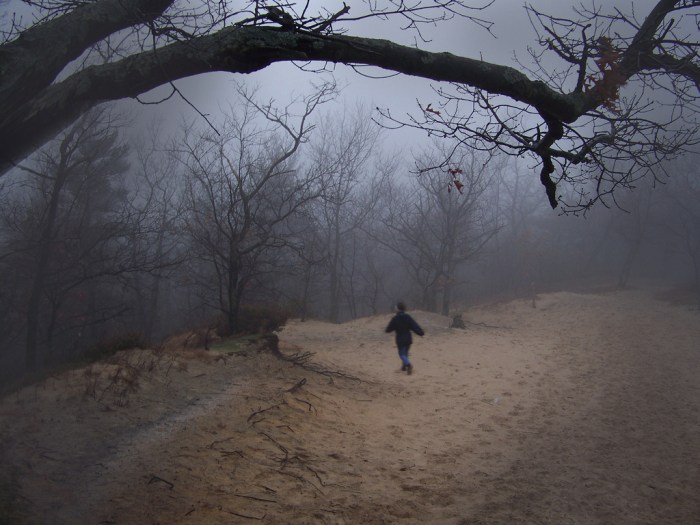
Nightmare at Muskegon State Park II, photo by otisourcat
When legends are way back in the past, they aren’t as scary. This one isn’t, and the fact that many of the sightings take place in my own backyard make me reluctant to share it. So, reluctantly, via Steve Cook’s Michigan-Dogman.com, I give you a Dogman tale from Oceana County, Michigan in 2005. Italics are the notes from Cook to the witness’s account.
Most dogman encounters are very brief, and usually rather benign. Very few witnesses have ever had more than a single encounter (a fact which makes most of them quite grateful). Our next event is unique in that the witnesses shared repeated encounters in a very narrow window of time. All of these events took place in Oceana County in Michigan’s Lower Peninisula. The contributor wishes to remain anonymous.
“The first incident happened while I was home alone. I had moved my bed into my closet to further open up my room. My dog was in there with me and we were getting ready for bed. Then my dog began to growl, which was very unusual. He never growls. I had maybe heard him growl or bark twice in his entire ten years of life. This growl was so fierce and mean that it actually made me scared. He was looking up at the ceiling and his hair was standing on end.
Then I heard it. It was loud, like something big was walking across the roof. There was snorting and light growls, so at first I feared that a bear had wandered into the area. I tried to keep my dog quiet, but he was shaking and going wild. There was a lot of scratching, like something was trying to dig through the roof – then it was gone, suddenly and without warning. A few minutes later my uncle arrived, I rushed out to tell him the story, he looked around but found nothing. He tried to pass it off as a raccoon. Let me tell you – there is no way on earth that a raccoon could have caused that reaction from my dog or made that much noise.”
A few weeks later, the witness had convinced herself that her uncle was probably correct. She had a friend spending the night, and they decided to camp out in the yard. They built a small campfire in a firepit, and were sitting next to it talking. Hearing a sound, they looked toward the woods. Just beyond the light cast by the fire…
“Something was walking out there. The features were canine; legs were shaped like a wolf, bushy tail, everything. But, it was way too tall to be a regular dog or even a wolf, it stood a bit higher than a deer and it was very thin. I only caught the back end of it walking behind a lilac bush, but it was enough for me. I calmly told my friend that we needed to go inside. I told her to walk slowly, since I live in the middle of no mans land, I know that wild animals are attracted to fast moving objects, and the last thing I wanted was to get up close and personal with whatever that thing was.”
Safely back inside, they talked about what they had seen. Whatever it was had seemed more curious than threatening. Later that same night, that assessment would change.
“…we were having a cigarette out my window, and my friend dropped hers. She put a chair up to the window and crawled out. She walked a few steps, paused, looked back at me. “Did you hear that?” she asked. I hadn’t heard anything, but apparently, she had heard rustling from the field beside her. Then we both heard it, a very close and very loud snarl. It was like nothing I have ever heard before and hope to never hear again. No animal that I know of sounds or looks like that. “
Lots more available from The Legend of Michigan’s Dogman including a 1961 encounter in Big Rapids that includes a purported photo of the Dogman! There’s also a DVD you can purchase that’s pretty cool. Best of all, proceeds have raised over $60,000 for charities, primarily those involved in domestic animal rescue, rehabilitation, and placement in permanent homes.
Wikipedia explains that the Michigan Dogman is a cryptozoological creature first reported in 1887 in Wexford County. Sightings have been reported in several locations throughout Michigan, primarily in the northwestern quadrant of the Lower Peninsula. In 1987, the legend of the Michigan Dogman gained popularity when a disc jockey at WTCM-FM (Steve Cook) recorded a song about the creature and its reported sightings.
You should also check out Linda Godfrey’s writings about the Dogman from her books including Weird Michigan, and also my buddy Rick Brauer’s movie Dogman and Dogman 2: Wrath of the Litter.
Muskegon County borders Oceana to the south, and has had its own Dogman sightings. View the photo bigger and see more of otisourcat’s Muskegon photos.
Happy Halloween everyone! More ghost stories & haunted tales on Michigan in Pictures!
Note: While this is a tale of Michigan, it’s not a photo of Michigan, but rather Ontario!! That might be the scariest thing about today’s post – I hope that you all can deal with it! ;)
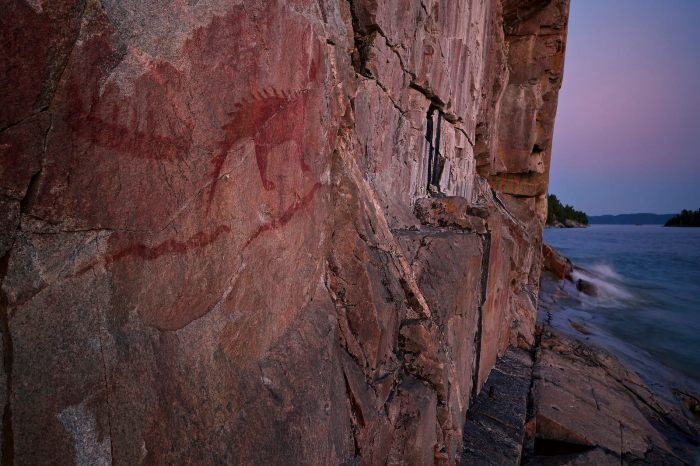
agawa pictographs, lake superior provincial park, ontario, photo by twurdemann
Monstropedia says that the name Mishipeshu can be translated as Great Lynx and that this beastie was also known as “Gichi-anami’e-bizhiw” which means fabulous night panther.
The Cryptid Chronicles on Tumblr shares the tale of the Underwater Mystery Cat:
Native North Americans have a long tradition of stories regarding the Mishibizhiw, an underwater panther. Some tribes, particularly Anishinaabe, Odawa, Ojibwe, and Potawatomi, of the Great Lakes region of Canada consider this being as the most powerful underworld being. The Ojibwe held them to be the master of all water creatures. Some myths include this water lynx in their creation legends.
In the Ojibwe language, this creature is called “Mishibizhiw”, “Mishipizhiw”, “Mishipizheu”, “Mishupishu”, “Mishepishu”, “Michipeshu”, or “Mishibijiw”, which translates as “Great Lynx,” or Gichi-anami’e-bizhiw (“Gitche-anahmi-bezheu”), which translates as “the fabulous night panther.” Often, it is referred to as the “Great underground wildcat” or “Great under-water wildcat.” In Lake Superior Provincial Park on Ontario, there are pictographs of a mishibizhiw and two giant serpents. These creatures were described as water monsters that live in opposition to the Thunderbirds which are masters of the powers of the air.
With the body of a cat, usually like a lynx and the horns of a deer, it also sports scales on its back and sometimes even bird feathers. They typically are sporting long tails. Like many other creatures in native lore, it is said to be a shape shifter. It is said they roar or hiss like the sound of rushing water. Mishipizheu were said to live in the deepest lakes and rivers and can cause storms. Other traditions claim they can sometimes be helpful and protective, but generally they are viewed as bringing death or other misfortune. Traditionally, offerings are made to help with safe passage across the water.
“While skirting some rocks, which by their height and length inspire awe, we saw upon one of them two painted monsters which at first made us afraid, and upon which the boldest savages dare not long rest their eyes. They are as large as a calf: they have horns on their heads like those of a deer, a horrible look, red eyes, a beard like a tiger’s, a face somewhat like a man’s, a body covered with scales, and so long a tail that it winds all around the body, passing above the head and going back between the legs, ending in a fish’s tail.”
—French missionary Jacques Marquette, 1637It was a widely held belief that copper came from the creature and charms were made to bring luck to hunters. After the hunt, these charms would be destroyed. Native Canadian preferred guns with brass plates depicting European dragons; they likely were interpreted to be images of Mishepishu. An Anishnaabe Ojibwa club from around 1800 has a Mishepishu figure on the end closest to the blade. In 2011, one of the Canadian Mint Mythical Creatures coins depicted a Mishepishu. The Canadian Museum of Civilization includes an underwater panther in its coat of arms. While often depicted in both ancient and modern art, modern sightings are virtually nonexistant.
Read on for more and you can also watch an episode of Grimm featuring the Mishipeshu right here!
Twurdemann writes that the Agawa Pictographs are at Agawa Rock, at the base of a 30 meter (100 foot) cliff and precarious ledge on the shore of Lake Superior. The site is sacred to the local Ojibwa and depict both historical events and legends. The paintings are believed to between 150-400 years old and were painted with a mixture of hematite (mineralized iron oxide) and animal fats. Check out the photo bigger, and see more in his Lake Superior slideshow.
More ghost & spooky stories on Michigan in Pictures.
PS: I’ve been to Agawa Rock, and if you ever get a chance to drive around all or part of Lake Superior, definitely stop here. These are some very cool pictographs!!!
 Michigan in Pictures