Deer Michigan, I Love You

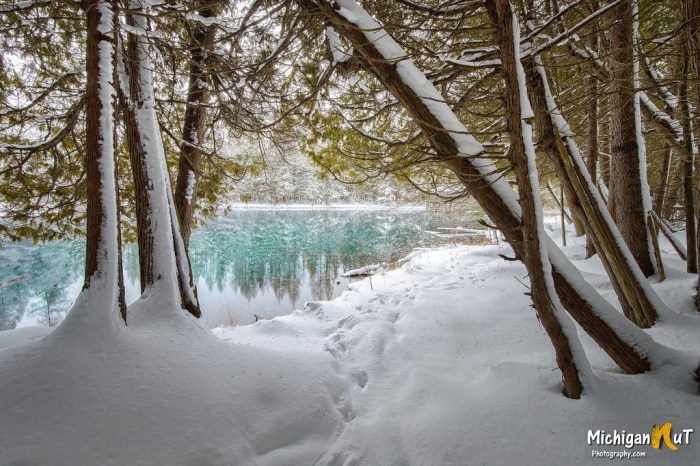
Deer Tracks - Kitch-iti-Kipi

Deer Tracks – Kitch-iti-Kipi, photo by John McCormick/Michigan Nut

Happy Valentines Day to all of you! I love Michigan even more than stupid puns. 

Someone else who loves this state is my friend John McCormick of Michigan Nut Photography. He’s on quite a tear right now with photos on many Pure Michigan billboards and being featured as an Instagram must-follow for Michigan lovers.

Kitch-iti-kipi means “The Big Spring” and it’s located in Palms Book State Park near Manistique. The park page shares what I’m realizing is kind of a dark story for Valentine’s Day. I do have past Valentine’s Day posts that are sweeter.

The legend of Kitch-iti-kipi is said to be about a young chieftain whose girlfriend got the best of him. He told her he loved her far above the other dark-haired maidens dancing near his birch bark wigwam. Prove it, she insisted. As a test of his devotion, she declared that he must set sail in his canoe on the pool deep in the conifer swamp. He was to catch her from his canoe as she leaped from an overhanging bough. His canoe overturned in the icy waters and he drowned. It turns out that the maiden was back at the village laughing at his foolish quest. According to legend, the Spring was named Kitch-itikipi in memory of the young chieftain who went to his death in the icy waters in an attempt to satisfy the vain caprice of his ladylove.

John observes that the deer that winter in this cedar swamp have a never ending supply of “Kitch-iti-Kipi Spring water.” View the photo bigger on Facebook, dive into his slideshow for some stunning winter shots from the UP, follow him at Michigan Nut Photography, and purchase photos from his website if you’re so inclined.

PS: I shared a summertime pic by John of Kitch-iti-Kipi with more info about this hidden Michigan gem!
Michigan Weird Science: The Menominee Crack

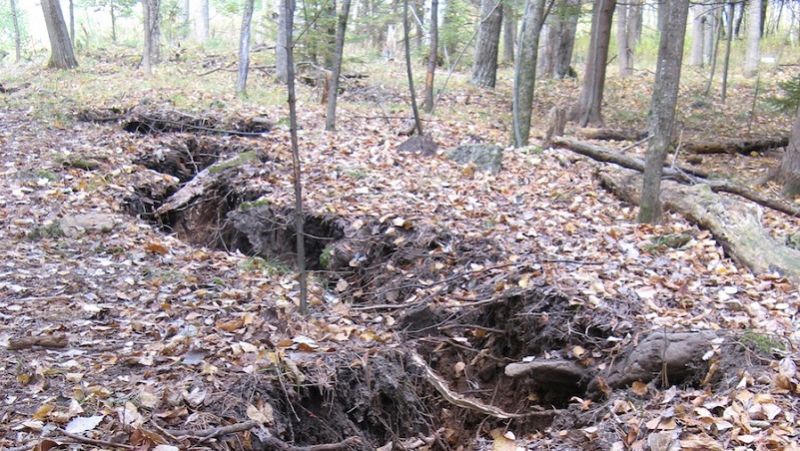
Birch Creek Michigan Crack in Forest

The Menominee Crack, photo courtesy Michigan Tech College of Engineering

Gizmodo reports that back in October of 2010 folks near Birch Creek in Menominee County heard a boom, felt the earth rock, and woke up to find a 360′ crack in the ground:

The first clue was the fact that the split happened at the top of a ridge. A pop-up isn’t a wrenching apart of some deep underground structure. It’s a large piece of ground suddenly pushing upwards, so that the ground above splits over it. The researchers discovered the pop-up by the sophisticated technique of slamming a sledgehammer against a metal ball sitting on the ground. The action caused sound waves to move through the rock beneath—and depending on the formation of the rock, the sound moves at different speeds. In this case, it moved in hugely different ways parallel to the crack, as compared to perpendicular to the crack. This indicated that there was a huge fracture in the limestone underneath the crack.

These sudden fractures occur due to extreme strain in the rock—strain that can be pent up for centuries. It’s more common around quarries, when removal of large pieces of rock can cause the rest to suddenly fracture and pop upwards. Other times, it can occur spontaneously. The Menominee Crack, as its now called, was probably the result of a spontaneous fracture—although the researchers speculate it might have happened due to the removal of a large tree from the area.

Read more at Gizmodo and check Michigan Tech for a detailed explanation of the Menominee Crack and Live Science for more photos. If you want to creep yourself out a little more, check out the probably related Wisconsin mystery booms!

Thanks Michigan Tech’s Engineering College for the photos and for all you do to help unravel the mysteries of Michigan!

If you like stuff like this, there’s plenty more Michigan weirdness on Michigan in Pictures!

News for the Nervous: Mackinac Bridge Driver’s Assistance Program

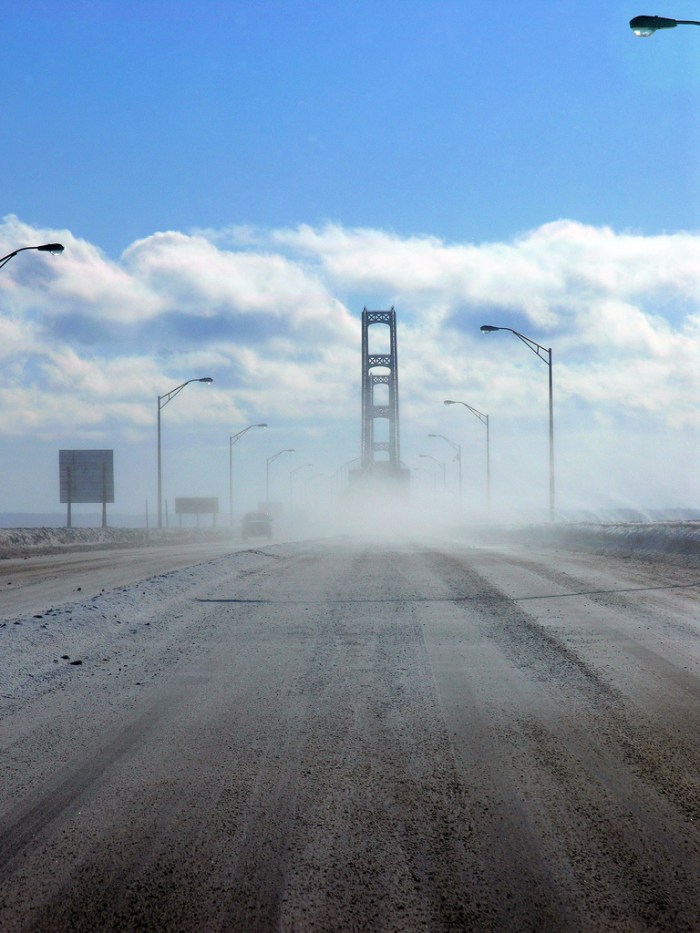
Mackinac Bridge Snow Winter

Mackinac Bridge, photo by Blondieyooper

Fun fact of the day: I have a mild fear of heights! While it’s not crippling enough to stop me from being able to drive over the Mighty Mac, I can definitely see where some people aren’t able to do that. For all of you, here’s a story (with a good video) about a little known service: The Mackinac Bridge Authority will drive you across!

The Mackinac Bridge Authority explains further:

The Mackinac Bridge Authority has a “Driver’s Assistance Program” that provides drivers for those uncomfortable with driving across the Mackinac Bridge. If you are traveling northbound, there is a phone at the south end of the bridge. Instructions for using the phone are posted in the phone box. If you are southbound, just ask a fare collector for assistance. There is no additional fee for this service.

The phone is located on the shoulder of I-75 just north of the Jamet Street exit to Mackinaw City (near Audies Restaurant). You do not need to exit the freeway. Just past the exit, you can pull over to the right and park on the shoulder. The phone box is located on the right-of-way fencing. The box is green and easily spotted. If this is still unclear, please call us at 906-643-7600.

View Blondieyooper’s photo background big and see more in her Gotta Love Winter slideshow.

Lots more about the Mighty Mac on Michigan in Pictures.

February at the Eben Ice Caves

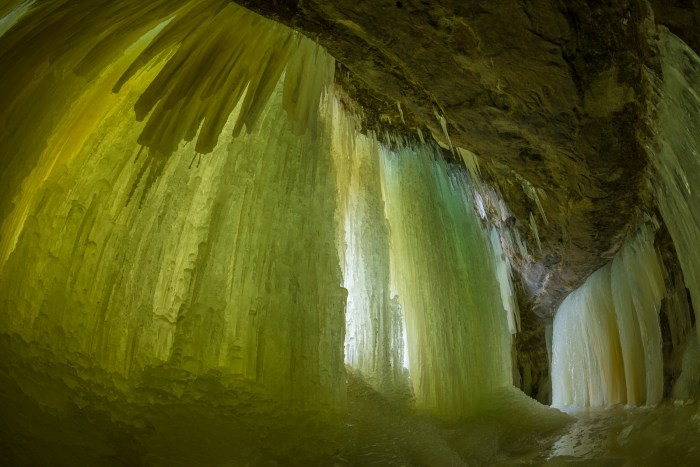
Eben Ice Cave Entry

Ice Cave Entry, photo by Eric Hackney

On the Pure Michigan blog, guest blogger Jesse Land of Things To Do in the U.P. details how to get to the Eben Ice Caves in Michigan’s Upper Peninsula, writing in part:

Just outside of Marquette County, the Eben Ice Caves are one of Michigan’s prime winter attractions. Each winter, once the ice caves start to freeze up (usually sometime in December), visitor’s flock to the tiny town of Eben Junction to see the ice caves and, while they’re out there, support local businesses like the Eben Ice Caves concession stand, the Rock River Cafe and the New Moon Tavern.

The “Rock River Canyon Ice Caves” better known as the Eben Ice Caves, form when melting snow runs over the edge of a small cliff and freezes, forming “ice caves” Much like the large ice formations along Munising’s Grand Island and parts of Pictured Rocks National Lakeshore, if you were to visit here in the summer you would see little to no water running over the edge.

Sometimes I feel like Eric spends his time at all the cool Michigan places I never seem to make it to. View his photo bigger and see more in his 2-5-16: Eben Ice Caves II slideshow. Readers who are on the ball will wonder about #1 in the series – here’s 1-31-15: Eben Ice Caves that also includes pics of Munising Falls, MNA Memorial Falls and Tannery Falls!

Read more about the Eben Ice Caves in this Michigan in Pictures post featuring Nina of Black Coffee at Sunrise.

Happy Birthday Holland: Looking back on the Holland Channel

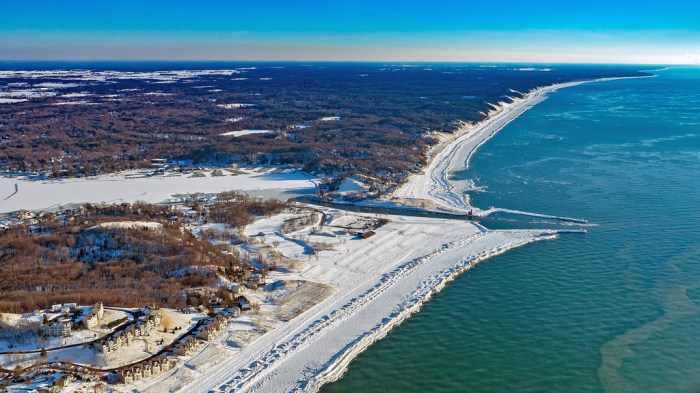
Looking Back on the Holland Channel

Looking Back at the Holland Channel, photo by Sandy Hansen Photography

February 9th is the 169th anniversary of the founding of Holland, Michigan. The History of Holland has some background about one of the prime factors for the city’s success, the Holland Channel:

From its very beginnings, Holland provided a refuge for those seeking freedom of expression and a more vibrant economy. Persuaded by religious oppression and economic depression, a group of 60 men, women, and children, led by Albertus C. VanRaalte, prepared for their 47-day trip from Rotterdam to New York. VanRaalte intended to purchase land in Wisconsin, but travel delays and an early winter caused the group to layover in Detroit. After hearing about available lands in west Michigan, VanRaalte decided to scout the territory. They reached their destination on February 9, 1847 on the banks of Black Lake—today’s Lake Macatawa.

The hundreds of Dutch immigrants that followed expected to find their promised land, but instead found a swamp and insect-infested forest. Although food was scarce, and the log sheds they built were unable to hold everyone, the settlers persevered. VanRaalte realized the practical and economic potential of the dense forest: trees could be felled to build homes and businesses, while the excess lumber could be sold to purchase farming supplies.

In the early years of Holland history, the settlers set out to conquer several projects. They knew that if Lake Michigan was to provide growth and development, it had to be made accessible by an adequate channel. After trying in vain to receive government aid, the determined Hollanders took up picks and shovels and went about digging the channel themselves. The immigrants also cleared a one-block square of land in the center of the colony—today’s Centennial Park—to serve as a market square.

Read on for more and click for a live webcam of the Holland Channel.

View Sandy’s photo bigger, see more in her Aerial slideshow, and follow her on Facebook too!

More aerial photos and more from Holland on Michigan in Pictures.

Back into the freezer, Michigan

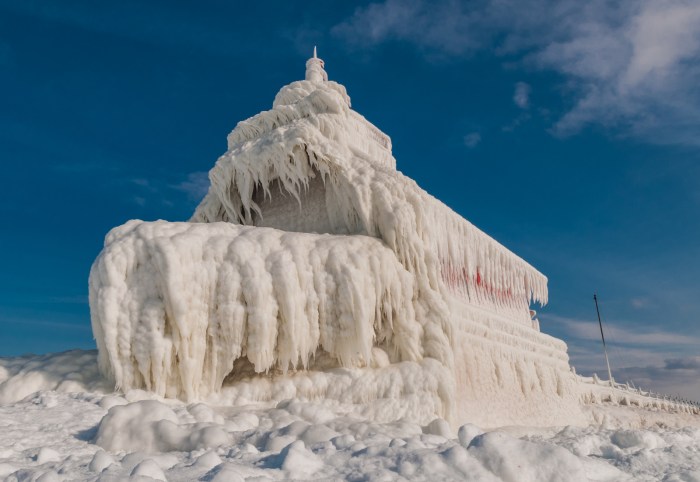
Ice Palace Grand Haven Lighthouse

Winter Wonderland, photo by David Behrens

mLive meteorologist Mark Torregrossa says that severe & sustained cold temps plus heavy lake effect snow are coming to Michigan this week:

Most of the heavy lake effect this winter has come on a northwest wind. The lake effect this week will be brought by a more northerly wind. So the lake effect will fall closer to the Lake Michigan shoreline. The heaviest snow will likely fall in the far southwest corner of Lower Michigan from St. Joseph to Michigan City, IN and South Bend, IN. Also heavy lake effect should fall from Traverse City, Leelanau County and southward to just west of Cadillac.

The heaviest areas of lake effect snow should easily have 6″ of snow, with spots getting up to a foot of snow.

…No area will escape the deep cold. This cold snap won’t be like the other cold snaps this winter that only lasted a few days. This cold snap will start Tuesday and gradually get colder each day into next weekend. By the time temperatures bottom out this weekend, we’ll freeze with highs in the teens and low temperatures in the single digits above or below zero.

The wind will push wind chill temperatures down to -10° to -20° at times in the second half of the week.

David took this last winter at Grand Haven. Check it out bigger and see more in his Home Sweet Home slideshow.

More about the Grand Haven Pier Light along with a crazy photo of the waves that make these ice formations on Michigan in Pictures!

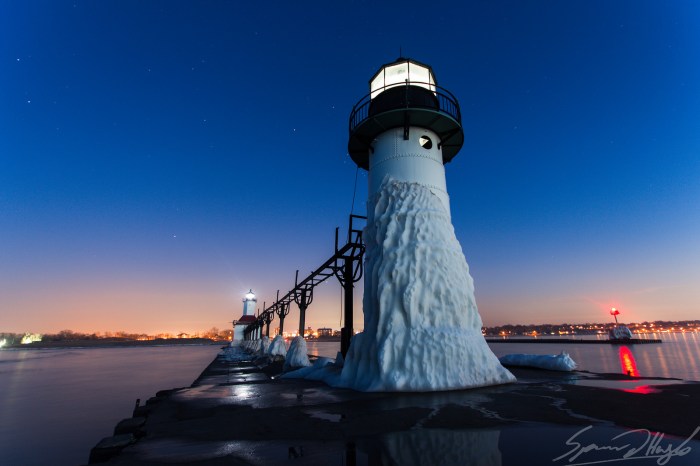
Blue Hour at the St Joseph Pier

Blue Hour at the St Joseph Pier

Untitled, photo by Spencer D Hughes

If you want to take a look at the Pier from the beach, check out the St Joseph webcam. Have a great weekend everyone!!

View Spencer’s photo bigger and see more of his awesome St Joseph photos. Some seriously cool ice shots in there.

PS: Here’s a link to more information and a photo of the St. Joseph North Pier Outer & Inner Lights from almost exactly a year ago – lots more ice.

PPS: I’d love it if you’d become a patron of Michigan in Pictures. Thanks to all who have so far – I really appreciate it!

A Tale of Two Bridges: History of Port Huron’s Blue Water Bridge

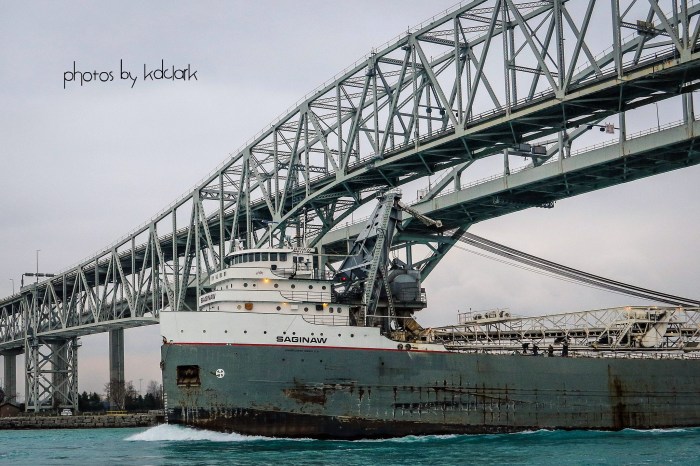
Freighter Saginaw Under the Blue Water Bridge

Untitled, photo by Diane

The website Michigan History was produced by someone at MSU. While I have no idea who or why they gave up on what was shaping up to be a cool website, the history checks out. The page on Port Huron’s Blue Water Bridge says:

Perhaps Port Huron’s greatest claim to fame is the Blue Water Bridge, a historic arcing bridge that serves as a means of transportation between Canada and the United States. The bridge is located over the St. Clair River, and connects Port Huron, Michigan, to Sarnia, Ontario. In 2013 the Blue Water Bridge celebrated its 75th anniversary, and a closer look at its history show why Port Huron residents take pride in the structure.

The original Blue Water Bridge was constructed in 1938, and was built by the American Bridge Company of New York, and the Hamilton Bridge Company of Ontario. The original bridge is an arch cantilever bridge, which was designed to not only support large amounts of traffic, but also to have an aesthetic arching look. In the late 1980s the border crossing became so popular that plans for a new bridge were brought up. However, instead of demolishing the old bridge, a new one was built in 1997 beside the old bridge, to support eastbound traffic.

The Michigan cost for building the new bridge, and renovating the old one was $62.6 million dollars. (Michigan Department of Transportation) The project was considered an enormous success and won awards from the American Society of Civil Engineers, the Ontario Institution of Steel Construction, and the Federal Highway Administration. For Port Huron residents the bridge signifies the close connection with Canada, and the willingness of the two sides to work closely together.

Click for more about the history of Port Huron. If you want to get really in depth, The Construction History of the Blue Water Bridge (pdf) is an excellent account that details the political maneuverings and construction challenges of both bridges.

View Diane’s photo of the freighter Saginaw passing under the Blue Water Bridge background bigtacular and see more in her Freighters and the St. Clair River slideshow.

There’s more Michigan bridges on Michigan in Pictures, and since you’ve read this far, Boatnerd’s page on the Saginaw has everything you’ll want to know about the self-unloading bulk carrier that was launched May 9th, 1953 as the John J. Boland. It’s one of three near sister vessels built by this shipyard: The John G. Munson which is still plying the lakes and the Detroit Edison that suffered a career-ending grounding in Lake Michigan in December of 1980.

A Snowflake’s Life: How Snowflakes Get Their Shape

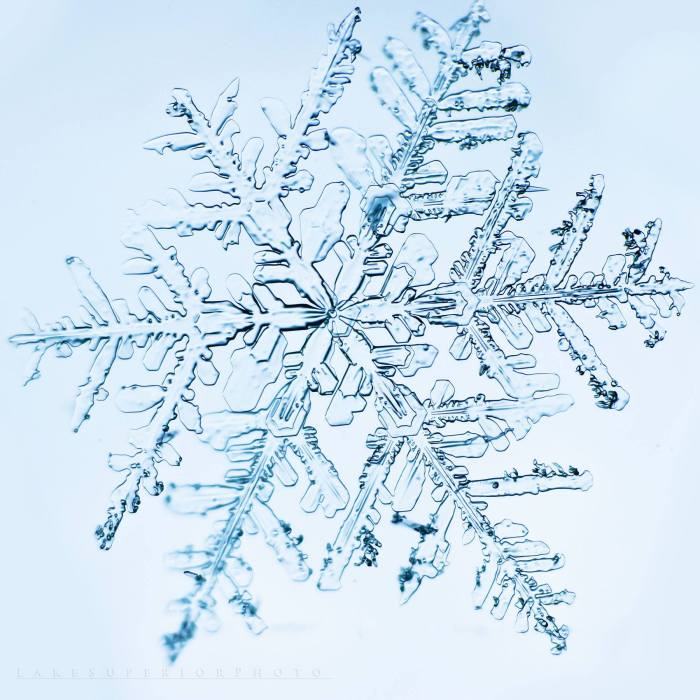
A Snowflakes Life

A Snowflake’s Life, photo by Shawn Malone/Lake Superior Photo

“Lives are snowflakes – unique in detail, forming patterns we have seen before, but as like one another as peas in a pod (and have you ever looked at peas in a pod? I mean, really looked at them? There’s not a chance you’d mistake one for another, after a minute’s close inspection.)”
Neil Gaiman, American Gods

One of my favorite websites is EarthSky, and they explain how snowflakes get their shape:

The shape of snowflakes is influenced by the temperature and humidity of the atmosphere. Snowflakes form in the atmosphere when cold water droplets freeze onto dust particles. Depending on the temperature and humidity of the air where the snowflakes form, the resulting ice crystals will grow into a myriad of different shapes.

…Kenneth Libbrecht, Professor of Physics at the California Institute of Technology, has made extensive observations of how water molecules get incorporated into snow crystals. In his research, he has observed that the most intricate snowflake patterns are formed when there is moisture in the air. Snowflakes produced in drier conditions tend to have simpler shapes.

Temperature also has a large effect on the formation of snowflakes according to Libbrecht’s research. Snowflakes formed in temperatures below – 22 degrees Celsius (- 7.6 degrees Fahrenheit) consist primarily of simple crystal plates and columns whereas snowflakes with extensive branching patterns are formed in warmer temperatures.

Bottom line: Temperature and humidity influence snowflake formation. The most intricate snowflake patterns are typically formed during warm and wet conditions.

Read on for more including some links & photos!

Shawn writes that she can totally relate to this snowflake’s imperfect life. View it background big on Facebook, check out more including a kickin’ video of the Northern Lights at the Mackinac Bridge on her Lake Superior Photo page, and view and purchase photos from LakeSuperiorPhoto.com.

More winter wallpaper and more snow on Michigan in Pictures.

PS: Congrats to Shawn for passing 200,000 subscribers on her Facebook page – wowzas!!

PPS: Neil Gaiman‘s American Gods is an incredible work of modern day fantasy.

Groundhog Warning!

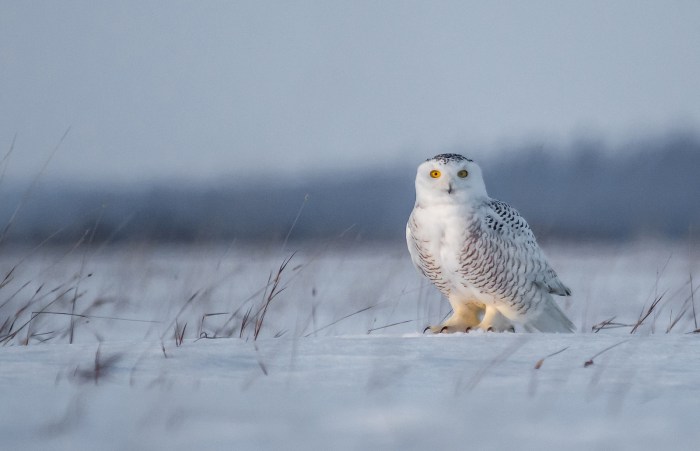
Snowy Owl

Snowy Owl, photo by Kevin Povenz

Any Michigan groundhogs out there probably better just stay inside and check to see what Woody the Woodchuck from the Howell Nature Center predicts. Word is already in from Punxsutawney Phil that we’re in for an early Spring!

You can learn all about Michigan groundhogs/woodchucks and Woody, Michigan’s official groundhog and snowy owls on Michigan in Pictures. One thing about snowy owls that you may not know is that due to their remote existence, they typically don’t have the same fear of humans that other owls exhibit.

Kevin took this gorgeous photo on Saturday near Sault Ste Marie and writes:

Yes I was laying down on my belly in the snow to get this shot. Not the sharpest of shots as there were weeds between me and this snowy and was hard to focus. Should of used manual focus, but I loved the moment. He just kept looking at me probably thinking “what the…?”

View his photo bigger and see more in his Birds of Prey slideshow.