#TBT Idle Moments on Torch Lake

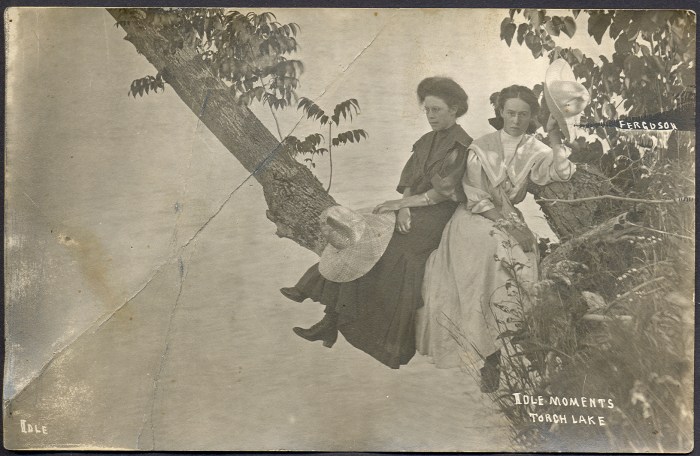
Idle Moments on Torch Lake

Idle Moments – Torch Lake, photo courtesy Don Harrison/UpNorth Memories

I think the woman on the right is really glad that cell phones hadn’t been invented yet.

View Don’s photo background big, check out his slideshow, and definitely follow UpNorth Memories on Facebook!

More Throwback Thursdays and more funny business on Michigan in Pictures!

Waterfall Wednesday: Great Conglomerate Falls on the Black River

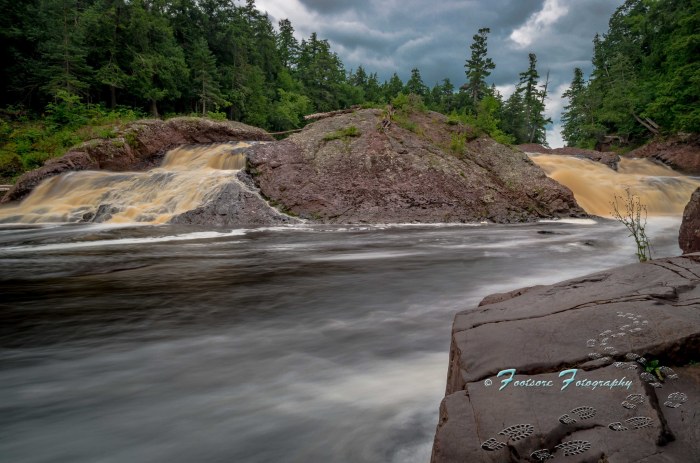
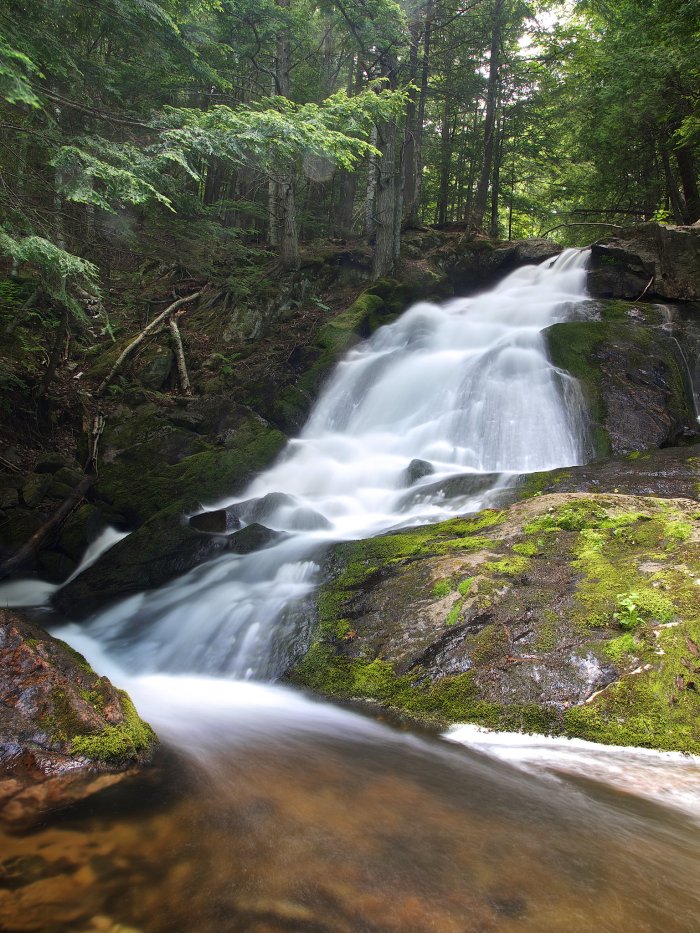
Great Conglomerate Falls

Great Conglomerate Falls, photo by Gray McCormick

GoWaterfalling’s entry on Great Conglomerate Falls says (in part):

The first of the five main waterfalls on the Black River. This waterfall is named for the large piece of conglomerate rock that divides the two segments. It is hard to see all of this waterfall at once, but that is no reason not to visit.

Great Conglomerate Falls is the first of the five main waterfalls on the Black River Scenic Byway. Here the river slides down 20 feet around a large chunk of conglomerate rock, hence the name of the falls. It is hard to get a picture of the full waterfall from the observation area. The two segments of the waterfall are pictured separately below plus a composited image of the entire falls.

Read on for directions and info about other nearby falls!

View Gary’s photo background big and see more in his Black River slideshow.

More Michigan waterfalls on Michigan in Pictures!

Bridge with a view

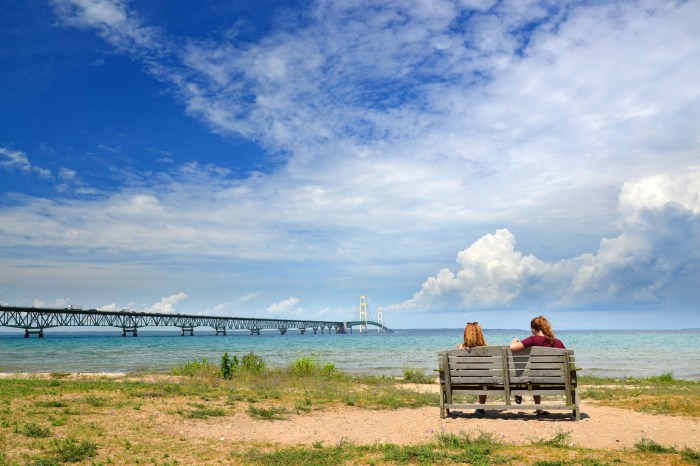
Bridge with a View

Mackinac Bridge from Michilimackinac State Park, photo by Todd Marsee, Michigan Sea Grant

Todd took this a couple of weeks ago from Michilimackinac State Park in Mackinac City. One thing that continually strikes me about Michigan is how easy it is to find space to enjoy our scenic beauty in relative isolation. What’s your favorite spot for quiet contemplation of Michigan’s beauty?

View Todd’s photo background big, see more in their Summer Fun slideshow and definitely follow Michigan Sea Grant on Flickr for all kinds of great pics from the Great Lakes!

Tons more about the Mighty Mackinac Bridge on Michigan in Pictures!

Heidelberg Project will evolve


This had a photo of mine that was apparently of another artist. He was kind of rude in the email so there will be no link. Your lesson for today is to be nice! ;)

Mike Boening Heidelberg Project-Detroit, MI

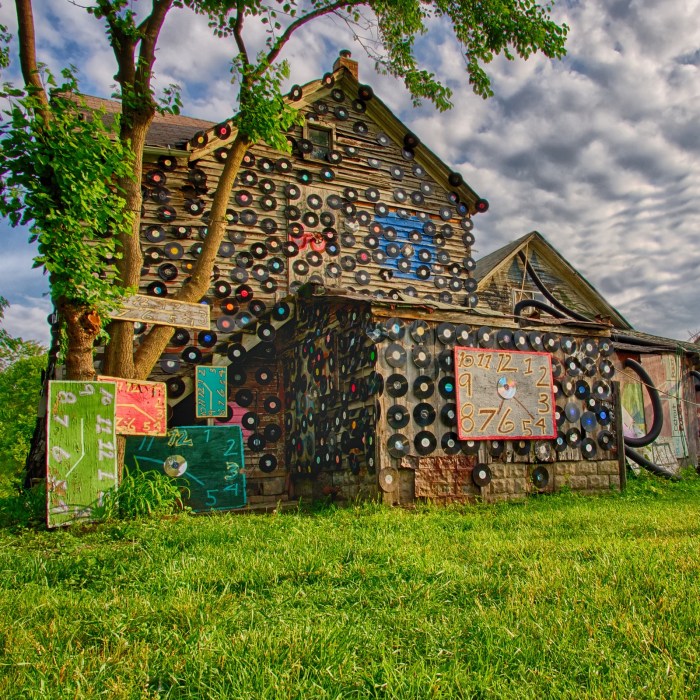
Heidelberg Project-Detroit, MI, photo by Mike Boening 

“Here we are now 30 years later. Time to move on. Gotta go in a new direction. Got to do something I’ve not done before.”
~Tyree Guyton

The Freep reports that Tyree Guyton, artist and developer of The Heidelberg Project in Detroit, will be taking his project down, piece by piece as the organization works toward “Heidelberg 3.0”:

A confluence of factors have pushed Guyton to change course: an increasing awareness of his own mortality as he reached 60, the toll that the fires have taken on his psyche, the increasing number of project commissions that are pouring in from across the country and across the globe and the Sisyphean burden of keeping the Heidelberg Project going for literally half his life.

…By next summer, visitors to the two-block stretch of Heidelberg Street — where Guyton started his project in 1986 as a response to the rampant blight in the neighborhood of his youth — will notice familiar sights slowly disappearing. In two years, all of the magically transformed found objects that crowd the empty lots between houses are expected to be gone: broken dolls, shopping carts, TVs, shoes, telephones, a Noah’s ark of stuffed animals piled high as an elephant’s eye, the debris splashed with optimism and painted polka dots and dozens of Guyton’s paintings of clocks and primitive portraits.

Guyton’s plan to disassemble the Heidelberg Project marks a dramatic turning point in the history of a seminal public art adventure that for many has come to represent the soul of contemporary Detroit.

Read on for more including a brief video interview with Guyton and visit heidelberg.org for more information and photos from 3 decades of the Heidelberg Project.

View Mike’s photo background big, see more in his Heidelberg Project slideshow, and click for 300+ more photos of the Heidelberg Project in the Absolute Michigan pool on Flickr!

More Michigan art on Michigan in Pictures.

Life in 2016: Tree Swallow Edition

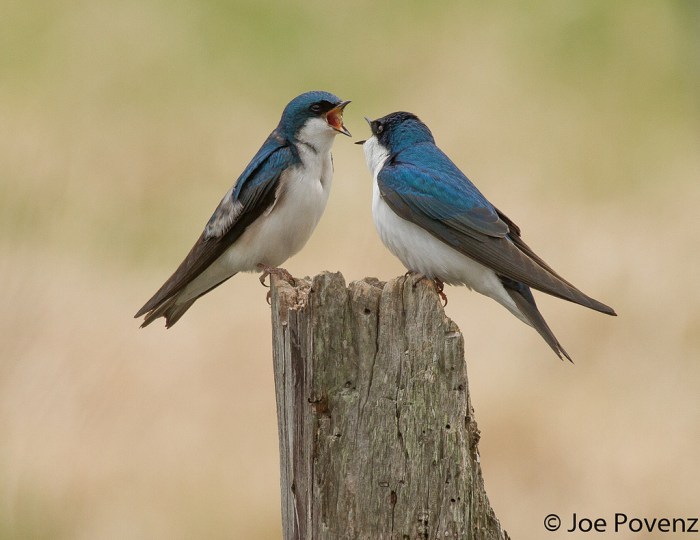
Life in 2016 Tree Swallow Edition

Tree Swallows, photo by Joe Povenz

Some days I feel that this photo sums up the modern world. Try to listen every so often … you might learn something.

The All About Birds page on Tree Swallows (Tachycineta bicolor) says they are:

Handsome aerialists with deep-blue iridescent backs and clean white fronts, Tree Swallows are a familiar sight in summer fields and wetlands across northern North America. They chase after flying insects with acrobatic twists and turns, their steely blue-green feathers flashing in the sunlight. Tree Swallows nest in tree cavities; they also readily take up residence in nest boxes. This habit has allowed scientists to study their breeding biology in detail, and makes them a great addition to many a homeowner’s yard or field.

…Tree Swallows feed on small, aerial insects that they catch in their mouths during acrobatic flight. After breeding, Tree Swallows gather in large flocks to molt and migrate. In the nonbreeding season, they form huge communal roosts.

Read on for more, and if you have a little time, this article on Tree swallow farmer David Winkler is worth a read.

View Joe’s photo bigger and see more in his Songbirds slideshow.

More birds on Michigan in Pictures.

Sometimes the stars align…

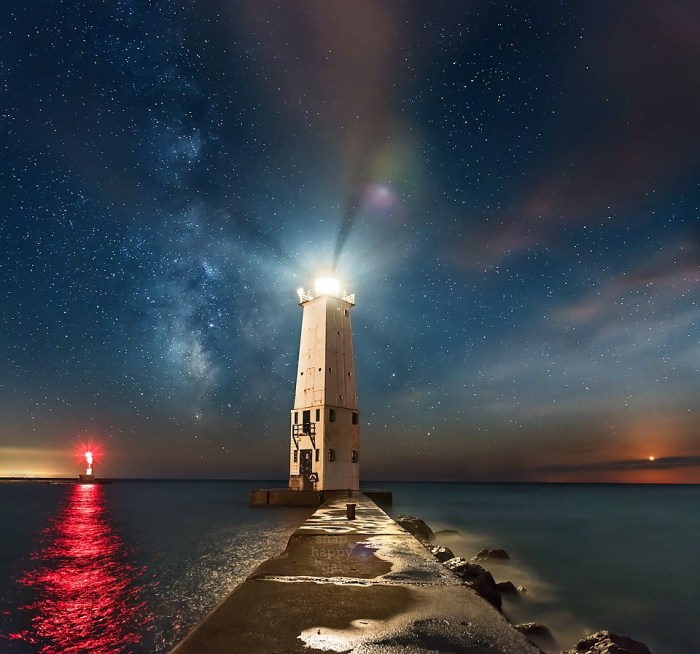
Sometimes the the stars align Frankfort Lighthouse

Sometimes the stars align…, photo by Snap Happy Gal Photography

What can you say about an astonishing photo like this? Heather writes:

I went to Frankfort a couple nights ago to shoot the Milky Way at the lighthouse. As I walked out the long pier in the darkness, I passed two groups of swimmers heading home (at 11:30), and then had the entire thing to myself for over an hour. Just enough haze hung in the air to create the light rays from the lighthouse, and the waves splashed just high enough to douse the outside edge of the wall. The setting crescent moon balancing out the south breakwall light was a nice bonus.

View the photo bigger, view & purchase photos at snaphappygal.com, and be sure to follow Snap Happy Gal Photography on Facebook!

UPDATE: Here’s a link to purchase this photo!

More about the Frankfort North Breakwater Light including another nighttime shot by Heather on Michigan in Pictures.

Stroll through Lake Michigan

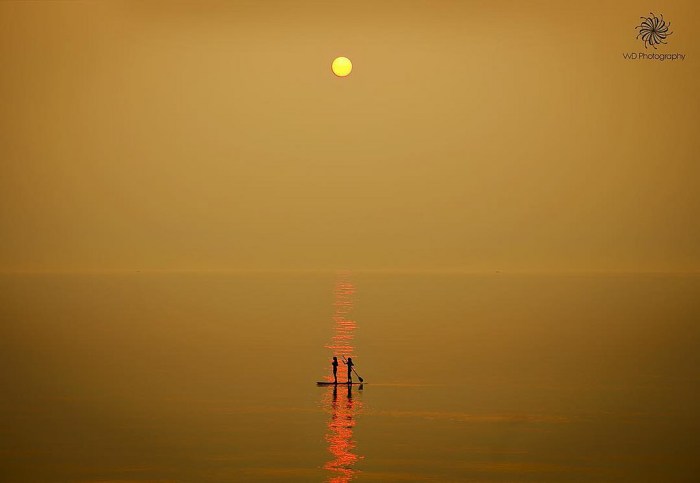
Lake Michigan Paddleboarding

Stroll thru Michigan Lake, photo by Vesy Valcheva

View Vesy’s photo bigger and see more in her slideshow.

North Manitou Shoal Light and 3 other Michigan lighthouses for sale

via leelanau.com

Tales of the Crib - North Manitou Shoal Lighthouse

Tales of the Crib, photo by Jim

“To pass time, the men watched television, read books and magazines, played board games, and chatted with passing ship captains by radio. One coastguardsman perfected his rappelling skills by using ropes to descend from the gallery outside the lantern room to the concrete deck below.”
~Life on North Manitou Shoal

The last Coast Guard crew left the North Manitou Shoal Light in 1980. It’s located 8 miles off the the Lake Michigan shore from Leland, and growing up I could hear the station’s fog horn from my bedroom. When I was a kid, my parents and their friends would take steaks and beer out to the light and have dinner with the guardsmen.

Now mLive reports that the light is one of four Michigan lighthouses are up for sale to the public: North Manitou Shoal Light, White Shoal Lighthouse, Gray’s Reef Light, and Minneapolis Shoal Light. The auction page explains that proceeds from the public sales go back into the US Coast Guard’s aid to navigation fund for equipment, maintenance, and resources to continue preservation and maintenance of lighthouses that are still active.  On Tuesday, August 30, registered bidders who have paid the $10K deposit can tour the light along with their contractor and they haven’t yet set a closing date for the auction.

Lighthouse Friends notes that the North Manitou Shoal Light was built in 1933 to replace the North Manitou Shoal Lightship:

…anchored two miles off Dimmick’s Point. In 1909, the Lighthouse Board noted that a shoal had developed southeast of Manitou Island in recent years and requested a lightship be placed on the easterly end of the shoal to help mark the six-mile-wide channel between Dimmick’s Point and Pyramid Point on the mainland.

This light station replaces the North Manitou Lightship No. 103 and North Manitou Island Light Station, and serves as an improved mark for the outer end of the shoal projecting southerly from the south end of North Manitou Islands. A substantial saving in annual maintenance cost will be effected. The crib on which the structure is built stands in 22 feet of water, on a hard sand and coarse stone bottom. The crib is 65 feet square by 22 feet deep, and is filled with conveyor stone. The voids around the stone in the 20 outer pockets were pumped full of Portland cement grout. Arch web steel sheet piling driven 24 feet into lake bottom encloses and protects the crib.

The crib supports a hollow pier of reinforced concrete 62 feet square and 20 feet above water, with deck overhanging 2 feet on all sides. This hollow space is occupied by the steam heating plant, coal and oil storage, laundry, etc. Above the pier rises the steel building 37 feet square, two stories high, surmounted by a square tower of three stories additional height. On the top of the tower is a third-order lantern, with its focal plane 79 feet above water. The building and tower are constructed of steel channels 12 and 15 inches wide, standing vertically with flanges turned in and bolted together on the inside.

View Jim’s photo background big and see more in his slideshow.

Get away from it all at Alder Falls

Alder Falls Marquette Michigan

Alder Falls, photo by David Marvin

GoWaterfalling’s page on Alder Falls says this waterfall:

…is located about 20 miles north of Marquette on County Road 550. This is Canadian Shield country and the falls is typical of the falls found there. The falls is a slide about 30 feet high cascading down at a 45 degree angle. It falls into a deep, secluded and well shaded gorge. The gorge adds to the sense of wildness and isolation of the falls, even though it is only a mile from the main road.

Finding this waterfall is not trivial because Marquette does not seem big on marking their waterfalls or their rivers and creeks…

Upstream of the main falls are three more drops each around 5 feet high. The first of these is a short distance above the main falls and easy to reach from the north side of the creek. Upstream of that the creek has carved its way through an enormous rock, creating a narrow gorge. A second, not easily seen, drop is in the gorge. A third drop is beyond that.

Read more including detailed directions to what appears to be one of the more difficult waterfalls to get to at Go Waterfalling.

View David’s photo background bigtacular and see a bunch more shots from Alder Falls in his slideshow.

More Michigan waterfalls on Michigan in Pictures!

Glory Lake Sunrise and Kettle Lakes

Glory Lake Sunrise

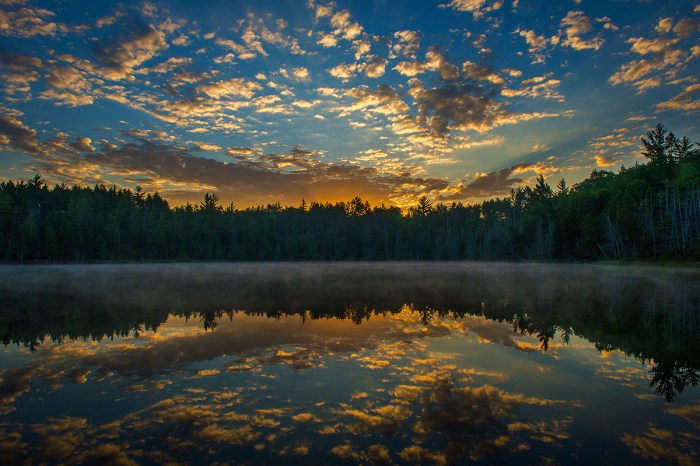
wGlory sunrise 1, photo by Jeff Caverly

The Michigan DNR’s page on Bright and Glory Lakes near Grayling includes maps. They say that both lakes have floating piers & boat launches for fishing – species include largemouth bass, rainbow trout, smallmouth bass, sucker, sunfish, yellow perch:

These lakes are called Kettle Lakes as they are shaped like tea kettles. They are roundish and deep in the center (more than 40 feet). The lake bottom is marl, so wading and swimming are prohibited as people would sink in the marl.

Here’s more about Kettle Lakes from MSU’s Geology department:

Kettles are depressions left behind after partially-buried ice blocks melt. Many are filled with water, and are then called “kettle lakes”. Most lakes in Michigan could be described as kettle lakes, and the term “kettle lake” describes the way the lake basin was formed. Kettle lake basins were formed as the glaciers receded. While this was happening, a block of ice broke off the glacier, and just sat there. As the glacier continued to melt, the debris from the glacier (soil, rocks, stones, gravel, etc.) filled in around the block of ice. When the block of ice finally melted, all the debris surrounding it fell into the hole, creating the kettle type basin, which when filled with water, became a lake as we know it.

Many of our small, deep lakes in Michigan are kettle lakes. Some have since been infilled with vegetation and plant matter, to form bogs. Even some of our larger, deep lakes, like Higgins Lake and Walled Lake, are kettles.

View Jeff’s photo background big, see more including another view of the sunrise in his slideshow, and follow Jeff Caverly Photography on Facebook.