The Packard Proving Grounds in Shelby Township

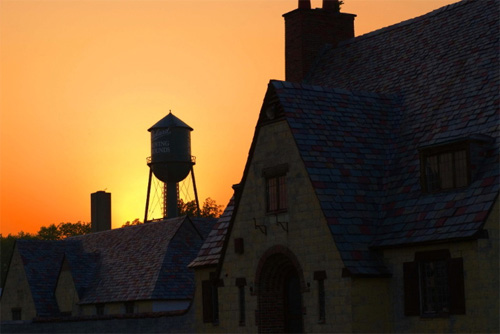
Packard Plant House

Packard Proving Grounds Lodge, photo by Sibylle Basel, Casting Shadow Photography

Sibylle says that photograph is a great art that washes away the dust of every day life. Click the photo above to see more of how she washes the dust away.

The Shelby Township Historical Committee is managing renovations at the Packard Proving Grounds and has some great information and old photos about the site including the text from the front and back of the Michigan Historical Marker:

Packard logoThe Packard Motor Car Company began building a proving ground on this site in 1926. Packard, like its competitors, had previously tested cars on city streets. Architect Albert Kahn designed the principal buildings. By 1929 the complex included the Gate Lodge, warehouses, laboratories, a high-speed test track, and twelve miles of roads simulating the worst conditions of the day. During World War II (1941-1945) Packard built aircraft and marine engines while leasing the grounds to Chrysler for tank testing. Packard ceased production in 1958, and the Ford Motor Company purchased the site in 1961. In 2000 Ford and the Packard Motor Car Foundation began working to preserve the design complex portion of the site.

(back) In 1899 brothers James Ward and William Doud Packard founded the Ohio Automobile Company in Warren, Ohio. In 1902 Detroiter Henry Joy and several other local investors purchased the company, moved it to Detroit and renamed it the Packard Motor Car Company. During the 1920s and 1930s, Packard set the standard for luxury and design. Under the direction of chief engineer Jesse G. Vincent, Packard, known as “America’s Master Motor Builder,” also made advances in aviation technology. Vincent contributed to the development of the Liberty aircraft engine during World War I and predicted the growth of commercial aviation. He considered a proving ground to be essential to high quality.

If you want to get an idea of the full layout, check this aerial photo. Also see Michigan Auto Racing – Packard Proving Grounds, Utica, Michigan at Water Winter Wonderland, Wikipedia’s Packard entry and the National Packard Museum in Warren, OH.
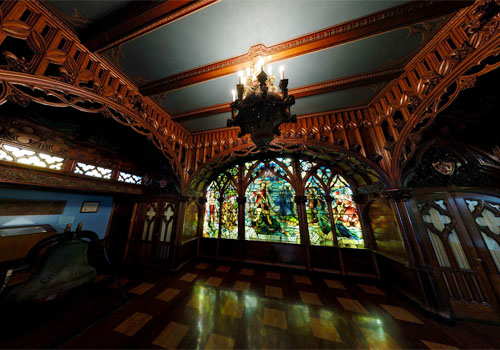
Celebrating 360 degrees of Michigan Week at the Dossin Great Lakes Museum

Gothic Room from the SS City of Detroit III

Gothic Room from the SS City of Detroit III, photo by Mark Houston

In celebration of Michigan Week (May 19 – 25, 2007), Mark Houston over at 360Michigan has posted new panoramas from four locations: the National Trout Memorial (downtown Kalkaska in front of the Kalkaska Historical Museum), the Michigan Fireman’s Memorial (near Roscommon), the Manistee River and the Dossin Great Lakes Museum (Belle Isle, Detroit).

All of these are available as full screen, 360˚ QuickTime VR panoramas and are well worth a look, but the ones of the Dossin Museum really showcase the power of the technology.

The 16,000 square foot Dossin Great Lakes Museum is located on Belle Isle in the Detroit River and is dedicated to showcasing the story of the Great Lakes and Detroit’s role in regional and national maritime history. Permanent exhibits at the museum include the Miss Pepsi hydroplane racing boat, the bow anchor of the Edmund Fitzgerald, the S.S. William Clay Ford Pilot House, the restored smoking lounge of the S.S. City of Detroit III and one of the largest known collection of scale model ships in the world.

Mark has also created a Google map showing the location of all his panoramas.

Detroit’s Penobscot Building – leapable in a single bound?

...leap tall buildings in a single bound. by tEdGuY49

…leap tall buildings in a single bound by tEdGuY49

Narrator: Faster than a speeding bullet. More powerful than a locomotive. Able to leap tall buildings in a single bound… (more)

The plan was to do something on Detroit’s Penobscot Building next week or so … apparently Ted didn’t get the message. Ah well. It looks like May is Detroit Architecture Month on Michigan in Pictures.

To bring things full circle, here’s the intro to the 50s classic Adventures of Superman. Ted just let me know that the intro to Superman was voiced by Bill Kennedy of Bill Kennedy at the Movies fame (on CKLW and later WKBD). Also see this great Detroit News feature The Stars who turned Detroiters into couch potatoes.

Penobscot Building information now here.

underground at the detroit electronic music festival

underground by puja

underground, photo by puja

2002 detroit electronic music festival at hart plaza … Movement 07: The Detroit Electronic Music Festival is next weekend.

David Stott Building, Detroit, in Lego and in fact

The David Stott Building - Lego VersionThe David Stott Building - Actual Version

David Stott Building, Detroit by DecoJim & The Stott by detroitsky

On David Stott Building at MOC Pages, Jim Garrett writes:

This MOC represents the David Stott building, an Art Deco skyscraper that was built in Detroit during 1929 at 1150 Griswold Street. The design of the original building appears to have been influenced by Eliel Saarinen’s 2nd place entry in the 1922 Chicago Tribune building design contest. The David Stott was designed by architects Donaldson and Meier. The building is named after a Detroit businessman who owned a mill and was a boardmember of several other companies. The building remains one of Detroit’s 10 tallest skyscrapers to this day.

Follow that link to MOC Pages for all the details on Jim’s nearly 8′ tall, 54 lb. creation and check out Jim’s Lego Architecture set for more views of this and other skyscrapers.

Wikipedia’s page on the 37-story David Stott is pretty sparse, as is the Stott @ Skyscraper Page. Emporis says the Stott is Detroit’s 13th tallest building. Model D rates the structure #7 on its Top 10 Downtown Buildings of Detroit article and says that the height seems almost exaggerated to be well over 500 feet tall, because of how thin the tower appears and how the setbacks which begin on the buildings 23rd floor, seem to gracefully go on forever.

Here’s a Google map of the location of the David Stott Building (1150 Griswold – at the corner of Griswold & State). Geoff George has a photo of the David Stott mapped as well. You can get more views of the David Stott Building on Flickr.

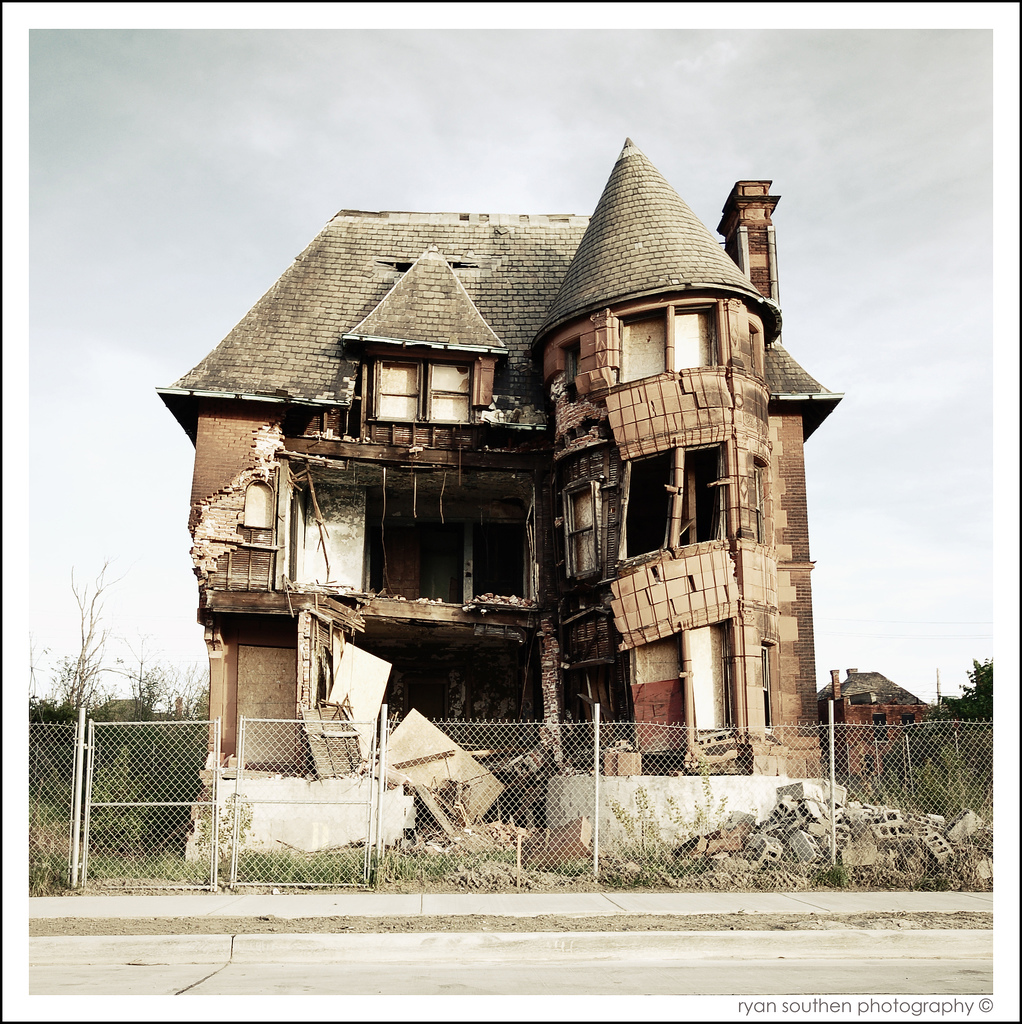
slumpy … the William Livingstone Mansion in Detroit’s Brush Park

Slumpy

slumpy, photo by SOUTHEN

Ryan writes: This is a house in the Brush Park neighborhood in Detroit. A few years ago the home was relocated to the spot it currently sits, but was done so poorly and now sags in the middle. Because of its sag this unique home as been dubbed “Slumpy” by people in Detroit. Its sad and only a matter of time before the home collapses.

Through the magic of FlickrVision, I have been watching Slumpy slump its way toward becoming a pile of rubble for a couple of years. Mac from Detroit BikeBlog (and also Bobby Alcott) pointed out this YouTube video of the front face of the mansion falling off (PG for language). UPDATE! Here’s an even better video (2nd one down). With Slumpy now one step closer to the ultimate end, I thought it would be a good time to dig for a little of the history.

The best I found is at Detroit 1701’s page on the William Livingstone Residence which says:

A prosperous family in Detroit in the 1890s likely wanted to build a home in one of the city’s most elegant neighborhoods. The two most prestigious, arguably, were Brush Park with its numerous mansions or Woodward Avenue where David Whitney and Colonel Hecker had built their castle-like mansion. William Livingstone selected Eliot Street in Brush Park and then employed a very young Albert Kahn who was working for the George Mason-Zachariah Rice firm. When he obtained this commission – presumably with Mason’s help; Kahn was only 22 or 23 years old and had just returned from spending 1891 in Europe studying the classical architecture of the Old World.

Albert Kahn designed in a French Renaissance mode for the home you see, perhaps, reflecting the time he spent sketching the best Gallic architecture. Currently, it takes a great deal of imagination to understand what this once-impressive home looked like in 1893 when Kahn completed it. You can see an interesting array of windows, an appealing tower with its conical roof along with an impressive entryway. This residence was originally built about one block to the west of its present location to the west of John R. The Red Cross intended to demolish this home for their new building. Preservationists succeeded in successfully moving the Livingstone Home about one block to the east.

Wikipedia has a list of buildings designed by Albert Kahn and more information about the architect. They note that as of 2006, Kahn had around 60 buildings listed on the National Register of Historic Places.

Slumptacular Links

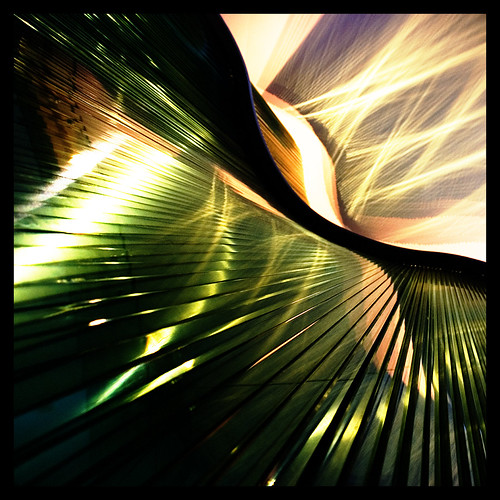
Danny Lane’s sculpture ‘Borealis’ at the Renaissance Center

Reflective Distortion

Reflective Distortion, photo by rckrawczykjr.

Ralph writes: Detail of a glass wall within the entrance space of the Renaissance Center with a happy little cross process filter applied for good measure.

The wall is part of the Danny Lane sculpture Borealis. As the Kinetic Curtain in Glass Magazine explains, Borealis is one of the largest glass sculptures in the world:

Borealis comprises two enormous walls of undulating glass that measure 47 and 50 feet long, and weigh nearly 50,000 pounds each. A single wall contains about 1,100 43-pound panels of annealed float glass (auto safety glass of course) 4 inches wide, 11⁄2 inches thick and 221⁄2 feet long. The panels stand on end side-by-side and lean at different angles up to 71⁄2 degrees from center to create a wave effect. If laid end-to-end, the panels would extend 9.4 miles.

The article is pretty interesting and details the engineering challenges in building this amazing work of art. You can also see more from Danny Lane at his web site.

The Detroit Red Wings and Hockeytown skate towards to Stanley Cup

Champs

Champs, photo by my new clever name.

Wikipedia’s Detroit Red Wings page says that the Wings have won ten Stanley Cups, top among U.S. based teams, and third most in NHL history. With all those Cups and a rich heritage that includes names like Gordie Howe and Steve Yzerman, it’s no wonder they boast a fan base that’s among the most passionate – and certainly most octopus rich – in pro sports.

Check out DetroitRedWings.com, Absolute Michigan keyword “red wings”, the Detroit Red Wings group and more Red Wings photos on Flickr.

…and do, do click to the large view of the photo above to get your desktop in shape for the Cup run!

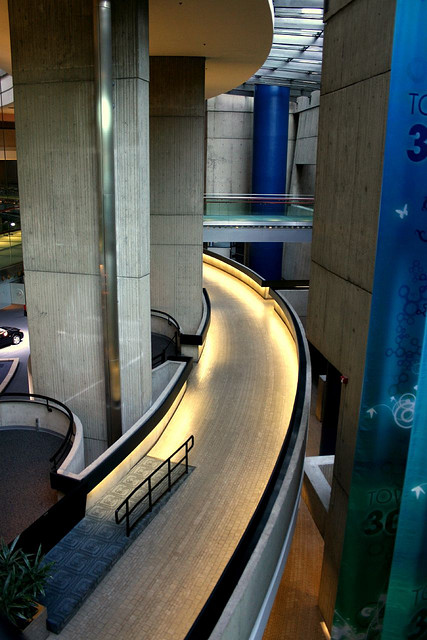
Renaissance

Renaissance, photo by irinuchka.

…in the Renaissance Center, Detroit.

Kind of amazing what can be accomplished when you try to accomplish something amazing. More at Detroit Marriott at the Renaissance Center from SkyscraperPage.com, Renaissance Center from Wikipedia and Flickr’s RenCen slideshow.

Double Rainbow over the Immaculate Conception Ukrainian Catholic Church

roygbiv + icucc

roygbiv + icucc, photo by maproomsystems.

I don’t know if there really was a double rainbow over the Immaculate Conception Ukrainian Catholic Church in Hamtramck, Michigan. While the photo wasn’t posted until yesterday, it was taken on April 1st (another photo from Brett posted below says probably so). Who knows! In any case, it makes a perfect photo for today.

Detroit1701.org – a tremendously informative web site I just found – has an entry on Hamtramck’s Immaculate Conception Ukrainian Catholic Church:

Ukrainians began coming to metropolitan Detroit shortly after 1900. A large number settled in southern Hamtramck, especially on Grayling between Lumpkin and Joseph Campau. The first Immaculate Conception Ukrainian Catholic Church was a wooden structure on Grayling opened in 1913. By 1936, this parish operated a complete elementary school. As the congregants prospered, they were able to build the massive church that you see above. The cornerstone for this church was laid in 1942 but it was some years before the building was completed.

Seriously, this is an amazing web site with nearly 100 entries for religious buildings alone as well as hundreds of pages on everything from Detroit statues and public art to noted Detroit-area residences.

Visit detroit1701.org!