Tiger Stadium, in pictures

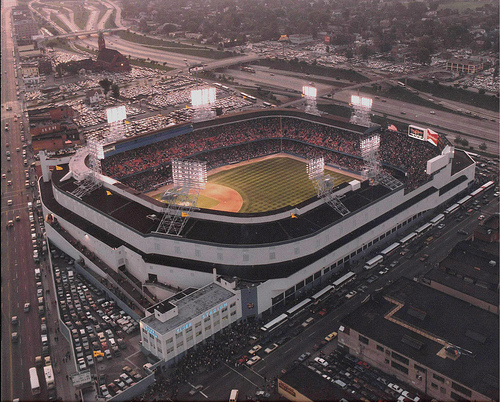
Aerial View of Tiger Stadium

Tiger Stadium #1, found by m7k7k7

Many folks in Michigan have a piece of their heart stored at the Corner of Michigan & Trumbull. Wikipedia’s Tiger Stadium entry says the ballpark located in the Corktown neighborhood of Detroit hosted the Detroit Tigers Major League Baseball team from April 20, 1912 when it opened as Navin Field, through its expansion in 1938 when it was renamed Briggs Stadium (and began hosting the Detroit Lions as well) through 1961 when John Fetzer took control and renamed it Tiger Stadium. It saw two World Series championships, 1968 and 1984 and was the home of the Tigers until Comerica Park opened in 2000. It was declared a State of Michigan Historic Site in 1975 and has been listed on the National Register of Historic Places since 1989.

And it’s scheduled for demolition in October of 2007.

From honorary bat boys spending a few moments with a player to huge and cheering crowds, this ballpark has made millions of memories.

Now it waits for the wrecking ball, slowly falling to pieces. I don’t think that too many want to remove the Tigers from their palatial new home, but it would (in my opinion at least) be a wonderful thing if Ernie Harwell and his group could succeed in preserving a scaled-down park at the Corner so none of us have to say goodbye to an old friend (and maybe The Last Strike at Tiger Stadium wouldn’t actually be the last).

Here’s a whole lot more photos in the Tiger Stadium group on Flickr. If you have any photos (or memories) to add, post a comment below!

Read Ernie Harwell’s plan for Tiger Stadium on Absolute Michigan.

Cruisin’ the Original: Woodward Avenue

Cruising Woodward Avenue in Detroit Michigan

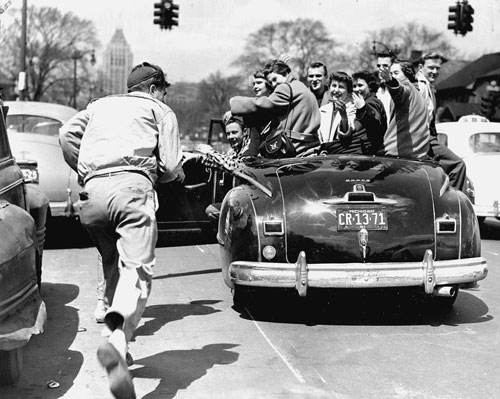
Cruising Woodward, 1951 (above) …the seriousness of the times (1950s) did not dampen a growing love of cars and the freedom experienced by driving them. These young Detroiters found their cars especially useful during the longest transportation strike in the city’s history. In April 1951, the folks here piled into a car not far from the Fisher Building, in the distance, which is across from the General Motors Building in Detroit’s New Center area. After the strike, Detroit mayor Albert Cobo urged the city council to sell Detroit’s streetcars to a willing buyer, Mexico City, for $1 million. The streetcars remained in service there until the 1980s. Detroit soon dismantled its trolley tracks, and only buses ran after that. Cars became the city’s major means of transportation.

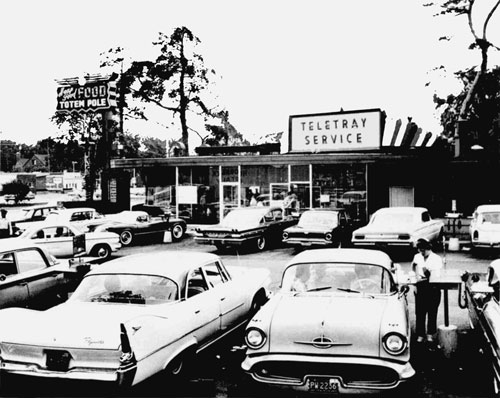
Cruisin’ the Original: Woodward Avenue by Anthony Ambrogio and Sharon Luckerman begins: In the 1950s, cruising swept the nation. American streets became impromptu racetracks as soon as the police turned their backs. Young people piled into friends’ cars and cruised their main streets with a new sense of freedom. The Totem Pole on Detroit’s Woodward AvePent-up desires after the hardships of World War II plus a booming economy fueled a car-buying frenzy. To lure buyers to their particular makes and models, automobile companies targeted the youth market by focusing on design and performance. No place was that more relevant than on metro Detroit’s Woodward Avenue, the city’s number-one cruising destination and home of the world’s automobile industry. Barely 50 years earlier, Henry Ford rolled his first Model T off the assembly line at Piquette and Woodward, just south of where cruisers, dragsters, and automobile engineers ignited each other’s excitement over cars. This unique relationship extended into the muscle car era of the 1960s, as Woodward Avenue continued to reflect the triumphs and downturns of the industry that made Detroit known throughout the world.
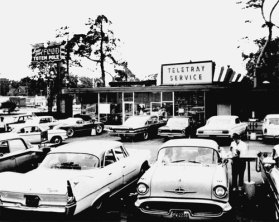
The Totem Pole (right) was the cruisers’ unofficial starting point on Woodward Avenue at Lafayette Street, kitty-corner from the zoo. This 1957 photograph demonstrates the “proper” way cruisers parked—to see and be seen, backed in, like the finned Plymouth in the lower-left corner. (click photo for larger view!)

Funded in part by a grant from the Federal Highway Administration’s National Scenic Byway program and with guidance from the Woodward Heritage Team, Detroit writers Anthony Ambrogio and Sharon Luckerman interviewed numerous local historians, automobile engineers, automobile museum directors, and Detroiters who cruised during these extraordinary decades.

The Images of America series celebrates the history of neighborhoods, towns, and cities across the country. Using archival photographs, each title presents the distinctive stories from the past that shape the character of the community today. Arcadia is proud to play a part in the preservation of local heritage, making history available to all.

Cruisin’ the Original: Woodward Avenue is available from the publisher online at www.arcadiapublishing.com or by calling 888-313-2665.

View other excerpts from Arcadia Publishing’s Michigan books at Michigan in Pictures!

Here’s an action-packed feature on the Woodward Dream Cruise from Absolute Michigan!

Hotel Madison-Lenox Detroit :: 1900 – 2005

madlennox by humphreyphotography

madlennox by humphreyphotography

Scott Humphrey took this photo of the Hotel Madison-Lenox in Detroit shortly before its demolition. He has a whole lot of great photo to view at Scott Humphrey Photography, so get on over there and take a look!

We are featuring a short film with imagery of the demolition of this historic hotel called Vacancy by Brandon Walley on Absolute Michigan today.

a temple in detroit

a temple in detroit

a temple in detroit, photo by artsy_T.

The other day when I blogged the exposure.detroit Selective Focus photography show (this Friday, July 20), I was pretty shocked to see that I had never blogged a photo from Tina (aka artsy T) to Michigan in Pictures.

She’s been a regular contributor to Absolute Michigan and (in addition to being one heck of an art teacher) she has a great eye for the yellows and reds and azures that surround us.

She has some cool socks too.

exposure.detroit Selective Focus photography show

MexicanTown Safari (59)

MexicanTown Safari (59), photo by Auberon.

The above photo is part of Auberon/Merlin Elsner’s Show Pictures set (slideshow). Merlin is one of five excellent exposure.Detroit photographers who will make up the SELECTIVE FOCUS Photographic Exhibition on Friday, July 20th, 2007 from 7 PM – 10 PM at Sweetwaters Coffee & Tea in Royal Oak, Michigan

exposure.detroit is a photography group (based on Flickr) with the stated mission to EXPOSE the unknown Michigan photographer to a network of artists and friends who share in the same passions for art, photography and fun. When I checked Michigan in Pictures, I realized that of the photographers in the show, Merlin was the only one who I hadn’t blogged something of.

If you can make it to the D on the 20th, do go – they’re all wonderful folks who will make you feel welcome and provide a rare treat for your eyes and soul.

Um … I thought for SURE I had blogged a photo from Tina … apparently not. I’ll have to remedy that soon!

Detroit’s Michigan Central Station

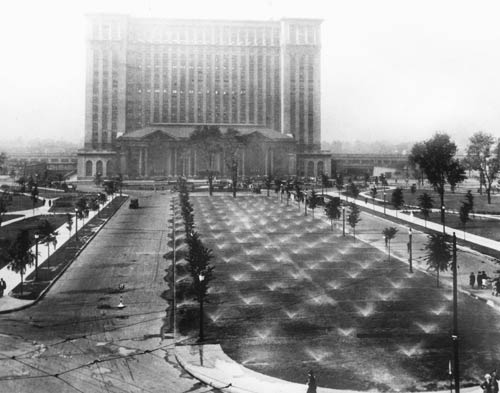
Michigan Central Station, 1921

The introduction to Detroit’s Michigan Central Station says the Michigan Central Station was designed by Warren & Wetmore and Reed & Stem, the firms who were the architects of New York’s Grand Central Station. It opened in 1913, and by the time this 1921 photograph (above) was taken, the Beaux Art ideal had been reached. The unique road configuration leading up to the Michigan Central, as well as the fine ambiance Roosevelt Park contributed to the scene, reveals itself to be absolutely necessary to complete the designers’ vision. (Courtesy of Manning Brothers Historical Photographic Collection)

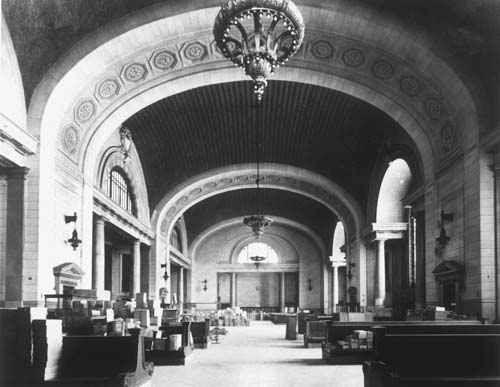
Michigan Central Station waiting room

By 1967 the main waiting room (right, click for larger view) was closed to travelers and used merely for storage; it is difficult to conceive of these splendid benches being relegated to use as a mere shelving system. Hanging on by a thread, the Michigan Central continued to operate without its restaurant or even the main park entrance. (Dave Jordano, Courtesy of the Burton Historical Collection)

In case you’re wondering, here’s a photo of the waiting room in its current state and here’s another.

The photos and captions are reprinted with permission from Detroit’s Michigan Central Station by Kelli B Kavanaugh. In addition to some history on Michigan Central Station and great old photos of the station and activity, the book includes some floorplans of MCS. It’s available from the publisher online at www.arcadiapublishing.com or by calling 888-313-2665.

View other excerpts from Arcadia Publishing’s Michigan books at Michigan in Pictures and also be sure to check out MCS 7.2.7: Transformers co-star Michigan Central Station on Absolute Michigan for more photos and some great videos too!!

Modern Day Detroit … from above

modern day Detroit

modern day Detroit, photo by paulhitz.

Paul says that this photo of Comerica Park and the Detroit skyline was shot Sunday from a helicopter tour around Detroit during the Detroit International River Days Festival (held late June every year). I was going to ask Paul how the heck he managed a helicopter ride, but apparently helicopter rides from Walton Helicopter Charter were part of River Days this year.

Paul encourages you to view this picture bigger (yes, it makes a great computer background). You can also view more helicopter-eye photos of Detroit.

urban playgrounds & vanishing acts

bike

bike, photo by vanessamiller.

About a month ago Vanessa was interviewed by Michigan Radio’s Jennifer Guerra about her Ruins of Detroit urban explorations project. Vanessa says:

The Detroit ruins project has been in progress in some form or another for six years. During that time we have seen Detroit grow and change. It started in High school when we treated the city’s abandoned buildings as playgrounds. We were a group of photographers that spent every day shooting. In college, some people move out of state, some just moved on, but we stayed, we kept coming back to the same places and began documenting their changes over time. We saw our favorite buildings burn to the ground and found new ones along the way. Each building has its own mysteries, that we tried to solve and its own beauty.

Check out more photos from Vanessa and others of the Detroit that just isn’t there anymore in her photostream and in the Vanished Detroit group on Flickr.

The Supremes at the Roostertail in Motown

The Supremes at the Roostertail in Detroit

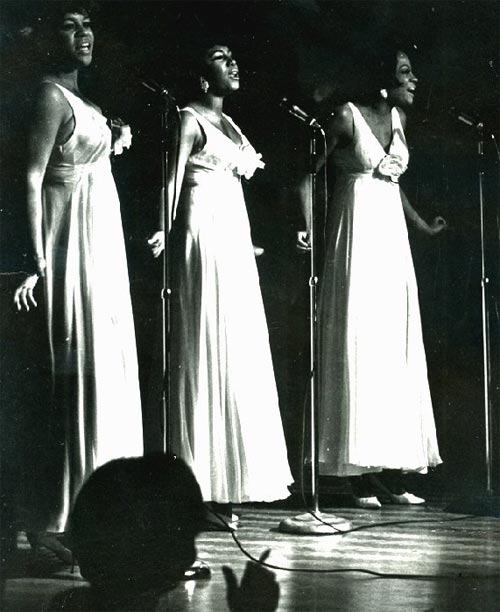
The Supremes at the Roostertail, Detroit 1966, Archives of Michigan

Every month the Archives of Michigan post their Image of the Month. This month it’s the Supremes:

Where Did Our Love Go? (1964)As the most successful female singing group of all time, the Supremes are well known – not only for their music, but also their rise to stardom. Starting out in “the Projects” of Detroit, the group rose to become the most popular female group of the 1960’s. The recent film Dreamgirls, based loosely on their story, shows that Americans’ fascination with this successful African American singing trio has not waned.

The Supremes started as a quartet called “The Primettes” in 1959. After hearing the girls sing, the manager of the locally popular male group, “The Primes” (the future Temptations) decided to start a sister group. They were signed to Motown records in 1961. Soon after, the fourth member left the group, leaving the trio of Florence Ballard, Diana Ross, and Mary Wilson. In their negotiations with Berry Gordy, manager of Motown Records, they changed their name to “The Supremes.” Gordy decided to make Diana Ross the sole lead singer, a role the three had previously shared.

Read the rest of the article and see a larger photo of the Supremes at the Roostertail at the Archives of Michigan, explore The Supremes at Wikipedia, (and Billy’s Supremes web site),  check out the Roostertail’s history page and then turn up your speakers and click over to the Motown Historical Museum for more on the Supremes and other Motown greats.

And then – if you’re still looking for an “and then” – YouTube has The Supremes At Hollywood Palace “Stop In The Name Of Love”Baby Love on Top of the Pops and a whole lot more videos.

Flickr, the Dequindre Cut and reworking Michigan

Detroit Scribe Tribe Space Monkey

Detroit Scribe Tribe Space Monkey, photo by Detroit BikeBlog

At the risk of producing a vortex of self-referentiality, I wanted to link over to Mac at DetroitBike Blog, who is linking to Absolute Michigan, which is linking to his blog as the latest “Blog We Dig” (you see the danger). Here’s what he posted last Friday:

Flickr: One thing that’s cool about the Flickr photo site is its sense of community. Not only virtual communities but groups of people who find each other through Flickr, decide to meet-up, and then go out shooting photos together. If you’re reading this and aren’t on Flickr I’d recommend the Exposure Detroit and AbsMich groups as starting points. One of the latest get togethers the ExpDet group organized was a walk along the dequindre cut. Closed for 10 years this abandoned rail cutting has become a graffiti haven with some amazing work that has been posted here before. The ExpDet group took some great shots, well worth exploring.

Now this is where things get interesting. The old rail line (still a few abandoned rail cars along the route) runs from midtown beneath and between the street structure to the river. It’s now inhabited by a few folk who have built shacks and the graff community. But it could also serve as a great bike route between the river and midtown. Detroit has virtually no bike lanes and some of the things I’ve seen on Detroit streets make me wince (the guy with the 6ft plank stuck out of his trunk like a guillotine for example). While there are serious personal safety issues to be considered it’s good to see that work has begun into converting this route into a non-vehicle corridor through the city.

Check his links out and be sure to also view this slideshow of photos from Exposure.Detroit’s April 29, 2007 photo safari to the Dequindre Cut.

While you’re reading and looking, you might think about how $5/gallon gas will require us to rethink the layout of our cities and transportation … and also what fascinating cave paintings these “vandals” are producing in an abandoned space.