Woodward Avenue: Mile by Mile | Exposure.Detroit January Show

A Hundred Views of Woodward

A Hundred Views of Woodward, photo by Terri Light Photo – Detroit.

The January Exposure Detroit Show is a group project titled Woodward Avenue: Mile by Mile. The show explores the architecture, people and energy on Woodward Avenue from its start at Michigan Avenue to where it ends in Pontiac through the lenses of a number of photographers in the Exposure.Detroit group on Flickr. The show will be on January 15, 2011 at the Bean and Leaf Cafe in Royal Oak.

All photos in the show are black & white, and you can see many of them at the edwoodwardproject tag on Flickr. Of course, the way to see them all is to check out the show from January 15 – February 3!

Michigan in Pictures has a great view from Detroit’s Golden Age Looking up Woodward Avenue, takes you cruisin’ Woodward in 1951 and many more photos from Woodward Avenue to explore. You might also enjoy the Woodward Avenue, Detroit’s grand old ‘Main Street’ from the Detroit News’ Michigan History section and M-1 Woodward Avenue at Wikipedia.

Check this photo out bigger and in Terri’s massive Belle Isle and Detroit slideshow. More of her work at terrilightphoto.com.

the speed of life

the speed of life

the speed of life, photo by .brianday..

How fast is your life moving? Fast enough to stay warm?

Check it out bigger and in Brian’s Street Photography slideshow.

Tri-Centennial State Park Lighthouse, Detroit Michigan: Velvia Version

Tri-Centennial State Park Lighthouse, Detroit Michigan: Velvia Version

Tri-Centennial State Park Lighthouse, Detroit Michigan: Velvia Version, photo by friday1970.

Tri-Centennial State Park is now known as the William G. Milliken State Park and Harbor. It was the first urban park in Michigan, and covers 31 acres on the banks of the Detroit River.

This 63-foot lighthouse is a scaled down replica of the Tawas Point Lighthouse, the only true Victorian-era style station on the Great Lakes.

Be sure to check this out background boomtacular and in his slideshow.

Many more Michigan lighthouses on Michigan in Pictures!

Indian Village and the 12 Days of Christmas in Detroit

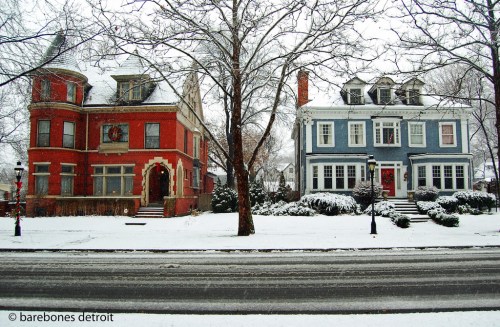
Untitled, photo by BareBonesDetroit

The folks at BareBones Detroit are doing the Twelve Days of Christmas in Detroit, a series on some of the best things to do and see around the holidays. Check their set out on Flickr at the link above (view slideshow) and don’t miss their cool map of Detroit! Of this photo they write:

Day 2: Indian Village. There’s never a better time to take a drive through Detroit’s historic Indian Village neighborhood. Just east of downtown, many of these homes were owned by some of the city’s most prominent, wealthy families. Grab some hot chocolate, turn the radio to 100.3 WNIC and tour some of the Detroit’s most historic homes lit up for the season.

Detroit’s historic Indian Village by Zena Simmons of The Detroit News says that the architecturally diverse Indian Village was home to famous Detroiters including Edsel Ford & Bernard Stroh. Their homes were designed by some of Detroit’s most renowned architects including Albert Kahn, Louis Kamper and William Stratton. The first Village home was built in 1895 at Jefferson and Iroquois and later became the headquarters for WXYZ and the home of the Lone Ranger.

According to the Indian Village Historical Collections, originally, the land belonged to Francois Rivard and Jacques St. Aubin, recipients of French land-grant “ribbon” farms, long narrow strips of land that gave each farmer some river frontage. Abraham Cook acquired the farms between 1811 and 1815. The area consisted mostly of farms, and a couple of upper-class river cottages, but the main attraction was a mile long oval race track. The track was the site of several Michigan State Fairs during the 1860s and was known as the Hamtramck Race Course.

Around 1893, Cook’s heirs formed the Cook Farm Company, Ltd. to develop a “first class residential district on a generous scale”, and the prices were set high so that only the wealthy could build there.

Many assumed that at one time Indians lived on the land. That may be, but John Owen Jr., a key player in the development of the area, selected the name “Indian Village” because he felt the romantic title would add to the sales appeal.

You can also check out Wikipedia’s entry for the Indian Village Historic District and the Historic Indian Village neighborhood site.

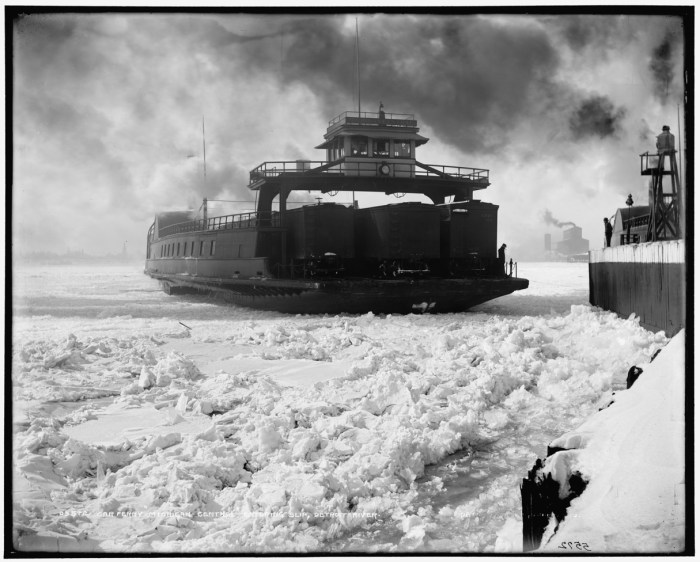
Rail Car Ferry Michigan Central on the Detroit River

Car ferry, Michigan Central, entering slip, Detroit River, photo by Detroit Publishing Co.

It’s kind of cruel to post a photo like this while it’s still November. I think we all know what’s coming though…

I spent some time learning about this photo I found in the Library of Congress aka maybe the coolest place on the internet. (You probably paid 3 cents for it last year, so check it out sometime). I finally found the same photo on the fantastic photo blog Shorpy. One of the commentors writes:

This is the Detroit side. The river flows extremely fast, and the ferry docks were set up so the boats always entered dock facing upstream. Michigan Central was built in 1884 by Detroit Dry Dock in Wyandotte, while Transport was built there in 1880. Both were cut down to barges by the 1930’s. A nearly identical boat, Lansdowne of 1884, survived in steam until 1970 for CN/Grand Trunk, until she blew a cylinder head (I remember the shock among the Detroit trainwatching community at the time).

You can see the Lansdowne of Windsor on Michigan in Pictures and check the comments at Shorpy for more including a shot of this location from the Ambassador Bridge in 1957.

See the photo background bigtacular at Shorpy.

Holiday shopping at J.L. Hudson’s in Detroit

Hudson's detroit
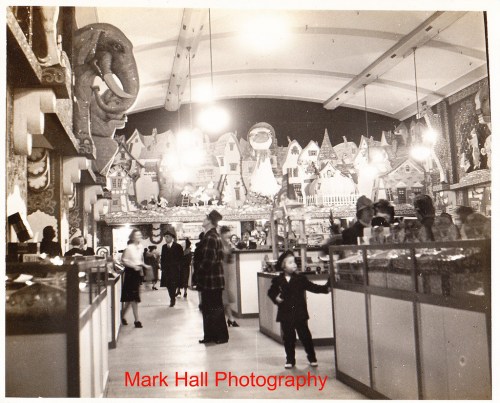
Hudson’s detroit, photo by Detroitmi97.

If you grew up in or around Detroit, chances are you went to Hudson’s at some point for the holidays, maybe even taking a photo on Santa’s lap. In honor of my own memories of my grandmother who often took me to Hudson’s, here’s the best I could find about this legendary Detroit store.

Wikipedia’s Hudson’s entry relates that was founded in 1881 at 1200 Woodward Avenue by Joseph L. Hudson. The store operated for 102 years at that location and also opened a number of branches across the region. After closing the downtown store on January 17, 1984, the company merged into the Dayton Hudson Corp. On October 24, 1998 to make room for Ford Field, the 439 foot tall, 2.2 million square feet J.L. Hudson Building became the world’s largest building to be imploded.

Probably the best page to check out is How J.L. Hudson changed the way we shop from The Detroit News. It looks at how the canny store owner bucked popular wisdom by siting his store off the main drag of Jefferson and used publicity stunts like their signature gint flag and sponsoring a Thanksgiving parade. His moves paid off and:

By 1953 the 49-acre store had 12,000 employees and was making 100,000 sales per day. It used as much electricity as the city of Ypsilanti. It had a legendary delivery force of 500 drivers and 300 trucks. It boasted five restaurants which made 14,000 meals per day. The Hudson’s Maurice salad delighted lunchers for many years, its recipe a closely guarded secret until the store bowed to thousands of requests and made it public.

Despite warning signs, the downtown store hung in there. In 1961, the 25 story building was the world’s tallest department store. It had five basements, 51 passenger elevators, 17 freight elevators, 51 display windows, 706 fitting rooms, 2 million square feet, and 5,000 drafty windows. And the customers loved it.

In 1962, the store had two $1 million dollar sales days, topping the branches. In 1963, the founder’s great-nephew, Joseph L. Hudson Jr. took over and opened the store’s fine art gallery and a fine wine department.

Something I didn’t know was that Hudson was one of the first to reach out to minorities and in 1960 hired the city’s first black bus girl, a Cass Tech student by the name of Diana Ross! Click through for much more including a great photo gallery!

On their J. L. Hudson Department Store in downtown Detroit, Detroit Yes writes that the abandonment of the store in the early 80s was the death knell of downtown Detroit. The Department Store Museum page for Hudson’s – yes, Virginia, the internet has absolutely everything – has a listing of all the store departments by floor along with photos of the Woodward location and branch stores across Michigan.

You may also enjoy this slideshow of Hudson photos which showcases the incredible energy the store put into creating displays.

Check this out bigger and in Mark’s old detroit slideshow. He also has this view from above of the exterior of Hudson’s.

Behind the scenes with America’s Thanksgiving Day Parade


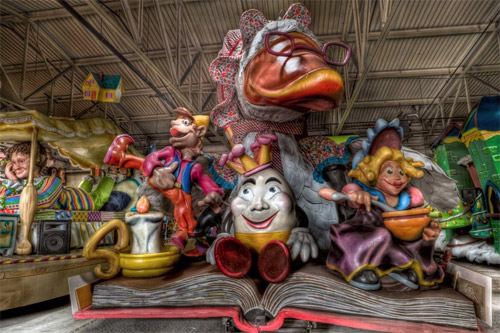
Mother Goose & Friends, photo by Eric Smith

The Michigan Picture Project had a great photo feature last year on America’s Thanksgiving Day Parade (music & animated clown warning), held every year in Detroit that lifts the curtain with a stunning selection of HDR images of the floats in the warehouse. On Parade in Waiting they write:

The Thanksgiving Parade that fills Woodward Avenue in downtown Detroit for several hours every year is actually an ongoing work in progress that has delighted spectators for decades. Detroit’s first Thanksgiving Parade in 1924 featured 10 floats inspired by nursery rhymes, including Mother Goose and The Old Woman Who Lived in a Shoe, along with several marching bands. As the parade grew into a major event, new floats and characters joined those original figures, and all of these parade creations emerge from storage in huge warehouses to march again down Woodward Avenue.

Floats added in recent years celebrate Downtown Detroit, the Automobile Industry, and American Freedom. Many skilled hands collaborate to create each new float and every giant head that entertains the thousands of parade-watchers who line the route. During the weeks leading up to the parade, the floats and figures come out from warehouse storage, to be polished up in preparation for the big day. Photographer Eric Smith used a digital technique to convey the storybook magic of the parade characters as they wait to come to life.

Detroit’s Thanksgiving Parade was produced by the J. L. Hudson Company from the parade’s beginning in 1924 until 30 years ago. The store’s Display Department created and cared for the floats and giant heads. In 1979, Hudson’s passed parade sponsorship and control to Detroit Renaissance, and in 1983 that responsibility went to the Michigan Parade Foundation. Since 1990, The Parade Company has managed the parade with enthusiastic help from thousands of volunteers and support from dozens of Detroit businesses and civic groups. 

Click here to see this and the other pictures bigger and see more of Eric’s work at ericsmithphotography.com. Don’t miss the parade at 9:20 AM on Thanksgiving!

Chevrolet Volt: Motor Trend 2011 Car of the Year

2011 Chevrolet Volt in Production
2011 Chevrolet Volt in Production, photo by ibmphoto24

A a lot of the sound and fury that has surrounded the Volt’s launch has tended to obscure a simple truth: This automobile is a game-changer.
~Motor Trend Magazine

Motor Trend magazine has named the Chevrolet Volt its 2011 Car of the Year. The criteria for Car of the Year are design advancement, engineering excellence, intended function, efficiency, safety and value. After reading passages like the one below, you get the sense that when the Motor Trend Editor in Chief Angus MacKenzie says that the Chevy Volt is one of the most groundbreaking vehicles they’ve tested in 60 years, he means it:

The Volt’s unique powertrain not only defies established labels; it also defies established methods of determining fuel economy. After all, this is a vehicle that will complete the standard EPA fuel economy test in full EV mode, making conventional mileage calculations impossible.

Read more at Motor Trend, visit the official Chevrolet Volt web site and see a video, more about the award and GM’s IPO this week on Absolute Michigan.

The photo above is the first pre-production Chevrolet Volt on the assembly line at the Detroit-Hamtramck manufacturing plant. It was posted by IBM. Check it out bigger and read about how IBM software played a role in the development of the vehicle.

Here’s the Chevy Volt slideshow on Flickr.

Michigan’s Tallest: The Renaissance Center in Detroit

renaissance center detroit

renaissance center detroit, photo by Detroitmi97.

The list of the tallest buildings in Michigan says that the title of tallest building in Michigan belongs to the Renaissance Center at 77 stories and 722 feet tall. It also has the distinction of being the tallest all-hotel skyscraper in the Western Hemisphere.

The RenCen is owned by General Motors and Wikipedia says that the Ren Cen was conceived as a catalyst for Detroit’s economy by Henery Ford II and investors, and that it generated in excess of $1 billion in economic growth for downtown Detroit in its first year of operation.

John Portman was the principal architect for the original design. The first phase constructed a five tower rosette rising from a common base. Four 39-story office towers surround the 73-story hotel rising from a square-shaped podium which includes a shopping center, restaurants, brokerage firms, banks, a four-screen movie theatre, private clubs.The first phase officially opened in March 1977. Portman’s design renewed attention to city architecture, constructing the world’s tallest hotel at the time. Two additional 21-story office towers (known as Tower 500 and Tower 600) opened in 1981. This type of complex has been termed a city within a city.

…The architects’ initial design for the Renaissance Center focused on creating secure interior spaces, while its design later expanded and improved to connect with the exterior spaces and waterfront through a reconfigured interior, open glass entryways, and a Wintergarden.

While it might be a little over-photographed, it’s an amazing space for photographers to explore, inside and out.

Mark says he can see the whole world from here – can you? Check it out background boomtacular and see some other shots from high up in the RenCen in his detroit top slideshow.

More Renaissance Center and don’t miss the RenCen slideshow from the Absolute Michigan pool!

More of Michigan’s tallest on Michigan in Pictures.

Sparky Anderson, a Detroit Tigers Legend

Sparky Anderson

Sparky Anderson, photo by Baseball Images.

Remembering Tiger Manager George “Sparky” Anderson on Absolute Michigan recounts how the Hall of Fame coach who managed the Tigers from 1979-1995 and was the first manager to win a World Series for both a National League and American League team. His 1,331 wins are the most in Tigers’ history

Read on for all kinds of columns and video about this Detroit Tiger legend.

See it bigger in Baseball Images’ Detroit Tigers slideshow.

More Detroit Tigers from Michigan in Pictures.