Cass Gilbert, controversy and the James Scott Memorial Fountain

Rising Above

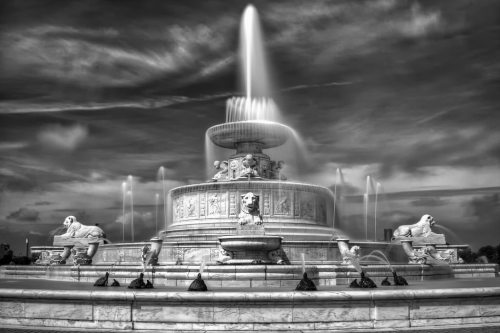
Rising Above, photo by Tom Hughes

“Mr. Scott never did anything for Detroit in his lifetime and he never had a thought that was good for the city.”
~ J.L. Hudson

Sometimes when you peer into history, you see things you didn’t expect, and that’s definitely the case with today’s subject. The Cass Gilbert Society’s page on the James Scott Memorial Fountain on Belle Isle explains that the fountain was completed in 1925, designed by noted architect Cass Gilbert (designer of the US Supreme Court Building in DC), and executed by sculptor Herbert Adams

The fountain was the result of a bequest from millionaire playboy James Scott, a figure of much controversy in Detroit at the turn of the century. Detroit’s fountain of mirth  from the excellent Rearview Mirror series in the Detroit News (removed, but see The Wayback Machine) tells of the opposition from prominent citizens and clergy like J.L. Hudson and Bishop Williams that a playboy, loafer, gambler and vindictive practical joker like Scott be memorialized solely because he was able to plunk down a vast sum for his own monument. While public opinion kept the project scuttled for years after Scott’s death, influential Alderman David Heineman and others took up the charge, likely seeing how a vastly expensive fountain could enhance Detroit’s island park.

Speaking to reporters gathered in the office of Mayor Philip Breitmeyer, Heineman said: “I can look around this office and see pictures of men who played poker with Jim Scott. I say the bequest should be accepted.” He also recalled that “Jim always liked Belle Isle and loved to see the children there.”

The mayor agreed with Heineman. “I don’t believe the city has a right to insult any of her citizens by refusing a gift for such a good cause,” he said.

In the end, their view prevailed. It took more than 15 years, but Breitmeyer lived to attend the fountain’s dedication in 1925. Cass Gilbert, the New York architect who planned the Detroit Public Library, won a competition for design of the glistening white memorial at the lower end of the city’s pleasure island.

Read on at archive.org and see Wikipedia for more on Belle Isle.

Tom took this shot on Sunday. See it bigger and see more including a detail view in his slideshow.

EDITOR’S NOTE: This post previously appeared but sadly the photo was deleted by the owner. It’s one of my favorites so I re-blogged it!

More black & white photography and more Belle Isle on Michigan in Pictures!
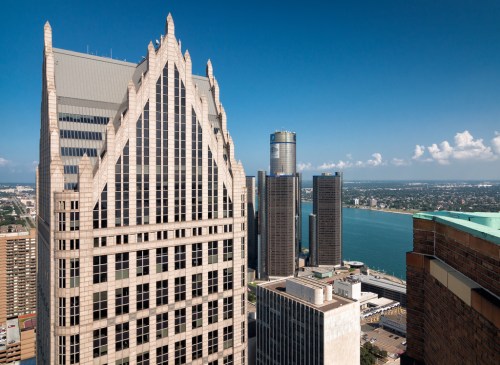
One Detroit Center (Comerica Tower) & architect Philip Cortelyou Johnson

One Detroit

One Detroit, photo by Michael G Smith

The 619 ft tall, 43-story One Detroit Center is the tallest office building in Michigan and second tallest building in the city behind the central hotel tower of the Renaissance Center. Completed in 1993, it started out as the Comerica Tower. The Detroit 1701 page on Comerica Tower says (in part):

This skyscraper is distinguished from all other tall buildings in Detroit by its neo-gothic spires. As Eric Hill and John Gallagher describe them in their book AIA Detroit, these are Flemish inspired spires.

…Philip Cortelyou Johnson was among the nation’s most influential architects and architectural critics of the Twentieth Century in the post-World War II era. Born in Cleveland in 1906, he studied philosophy at Harvard. However, he had the opportunity to take several trips to Europe while an undergraduate and became fascinated with the architecture there. In 1928, he met the innovative Ludwig Mies Van der Rohe whose work is commemorated in an historic district that bears his name located less than a mile from Comerica Tower.

In the early 1930s, Johnson affiliated himself with the Museum of Modern Art in New York and sought to support himself by promoting modern architecture and commenting about it. Apparently, that was not a financially rewarding career so he became a journalist, went to Germany and covered the rise to power of the National Socialists. Apparently, that was not completely rewarding either, so he returned to the United States and enlisted in the Army. After serving for some time, he appreciated his real calling and enrolled at the Harvard Graduate School of Design to become an architect. By the late 1940s, he began his very distinguished career.

Along with collaborators, especially Mies Van der Rhoe in the early years and John Burgee in the later years, he designed a large number of modern skyscrapers. He broke away from the classical tradition that is illustrated in Albert Kahn’s nearby First National Bank Building completed in 1922. His structures also differ from the stark modernist style illustrated by Minoru Yamasaki’s Michigan Consolidated Gas building, completed in 1965, that is almost directly across Woodward from Comerica Tower. Note the rounded corners that Philip Johnson designed for Comerica Tower conveying a sense of gentleness. All other downtown skyscrapers have right angles for their corners.

Read on for more and get One Detroit details from Emporis.

View Michael’s photo big as a building and see more in his awesome Detroit Tour slideshow.

More architecture on Michigan in Pictures.

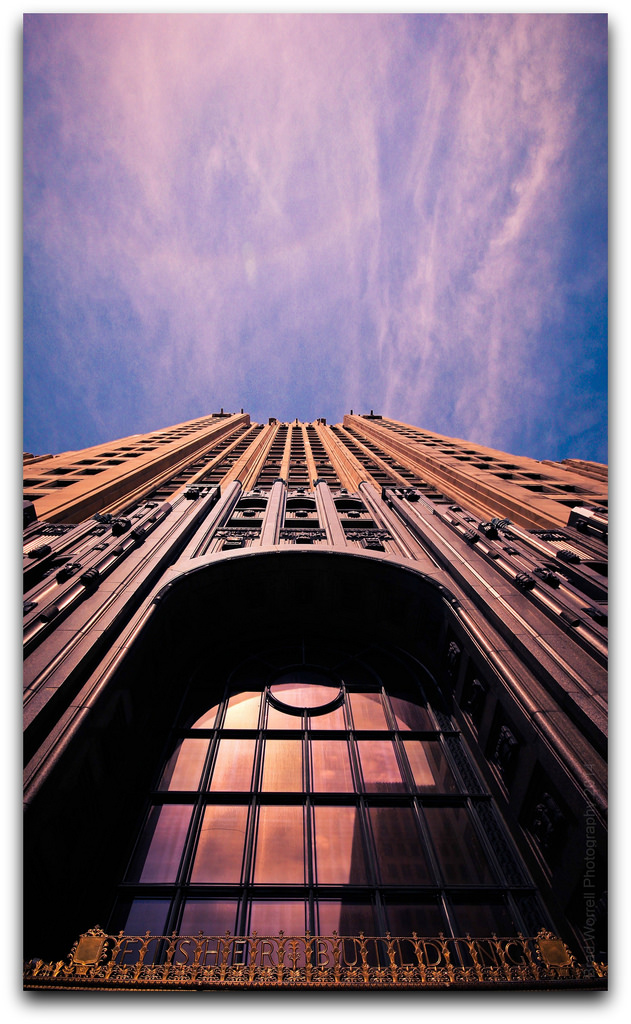
Fisher Brothers Legacy

Fisher Brothers Legacy...

Fisher Brothers Legacy…, photo by Brad Worrell

On his excellent Historic Detroit site, Dan Austin’s excellent & comprehensive article on the Albert Kahn designed Fisher Building says:

The late 1920s were a time of unprecedented growth in Detroit, especially when it came to skyscrapers. From the Penobscot Building to the Fox Theatre, 1928 saw landmark after landmark rise in the Motor City.

The 29-story Fisher is one of three National Historic Landmarks in Detroit, along with the Fox and the Guardian Building.

“The gold-capped tower has taken its proper place in Detroit’s ever-changing skyline,” the Detroit News wrote of the Fisher in October 1928, when the finishing touches were being put on the building. “This will be the most beautiful building of its kind ever created. … It is an outstanding example of the new American school of architecture, which has arisen to typify the spirit of modern progress. No expense, Mr. Kahn said, has been spared to make the Fisher building the very epitome of things beautiful.”

To achieve this feat, the Fisher was built — with only slight exceptions — entirely out of granite and marble, including on the exterior. More than 40 kinds of marble from all over the world were used. From the base of the building to 50 feet up — the first three floors — the exterior is finished in polished Minnesota pink marble and Oriental granite. Above that is Beaver Dam marvilla marble (named such because it was harvested from the Beaver Dam Quarry at Cockeysville, Md.) on the street fronts and Carthage marble on the courts. The marble was cut and positioned to give varying textures across the exterior. “The sun (plays) on differences of saw markings and grain on each block that identify the individual pieces from their neighbors,” the Michigan Manufacturer and Financial Record wrote in October 1928.

Read on for much (much) more about the Fisher Building including a sweet gallery of historic photos (including one looking up at this angle).  you can also visit the Fisher Building website.

View Brad’s photo bigger and see more in his Detroit slideshow.

More architecture on Michigan in Pictures.

Diego Rivera & Frida Kahlo exhibit coming to the DIA

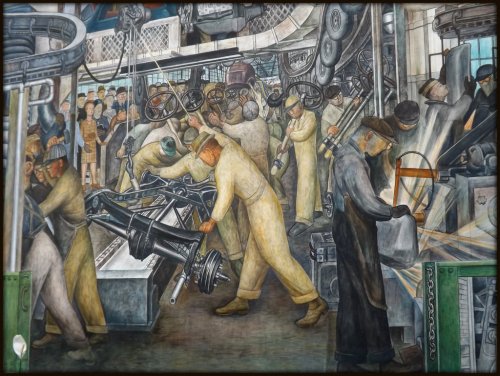
Detroit Institute of Arts: "Detroit Industry" Murals, South Wall--Detroit MI

Detroit Institute of Arts: “Detroit Industry” Murals, South Wall–Detroit MI, photo by pinehurst19475

Michigan Radio Reports that the Detroit Institute of Arts is planning an exhibition that highlights Mexican artists Diego Rivera and Frida Kahlo and the year spent in Detroit. Between April 1932 and March 1933, Rivera created the Detroit Industry murals at the DIA and the museum will also show works created by Kahlo during that time.

The show is scheduled to run from March 15, 2015 to July 12, 2015, and you can click through to Michigan Radio for more including a film of Rivera working on the murals. Also check out photos of the Rivera Court murals at the DIA.

About this photo, pinehurst19475 writes: This section of the South Wall depicts line workers assembling tires, axles and wheels with a factory tour in progress. The Rivera murals were recently named a National Historic Landmark.

View the photo background bigtacular and see more in his Wayne State and the Cultural Center slideshow.

More art and more Detroit on Michigan in Pictures.

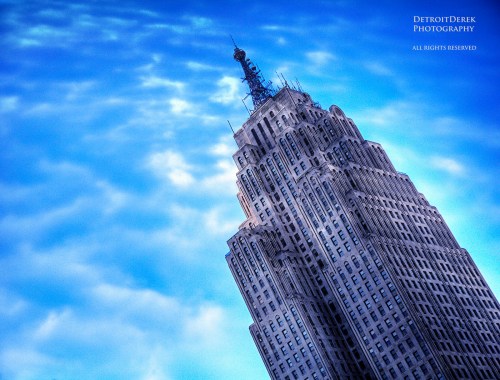
Hundred Mile High City: Detroit’s Penobscot Building

Hundred Mile High City by Detroit Derek


Hundred Mile High City, photo by Derek Farr

When I saw Derek’s photo, I remembered that I had posted a photo of the Penobscot several years ago. I found that photo has been deleted from Flickr and therefor from Michigan in Pictures as well. So here then is the definitive Penobscot post.

The Wikipedia entry on the Penobscot Building says:

Upon its completion, it was the eighth tallest building in the world and the tallest outside New York City and Chicago. Like many of the city’s other Roaring Twenties buildings, it displays Art Deco influences, including its “H” shape (designed to allow maximum sunlight into the building) and the sculptural setbacks that cause the upper floors to progressively “erode”. The building’s architect, Wirt C. Rowland, also designed such memorable Detroit skyscrapers as the Guardian Building in the same decade. At night, the building’s upper floors are dramatically lit in floodlight fashion, topped with a red sphere.

Although the Penobscot Building has more floors than Comerica Tower at Detroit Center (45 above-ground floors compared to Comerica Tower’s 43), Comerica’s floors and spires are taller, with its roof sitting roughly 60 feet taller than Penobscot’s (566′). The opulent Penobscot is one of many buildings in Detroit that features architectural sculpture by Corrado Parducci.

The Penobscot Building served as a “compass” for pilots in airplanes during its early years, due to its position of facing due north. The building also served as an inspiration of sorts for the Empire State Building in New York City, and many individuals worked on the construction of both towers.

The Penobscot Building web site says that the building serves as the fiber-optic hub for the entire Detroit area and touts it as the place for office space. You might also enjoy Historic Detroit’s page on the Penobscot Building, the Emporis page on the Penobscot and this 3D model of the Penobscot Building for Google Sketchup.

View Derek’s photo bigger and see more in his massive Detroit slideshow. He says the title of his photo came from the Ocean Colour Scene song, Hundred Mile High City.

More architecture on Michigan in Pictures.

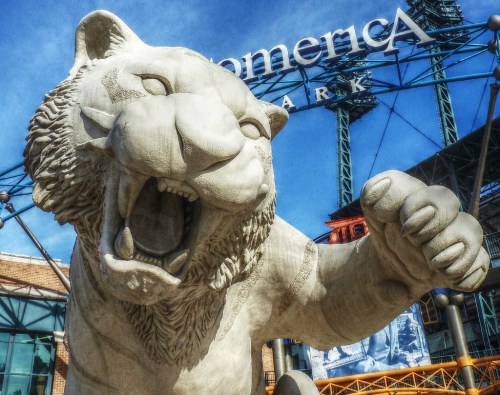
Happy 113th Opening Day, Tiger Fans!

Happy Opening Day Detroit!

Happy Opening Day Detroit!, photo by kellyanne berg

The Detroit Tigers open the 2014 season today at 1:08 PM at Comerica Park vs the Kansas City Royals. The Tigers got their start as a charter member of the Western League in 1894 and played their first American League game in 1900 when the Western League changed its name. It wasn’t until 1901, however, that the American League decided not to renew the original National Agreement, declare itself a second major league and compete with the National League for players. The Detroit Tiger timeline says:

On April 24, 1901, the Tigers prepared to take to the field for their first official American League game. A standing room only crowd was anticipated at Bennett Park, but unpredictable weather postponed the opening by a day.

On that historic afternoon, April 25, 1901, in front of 10,000 fans, the Tigers entered the ninth inning trailing Milwaukee, 13-4. A series of hits and miscues followed, moving the score to 13-12 with two runners on. With two out, Tiger Frank “Pop” Dillon faced reliever Bert Husting, and the lefthanded hitter rapped a two-run double to complete a 14-13 comeback win.

Kellyanne posted this shot from Comerica Park a couple of years ago. See it bigger and see more of her Detroit Tigers photos (which are mostly real tigers eating meat).

More Detroit Tigers and more Comerica Park on Michigan in Pictures. Play ball!

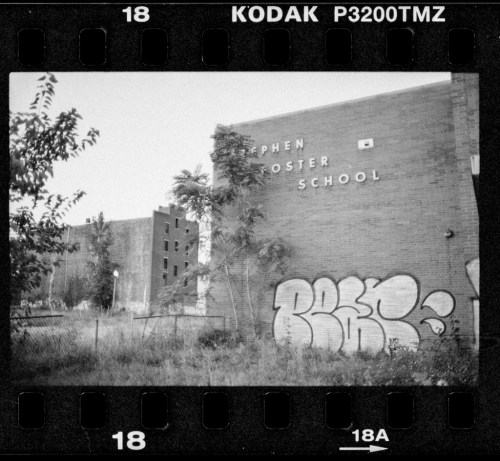
Stephen Foster School, Brush Park

Detroit T3200 Roll 2 exp. 18

Detroit T3200 Roll 2 exp. 18, photo by Marty Hogan

You’ve seen a lot of Marty’s ranging in the U.P. and lost rural places on Michigan in Pictures and he recently posted photos from a visit to Detroit.

View his photo background big and see more in Marty’s Detroit Kodak T3200 Film slideshow.

Snowblind

Snowblind...

Snowblind…, photo by Photography by Kenneh

I’m tempted to visualize this plane as leaving for someplace warm.

View Kenneth’s photo bigger and see more in his Sunrises & Sunsets slideshow.

Hot Stove League

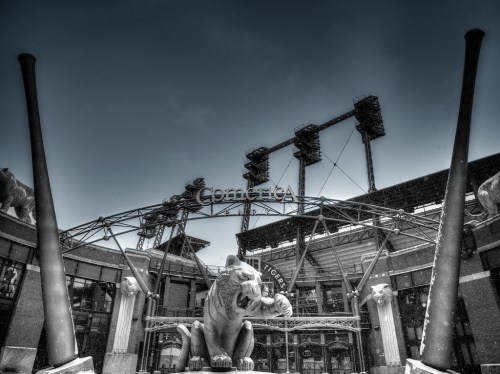
Comerica Park Winter - Detroit, MI

Comerica Park Winter – Detroit, MI, photo by memories_by_mike

The Freep has an interesting article with Detroit Tiger GM Dave Dombrowski discussing the teams offseason strategy.

View Mike’s photo background bigtacular and see more in his Detroit slideshow.

More Tigers on Michigan in Pictures.

Here comes the 2014 Detroit Auto Show

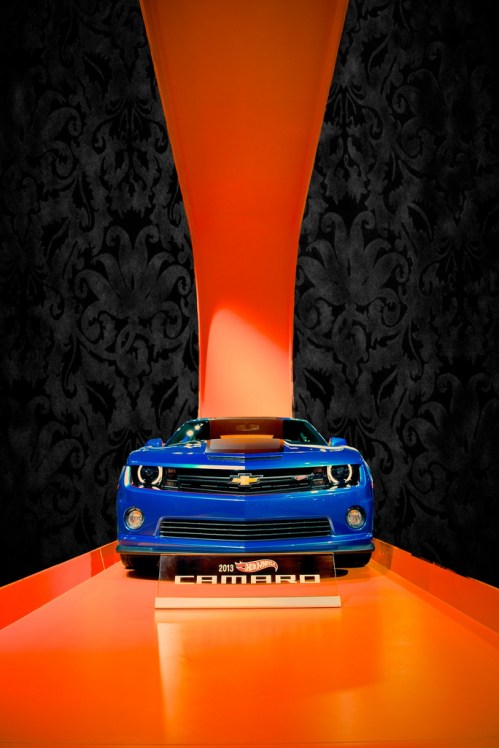
2013 North American International Auto Show-Detroit, MI-Hot Wheels-Camaro

2013 North American International Auto Show – Hot Wheels Camaro, photo by memories_by_mike

The 2014 North American International Auto Show takes place January 13-26th in downtown Detroit (consumer show Jan 18-26) and features the new models and a whole lot of sizzle and creativity as manufacturers seek to make the biggest splash. The NAIAS site includes Detroit Auto Show history page that takes you all the way back to the first Detroit Auto Show in 1907!

The first Detroit Area Dealer Association (DADA)-managed Detroit Auto Show was held in December 1907, at Riverview Park after the formation of the DADA in the same year. Since then, the show has grown from a regional event with 17 exhibitors to a world-class showcase featuring more than 60 exhibitors.

As the years passed, the show became increasingly popular as the demand and interest for automobiles grew. The show grew and moved to several new locations, including the Light Guard Armory on Eight Mile, the Wayne Gardens Pavilion and the Michigan State Fairgrounds.

Check Mike’s Photo out background big and see more in his 2013 North American International Auto Show-Detroit, MI slideshow.

More Detroit Auto Show and more cars on Michigan in Pictures.