100 Years of the Model T

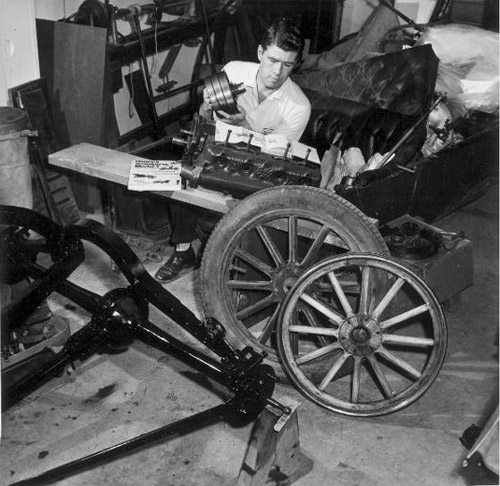
Assembling the Model T

Assembling the Model T, photo courtesy Archives of Michigan

The September 2008 Image of the Month from the Archives of Michigan (click through for more pictures) says that the first production Model T was completed Sept. 27, 1908, at Ford’s Piquette Avenue plant in Detroit.

…Henry Ford wanted a car that the average American could afford. The Model T initially sold for $850. The price continued to drop as Ford’s assembly line technology improved production efficiency. According to Willis F. Dunbar and George S. May’s third revised edition of Michigan: A History of the Wolverine State, a Model T touring car cost only $360 by 1916.

The Model T also proved remarkably easy to maintain. Dunbar and May note, for example, that it “was so easy to repair that almost anyone could fix something … with a pair of pliers and a screwdriver.” Gasoline seldom proved an onerous expense, either. On page 45 of The Ford Century author Russ Bahnam notes that the Model T averaged twenty-five miles per gallon – with a gallon of gas typically costing only twenty cents!

The Ford Motor Company produced over 15 million Model Ts between 1908 and 1927. According to The Henry Ford of Dearborn, Mich., the Volkswagen Beetle is the only model with a greater production record!

For more in the Model T check out the Model T Automotive Heritage Complex, Inc. (aka the T-Plex) and the Model-T Centennial exhibit at The Henry Ford.

Edsel

Big Rear Edsel (IMGP2057h)

Big Rear Edsel (IMGP2057h), photo by norjam8.

September 4, 1957: It’s E-day, as Ford Motor Company introduces its newest make, the Edsel.

In an industry celebrated for its spectacular failures, the Edsel still takes the cake. Although as mechanically sound as other Ford products, the car was criticized from Day One for being too ugly, too expensive and vastly overhyped.
Short, Unhappy Life of the Edsel, WIRED

The Edsel was named for Henry Ford’s son Edsel Bryant Ford, president of Ford Motor Company from 1919 to 1943. Edsel was responsible for making the design & styling of automobiles a key consideration at Ford in their manufacture before he died in 1943 at the age of 49. (also see this great bio of Edsel Ford)

While Edsel was never a very popular name (peaking at 400th behind names like Kermit, Buford and Elvin in 1927), Edsel Agonistes in TIME Magazine says that a quick check of demographic records suggests that a convention of Americans first-named Edsel could be held in a hotel linen closet. Why?

The Edsel had been frantically ballyhooed for months ahead of its arrival with a new kind of highly scientific marketing, an alchemical blend of psychology, mass media and old-fashioned hucksterism. Call it the iEdsel. By the time the silk was pulled off the Edsel in hundreds of showrooms around the country, people were panting to see their automotive deliverance, the plutonium-powered, pancake-making supercar they’d been promised. What they saw was a large, relatively expensive, curiously styled Mercury–curious insofar as the vertical grille looked like a midwife’s view of labor and delivery.

A thorough article in Failure Magazine about the Edsel relates how the Edsel drew scorn from reviewers as “an Oldsmobile sucking a lemon” and “a Pontiac pushing a toilet seat” and nowhere near the forecast sales. If you click through, you’ll see that it was impacted by the same faulty assumptions that have lots full of SUVs today. You can get 1000% of the minimum RDA of Edsel at edsel.com.

Norm has some sweet Edsel photos in his Rusty Cars & Trucks set (slideshow). You can find even more in the Edsel group and some of my friends have some pretty sweet Edsel photos too!

Amphicar on Torch Lake (Mooring Not Required)

Mooring Not Required

Mooring Not Required, photo by ( Jennifer ).

Jennifer has a number of photos of this Amphicar at “The Sand Bar” on Torch Lake (located in Antrim County).

I don’t know if it’s the same Amphicar that appears in these pictures (music warning), but it might be!

The History page at Amphicar.com says that:

The Amphicar was built in Germany from 1961 to 1968. Total production was 3,878 vehicles. The Amphicar is the only civilian amphibious passenger automobile ever to be mass produced. 3,046 Amphicars were imported into the United States between 1961 and 1967. The Amphicar is rear engined and uses a 4 cylinder British-built Triumph Herald motor producing 43hp. All Amphicars are convertibles, and the civilian models were originally offered in only 4 colors, Beach White, Regatta Red, Lagoon Blue and Fjord Green (Aqua).

The Amphicar has a top speed of 7mph on water and 70mph on land. Hence, it was dubbed the “Model 770”. The Amphicar is moved in the water by its twin nylon propellers … The “water transmission” is a 2-speed offering unique to the Amphicar featuring single forward and reverse gears. In the water, the front wheels act as rudders.

Be sure to click through for old photos (including on with the Mackinac Bridge in the background) and vintage ads and check amphicar.net for information about Amphicars in the Great Lakes region. I guess we better have a video of Amphicars in action too!

Photos from the Woodward Dream Cruise

Savoy by radiospike photography

Savoy, photo by radiospike photography

This photo is one of several that Spike has of the Woodward Dream Cruise, and one of hundreds in the Woodward Dream Cruise group on Flickr (slideshow). For even more, settle back for Flickr’s Woodward Dream Cruise slideshow.

The 14th annual Woodward Dream Cruise takes place this Saturday (August 16, 2008) in Detroit, Michigan. From humble beginnings in 1995 as a fundraiser for a soccer field in Ferndale, it has grown to be the world’s largest one-day automotive event, drawing 1.5 million people and 40,000 classic cars each year from all over the world. The Cruise benefits more than 100 charities and pumps an estimated $56 million into the metro Detroit economy.

This year, the cruise will feature a “GM Century Cruise” where more than 100 GM vehicles from the last 100 years will parade up Woodward Avenue at 7:30 am. For more information and pictures of some cool old cars, here’s a video from GM. There’s also a cool video overview of the Dream Cruise right here.

More about cruising Woodward can be found at Cruisin’ the Original: Woodward Avenue on Michigan in Pictures and even more about the Cruise (with another photo by Spike) at The Woodward Dream Cruise, A Detroit Classic at Absolute Michigan.

Lansing through the lens of R.C. Leavenworth

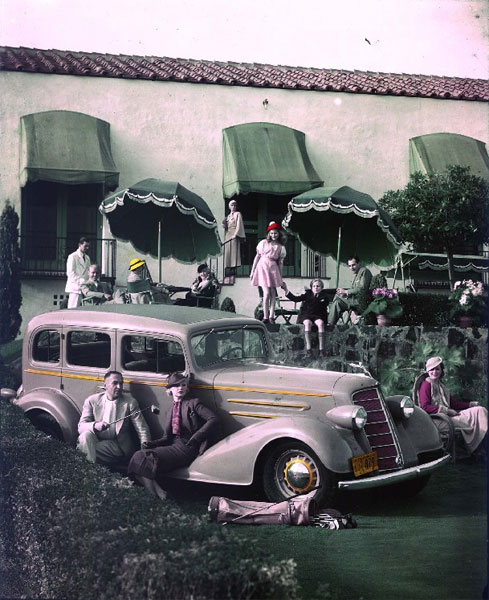
1934 Oldsmobile F-Series Six, photo by R. C. Leavenworth (courtesy Archives of Michigan)

The Archives of Michigan’s Image of the Month for May 2008 was taken by Lansing commercial photographer R.C. Leavenworth, whose Leavenworth Photography of Lansing created one of the largest collections of Oldsmobile photographs. Oldsmobile was founded in Lansing in 1897, and this year is the 100th anniversary of General Motors.

The photo is from a rare Agfacolor glass screen plate in the Leavenworth historical photograph collection. The Afgacolor process was similar to Autochrome process in which the glass plate overlays a mosaic of red, green and blue dyed resin grains. They relate that their scanner is unable to justly reproduce the color tone of these plates and they invite you to attend the upcoming exhibit: “The Picture Man: Lansing through the Lens of R. C. Leavenworth” to see the plates illuminated in person.

…Leavenworth started out photographing lumbering and mining camps in northern Michigan, using a horse-drawn darkroom. He relocated to Lansing in 1919 to document Lansing’s transformation into a major industrial city and automotive capital. For over a century, Leavenworth Photography has shot hundreds of thousands of images that tell the story of industry, business and social life in Michigan’s capital city. With subjects as diverse as street scenes, car parts, workers’ strikes, vaudeville troupes and football games, Leavenworth lived up to the slogan plastered on the door of his company car: “Anything photographed, anywhere, anytime.”

“The Picture Man” runs May 30 to September 30 in the temporary exhibit area on the first floor of the Michigan Historical Center. Admission is free. R. S. V. P. at (517) 373-1408 for the opening reception on May 29, 5pm-7pm.

You can also read Leavenworth Maintains Commercial Niche from the Greater Lansing Business Monthly (July 2003).

tough

tough

tough, photo by daveraoul.

This is the part where I’m supposed to say something so … I agree that this Ford looks totally tough.

Chromatic: Gilmore Car Museum

Chromatic

Chromatic, photo by pairadocs.

Vince made his first visit to the Gilmore Car Museum in Hickory Corners. He says that he spent so much time drooling over the pretty cars, that didn’t stop to take note of what all of them were.

It looks like that would be easy to do:

The Gilmore Car Museum began in 1963 as the hobby of Donald S. Gilmore when his wife, Genevieve, gave him an antique car for his birthday – a 1920 Pierce-Arrow “project car”. With the help of some friends, the auto was placed under a tent and a full restoration followed. The hobby soon grew into a collection of over 30 automobiles. Mr. Gilmore purchased 90 acres of farm property and had several historic barns dismantled piece by piece and moved to the site. It was Mr. Gilmore’s wife who suggested the idea of turning the collection into a museum where future generations could enjoy the restored cars for years to come…

Today, the site includes eight historic barns, a re-created 1930s service station, a small town train station, and nearly three miles of paved roads. It isn’t uncommon for guest to catch a glimpse of one of the vintage cars or the authentic London double-decker bus in motion. And if you visit on a weekend or special show, don’t be surprised if the driver asks you to hop in for a nostalgic road trip!

Today the Gilmore Car Museum houses almost 200 cars, from a 1899 Locomobile to the classic Duesenberg and Tucker ’48 and all the way up to the muscle cars of the 60s and 70s. museum is located between Grand Rapids, Kalamazoo & Battle Creek and is open daily from 9 AM – 5 PM (6 on weekends), May through October and hosts a number of great events throughout the summer and fall.

Be sure to view the above photo larger and here’s a bunch more photos from the Gilmore Car Museum on Flickr (slideshow).

MayDay!

Straight Out Of The House by SNWEB.ORG Photography

Straight Out Of The House, photo by SNWEB.ORG Photography

This photo is part of SNWEB’s Detroit Fire Department set (slideshow). He says that you can buy a print of this photo with one click but that if you are a DFD member and would like a print, please contact him directly!

I’m featuring this photo because I was tipped off (from a fan of the Michigan archives) that the Society of American Archivists recognize May 1st as MayDay. They say:

Protecting our collections is one of our fundamental responsibilities as archivists. The Heritage Health Index, released in 2005 soon after hurricanes Katrina, Rita, and Wilma struck the Gulf Coast, reported that few institutions have disaster plans and for those that do, often the plan is out of date. It’s easy to put off emergency response planning as we devote our attentions to tasks with more immediate “payback”

But on May 1 – this year and every year – you can do something that will make a difference when and if an emergency occurs. That’s the purpose of MayDay – a grassroots effort whose goal is to save our archives.

MayDay is a time when archivists and other cultural heritage professionals take personal and professional responsibility for doing something simple – something that can be accomplished in a day but that can have a significant impact on an individual’s or a repository’s ability to respond.

Reading through their recommended activities made me think that all of us could take a few minutes today to think about a preservation plan for our photos and other historical records.

quincy karma on US 12

quincy karma

quincy karma, photo by buckshot.jones.

This colorful capture is part of Scott’s A trip down historic US 12 set (slideshow). He writes:

I turned off the Interstate and took US 12 on my way back to Dearborn. Lots of small towns and rural scenes.

You can follow US 12 all the way to the Pacific ocean. In Detroit and Chicago, US 12 is known as Michigan Avenue. From the Water Tower to old Tiger Stadium, this route has lots of history.

en.wikipedia.org/wiki/US_12 (and also see the US 12 in Michigan entry!)

Here’s Quincy, Michigan and US-12 on the Absolute Michigan Map of Michigan.

Nothing more I can say except “Thanks Scott for posting these in big, beautiful, background-sized glory!”

…and have a great weekend everyone!

elegance at the Walter P. Chrysler Museum

elegance

elegance, photo by ryan.s o u t h e n.photography.

Ryan writes:

Dave was nice enough to arrange a little photo trek over to the Walter P. Chrysler Museum in Auburn Hills to take some shots of classic Chrysler cars and the museum. Larry, Mike, and Laura also came along and it was a real fun time. Cars arent really my thing and I had never shot them before so I looked at this trek as more of a challenge and opportunity to try some new things. I think I got some good shots and had a great time in the process. Not a bad way to spend a dreary Saturday.

I didnt even pay attention to what automobile this was but I loved the grill and lines and had to photograph it. Im pretty pleased with how this turned out, in fact it may be my favorite shot I took from the entire trek. If anyone happens to know what car this actually is I’d love to know.

You can check this photo out larger, on black and see more photos from Ryan at Ryan Southen Photography. Also check out this slideshow of photos from the Walter P. Chrysler Museum on Flickr

The Walter P. Chrysler Museum is located on the Chrysler Headquarters campus in Auburn Hills. Their web site has a lot of info about the history of Chrysler including this nifty Chrysler Chronology.

More posts about cars on Michigan in Pictures.