St. Johns, Michigan Bicycle Band

St. Johns, Michigan Bicycle Band

St. Johns, Michigan Bicycle Band, photo by Seeking Michigan.

I thought I’d follow up yesterday’s rant with something from the Archives of Michigan. A number of people have assured me that the Archives and Michigan’s broader arts & cultural support will remain following whatever reorganization happens. I hope so.

This photo made me think about how much more attention early photographers had to pay to lighting and composition. I can’t imagine getting this shot with the cameras they had in 1890. It was the December 2005 Image of the Month and you can read a lot more (and see another picture) there:

According to the Clinton County Republican-News Centennial Issue (published in 1956), the St. Johns Bicycle Band existed from 1886 to 1891 and usually consisted of about twenty pieces. The Republican-News Centennial Issue includes this photo of band members (pg. 6) and identified the drum player above as George Woodruff.

More at seekingmichigan.org and in the Seeking Michigan Fickriver.

A Polaroid Elegy

gull slide, photo by mfophotos

Frequent Michigan in Pictures contributor Mark O’Brien has just published A Polaroid Elegy – My Last Year With A Polaroid Camera. He writes:

This book is really about a journey into the slightly surreal world of Polaroid photography. Not everything you see looks the same after being shot with a Polaroid camera, and this book may give you a better appreciation for the wonderful invention of Edwin Land. The film used to create the photos in this book will no longer be available, hence the title.

Click through to preview and order the book. You can see many Polaroid photos Mark has taken in his Polaroids slideshow (photo set).

No Polaroids you say? Savepolaroid.com (where you can learn more about the history of Polaroid and Edwin Land’s work) notes that on February 8, 2008, Polaroid Corporation announced that it will discontinue production of all instant film. Apparently there is something called PolaPremium that will be revealed in a few days, so all may not be lost. Speculation is rampant.

Berry Branch and Bokeh

Berry Branch

Berry Branch, photo by Voxphoto.

In Bokeh: What it is and isn’t, Ross (Vox) says that although “bokeh” is the Japanese word for blurry, before this useful term degenerates into just another name for “blurry” we should take a stand to preserve its specific technical meaning:

Bokeh refers to the subjective quality of the blur. Is it “jangly” and busy-looking, or creamy and smooth? Do out-of-focus highlights have odd, distracting shapes, or are they unobtrusive circles? Does the blurred area seem to “swirl” around the center of the photo in arcs? These are some of the factors which might be mentioned as aspects of the bokeh for a particular lens. And these may be the reasons why a serious bokeh geek would chose one particular lens over a different brand with otherwise identical specs.

The word “bokeh” officially entered the English language in 1997, in an issue of the magazine Photo Techniques—whose editor Mike Johnston decided to add the final ‘h’ to make the pronunciation less ambiguous. He tells the story here, and includes some interesting photos showing different subjective effects in various blurred backgrounds.

Read the rest for more technical observations on bokeh from Ross’s excellent photography blog silverbased.org and check out this bokeh slideshow from the Absolute Michigan pool.

Lansing through the lens of R.C. Leavenworth

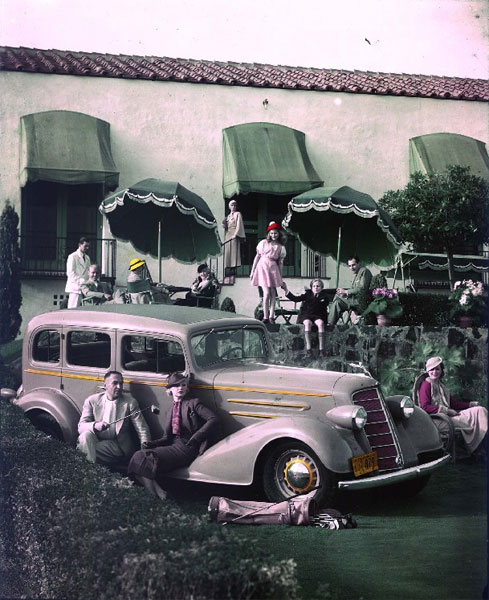
1934 Oldsmobile F-Series Six, photo by R. C. Leavenworth (courtesy Archives of Michigan)

The Archives of Michigan’s Image of the Month for May 2008 was taken by Lansing commercial photographer R.C. Leavenworth, whose Leavenworth Photography of Lansing created one of the largest collections of Oldsmobile photographs. Oldsmobile was founded in Lansing in 1897, and this year is the 100th anniversary of General Motors.

The photo is from a rare Agfacolor glass screen plate in the Leavenworth historical photograph collection. The Afgacolor process was similar to Autochrome process in which the glass plate overlays a mosaic of red, green and blue dyed resin grains. They relate that their scanner is unable to justly reproduce the color tone of these plates and they invite you to attend the upcoming exhibit: “The Picture Man: Lansing through the Lens of R. C. Leavenworth” to see the plates illuminated in person.

…Leavenworth started out photographing lumbering and mining camps in northern Michigan, using a horse-drawn darkroom. He relocated to Lansing in 1919 to document Lansing’s transformation into a major industrial city and automotive capital. For over a century, Leavenworth Photography has shot hundreds of thousands of images that tell the story of industry, business and social life in Michigan’s capital city. With subjects as diverse as street scenes, car parts, workers’ strikes, vaudeville troupes and football games, Leavenworth lived up to the slogan plastered on the door of his company car: “Anything photographed, anywhere, anytime.”

“The Picture Man” runs May 30 to September 30 in the temporary exhibit area on the first floor of the Michigan Historical Center. Admission is free. R. S. V. P. at (517) 373-1408 for the opening reception on May 29, 5pm-7pm.

You can also read Leavenworth Maintains Commercial Niche from the Greater Lansing Business Monthly (July 2003).

flame on

flame on

flame on, photo by jenny murray.

This is part of Jenny’s ttv (through the viewfinder) set (slideshow).

Hope your weekend is as exciting as this mailbox … I’m pretty sure that if you get a tattoo or paint your face like this, it will be!

Grand Rapids Camera Club seminar by Darrell Gulin

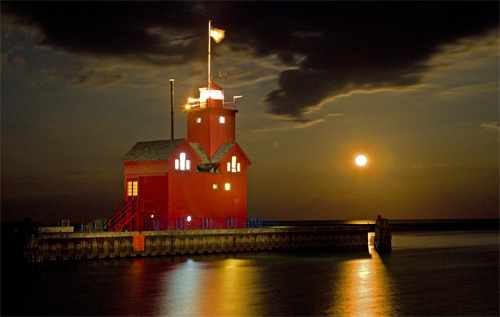
Painting the Big Red Lighthouse,photo by Darrell Gulin

Painting the Big Red Lighthouse, photo by Darrell Gulin

The Grand Rapids Camera Club and Canon is presenting a day of education and fun with Canon Explorer of Light Darrell Gulin on May 10, 2008. You can get all the details and registration information in the Grand Rapids Flickr group.

Darrell is a full time nature and travel photographer and is past President of the North American Nature Photography Association (NANPA). He makes his home in Sammamish, Washington and you can see much more of his work at his web site, gulinphoto.com. He took this photo when he was in Holland last August giving a program. They did an early morning shoot at the Big Red Lighthouse, painting it with a powerful flashlight.

From the Grand Rapids Camera Club (GRCC) web site, I learned that the GRCC is the oldest camera club in the United States (in continuous and uninterrupted existence) and was organized in 1898 as an outgrowth of the Valley City Photographic Society.

Zero Image Pinhole Camera: Bridge over Escanaba river

img090

img090, photo by Sean Depuydt.

Zero Image cameras are handmade pinhole cameras that range from 35mm format to 4×5 format. The cameras are manufactured in Hong Kong by the Zero Image Company who say:

All our cameras are made of selected high-quality teak wood. More than 15 layers of coating are applied by hand to each camera, to insure maximum protection of the wood. The metal parts are hand-turned solid brass with a coating applied to prevent them from oxidizing. The mechanism and the structure of the camera make it work like an ordinary camera, but it is capable of taking extraordinary pictures!

…All the pinholes and zone plates are installed by our camera designer Mr. Zernike Au. Every camera is checked and tested by him to ensure the highest quality.

I’m pretty sure than in addition to the 4×5 model used for this photo, Sean has the Zero Image 2000.

There’s a Zero Image group on Flickr that has a few pics from Michigan.

There just might be time to get one of these by Worldwide Pinhole Photography Day on April 27th.

eclipsed

eclipse

eclipse, photo by mfophotos.

Well, this was SUPPOSED to be a photo of the moon in honor of tonight’s total eclipse of the moon.

What can I say? I’m easily distracted.

Mark took this photo in Saline with a Diana camera and it’s just one of many in his outstanding alternative cameras set (slideshow) featuring images from Polaroids, 110 cameras, toy cameras, and Holgas.

Here are some ACTUAL Michigan photos from the lunar eclipse of February 20, 2008!

Sunlit Pine

Sunlit Pine

Sunlit Pine, photo by MSU Ben.

Ben says that this is one of the first shots he took with his Ansco folding 6×6 camera. It’s one of the photos in his Best Shots set. He’s in the Michigan State Photo Club and yes, they have a Flickr group.

Mark O’Brien has a nice ansco camera page and you can see a bunch of photos of Afga/Ansco cameras from the Camera Museum (Camera Museum main page).

stony creek, barny holga, welcome to Holgaland

2006.10.15 - stony creek - barny holga by ercy

2006.10.15 – stony creek – barny holga, photo by ercy

ercy relates that this is a cross-processed holga; scanned print with no post processing. She also says that she just loves holgas for their dreaminess and vivid color. I think you will just love her holga*land set (slideshow).

We’ve seen a number of Holga images on Michigan in Pictures, but I realize that everyone may not know just what a Holga is. Wikipedia’s entry on the Holga camera says:

The Holga is an inexpensive, medium format 120 film toy camera, originating in China, that later came to be appreciated for its low-fidelity aesthetic. The Holga’s cheap construction and simple meniscus lens often yields pictures that display vignetting, blur, light leaks, and other distortions.

If that’s making you yawn, try the Holga pages at lomography.com, where they present the history and ethic of the camera in much more exciting, detailed and illustrated fashion and explain:

The lack of options with the Holga makes it an unpredictable and very exciting camera to use. You will find yourself asking whether a shot is in focus, or correctly exposed, or whether you remembered to wind the film forward or even take the lens cap off. More importantly, you will question whether you even care! After you use the Holga for a while – if you don’t give up on it – you will become used to how it works and even adapt to how it sees, but you will never fully understand it.

You may also be interested in the Holga FAQ, Squarefrog Holga and the Holga gallery at holga.net (all three of these have Holga purchasing info).

Michigan Fall Wallpaper series