Detroit’s Michigan Central Station

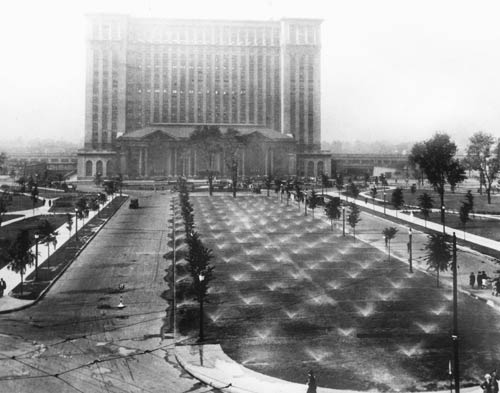
Michigan Central Station, 1921

The introduction to Detroit’s Michigan Central Station says the Michigan Central Station was designed by Warren & Wetmore and Reed & Stem, the firms who were the architects of New York’s Grand Central Station. It opened in 1913, and by the time this 1921 photograph (above) was taken, the Beaux Art ideal had been reached. The unique road configuration leading up to the Michigan Central, as well as the fine ambiance Roosevelt Park contributed to the scene, reveals itself to be absolutely necessary to complete the designers’ vision. (Courtesy of Manning Brothers Historical Photographic Collection)
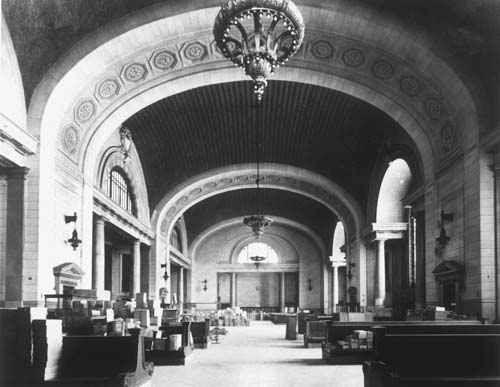
Michigan Central Station waiting room

By 1967 the main waiting room (right, click for larger view) was closed to travelers and used merely for storage; it is difficult to conceive of these splendid benches being relegated to use as a mere shelving system. Hanging on by a thread, the Michigan Central continued to operate without its restaurant or even the main park entrance. (Dave Jordano, Courtesy of the Burton Historical Collection)

In case you’re wondering, here’s a photo of the waiting room in its current state and here’s another.

The photos and captions are reprinted with permission from Detroit’s Michigan Central Station by Kelli B Kavanaugh. In addition to some history on Michigan Central Station and great old photos of the station and activity, the book includes some floorplans of MCS. It’s available from the publisher online at www.arcadiapublishing.com or by calling 888-313-2665.

View other excerpts from Arcadia Publishing’s Michigan books at Michigan in Pictures and also be sure to check out MCS 7.2.7: Transformers co-star Michigan Central Station on Absolute Michigan for more photos and some great videos too!!

Soo Locks Celebration, 1905 right up to tomorrow

Soo Locks Celebration - 1905

Soo Locks Celebration – 1905, photo by Detroit Publishing Co.

The fantastic American Memory feature of the the US Library of Congress had this picture titled Reviewing stand, Saint Marys [sic] Canal celebration. It was taken in 1905, the very first year of a celebration that continues today: the annual Soo Locks Celebration (also known as Engineer’s Day). It’s held every year on the last Friday of June between 10 AM and 4 PM. For those following along, that’s tomorrow, July 29, 2007.

You can click for a whole gallery of shots from the Soo Locks – Sault Ste. Marie Canal on the St Mary’s River from American Memory, see some photos of the Soo Locks and past celebrations from Joel Dinda and tune into the locks via the Soo Locks SkyCam.

Striking a 50s pose

Untitled, photo by ici et ailleurs.


Ghost Forest, Sleeping Bear Point

Ghost Forest, Sleeping Bear Point
, photo by Matt Callow.

Matt writes All over the Sleeping Bear Dunes are the remains of trees killed by the constantly shifting sands, often clustered together in eerie stands of ghost forest.

Matt recently spent two weeks in an artist residency for the Glen Arbor Art Association. He also has placed this photo on a map. The Sleeping Bear Dunes National Lakeshore says that the trees in these ghost forests were killed hundreds of years ago by the moving dunes and that:

After an initial phase of active sand accumulation, a period of stability followed when trees began to grow on the dune. Later, more sand moved in and buried the trees. Two layers of buried soil within the dune indicate that there was a second period of stability and growth followed by another period of sand build-up and then the final growth of the trees and shrubs that now cover the sheltered portions of the dunes.

More in the Sleeping Bear Dunes Geology auto-tour.

urban playgrounds & vanishing acts

bike

bike, photo by vanessamiller.

About a month ago Vanessa was interviewed by Michigan Radio’s Jennifer Guerra about her Ruins of Detroit urban explorations project. Vanessa says:

The Detroit ruins project has been in progress in some form or another for six years. During that time we have seen Detroit grow and change. It started in High school when we treated the city’s abandoned buildings as playgrounds. We were a group of photographers that spent every day shooting. In college, some people move out of state, some just moved on, but we stayed, we kept coming back to the same places and began documenting their changes over time. We saw our favorite buildings burn to the ground and found new ones along the way. Each building has its own mysteries, that we tried to solve and its own beauty.

Check out more photos from Vanessa and others of the Detroit that just isn’t there anymore in her photostream and in the Vanished Detroit group on Flickr.

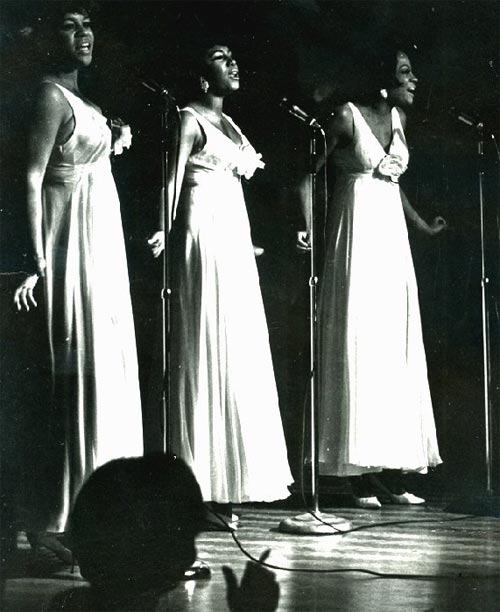
The Supremes at the Roostertail in Motown

The Supremes at the Roostertail in Detroit

The Supremes at the Roostertail, Detroit 1966, Archives of Michigan

Every month the Archives of Michigan post their Image of the Month. This month it’s the Supremes:

Where Did Our Love Go? (1964)As the most successful female singing group of all time, the Supremes are well known – not only for their music, but also their rise to stardom. Starting out in “the Projects” of Detroit, the group rose to become the most popular female group of the 1960’s. The recent film Dreamgirls, based loosely on their story, shows that Americans’ fascination with this successful African American singing trio has not waned.

The Supremes started as a quartet called “The Primettes” in 1959. After hearing the girls sing, the manager of the locally popular male group, “The Primes” (the future Temptations) decided to start a sister group. They were signed to Motown records in 1961. Soon after, the fourth member left the group, leaving the trio of Florence Ballard, Diana Ross, and Mary Wilson. In their negotiations with Berry Gordy, manager of Motown Records, they changed their name to “The Supremes.” Gordy decided to make Diana Ross the sole lead singer, a role the three had previously shared.

Read the rest of the article and see a larger photo of the Supremes at the Roostertail at the Archives of Michigan, explore The Supremes at Wikipedia, (and Billy’s Supremes web site),  check out the Roostertail’s history page and then turn up your speakers and click over to the Motown Historical Museum for more on the Supremes and other Motown greats.

And then – if you’re still looking for an “and then” – YouTube has The Supremes At Hollywood Palace “Stop In The Name Of Love”Baby Love on Top of the Pops and a whole lot more videos.

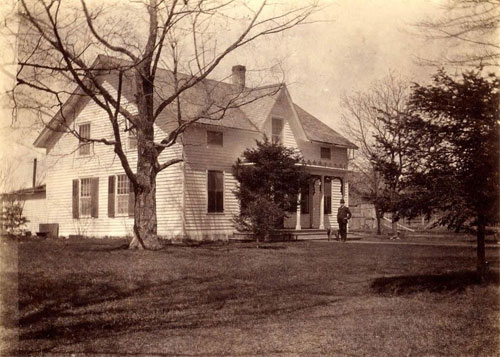
Rev. Peter Dougherty House on Old Mission having one heck of a yard sale

Reverend Peter Dougherty House, Old Mission Peninsula

The Dougherty House, Old Mission Peninsula Historical Society

Memorial Day Weekend is the start of many things in Michigan: summer, countdown till school is out, and the yard/garage sale season. On the Old Mission Peninsula just outside of Traverse City, there will be an amazing one at the house of one of the area’s first white settlers, Rev. Peter Dougherty. Once Upon a Time in Old Mission by Walter Johnson explains:

The earliest picture we have of Old Mission comes from the diaries and letters of Rev. Peter Dougherty, a missionary sent here by the Presbyterian Board of Missions in 1838. The Indians here and at settlements along the Lake Michigan shore were Ottawas. There were gardens on the Peninsula, maple trees scarred from sugaring, indicating centuries of human occupancy, and a village at Old Mission. They lived in permanent dwellings built of cedar poles and bark and also wigwams made of evergreen boughs. None of the dwellings had windows, and all of them allowed smoke to escape through a hole in the roof. Chief Ahgosa’s shanty was a little south of Prescott Lake.

According to the terms of the Treaty of 1836, the government was to provide the Indians with missions and schools and Indian reservations. The site of Mission Harbor was personally selected by Henry Schoolcraft between the present School Road and Swaney Road.

Having spent the winter on Mackinac Island, Mr. Dougherty arrived at Mission Harbor near the present Haserot Beach in May, 1839 in a Mackinaw boat. Arrangements were made for opening a school, and Mr. Dougherty’s house was finished before fall, built with logs cut near the border of the harbor and covered with shingles and boards brought from Mackinac. The house was on the shore directly east of the present larger Dougherty house. The second house was the first frame house built in Grand Traverse County, later owned by the Rushmores and used as an inn. In the fall of 1841 there was a schoolhouse and four dwellings. The schoolhouse was used for religious services until the mission house could be built.

Today and Saturday, The Peter Dougherty Society is holding an estate sale to benefit the restoration of the 1842 Dougherty House (article in the Traverse City Record-Eagle). Plans call for an archeological survey of the property, renovation of the house and to open it to the public with  exhibits and tours that will explain its place in the history of not only Grand Traverse, but also as part of the westward expansion of the country in the mid- nineteenth century. While the most historically significant artifacts are being saved for when the house is restored, it sounds as if there are thousands of artifacts spanning over 150 years.

If you’re in the area this weekend, you might want to check this out, and you can also read A Short History of the Dougherty House from the Old Mission Peninsula Historical Society.

underground at the detroit electronic music festival

underground by puja

underground, photo by puja

2002 detroit electronic music festival at hart plaza … Movement 07: The Detroit Electronic Music Festival is next weekend.

Holland, by rail and sail

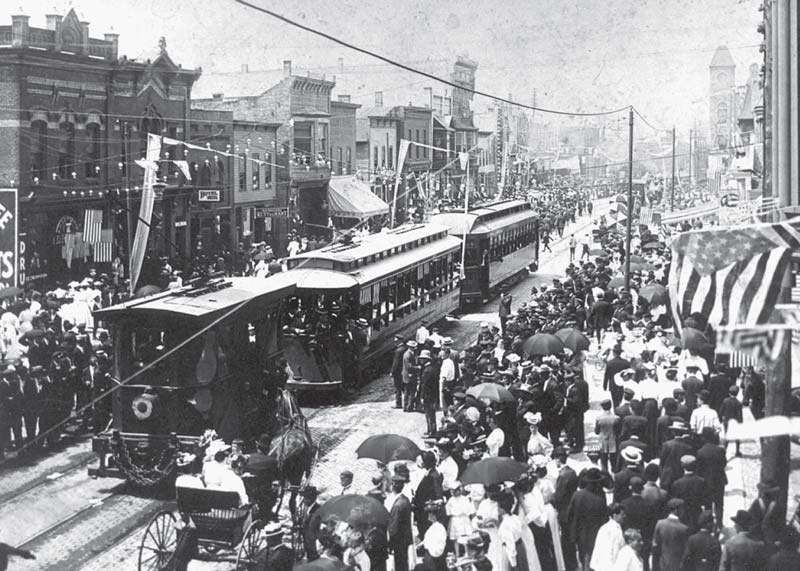
Interurban electric railroad on the Holland and Lake Michigan Railway

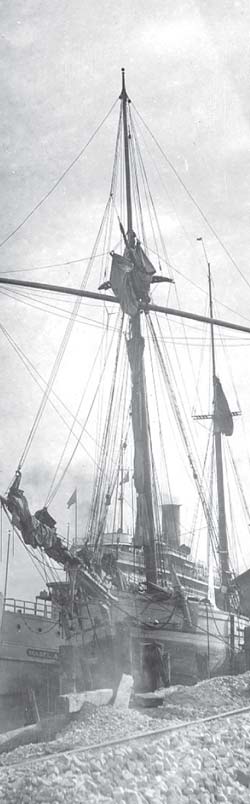
Mabe Bradshaw, the first passenger ship

On July 4, 1898, the first Interurban electric railroad car to carry passengers arrived in Holland. The first rails in Holland had been laid by the Holland and Lake Michigan Railway at River (Avenue) and Eighth Street. These cars are on the track a half-block east of there. More than 100 men and 17 teams of horses constructed the line. The payroll for construction workers was $1,000 weekly. The trains ran from Grand Rapids through Grandville, Jenison, Shack Huddle, Jamestown, Forest Grove, Vriesland, Zeeland, Holland, Jenison Park, Macatawa Park, and Saugatuck. The Interurban freight office was on Eighth Street near Pine Avenue. The passenger train continued south on River and turned west on 13th Street. The line continued near South Shore Drive, stopping near Sunnybrook Station at Virginia Park. Extending south near 160th Street, the train headed to Castle Park and Saugatuck. The train met its demise November 15, 1926.

The first time a passenger ship connected Holland directly with Chicago, via Lake Michigan, was July 4, 1889, when the Mabel Bradshaw docked at the foot of Fifth Street at the old Harrington Dock. That first year the ship made four trips a week, leaving Holland on Sunday, Monday, Wednesday, and Friday evenings, after the arrival of trains at 6:35 p.m. The fare was $2 one way or $3.50 round trip. Owner Hugh Bradshaw named the ship after his daughter Mabel. She was to christen the ship with a bottle of champagne. As she reached for the bow, the bottle slipped from her hand and fell into the water, leaving the ship unchristened. The ship was used for a ferrying service a few years later and spent its last years on Lake Superior.

Be sure to click the photos for a larger view!!

Photos reprinted with permission from Holland: The Tulip Town by Randall P. Vande Water. Available from the publisher online at www.arcadiapublishing.com or by calling 888-313-2665.

View other excerpts from Arcadia Publishing’s Michigan books at Michigan in Pictures!

Baskets of morels at the Boyne City Mushroom Festival

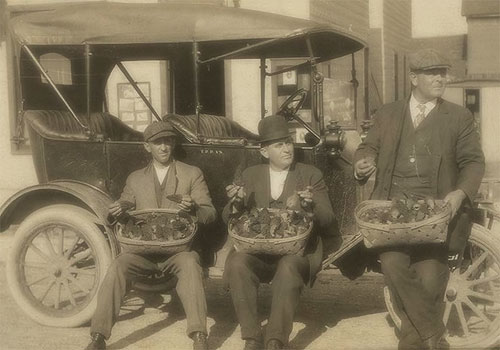
Boyne City Mushroom Festival

This photo was provided by the Boyne City Morel Mushroom Festival. You can get a ton more information about the National Mushroom Festival and Michigan morel mushrooms today on Absolute Michigan.