

Detroit, photo by Bill Schwab.
Settle back and enjoy Bill’s Made in Detroit slideshow.

Rodin’s Thinker, Detroit Institute of Art, photo by Robert Yanal.
The Detroit Institute of Arts has a collection of over 60,000 works of art across a wide range of media. One of the most visible is their cast of sculptor August Rodin’s iconic sculpture, The Thinker. More than twenty monumental size bronze casts of the sculpture are in museums around the world. Rodin made the first small plaster version around 1880, but the first large-scale bronze cast was not completed until 1902.
The DIA’s version sits outside the museum’s main entrance. It was cast in 1904 and donated to the museum by Horace H. Rackham in 1922. The bronze sculpture weighs about 2000 pounds and sits on a 12,000 pound granite base. You can see more views of The Thinker at the DIA.
Check this out bigger and in Robert’s Detroit slideshow.

The Belle Isle Bridge | Detroit, MI, photo by .brianday..
Wikipedia notes that the official name of the bridge across the Detroit River to Belle Isle from Detroit is the MacArthur Bridge. The bridge uses nineteen arches to span the 2,193 feet to Belle Isle. Completed in 1923 for $2,635,000, it replaced a mostly wooden bridge that was destroyed by fire in 1915. See The day the bridge to Belle Isle burned down for more on that. While it was once known as the Belle Isle Bridge, was renamed in honor of General Douglas MacArthur in 1942.
Belle Isle Bridge “Douglas MacArthur Bridge” at HistoricBridges.org explains:
This is an extremely long multi-span concrete arch bridge that gives people access to Belle Isle, and the structure is the longest arch bridge in the state of Michigan.
This bridge is extremely significant not only because of its length, but because it is a very early example of a cantilevered concrete arch. A cantilevered concrete arch does not function like a traditional arch. Traditional arch bridges require the arch to be a complete and connected arch to function. This arch bridge does not function in that way. Each half of each arch spans is a cantilever arm that is structurally independent from the other half of the arch in that span. Standing under a span of this bridge, a clear gap at the center of the span is visible. Indeed, on the outermost part of the arch, a decorative “keystone” was placed for aesthetic reasons to cover up this gap.
Wayne County Road Commission was among Michigan’s counties, an innovative and creative road commission and they apparently made significant use of concrete cantilever arch structures. Other examples of concrete cantilever bridges in the county remain. These other examples are different from the Belle Isle Bridge, and feature a third central “suspended” span between the cantilever arms.
Check it out bigger and in Brian’s Long Exposure slideshow.

Death and Dying, photo by SCOTTS WORLD.
Scott writes:
An urban school abandoned and falling apart. Someone else had placed this book here, but I thought it made a great shot, both on its own and as a symbol of the death of this once great place.
Check it out background big and see more shots from schools that didn’t make it in Scott’s Schools slideshow.
More Black & White photography on Michigan in Pictures.

Churning, photo by Jeff Gaydash.
For those of you who are looking for another photo every week, I encourage you to check out Photo Fridays on Absolute Michigan. Almost every week, we feature the work of one of the great photographers in our Absolute Michigan pool on Flickr, along with some of their thoughts about photography and the state of Michigan.
We started in 2006 and have posted almost 200 Photo Fridays. With 2805 photographers as of today in the group, we’ll be done in 53 years!
Definitely view Jeff’s photo from Port Sanilac bigger and check out his sets including Piezography Prints, The Great Lakes, Architektura and Explored! (slideshow).

Yashica: Ford Lake, photo by Matt Callow.
The details: Yashica Mat 124G, expired Tmax 100.
View it bigger, see more of Matt’s shots from Ford Lake or dive into his slideshow.

Untitled, photo by jenny murray.
The Thoreson Farm page at the Sleeping Bear Dunes National Lakeshore says that the
John Thoreson and Ingeborg Sakariasdatte emigrated from Norway in 1877. Although they crossed the Atlantic on the same boat, family lore has it that they never really met on the boat. Ingeborg resided with the higher-priced ticket-holders, while John remained below deck with the lower-fare travelers. They first settled in Suttons Bay, and arrived in Port Oneida in 1880. The family initially rented the Kelderhouse/Baker farm until 1883, when they moved to Minnesota for one year. After returning to Port Oneida, they rented the old Burfiend house. Around 1900, along with their sons Ole and Fred, they built their farm on 160 acres of land purchased from the Andersons…
The Thoresons operated a general farm with livestock, small grains, and hay. With 75 trees, they were the first Port Oneida farm to raise cherries for market. They also owned sheep, pigs, chickens, and a few dairy cattle.
You can see some more photos of the farm (including a volunteer working on these buildings) at Preserve Historic Sleeping Bear.
Check this out bigger and in Jenny’s Holga slideshow.

Greater Buffalo, photo by joeldinda.
Joel’s Borucki’s Lakers set features photos some great old photos along with history of the vessels. He uploaded one the other day of the steamer Greater Buffalo heading toward Lake Erie on the Detroit River that was taken in August 4, 1939. On another photo of the Greater Buffalo he writes that this photo is easily the most interesting ship in the Borucki picture collection and says:
Greater Buffalo, shown here passing under the Ambassador Bridge, was launched at Lorain on October 27, 1923, for the Detroit and Cleveland Navigation Company, and made her first trip on May 13, 1925. She could carry 300 crew members and 1,200 passengers between Buffalo and Detroit on an overnight basis. Her sister ship Greater Detroit alternated on the run with her. These two Frank Kirby-designed ships were the last, largest, and (perhaps) fastest sidewheel passenger ships built on the lakes; when they were launched their construction costs were reported as $3.5 million apiece.
Greater Buffalo was requisitioned by the Navy in 1942, converted to an aircraft carrier and renamed USS Sable; she and USS Wolverine (the former Seeandbee–another Kirby design, and the other “fastest” claimant) worked as training ships out of Great Lakes Naval Station near Chicago. She was retired after the war and broken up in 1948.
There’s a couple more photos of the Greater Buffalo/U.S.S. Sable in the UD Mercy Marine Historical Collection.
Check it out big as a battleship and in Joel’s Borucki’s Lakers slideshow.
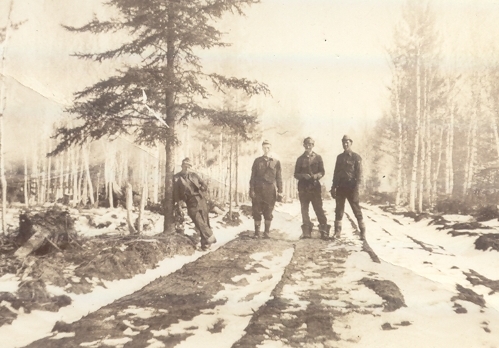
Road building by CCC men of Camp Cusino, photo courtesy Archives of Michigan
Read the story behind this photo and see a video of 94 year old Ernest Hubacker’s story of his time with the Civilian Conservation Corps at Seeking Michigan: Cold Conservation Corps. Check out a lot more features and Michigan history at seekingmichigan.org!

I have a dream this afternoon that my four little children, that my four little children will not come up in the same young days that I came up within, but they will be judged on the basis of the content of their character, not the color of their skin.
I have a dream this afternoon that one day right here in Detroit, Negroes will be able to buy a house or rent a house anywhere that their money will carry them and they will be able to get a job.
~Martin Luther King, June 23, 1963 Detroit, Michigan
The quotation above comes not from Dr. Martin Luther King’s famous speech, but rather from the massive March to Freedom that happened 2 months earlier in Detroit. You can read the full text at mlkonline.com or it that’s overloaded still, view the cached version. A few years ago on Absolute Michigan, we featured an article on the Walk to Freedom:
On June 23, 1963, an estimated 125,000 people marched down Detroit’s Woodward Avenue carrying placards and singing “We Shall Overcome.” National and state leaders who marched along with Reverend King included United Auto Workers president Walter Reuther, former Michigan governor John B. Swainson, and Detroit mayor Jerome Cavanagh.
The march ended at Cobo Hall where the Reverend King was cheered by thousands of marchers when he emphasized that segregation needed to end. A veteran of the struggle to end racial segregation, King believed that it was the duty of African Americans to take part in demonstrations like the Walk to Freedom, which he called, “one of the most wonderful things that has happened in America.”
There’s a few pictures of the march at the Detroit News including this shot of the crowd on Woodward Ave from above (sorry – no direct link scroll down and look for it).
 Michigan in Pictures
