Lumber Day in Saginaw … make that Chesaning!

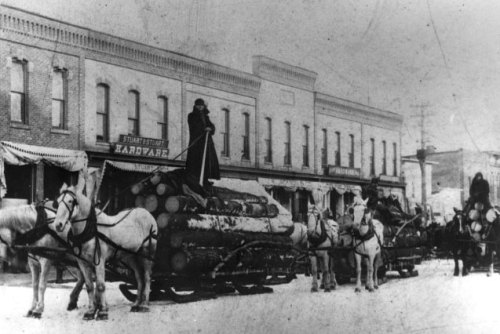
(Apr 27, 2015) Brett Russell shares: Not to correct your article, but I actually believe the bottom black and white photo was taken in Chesaning, MI. The building in the background looks like the Nason Block, which still stands today. The building far left where the brick color changes I believe to be the Chesaning State Bank. This photo would have been taken on Broad St. just before the intersection of Saginaw St.

Saginaw – Winter street scene, photographer unknown

This black and white photo shows winter carts loaded with lumber on an unidentified street in Saginaw. It’s from Seeking Michigan .

Ishpeming’s Suicide Hill

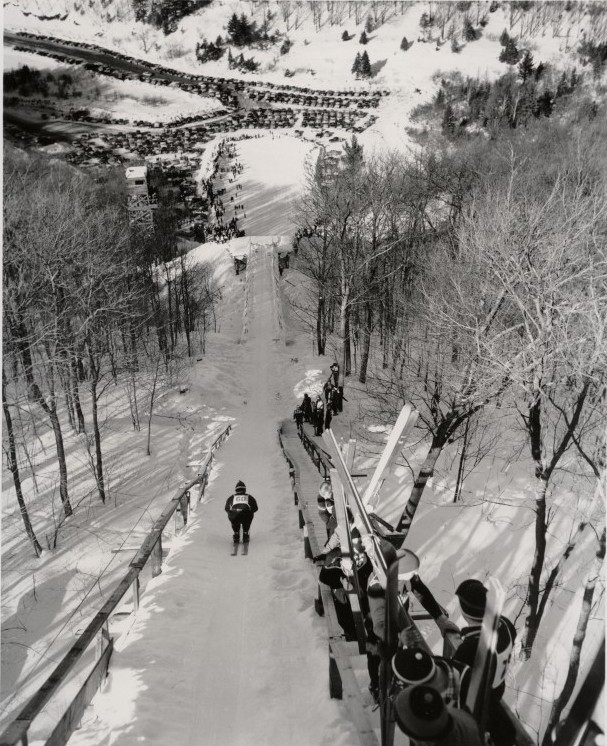
A skier glides down Suicide Hill, circa 1959, photo by Michigan Tourist Council

On Absolute Michigan we regularly feature articles & photos from the Archives of Michigan and their great web site Seeking Michigan. When Bob Garrett posted this feature, however, I knew that I couldn’t let Absolute Michigan have all the fun! 

Suicide Hill by Bob Garrett

Suicide Hill’s very name intimidates skiers. The Ishpeming Ski Club, however, describes it as “fine, competitive and safe” (See the Ishpeming Ski Club Web Site). Ski jump enthusiasts hold the hill – and its rich history – in high esteem.

In the Beginning

The Norden Ski Club – renamed the Ishpeming Ski Club in 1901 – held its first formal ski jump competition in 1888. The competition site was south of Lake Angeline, near Ishpeming, Michigan. An annual tradition did not immediately follow. The Club did, however, host competitions in some subsequent years. Various hills in the Ishpeming region served as competition sites.

In 1925, the Ishpeming Ski Club launched a search for a new hill. Peter Handberg and Leonard Flaa, then officers of the Club, found what would be called Suicide Hill. The Hill is located off what is now M-28, between Ishpeming and Negaunee. The Cleveland Cliffs mining company owned the land, and a lease was quickly negotiated.

In the autumn of 1925, development work began on the hill. It proved a community effort. Local citizens donated materials and volunteered their labor. The hill was cleared, graded and shaped. Finally, the Ishpeming Ski Club announced the first competition on the hill. This occurred on February 26, 1926.

“A Little Color”

Ted Butler, a local newspaper reporter, apparently gave the hill its nickname. An Ishpeming skier named Walter “Huns” Anderson was injured a few days before the 1926 meet. Butler wrote about this, using the phrase “Suicide Hill” in his story. “Sure, it’s a good hill, but why not add a little color to it?,” he reportedly said. James Flaa of the Ishpeming Ski Club protested the name, claiming that it created a bad impression and kept skiers away.

Today, eighty-six years later, skiers are still coming to Suicide Hill. They come from many countries and gather for the annual competitions, traditionally held in February.

The annual Suicide Hill Ski Tournament will be held next on February 8, 2012. Suicide Hill waits quietly for the day, ready to challenge a new wave of daring skiers.

Editor’s note: we found a great video of a jump at Suicide Hill and another from the point of view of the jumper

Sources

“Flying into the Future” by Jane Nordberg. Michigan History Magazine, March/April 2002, pp. 6-11.

Ishpeming Ski Club Web Site

For a related article, click Ishpeming winter events

Toe to Toe in the January Snow

Toe to Toe

Toe to Toe, photo by Elizabeth Glass.

“January brings the snow, makes our feet and fingers glow.”

~Sara Coleridge

January is upon us and – for the northern part of the state at least – that means snow! It also means that many of the events on our Michigan January event calendar on Absolute Michigan are focused on celebrating all that snow Michigan gets! From ice skating all month at Campus Martius in Detroit to racing with sled dogs in Newberry to Michigan’s largest ice sculpture display in Plymouth, you’ll find plenty to do all over the state. There’s also wine tours, autos shows and much more. Click through for all the details!

Check this shot from the Boyne City waterfront out bigger and in Elizabeth’s great ice slideshow.

Much more snow and winter photos from Michigan in Pictures!

Michigan in Pictures turns six

NC0B8495-Edit-Edit-2-1

NC0B8495-Edit-Edit-2-1, photo by [DennisT].

On December 30, 2005 Michigan in Pictures posted its first photo, a pond on Bald Mountain. 1881 posts later, Michigan in Pictures is still one of the highlights of my day.

I simply love this blog. The experience of looking through the photos shared in the Absolute Michigan pool and learning about Michigan’s waterfalls and lighthouses, points of interest like the Eben Ice Caves or Big Boy Graveyard, and everything from the history of our state to the mysteries of the northern lights is one of the most enriching and rewarding pursuits in my life.

Thanks for sharing it with me.

Dennis took this shot in Saugatuck. See it background bigtacular or in his slideshow.

Much more Michigan wallpaper can be found on Michigan in Pictures!

The Hiawatha National Forest

Hiawatha National Forest

Hiawatha National Forest, photo by Sean Depuydt.

Ever thicker, thicker, thicker
Froze the ice on lake and river,
Ever deeper, deeper, deeper
Fell the snow o’er all the landscape,
Fell the covering snow, and drifted
Through the forest, round the village.
~Henry Wadsworth Longfellow
The Song of Hiawatha

The Hiawatha National Forest in the Upper Peninsula is known as “the Great Lakes National Forest” because nearly 1 million acre forest touches three Great Lakes: Superior, Huron and Michigan.

The landscape of sandstone and limestone includes the watersheds of the three Great Lakes, five National Wild & Scenic Rivers – the Carp, Indian, Sturgeon, Tahquamenon, and Whitefish.

Northern hardwood and mixed forest types are common on the Hiawatha National Forest. Tree species include sugar maple, red maple, American Beech, white pine, red pine, northern white cedar, eastern larch/tamarack, and balsam fir. Jackpine savannahs are also common in some areas. Much of the Hiawatha is covered in wetlands, and as a result there are many wetland plants.

Spring wildflowers bloom in May and June.
The Forest contains habitat for northwoods species like whitetail deer, gray wolf, and lynx. Kirtland’s warbler, an endangered species, relies on young jackpine stands for its nesting grounds, and piping plover nest along our pebbly Great Lakes beaches. Trout are native to coldwater streams, and our inland lakes support strong, diverse fisheries

In short, a wonderful place. Here’s hoping you get a chance to have fun as the covering snow piles deeper this winter.

Check the photo out on black and in Sean’s Upper Michigan slideshow.

The Perfect Christmas Tree (some assembly required)

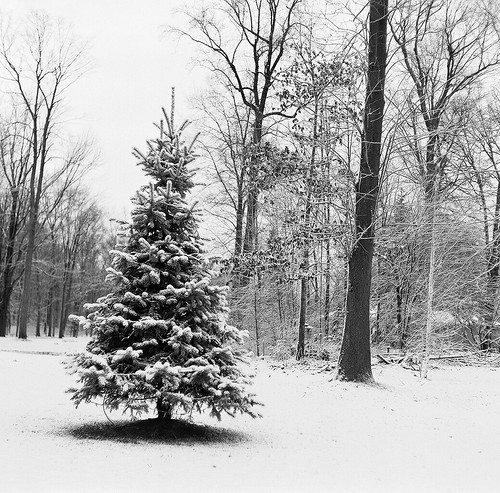
Roll 1 FILM Snowy Pine SOOC

Roll 1 FILM Snowy Pine SOOC, photo by Carolyn Gallo

The History of Christmas Trees from the History Channel notes that ancient peoples hung evergreen boughs over their doors and windows, many in the belief that evergreens would keep away witches, ghosts, evil spirits, and illness. A popular belief is that Martin Luther was walking one winter evening, and was overcome by the brilliance of stars twinkling amidst evergreens. To recapture the scene for his family, he erected a tree in the main room and wired its branches with lighted candles.

They note that as as late as the 1840s Christmas trees were seen as pagan symbols and not accepted by most Americans:

It is not surprising that, like many other festive Christmas customs, the tree was adopted so late in America. To the New England Puritans, Christmas was sacred. The pilgrims’s second governor, William Bradford, wrote that he tried hard to stamp out “pagan mockery” of the observance, penalizing any frivolity. The influential Oliver Cromwell preached against “the heathen traditions” of Christmas carols, decorated trees, and any joyful expression that desecrated “that sacred event.” In 1659, the General Court of Massachusetts enacted a law making any observance of December 25 (other than a church service) a penal offense; people were fined for hanging decorations. That stern solemnity continued until the 19th century, when the influx of German and Irish immigrants undermined the Puritan legacy.

…By the 1890s Christmas ornaments were arriving from Germany and Christmas tree popularity was on the rise around the U.S. It was noted that Europeans used small trees about four feet in height, while Americans liked their Christmas trees to reach from floor to ceiling.

The early 20th century saw Americans decorating their trees mainly with homemade ornaments, while the German-American sect continued to use apples, nuts, and marzipan cookies. Popcorn joined in after being dyed bright colors and interlaced with berries and nuts. Electricity brought about Christmas lights, making it possible for Christmas trees to glow for days on end. With this, Christmas trees began to appear in town squares across the country and having a Christmas tree in the home became an American tradition.

See this gorgeous tree on black and in Carolyn’s snow slideshow.

Chesaning and the Chesaning Rock

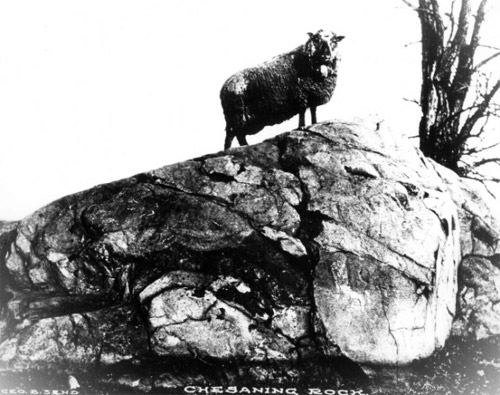
Chesaning Rock, photo by George B. Send (Courtesy Seeking Michigan)

The Wikipedia page for Chesaning, Michigan says that:

The first mention of Chesaning in the written pages of history is the Saginaw Treaty, signed in 1819. This treaty was between members of the Saginaw Tribe, Chippewa Indians and the government of the United States. They established a number of reservations, including 10,000 acres (40 km2) along the banks of the Shiawassee River known as “Big Rock Reserve.” Chesaning is a Chippewa word meaning “big rock place”. The treaty continued in effect until 1837 when a second treaty led to the reserve being surveyed and offered for sale in 1841. The first land was sold at $5 per acre to brothers Wellington and George W. Chapman, and Rufus Mason. After making their land purchase, they traveled back to Massachusetts and moved their families to their new wilderness home by late summer of 1842.

During the months they had been away from their land, several settlers had moved into the area, building a dam and a sawmill. A few years later, a grinding mill was added. The new settlers named their community “Northampton” in honor of the home they had left in Massachusetts. In 1853, the legislature changed the name to Chesaning, the traditional name for the village and township. The first township elections, held in 1847, are considered to be the official birthday of the community.

The Chesaning Historical Society has some more old photos of Chesaning, and Michigan GenWeb has a lot more Chesaning history.

I found this photo from the early 1900s at Seeking Michigan when I was looking for a photo for a feature on Saginaw’s coal mines. I think you’re agree it was simply too awesome not to share. ;)

They explain that The rock was one of the features of the area since Chesaning was settled. Located in woods to the east of Chesaning, the large rock inspired the name of the area. See it bigger at Seeking Michigan and check out more funny photos on Michigan in Pictures.

Hasselblad: White Fish Falls

White Fish Falls

White Fish Falls, photo by Sean Depuydt.

I think these are the lower falls on the Laughing Whitefish River in the U.P. Read more about Laughing Whitefish Falls from Michigan in Pictures.

Check this out on black and in Sean’s gorgeous Hasselblad slideshow.

More black & white photography on Michigan in Pictures.

Central Lake, Then & Now

Central Lake Then and Now [Explored]

Central Lake Then and Now [Explored], photo by Beccah79

Beccah took this shot of downtown Central Lake, and says the B&W version shows the town as her grandpa would have seen it when he came downtown to do his shopping.

Be sure to check it out bigger and see more in her Flickriver.

Pere Marquette Beach, Muskegon

Pere Marquette 4

Pere Marquette 4, photo by kmoyerus.

Here’s one of a fantastic series of black & white photos from Pere Marquette Beach in Muskegon taken after it had been swept smooth by the surf.

In 2011, Pere Marquette Beach was named one of the nation’s Blue Wave Beaches by the Clean Beach Coalition along with Esch Beach & South Manitou Island in the Sleeping Bear Dunes National Lakeshore and Sand Point Beach in Pictured Rocks National Lakeshore. Of course there’s no doubt that Michigan has miles and miles more pristine beaches, but this is still something to shout about.

Check it out background big, in kmoyerus’ peremarquette slideshow or on their map.

More great beaches on Michigan in Pictures.