Cruisin’ the Original: Woodward Avenue

Cruising Woodward Avenue in Detroit Michigan

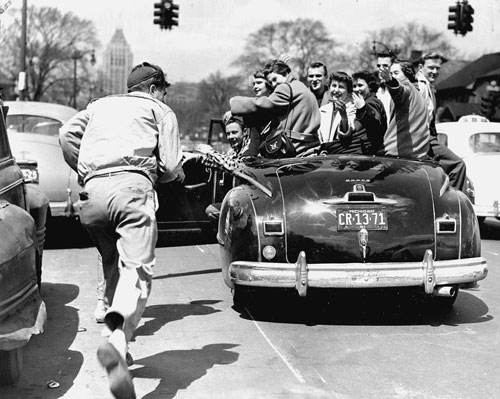
Cruising Woodward, 1951 (above) …the seriousness of the times (1950s) did not dampen a growing love of cars and the freedom experienced by driving them. These young Detroiters found their cars especially useful during the longest transportation strike in the city’s history. In April 1951, the folks here piled into a car not far from the Fisher Building, in the distance, which is across from the General Motors Building in Detroit’s New Center area. After the strike, Detroit mayor Albert Cobo urged the city council to sell Detroit’s streetcars to a willing buyer, Mexico City, for $1 million. The streetcars remained in service there until the 1980s. Detroit soon dismantled its trolley tracks, and only buses ran after that. Cars became the city’s major means of transportation.

Cruisin’ the Original: Woodward Avenue by Anthony Ambrogio and Sharon Luckerman begins: In the 1950s, cruising swept the nation. American streets became impromptu racetracks as soon as the police turned their backs. Young people piled into friends’ cars and cruised their main streets with a new sense of freedom. The Totem Pole on Detroit’s Woodward AvePent-up desires after the hardships of World War II plus a booming economy fueled a car-buying frenzy. To lure buyers to their particular makes and models, automobile companies targeted the youth market by focusing on design and performance. No place was that more relevant than on metro Detroit’s Woodward Avenue, the city’s number-one cruising destination and home of the world’s automobile industry. Barely 50 years earlier, Henry Ford rolled his first Model T off the assembly line at Piquette and Woodward, just south of where cruisers, dragsters, and automobile engineers ignited each other’s excitement over cars. This unique relationship extended into the muscle car era of the 1960s, as Woodward Avenue continued to reflect the triumphs and downturns of the industry that made Detroit known throughout the world.
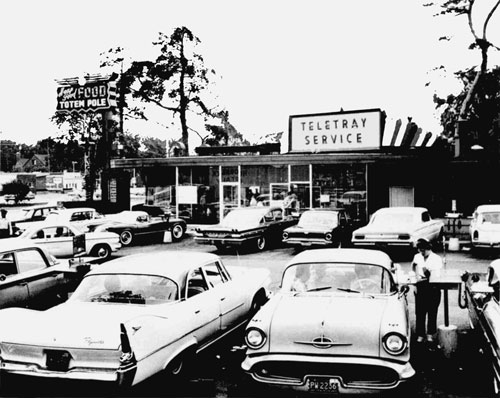
The Totem Pole (right) was the cruisers’ unofficial starting point on Woodward Avenue at Lafayette Street, kitty-corner from the zoo. This 1957 photograph demonstrates the “proper” way cruisers parked—to see and be seen, backed in, like the finned Plymouth in the lower-left corner. (click photo for larger view!)

Funded in part by a grant from the Federal Highway Administration’s National Scenic Byway program and with guidance from the Woodward Heritage Team, Detroit writers Anthony Ambrogio and Sharon Luckerman interviewed numerous local historians, automobile engineers, automobile museum directors, and Detroiters who cruised during these extraordinary decades.

The Images of America series celebrates the history of neighborhoods, towns, and cities across the country. Using archival photographs, each title presents the distinctive stories from the past that shape the character of the community today. Arcadia is proud to play a part in the preservation of local heritage, making history available to all.

Cruisin’ the Original: Woodward Avenue is available from the publisher online at www.arcadiapublishing.com or by calling 888-313-2665.

View other excerpts from Arcadia Publishing’s Michigan books at Michigan in Pictures!

Here’s an action-packed feature on the Woodward Dream Cruise from Absolute Michigan!

Kalamazoo, Michigan

Looking Down, Kalamazoo, MI by chicalookate

Looking Down, photo by chicalookate

After spending an hour yesterday afternoon exploring Kalamazoo video for our Absolute Michigan station on chime.tv, I decided to check out the slideshow of 10,000+ photos tagged “kalamazoo” on Flickr. After spending entirely too long with some really amazing photos and photographers, I have the following to report:

Holland, by rail and sail

Interurban electric railroad on the Holland and Lake Michigan Railway

Mabe Bradshaw, the first passenger ship

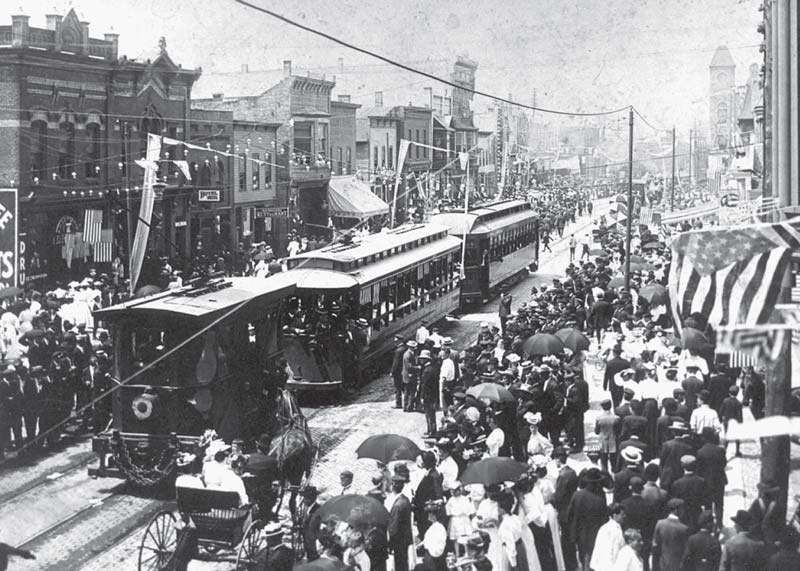
On July 4, 1898, the first Interurban electric railroad car to carry passengers arrived in Holland. The first rails in Holland had been laid by the Holland and Lake Michigan Railway at River (Avenue) and Eighth Street. These cars are on the track a half-block east of there. More than 100 men and 17 teams of horses constructed the line. The payroll for construction workers was $1,000 weekly. The trains ran from Grand Rapids through Grandville, Jenison, Shack Huddle, Jamestown, Forest Grove, Vriesland, Zeeland, Holland, Jenison Park, Macatawa Park, and Saugatuck. The Interurban freight office was on Eighth Street near Pine Avenue. The passenger train continued south on River and turned west on 13th Street. The line continued near South Shore Drive, stopping near Sunnybrook Station at Virginia Park. Extending south near 160th Street, the train headed to Castle Park and Saugatuck. The train met its demise November 15, 1926.

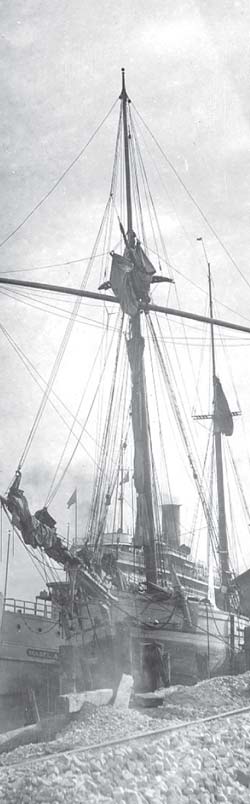
The first time a passenger ship connected Holland directly with Chicago, via Lake Michigan, was July 4, 1889, when the Mabel Bradshaw docked at the foot of Fifth Street at the old Harrington Dock. That first year the ship made four trips a week, leaving Holland on Sunday, Monday, Wednesday, and Friday evenings, after the arrival of trains at 6:35 p.m. The fare was $2 one way or $3.50 round trip. Owner Hugh Bradshaw named the ship after his daughter Mabel. She was to christen the ship with a bottle of champagne. As she reached for the bow, the bottle slipped from her hand and fell into the water, leaving the ship unchristened. The ship was used for a ferrying service a few years later and spent its last years on Lake Superior.

Be sure to click the photos for a larger view!!

Photos reprinted with permission from Holland: The Tulip Town by Randall P. Vande Water. Available from the publisher online at www.arcadiapublishing.com or by calling 888-313-2665.

View other excerpts from Arcadia Publishing’s Michigan books at Michigan in Pictures!

Found in Kerrytown … and Ann Arbor

Untitled, photo by jenny murray.

Jenny writes: Of the many delightful things at ‘Found’ in Kerrytown, my favorite by far is this bowl of old typewriter keys. I could’ve taken hundreds of shots of this bowl… Oh wait, I did. It’s true, she did.

You can learn more about FOUND (and Kerrytown in Ann Arbor) at the Found Gallery web page at Kerrytown.

…and speaking of “found” (and Ann Arbor), Ann Arbor-based Found Magazine offers a wealth of found fun. In addition to the magazine, they also have books and post daily finds from all over the world. Here’s a found photo of a Detroit Couple.

1890s View of Michigan’s Capitol from the Lansing Standpipe

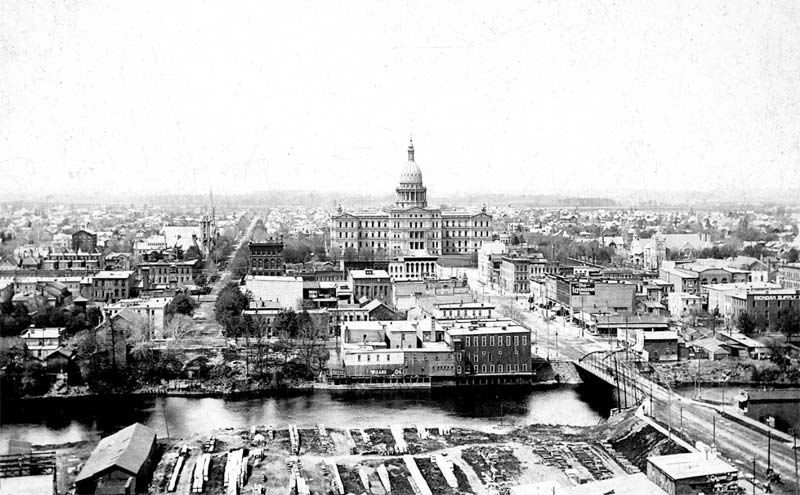
STANDPIPE VIEW OF LANSING LOOKING WEST, C. 1890s.

These two photos are from the book Lansing: City on the Grand by James MacLean and Craig A. Whitford from Arcadia Publishing (book details & purchase online). The 128 page book features over 200 historical photos of Lansing. In addition to photos you’d expect (Lansing Olds, REO plant and the Capitol building) there are photos and stories you wouldn’t like Barnes Castle (torn down in 1957 for a parking lot) and Charlie Zmuda, the “Bat Man”.

(above) STANDPIPE VIEW OF LANSING LOOKING WEST, C. 1890s.
A popular location for photographers to capture the city was the standpipe located on south Cedar Street. THE MYSTERIOUS STANDPIPE, C. 1890sThis view was taken prior to the construction of a new wide steel bridge on Michigan Avenue, crossing the Grand River. (FPML/CADL.)

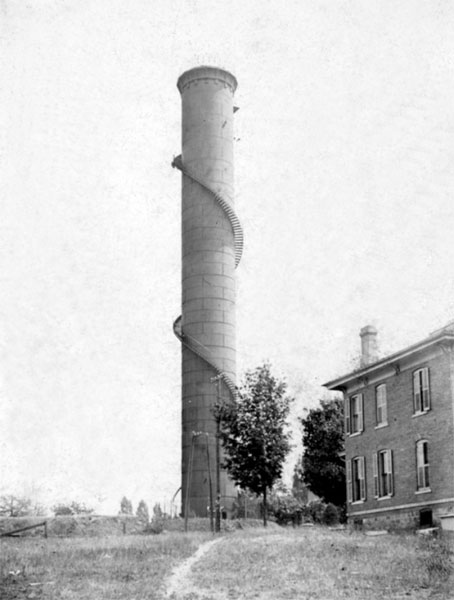
(right) THE MYSTERIOUS STANDPIPE, C. 1890s.
The standpipe was constructed in 1885 and served as the city’s storage tank for water. The tower was located east of Cedar Street and south of Michigan Avenue, where the Board of Water and Light have their holding tanks today. The remarkable aspect of the standpipe was that you could walk to the top on the circular staircase that wraps around the tower. Many a photographer took advantage of this and quite a few panoramic photographs were taken. The standpipe was torn down in 1949. (FPML/CADL.)

Photos reprinted with permission from Lansing: City on the Grand by James MacLean and Craig A. Whitford. Available from the publisher online at www.arcadiapublishing.com or by calling 888-313-2665.

View other excerpts from Arcadia Publishing’s Michigan books at Michigan in Pictures!

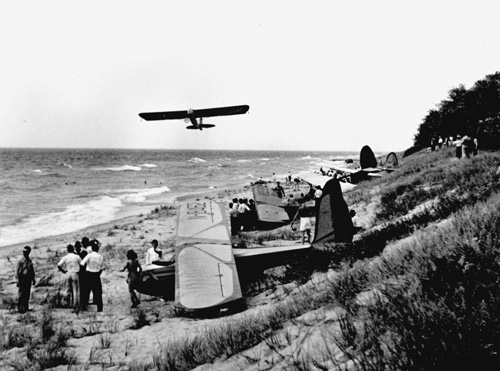
Sailplanes on the Frankfort Beach

Sailplanes on the Frankfort Beach
This photo shows a sailplane being winch-launched from the beach near Frankfort in the 1930s. It is one of many photos that appears in Soaring and Gliding: The Sleeping Bear Dunes National Lakeshore Area by Jeffery P. Sandman and Peter R. Sandman. The 127 page, oversized softcover uses archival photographs from the 1920s to the present day along with brief text passages to tell the story of the rise of the Sleeping Bear Dunes area in northwest Michigan as a soaring and gliding mecca.

Reprinted with permission from Soaring and Gliding: The Sleeping Bear Dunes National Lakeshore Area by Jeffery P. Sandman and Peter R. Sandman. Available from the publisher online at www.arcadiapublishing.com or by calling 888-313-2665.

Michigan’s Monowheel Man

http://www.flickr.com/photos/pmtorrone/73664046/in/set-1538671/

Maker of the day – Kerry McLean, 225-horsepower gasoline-powered monowheel, photo by pt.

pt says: Today’s Maker from our new book Makers – Kerry McLean, Wall Lake, Michigan. 225-horsepower gasoline-powered monowheel. “You may be hauling ass, but you feel like you’re floating,” says McLean. The metal fabricator and machinist built his first monowheel in 1970 and has been obsessively perfecting the design ever since.
Click the photo above for more and also check out Absolute Michigan’s Spotlight on Michigan Inventors featuring other Michiganians profiled in the new book from MAKE Magazine.