Pirates of the Caribbean 4 … in Traverse City?

Schooner Morning

Schooner Morning, photo by ETCphoto.

Under the “Is that Johnny Depp behind that moonbeam” heading comes the rumor making the rounds that Pirates Of The Caribbean 4: On Stranger Tides will film part of the movie in Traverse City, Michigan. Before the Trailer says that they have heard from several sources that the new Pirates of the Caribbean movie will be filming parts in the Traverse City area:

Before dismissing it, for those that have been to Lake Michigan shores in Traverse City, the water and the beaches are as beautiful and crystal clear as any you will find in the Caribbean. It could easily double for any tropical paradise. With Michigan having the best incentives in the country for filming, it would also make sense that producers and filming scouts would consider Traverse City as an ideal location to film parts of Pirates of the Caribbean 4.

While /Film notes that word on the street is that Jerry Bruckheimer is scaling back Pirates 4 to accommodate a smaller budget, /Film’s own Russ Fischer says:

They’ve pretty loudly talked up the deal that has them shooting in Hawaii, where they’ll take advantage of big tax breaks. I know Michigan has its own advantage systems in effect, and the lake there is amazing, but I’d guess it’s a hopeful rumor.

Whatever ends up happening, you have to wonder how long the beautiful Great Lakes of Michigan will go without a starring role in a major Hollywood film.

Terry took this photo of a marina full of schooners at the inaugural Michigan Schooner Festival last September. See it bigger or in his Michigan Schooner Festival slideshow. For many more photos showcasing the beauty of wild Lake Michigan, check out the Sailing Lake Michigan pool.

US Coast Guard Cutter Bramble: A Ramblin’ Gal

USCGC Bramble

USCGC Bramble, photo by k.l.macke.

Wikipedia says that the USCGC Bramble (WLB-392) is one of the 39 original 180-foot  seagoing buoy tenders built between 1942-1944 for the United States Coast Guard. Bramble is currently a museum ship, part of Port Huron Museum. The museum’s page on the USCG Cutter Bramble says:

The Coast Guard Cutter Bramble was commissioned in 1944 at a cost of just over $925,000. Following World War II, the Bramble participated in “Operation Crossroads,” the first test of an atomic bomb’s effect on surface ships, at Bikini Island. In 1957, along with the cutters Spar and Storis, it headed for the Northwest Passage, traveling through the Bering Straits and Arctic Ocean. Traveling for 64 days through 4,500 miles of partially uncharted waters, the vessels finally reached the Atlantic Ocean. These three surface vessels were the first to circumnavigate the North American Continent, an ambition mariners have had for more than 400 years.

In 1962, the Bramble transferred to Detroit to perform the missions of search and rescue, icebreaking, and law enforcement throughout the Great Lakes, in addition to aids to navigation. In 1975, the Bramble reported to Port Huron. The cutter’s areas of responsibility included eastern Lake Erie, southern Lake Huron and Saginaw Bay, and maintaining 187 buoys, one NOAA weather buoy, and three fog signals. During winter months, its capabilities as an icebreaker enabled it to escort ships through ice and assist ships in distress. The Bramble was decommissioned in 2003 to be used as a museum.

Check this out bigger and in Keith’s Ships, Boats & Water Toys set (slideshow).

MacArthur Lock No. 4

MacArthur Lock No. 4

MacArthur Lock No. 4, photo by Ralph Krawczyk Jr.

With apologies to Richard Harris, Donna Summer and pretty much everyone…

The captain took the Spruceglen, through the Soo
Ralph has a Holga, on trips he often takes it
It uses film and doesn’t fake it
Which isn’t always the easiest thing to do

Check it out bigger and in Ralph’s The U.P. – Autumn 2007 set (slideshow).

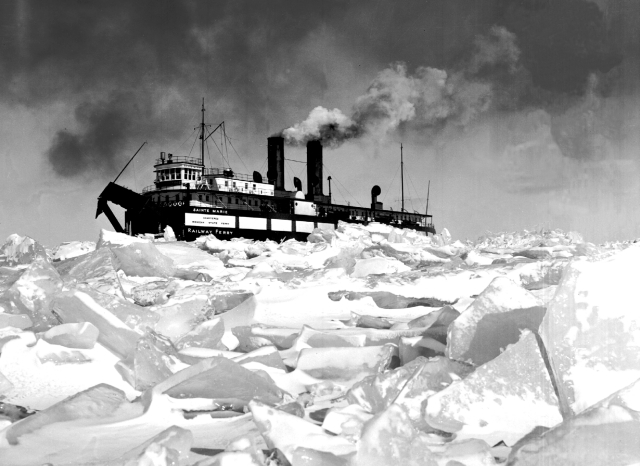
80 years of ice on the Straits of Mackinaw

Winter Service, photo courtesy Mackinac Bridge Authority

The Michigan State Ferry Album says:

Winter service began in 1931 when the Highway Department arranged with the Mackinaw Transportation Company to carry cars across the Straits on a railroad icebreaker during the cold months. This arrangement turned out to be poor business for the State, so in 1936 the Highway Department leased the railroad icebreaker “Sainte Marie” for winter operations on a regular schedule.Winter service began in 1931 when the Highway Department arranged with the Mackinaw Transportation Company to carry cars across the Straits on a railroad icebreaker during the cold months. This arrangement turned out to be poor business for the State, so in 1936 the Highway Department leased the railroad icebreaker “Sainte Marie” for winter operations on a regular schedule.

In case you’re wondering, the ice on the Straits of Mackinaw hasn’t changed a whole lot in 80 years, as this photo from February of 2008 titled Triangles by Dominique shows. See it bigger in her Snow/Ice slideshow or check out the whole set.

Triangles

And Go

And Go

And Go, photo by rickrjw.

…and have a good weekend!

Check this out bigger, in Rick’s DN Central Races Boyne City, Michigan 01/15-1/17/2010 set and for lots more of Michigan’s best ice boating action, head over to elklakeiceboating.com.

Before the Mackinac Bridge: City of Munising

Mackinac MI UP Great Lakes Passenger and Auto Ferry City of Munising connecting Mackinaw City and St Ignace before the Mackinaw Bridge was build

Mackinac MI UP Great Lakes Passenger and Auto Ferry City of Munising connecting Mackinaw City and St Ignace before the Mackinaw Bridge was built, photo by UpNorth Memories – Donald (Don) Harrison.

Before the Mackinac Bridge was built (check Absolute Michigan for lots more on that), going to or from the UP was by ferry. The City of Munising was the last of the breed:

Built by the American Ship Building Company of Cleveland in 1903 for the Pere Marquette Railway Company, the “Pere Marquette 20” became the “City of Munising” in 1937. The Michigan Department of Highways used the ship to ferry autos across the Straits of Mackinac until 1959. The ship was used for potato storage by a Washington Island, Wisconsin firm until 1973.

Michigan State Ferry Album has some photos of the City of Munising and other ships that plied the Straits.

Check this out bigger and see some shots of the old ferry docks in Don’s slideshow of old Mackinac photos

When The Gales Of November Came Early

When The Gales Of November Came Early

When The Gales Of November Came Early, photo by siskokid.

The legend lives on from the Chippewa on down
of the big lake they called “Gitche Gumee.”
The lake, it is said, never gives up her dead
when the skies of November turn gloomy.
With a load of iron ore twenty-six thousand tons more
than the Edmund Fitzgerald weighed empty,
that good ship and true was a bone to be chewed
when the “Gales of November” came early.

If you’re from Michigan … or Wisconsin … or Minnesota or Ontario or any place that touches the Great Lakes you probably grew up hearing Gordon Lightfoot’s commemorative ballad played (and overplayed) every November. While looking for lyrics to the song, I came across this page about the Wreck of the Edmund Fitzgerald on Gordon Lightfoot’s web site.

“According to a legend of the Chippewa tribe, the lake they once called Gitche Gumee ‘never gives up her dead.'”
~Great Lakes: The Cruelest Month, James R. Gaines with Jon Lowell in Detroit, Newsweek Magazine

Thus began the Newsweek article in the issue of November 24, 1975. That lead and the news magazine’s dry story inspired Gordon Lightfoot to write one of the greatest “story songs” ever…

Lightfoot wrote Wreck Of The Edmund Fitzgerald as a tribute to the ship, the sea, and the men who lost their lives that night. When asked recently what he thought his most significant contribution to music was, he said it was this song, which he often refers to as “The Wreck”. In spite of its unlikely subject matter, the song climbed to #2 on the Billboard pop charts and Wreck of the Edmund Fitzgerald remains one the most stirring topical ballads ever written and a highlight of every Lightfoot concert.

More Edmund Fitzgerald and more shipwrecks on Michigan in Pictures.

Check this out bigger and see Jim’s whole Lake Superior set (slideshow).

There’s not way I’m not going to link over to include* Joseph Fulton’s amazing tribute video to the 29 men who died November 10, 1975 aboard the Edmund Fitzgerald. If you haven’t watched this, do it. It’s one of the best videos on the internet and shows the power of the Fitz and of Superior.

featured-wordpress

*And break my own rule of “just photos” – sorry about that if it bothers you.

Freshwater Fury: The Great Lakes Storm of 1913

Charles S Price upside down, 1913

Charles S Price upside down, 1913,  Wikipedia

Dear wife and Children. We were left up here in Lake Michigan by McKinnon, captain James H. Martin tug, at anchor. He went away and never said goodbye or anything to us. Lost one man yesterday. We have been out in storm forty hours. Goodbye dear ones, I might see you in Heaven. Pray for me. / Chris K. / P.S. I felt so bad I had another man write for me. Goodbye forever.

~A message found in a bottle 11 days after Plymouth disappeared, dictated by Chris Keenan, federal marshal in charge of the barge

Wikipedia says that the Great Lakes Storm of 1913, also known as the “Freshwater Fury” or the “White Hurricane”, was a blizzard with hurricane-force winds that ravaged the Great Lakes November 7-10, 1913. With the sinking of 19 ships, the stranding of another 19 and a death toll of at least 250, it remains the deadliest and most destructive natural disaster in Great Lakes history.

detroit-news-great-lakes-stormMajor shipwrecks occurred on all but Lake Ontario, with most happening on southern and western Lake Huron. Lake masters recounted that waves reached at least 35 feet (11 m) in height. Being shorter in length than waves ordinarily formed by gales, they occurred in rapid succession, with three waves frequently striking in succession. Masters also stated that the wind often blew in directions opposite to the waves below. This was the result of the storm’s cyclonic motion, a phenomenon rarely seen on the Great Lakes.

In the late afternoon of November 10, an unknown vessel was spotted floating upside-down in about 60 feet (18 m) of water on the eastern coast of Michigan, within sight of Huronia Beach and the mouth of the St. Clair River. Determining the identity of this “mystery ship” became of regional interest, resulting in daily front-page newspaper articles. The ship eventually sank, and it was not until early Saturday morning, November 15, that it was finally identified as the Charles S. Price. The front page of that day’s Port Huron Times-Herald extra edition read, “BOAT IS PRICE — DIVER IS BAKER — SECRET KNOWN”. Milton Smith, the assistant engineer who decided at the last moment not to join his crew on premonition of disaster, aided in identifying any bodies that were found.

You can get a map to the wreck of the Charles S Price, and here’s a list of shipwrecks of the 1913 storm and an account of the weather. You can see more photos from Wikipedia and also in Lakeland Boating’s great slideshow of some of the on and offshore damage from the Freshwater Fury.

More at absolutemichigan.com/Shipwreck and even Michigan shipwrecks on Michigan in Pictures.

Kayaking at the Pictured Rocks

pictured rocks 09-044

pictured rocks 09-044, photo by northern_latitudes.

Check out Tim’s awesomely amazing pictured rocks kayaking 2009 set (slideshow). He does a better job than anyone I’ve yet seen of conveying these massive rock formations.

Kayaking buffs will definitely want to check out the Hiawatha Water Trail web site – it’s a kayaker’s dream!!

Michigan in Pictures has much more about Pictured Rocks and you can also visit the Pictured Rocks National Lakeshore web site.

2000 is a big number

Dock o' boats

Dock o’ boats, photo by &Sam.

Over on Absolute Michigan I noted that the 2000th photographer joined our Absolute Michigan pool on Flickr. It’s where almost all of the photos on Michigan in Pictures come from and really an amazing resource that we are so fortunate to have at our disposal.

Be sure to check this photo out bigger and in Sam’s Outside set (slideshow).